Paintings Within Paintings
Behind the figure in almost any Vermeer interior hangs another painting: a map, a Cupid, a Last Judgment, each one chosen to quietly comment on the scene below.
A picture on the wall
Johannes Vermeer, the Dutch painter who worked in the small city of Delft in the 1660s, is famous for stillness. A woman reads a letter by a window. A maid pours milk. The light is soft, the room is hushed, and very little seems to be happening. Look past the figure, though, and you keep noticing the same thing: there is almost always another picture on the wall behind her. A map, a landscape, or a framed painting hanging just over her shoulder.
This was not a one-off idea. Of the roughly thirty-five paintings now accepted as Vermeer’s, a large share of the indoor scenes put something deliberate on the back wall, and again and again that something is a painting chosen to comment on the moment below it, like a quiet caption only the attentive viewer notices. Once you start reading those captions, the quiet rooms turn out to be saying a great deal.
The Cupid he kept reusing
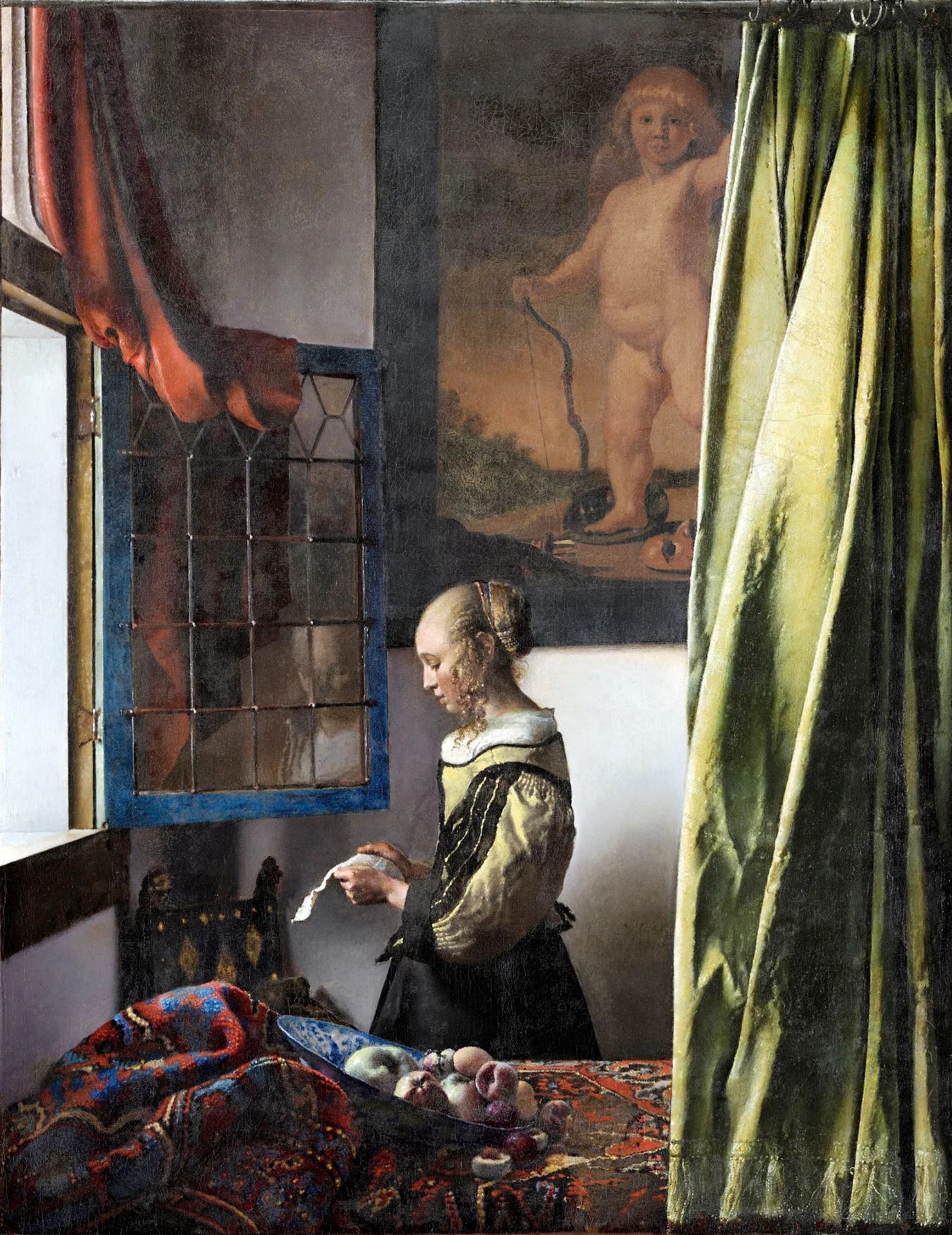
Take the one inner picture that nearly went missing for good. In Girl Reading a Letter at an Open Window, in Dresden, a young woman stands at a window reading. For nearly 250 years the wall behind her was blank, until a 2021 restoration uncovered a large painting of Cupid that a later hand had hidden under a coat of paint. We tell that whole story separately, in The Cupid That Came Back.
That Cupid is not a random flourish. He holds up a bow, and in some versions tramples masks underfoot. In the visual shorthand of Vermeer’s time he came from a popular love emblem and stood for faithful love, devotion to a single person rather than many. Set him on the wall above a woman reading a letter, and the letter quietly becomes a love letter.
What really gives him away is that Vermeer used the same Cupid four separate times. He turns up in Girl Interrupted in Her Music and, painted in lighter and airier tones, in A Lady Standing at a Virginal, both scenes of music and courtship. He even appears in one of Vermeer’s earliest interiors of all.
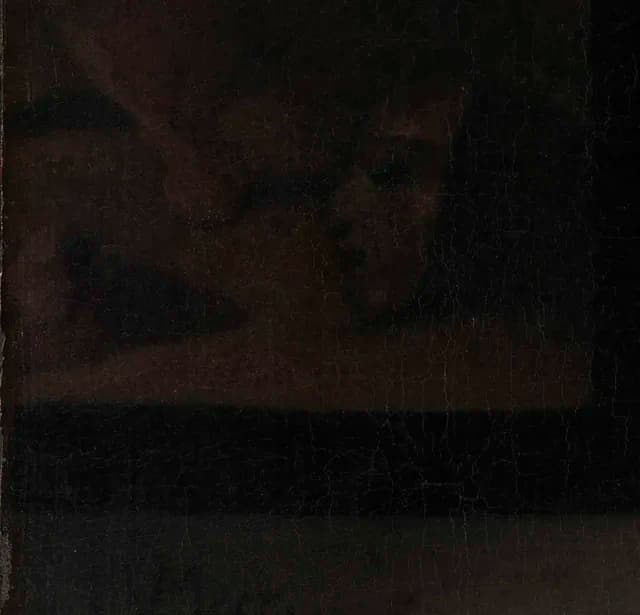
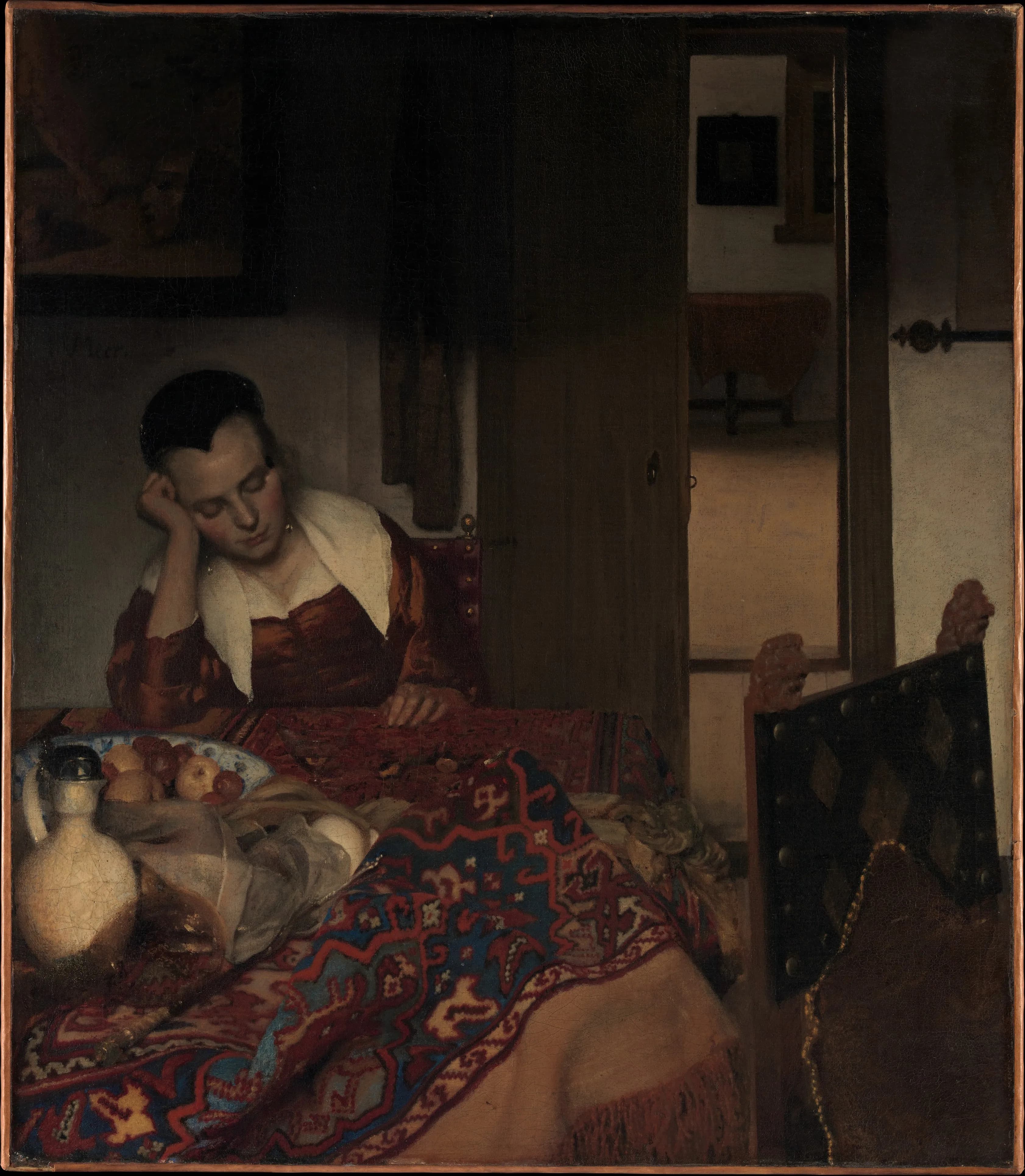
In A Maid Asleep, from about 1657, a young woman has dozed off at a table after, it seems, a glass of wine. High on the wall behind her hangs a shadowy picture, easy to miss. Clean it up and you find a leg of the same Cupid, and at his feet a fallen mask.
The mask is the clue. In Dutch art a discarded mask stood for deceit, for a face that is not what it seems. With Cupid and a dropped mask hanging over her, the sleeping maid may not be simply sleepy. The picture on the wall hints that something here is being hidden.
A painting his mother-in-law owned
Some of the paintings on Vermeer’s walls were real pictures he could actually see. The clearest example is a brash, candle-lit scene of a young woman with a lute, a grinning client, and an old go-between demanding payment. It is The Procuress, painted in 1622 by Dirck van Baburen, a Dutch artist who had worked in Rome. The picture, or a copy of it, belonged to Vermeer’s mother-in-law, Maria Thins, in whose house he lived and worked.
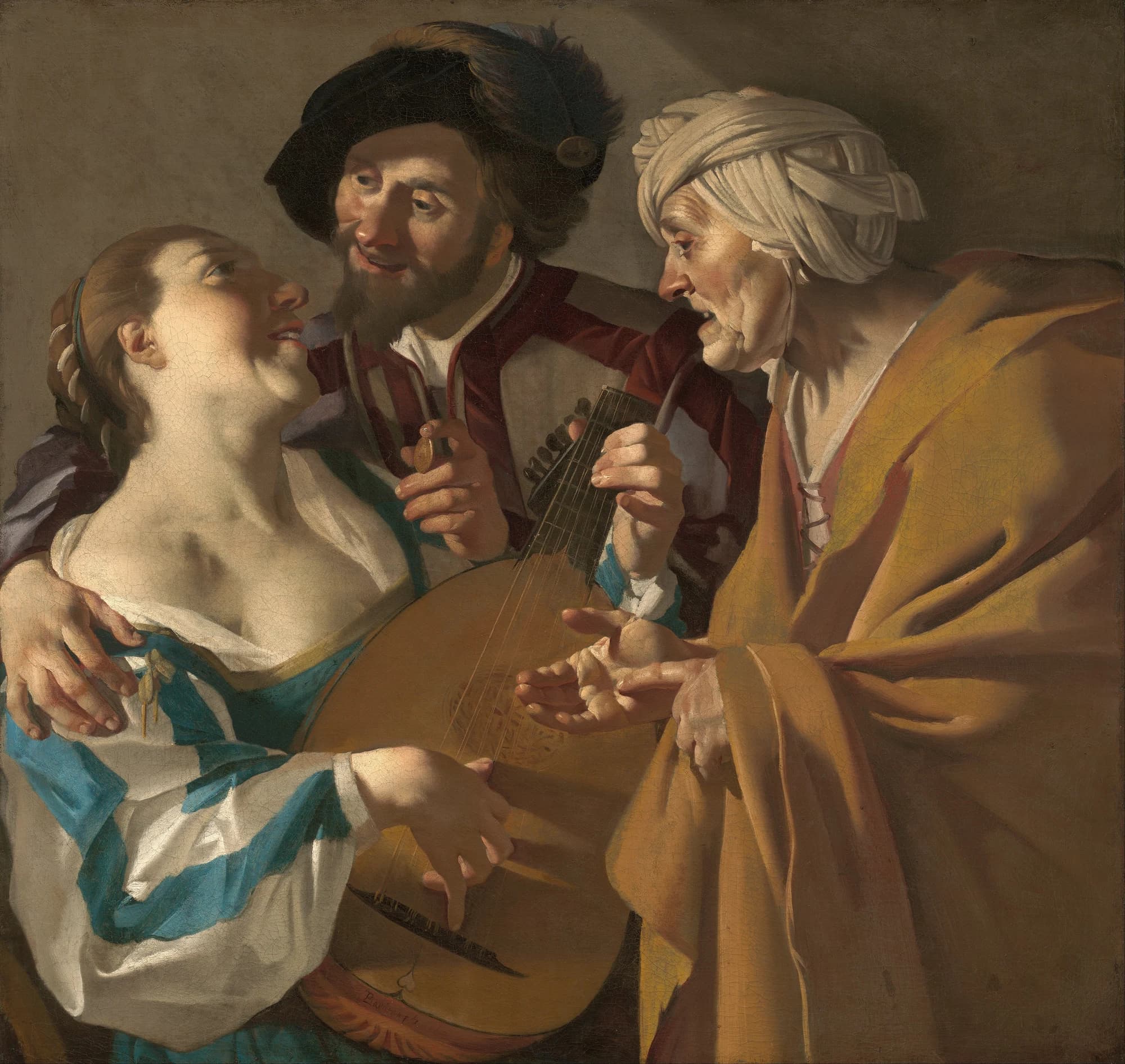
Vermeer hung Baburen’s rowdy brothel scene on the back wall of two of his most refined interiors, The Concert and A Lady Seated at a Virginal, both showing well-dressed people making music. The contrast is the point. Baburen’s figures buy and sell love openly, while Vermeer’s sit in genteel quiet at a keyboard, and the older painting on the wall hints at the desires running beneath the good manners.
Pictures that pass judgment
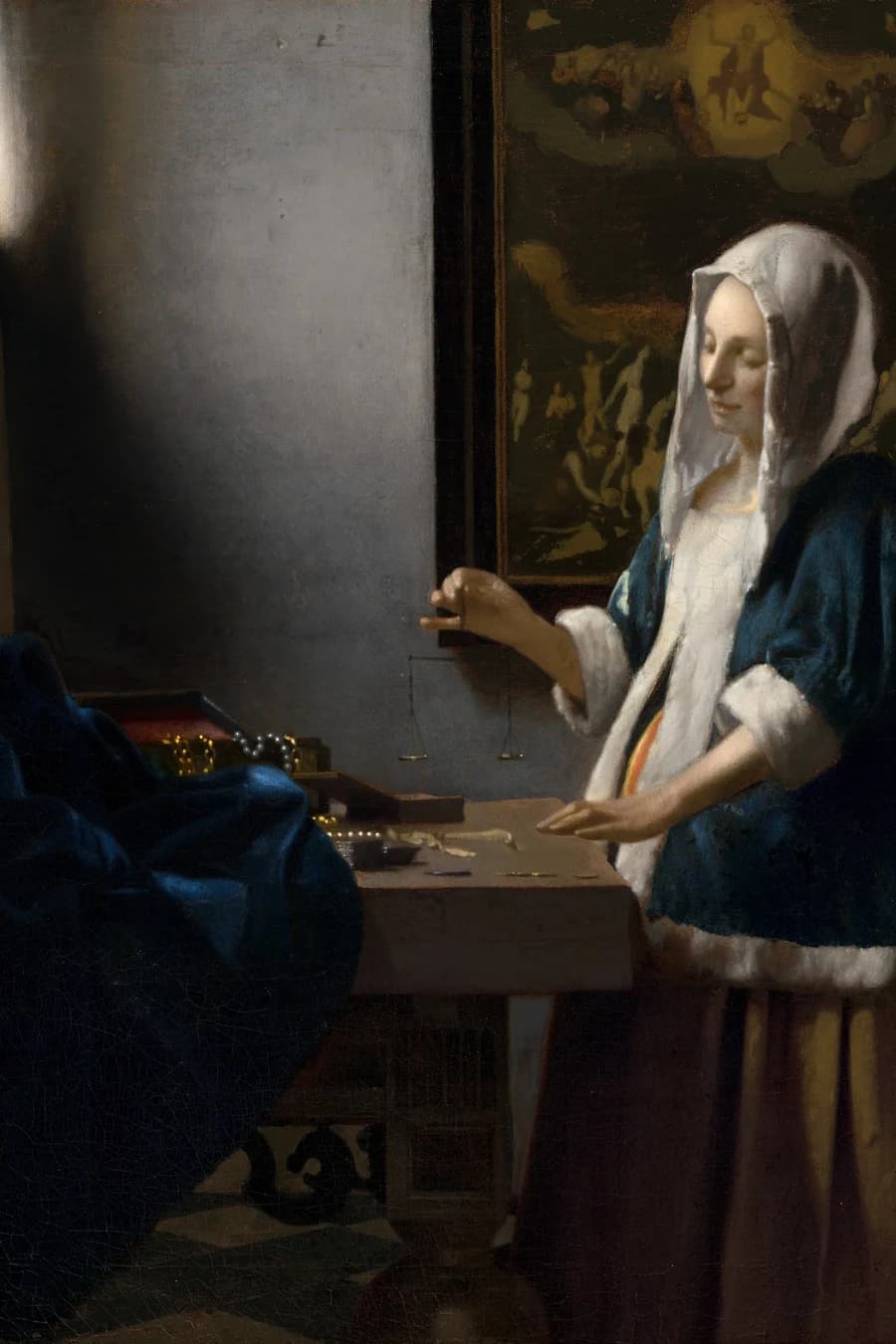
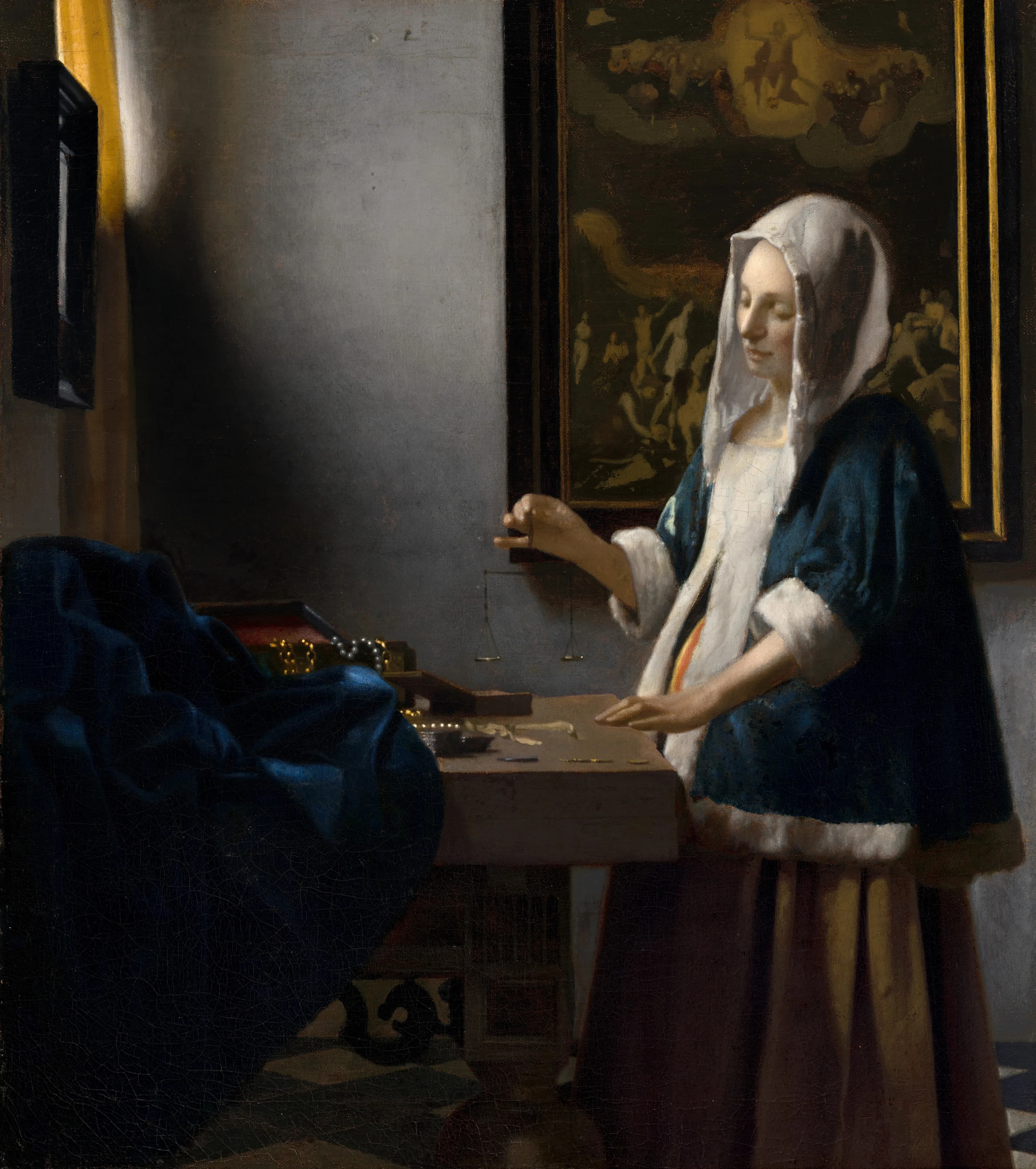
Once you start reading Vermeer’s walls, the trick is everywhere. In Woman Holding a Balance, a woman stands at a table weighing an empty set of scales, with pearls and gold laid out before her. On the wall directly behind her hangs a large painting of the Last Judgment, the moment when Christian tradition says every soul is weighed and sorted. Her small act of weighing worldly treasure is set against the ultimate weighing of souls.
He did it with scholarship too. In The Astronomer, a man leans toward his celestial globe, and on the wall behind him is a painting of the Finding of Moses, the infant rescued from the river. Moses was traditionally credited with great learning, so the picture flatters the scholar’s pursuit of knowledge. Vermeer liked that one enough to use it again, hanging the same Finding of Moses behind the writer in Lady Writing a Letter with Her Maid.
He did this constantly
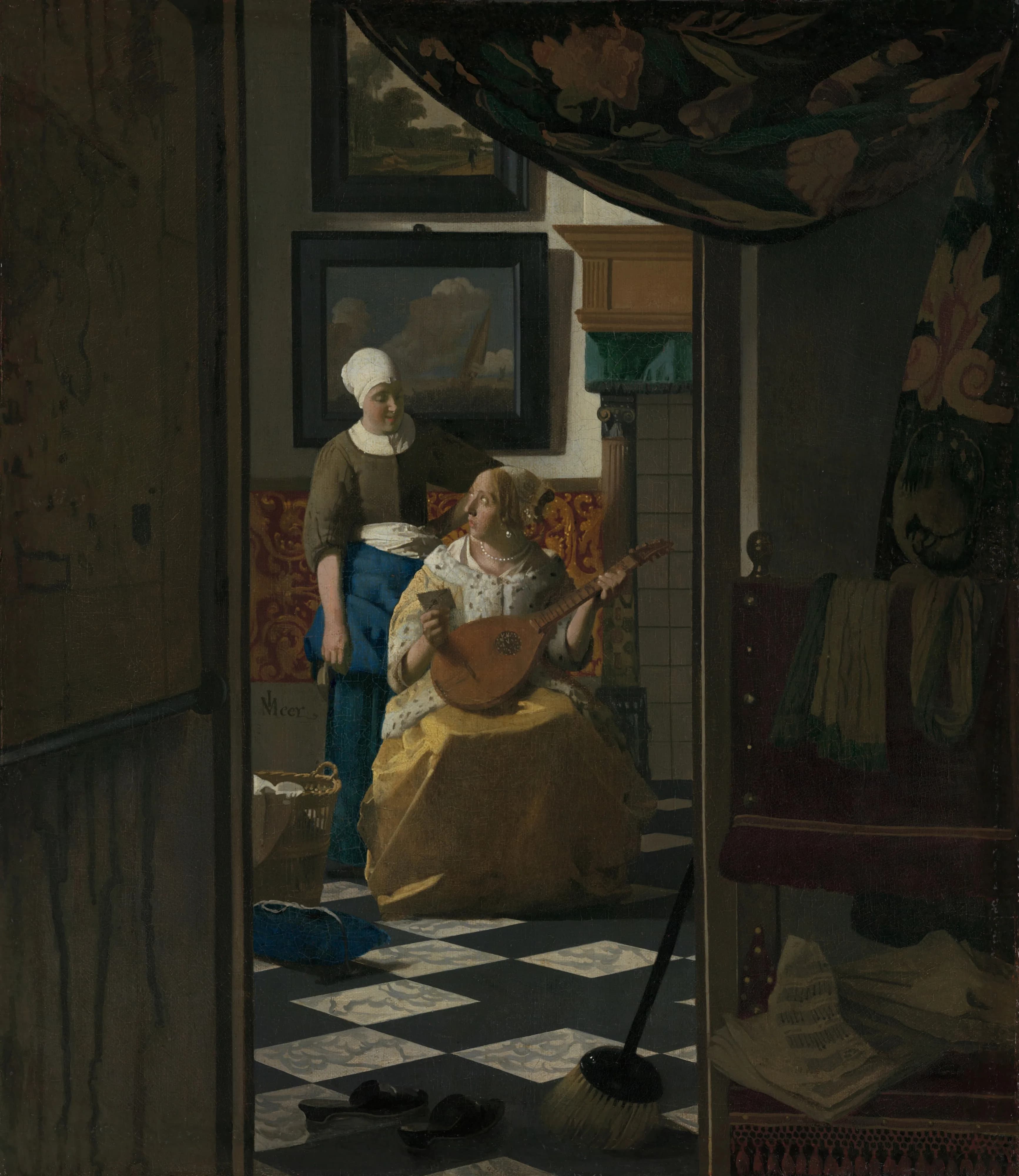
By now the pattern is hard to unsee, and the examples keep coming. In The Love Letter, a maid hands her mistress a letter while she sits with a lute. Above them hang two pictures: a landscape with a lone traveller on a road, and, lower down, a ship riding a choppy sea. A sea voyage was a well-worn emblem for love, calm or stormy by turns, and the absent traveller stands in for the man who wrote.
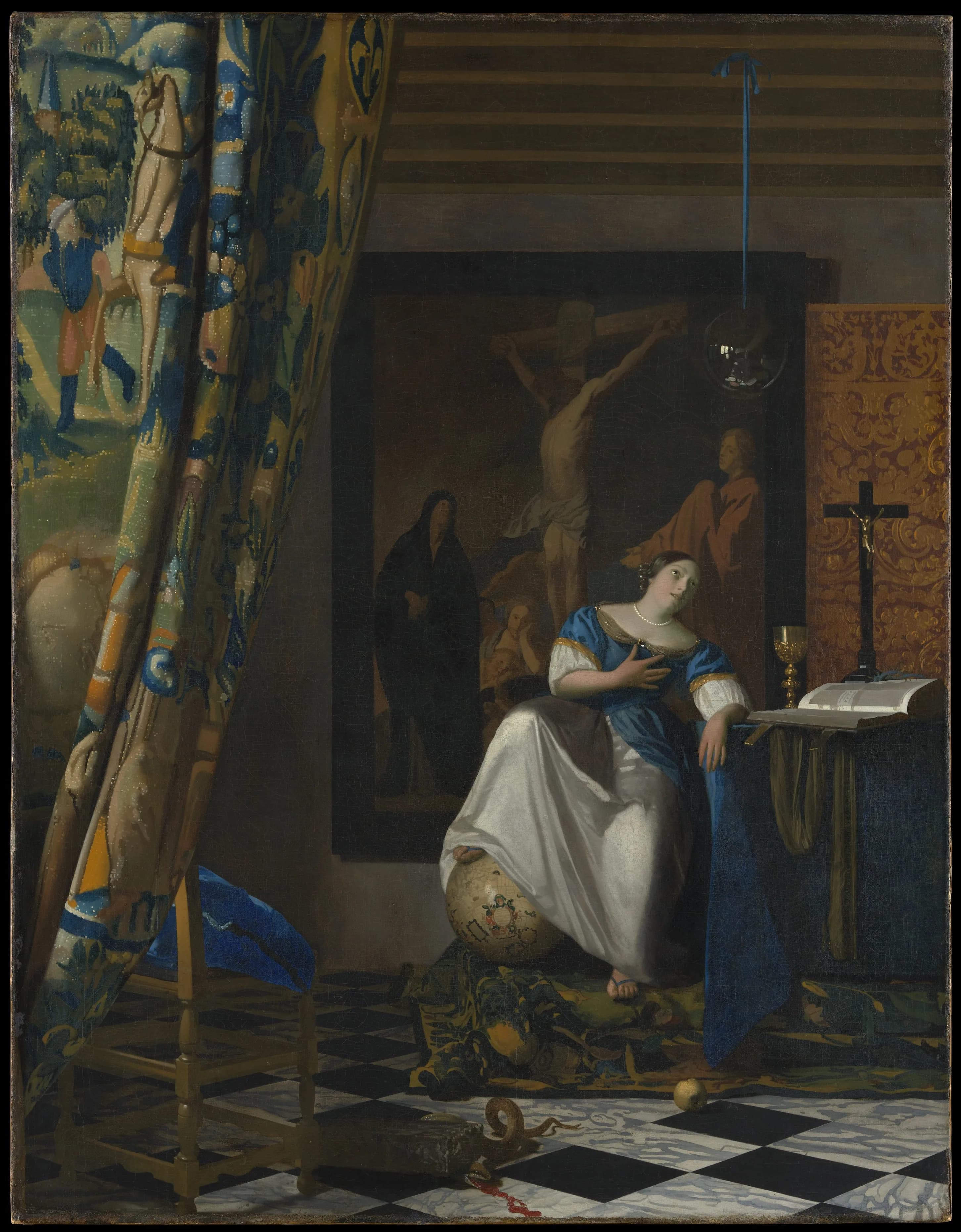
Sometimes the picture on the wall is the whole point. In Allegory of Faith, a woman posed as the personification of the Catholic faith sits beneath an enormous Crucifixion. That inner painting is borrowed from a real one by the Flemish artist Jacob Jordaens, and a “large painting representing Christ on the Cross” was listed among Vermeer’s own belongings when he died.
And he used pictures to keep a watchful eye on his characters. In The Girl with a Wine Glass, a man leans in to press wine on a smiling young woman. On the wall behind them hangs a stern portrait of a man in old-fashioned dress, an ancestor, it seems, looking down on the flirtation like a disapproving chaperone.
He even pulled the trick with things that were not quite paintings. In both The Girl with a Wine Glass and The Glass of Wine, a stained-glass window carries a small figure of Temperance holding a bridle, the old symbol of self-restraint, glowing right above the wine. And in A Lady Writing, the dim picture behind the sitter is a still life of a stringed instrument, the kind of image Dutch painters used to whisper that earthly pleasures do not last.
When it was not a painting, it was a map
The pictures Vermeer hung were not always pictures. Just as often the back wall holds a map or a globe, and those are chosen with the same care. A large map of the province of Holland, an actual printed map Vermeer owned, hangs behind the soldier in Officer and Laughing Girl and again behind the pregnant figure in Woman in Blue Reading a Letter. Other maps and globes fill the walls of Woman with a Lute, The Geographer, and his grandest interior of all, The Art of Painting, where a huge map of the Low Countries spreads across the back wall.
Reading the walls
None of this was unusual in itself; many Dutch painters hung a picture inside a picture. What sets Vermeer apart is how often he did it, and how patiently he matched each one to the human moment in front of it. The thing on the back wall, painting, map or window, is a second and softer voice in the room, saying what the quiet figures never will.
There is one last twist. The most famous of these inner pictures, the Baburen in The Concert, can no longer be seen at all. That Vermeer was stolen from a Boston museum in 1990 and has never been found, so its inner picture is missing along with it. The Dresden Cupid was lost to a coat of paint and recovered. The procuress in The Concert is lost to a robbery, and waits.
Notes
- 1.Only about thirty-five paintings are accepted as Vermeer’s today. For the catalogue and the count, see Wikipedia, “List of paintings by Johannes Vermeer”.
- 2.The standing Cupid, derived from a composition attributed to Caesar van Everdingen, appears in four Vermeers: A Maid Asleep, Girl Reading a Letter at an Open Window, Girl Interrupted in Her Music, and A Lady Standing at a Virginal. Its meaning is usually traced to a love emblem standing for fidelity to a single person. See Wikipedia, “Lady Standing at a Virginal”.
- 3.In A Maid Asleep (c. 1657, Metropolitan Museum of Art), a leg of Cupid and a fallen mask are just visible in the dim, ebony-framed picture above the woman; the mask is traditionally read as a sign of deceit. See the work’s record.
- 4.The Procuress (1622) by Dirck van Baburen, now in the Museum of Fine Arts, Boston, was owned by Vermeer’s mother-in-law Maria Thins. Vermeer set it on the back wall of The Concert (c. 1664) and A Lady Seated at a Virginal (c. 1670–1675). See Wikipedia, “The Procuress (Dirck van Baburen)”.
- 5.The picture on the wall behind the woman in Woman Holding a Balance (c. 1662–1663, National Gallery of Art, Washington) is a Last Judgment. See Wikipedia, “Woman Holding a Balance”.
- 6.The painting on the wall in The Astronomer (1668, Louvre) shows the Finding of Moses; the same subject hangs in Lady Writing a Letter with Her Maid (National Gallery of Ireland). See Wikipedia, “The Astronomer”.
- 7.In The Love Letter (c. 1669–1670, Rijksmuseum) the lower picture is a stormy seascape, a common emblem for the ups and downs of love, and the upper one a landscape with a traveller on a road, often read as the absent writer. See Wikipedia, “The Love Letter”.
- 8.The large Crucifixion in Allegory of Faith (c. 1670–1672, Metropolitan Museum of Art) is based on a composition of about 1620 by Jacob Jordaens; a “large painting representing Christ on the Cross” is listed in the inventory taken at Vermeer’s death. See Wikipedia, “Allegory of the Catholic Faith”.
- 9.The framed portrait of a man in 1630s dress on the back wall of The Girl with a Wine Glass (c. 1659–1660, Herzog Anton Ulrich Museum, Braunschweig) has been read by Arthur K. Wheelock Jr. as an ancestral presence weighing on the scene of seduction below. See Wikipedia, “The Girl with the Wine Glass”.
- 10.Both Braunschweig pictures and their Berlin companion, The Glass of Wine (c. 1660), set a stained-glass window holding a figure of Temperance, with a level and bridle, against the wine on the table. See Wikipedia, “The Wine Glass”.
- 11.The dim picture behind the sitter in A Lady Writing (c. 1665, National Gallery of Art, Washington) is a still life of a large string instrument, a type often given a vanitas reading. See Wikipedia, “A Lady Writing a Letter”.
- 12.The same wall map of Holland and West Friesland, a Blaeu and Berckenrode map Vermeer owned, appears in Officer and Laughing Girl and Woman in Blue Reading a Letter; other maps and globes hang in Woman with a Lute, Young Woman with a Water Pitcher, The Art of Painting, and The Geographer. See Wikipedia, “Officer and Laughing Girl”.
- 13.The Concert was stolen from the Isabella Stewart Gardner Museum in Boston in 1990 and has never been recovered. See our story, The Heist of The Concert.