The Art of Painting
About this painting
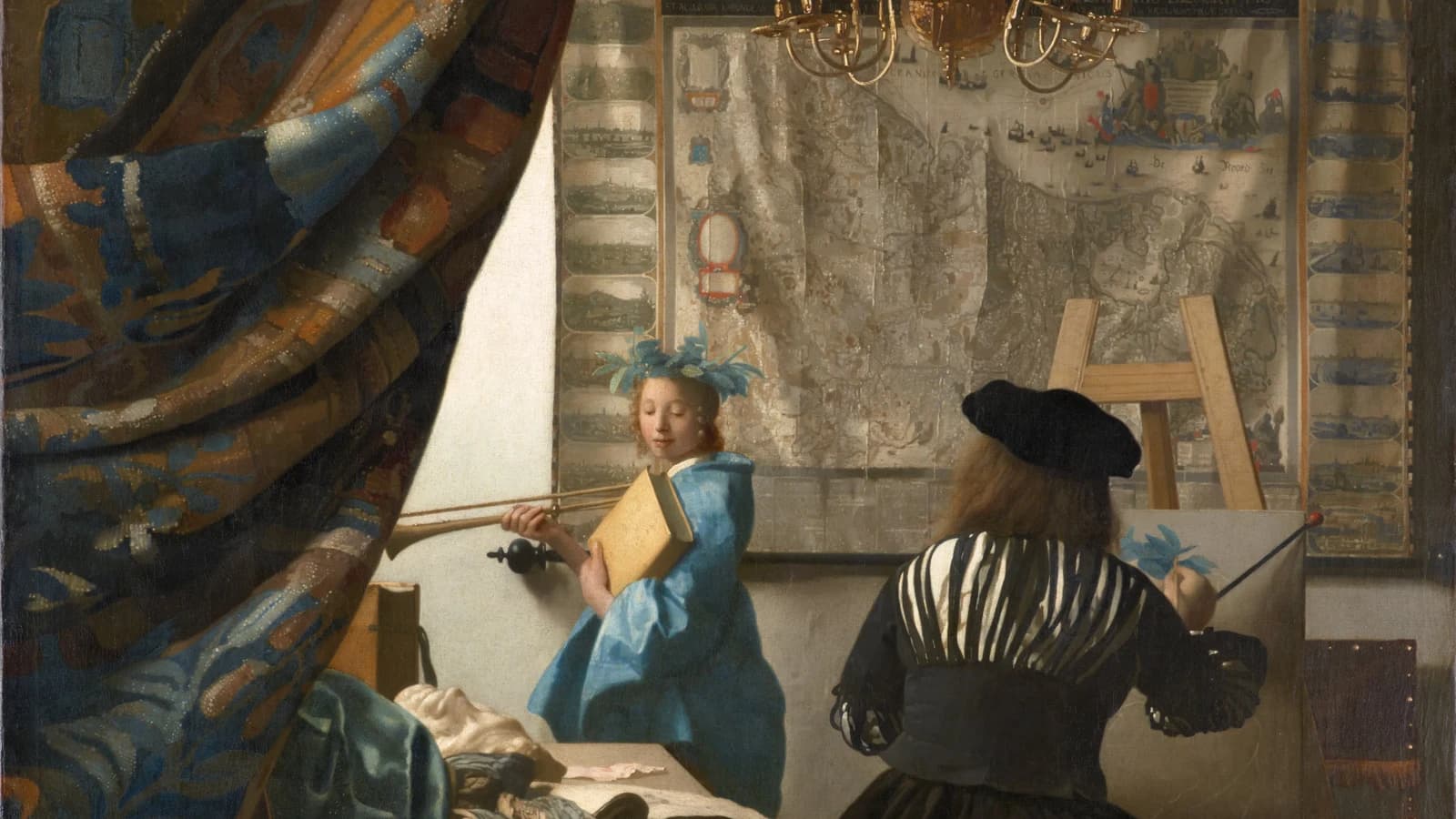
Among Vermeer’s largest and most ambitious works, The Art of Painting shows an artist seen from behind, seated at his easel and painting a young woman who poses by a window. Most scholars date it to the second half of the 1660s, and at 120 by 100 centimetres it is built on a far grander scale than the small domestic interiors for which Vermeer is best known. Rather than a straightforward studio scene, it reads as an allegory of painting itself, an argument for the dignity of the painter’s art.
The model as Clio
The model is dressed as Clio, the muse of history, identifiable by her laurel wreath, the trumpet she holds, and the heavy book in her arms. These attributes follow the standard handbook of the period, Cesare Ripa’s Iconologia, where the laurel signifies glory, the trumpet fame, and the book the writing of history. By placing the muse of history before his easel, Vermeer suggests that painting confers lasting fame and takes its place among the liberal arts rather than the manual crafts, a live debate in his century.
The map and the chandelier
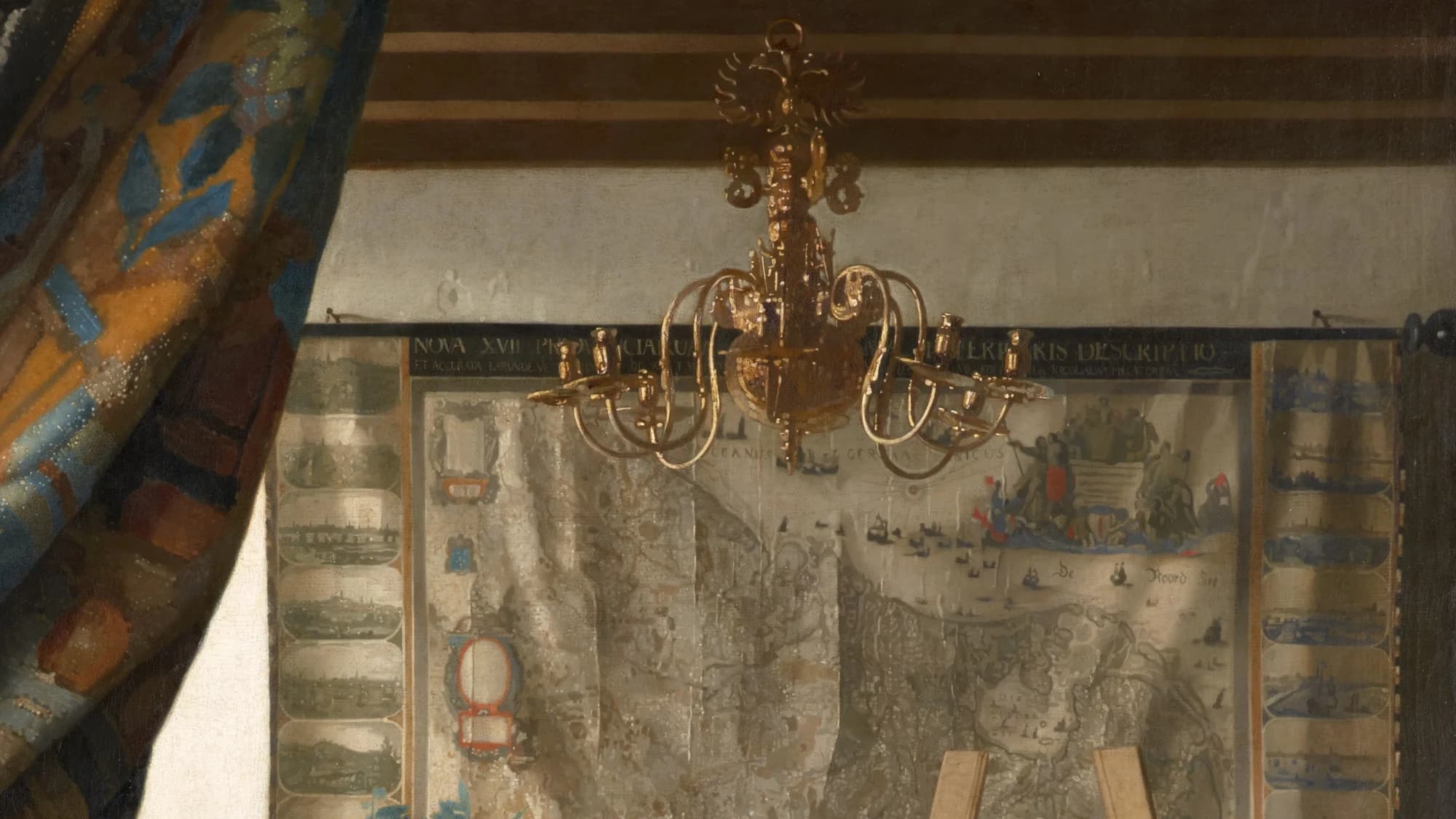
A large map of the Seventeen Provinces of the Netherlands fills the back wall, showing the Low Countries before their division into a Protestant north and a Spanish-held south. Published in the first half of the seventeenth century, it has been read as evoking a nation famous for its painting. Above the figures hangs a gilt chandelier crowned by the Habsburg double-headed eagle, an emblem that may allude to the imperial rule once held over the Netherlands.
A painting Vermeer never sold
Vermeer seems to have kept The Art of Painting in his own house throughout his life, never parting with it despite mounting financial pressure. After his death in 1675 his widow, Catharina Bolnes, tried to transfer the picture to her mother, Maria Thins, to keep it out of the hands of creditors, though the executor of the estate ruled the transfer invalid. Its hold on later viewers is reflected in its inclusion in major surveys such as the 2001 exhibition Vermeer and the Delft School.
From the Czernin collection to Hitler and Vienna
By the nineteenth century the painting had entered the Czernin collection in Vienna, where it was for a time attributed to Pieter de Hooch. In 1940 Adolf Hitler acquired it from Count Jaromir Czernin, intending it for the Führermuseum he planned in Linz. Allied forces recovered the picture in 1945 from the Altaussee salt mine, where looted artworks had been stored, and it was transferred to the Kunsthistorisches Museum in Vienna, entering its permanent collection in 1958.
- Date
- 1662–1668
- Medium
- Oil on canvas
- Dimensions
- 120 × 100 cm