The Milkmaid
About this painting
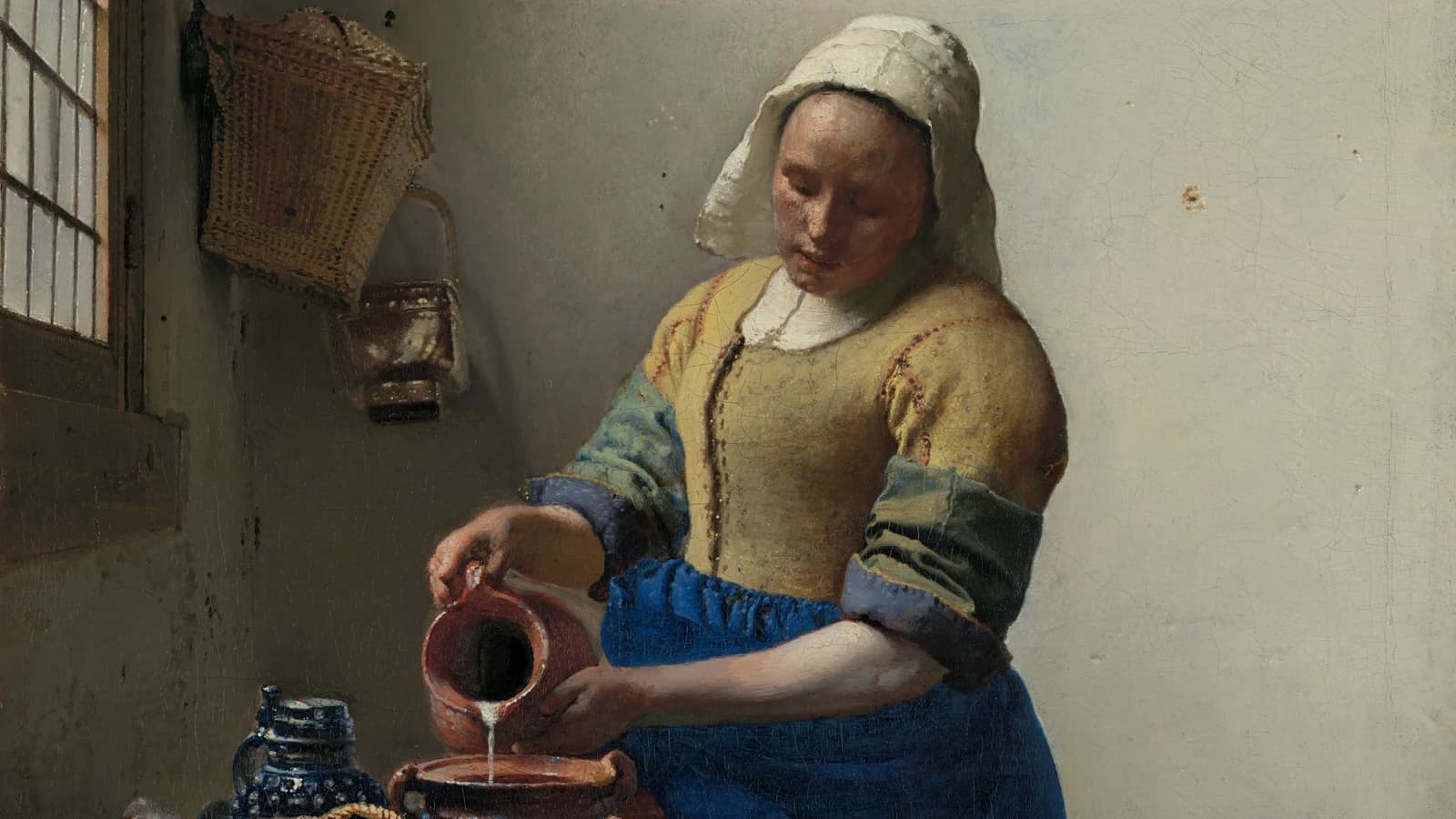
Painted in the late 1650s, The Milkmaid shows a kitchen maid standing at a table by a window, pouring milk from an earthenware jug into a low bowl with complete absorption in her task. The figure is the only person in the room, lit from the window at the left, and her sturdy, monumental form has often been described as statue-like in its stillness. Vermeer raises an ordinary domestic chore to the level of a major picture, and the work is now held at the Rijksmuseum in Amsterdam.
Light and the pointillé
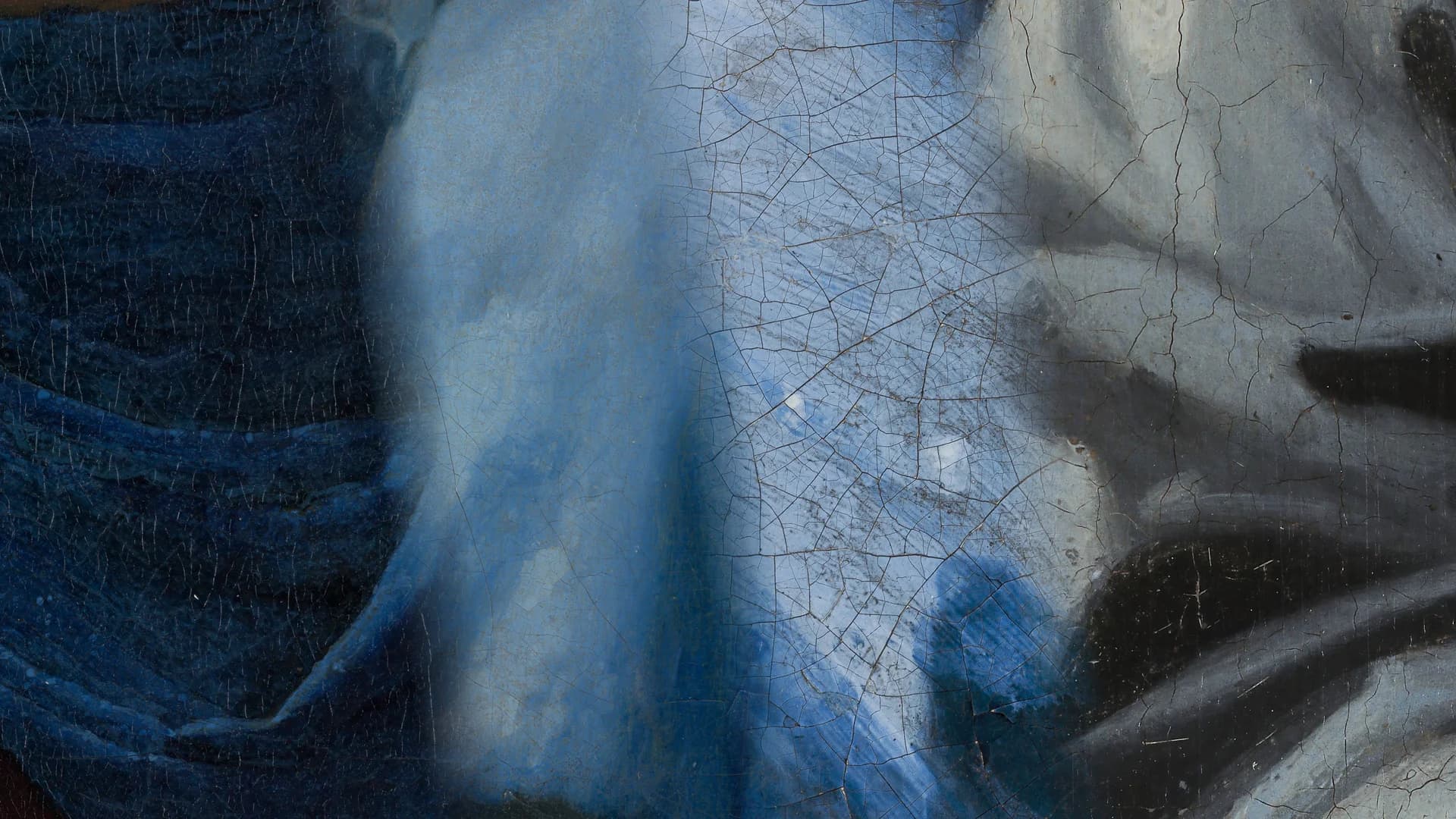
The painting is celebrated for its rendering of daylight, which Vermeer builds up from small, thick points of pale paint, the technique often called pointillé, scattered across the most strongly lit surfaces. These bright dabs are most conspicuous on the crust of the bread and on the wicker basket, and they appear again in the thin thread of milk falling from the jug. For the maid’s apron and skirt Vermeer used costly natural ultramarine, glazed over a monochrome underpainting, set against the lead-tin-yellow of her bodice so that the blue and yellow carry the colour of the whole picture.
A kitchen maid, not a milkmaid
Despite the familiar English title, the woman is a household kitchen maid rather than a dairy worker, shown at the everyday job of pouring milk indoors. Along the baseboard at the lower right are Delft wall tiles, one of which shows a figure of Cupid, and a foot warmer sits on the floor nearby. Some scholars read these as quiet allusions to love or desire, the foot warmer standing for warmth or hidden passion and the Cupid for romance, while others treat them as ordinary furnishings without hidden meaning.
Changes beneath the surface
Technical examination has shown that Vermeer simplified the scene as he worked, painting out a wall map and a large laundry or fire basket that once stood behind the figure so that nothing competes with the maid and her pouring. The bare whitewashed wall behind her, with its nail holes and patches of broken plaster, is among the most admired passages of painted texture in his work.
Value and acquisition
The Milkmaid was probably bought directly from Vermeer by his Delft patron Pieter van Ruijven, and at the Dissius sale in Amsterdam in 1696 it fetched 175 guilders, more than any other Vermeer in that auction except the View of Delft. The Rijksmuseum acquired it in 1908, with the support of the Vereniging Rembrandt, as part of the purchase of paintings from the Six family heirs, after public concern that it might be sold abroad.
- Date
- 1657–1661
- Medium
- Oil on canvas
- Dimensions
- 45.5 × 41 cm
- Home
 Rijksmuseum