Amsterdam · 16 May 1696 · 21 Vermeer lots
The Dissius Sale
On 16 May 1696 the Amsterdam auction of a collection assembled by the Delft printer Jacob Dissius offered twenty-one paintings by Vermeer, the largest concentration of his work ever recorded. The lots had descended from his earliest patrons, Pieter van Ruijven and Maria de Knuijt, and the catalogue that survives, preserved by Gerard Hoet in 1752, remains the single most important document of Vermeer's output and early market value. Roughly fifteen of the twenty-one lots can be matched to surviving paintings; the rest are known only from these few lines.
From Van Ruijven to Dissius
Almost every painting in the 1696 sale traces back to one Delft household. Vermeer’s most faithful patrons, Pieter van Ruijven and his wife Maria de Knuijt, had bought from the artist across much of his career, and over time they gathered the largest single holding of his work. When their daughter Magdalena married the printer and bookseller Jacob Abrahamsz Dissius in 1680, the pictures passed with her into his house.
Magdalena died in 1682, only two years into the marriage and without children. An inventory drawn up the following year lists twenty paintings by Vermeer hanging in the Dissius home. Jacob held them, for a decade jointly with his father Abraham, until his own death in October 1695. With no heir to keep the collection together, the estate was sent to auction in Amsterdam the next spring.
The sale
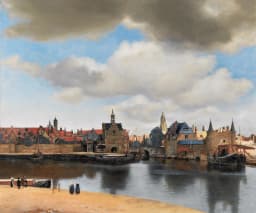
The auction was held on 16 May 1696 at the Oude Heeren Logement in Amsterdam, where some 134 paintings changed hands. Twenty-one of them were given to Vermeer, a concentration of his work never assembled before or since until the Rijksmuseum’s 2023 retrospective. The Vermeer lots alone brought 1,503 guilders and 10 stuivers. The View of Delft took the highest price of the day at 200 guilders; the small Lacemaker went for the least, just 28.
No record of the buyers survives, and the original catalogue is lost. What we have is a transcription made by Gerard Hoet in his Catalogus of Naamlyst van Schilderyen of 1752, and it is from these few printed lines that the early history of so many Vermeers is reconstructed. Prices below are given in guilders, written in the old florin notation (ƒ), with stuivers after the point.
What survives, what was lost
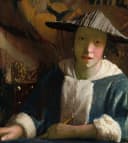
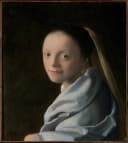
About fifteen of the twenty-one lots can be matched with reasonable confidence to paintings that survive. Several matches remain open. The two townscapes, lots 32 and 33, are usually read as The Little Street and a second, now-lost view of houses in Delft, but which is which is not settled. The three tronies of lots 38 to 40 are the likely home of Girl with a Pearl Earring, though it cannot be said which of the three she was.
A handful of lots correspond to nothing we can still see. Lot 3, the self-portraitof Vermeer “in a room with various accessories,” and lot 5, a gentleman washing his hands in a perspectival room, are known only from their entries here. The catalogue is, for these works, the last trace they leave.
The 1696 catalogue
| Lot | Subject in the catalogue | Work | Price |
|---|---|---|---|
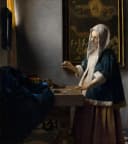
| 1 | A young lady weighing gold, in a box, extraordinarily artful and vigorously painted | ƒ 155 | |
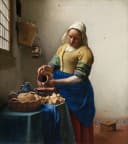
| 2 | A maid pouring out milk, extremely well done | ƒ 175 | |
| 3 | The portrait of Vermeer in a room with various accessories, uncommonly beautiful | Lost or untraced | ƒ 45 |
| 4 | A young lady playing the guitar, very good | ƒ 70 | |
| 5 | A gentleman washing his hands, in a see-through room with sculptures, artful and rare | Lost or untraced | ƒ 95 |
| 6 | A young lady playing the clavecin in a room, with a listening gentleman | ƒ 80 | |
| 7 | A young lady to whom a maid brings a letter | ƒ 70 | |
| 8 | A drunken, sleeping maid at a table | ƒ 62 | |
| 9 | A merry company in a room, vigorous and good | Possibly 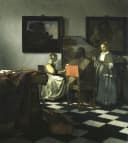 The Concert The Concert | ƒ 73 |
| 10 | A gentleman and a young lady making music in a room | Possibly 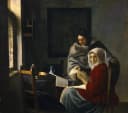 Girl Interrupted in her Music Girl Interrupted in her Music | ƒ 81 |
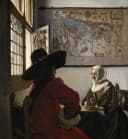
| 11 | A soldier with a laughing girl, very beautiful | ƒ 44.10 | |
| 12 | A young lady doing needlework | ƒ 28 | |
| 31 | The town of Delft in perspective, to be seen from the south | ƒ 200 | |
| 32 | A view of a house standing in Delft | Possibly  The Little Street The Little Street | ƒ 72.10 |
| 33 | A view of some houses | PossiblyA View of Houses in Delft | ƒ 48 |
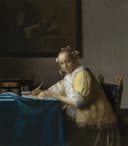
| 35 | A writing young lady, very good | ƒ 63 | |
| 36 | A young lady adorning herself, very beautiful | ƒ 30 | |
| 37 | A young lady playing the clavecin | ƒ 42.10 | |
| 38 | A tronie in antique dress, uncommonly artful | ƒ 36 | |
| 39 | Another tronie by the same hand | Lost or untraced | ƒ 17 |
| 40 | A pendant tronie by the same hand | Lost or untraced | ƒ 17 |