The Lacemaker
About this painting
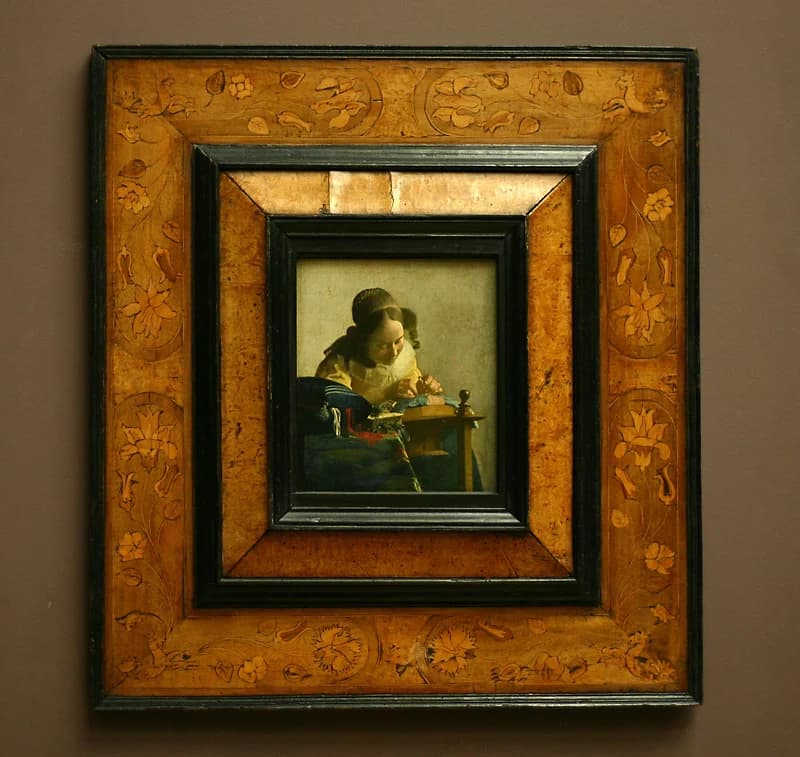
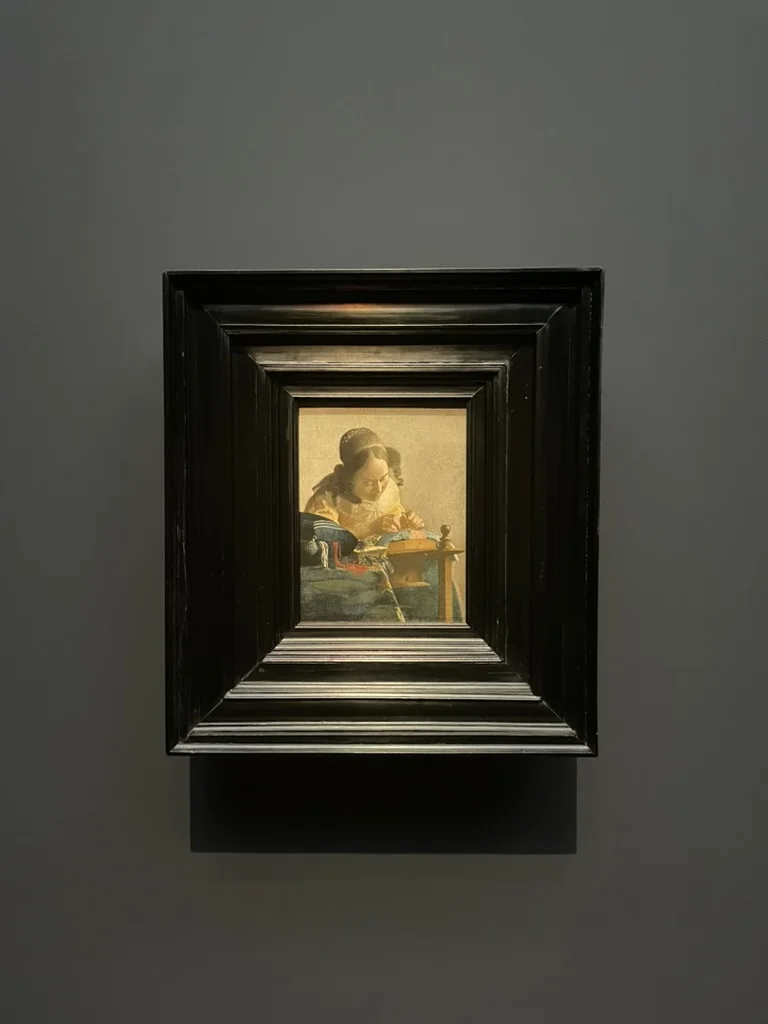
The smallest of Vermeer’s surviving paintings, at roughly 24.5 by 21 centimeters, is also one of his most intensely focused. Painted around 1669–1670, it shows a young woman bent close over her work, holding the bobbins in one hand as she sets a pin into the cushion that supports the lace. Vermeer places her against a bare, whitewashed wall, with only her tools, a book, and the spilling threads to fill the frame, so that nothing distracts from her concentration.
The blurred foreground
The red and white threads tumbling from the sewing cushion at left are painted so loosely that, out of context, they would scarcely be identifiable as thread at all. This soft, out-of-focus foreground, set against the sharply observed lacework behind it, has led many scholars to argue that Vermeer studied the scene through a camera obscura, whose shallow depth of field and small discs of confused light he seems to imitate. The Louvre notes that the loose, almost blurred handling of the threads in the foreground serves, by contrast, to sharpen the precise rendering of everything behind it. Salvador Dalí singled out this passage for special admiration and made his own faithful copy of the picture at the Louvre in 1955.
Lacework and domestic virtue
Lacemaking carried a clear moral charge in the seventeenth-century Dutch Republic, where diligent needlework stood for a woman’s discipline, industry, and domestic virtue. The parchment-covered book at the right, probably a Bible or prayer book, and the blue sewing cushion reinforce that reading. The Louvre describes the sitter as a young woman of standing rather than a professional lacemaker, her yellow garment and lace collar marking her refinement. Unusually for Vermeer, the light here falls from the right rather than the left.
From Delft to the Louvre
The canvas was cut from the same bolt of cloth Vermeer used for A Young Woman Seated at the Virginals, with which it once shared identical dimensions. The picture most likely passed through the 1696 Dissius sale in Amsterdam, where it appeared as lot 12, and then through a long succession of Dutch and French collections before the Musée du Louvre bought it in 1870, where it hangs today as inventory M.I. 1448.
- Date
- 1669–1671
- Medium
- Oil on canvas (attached to panel)
- Dimensions
- 24.5 × 21 cm
- Home
 Musée du Louvre