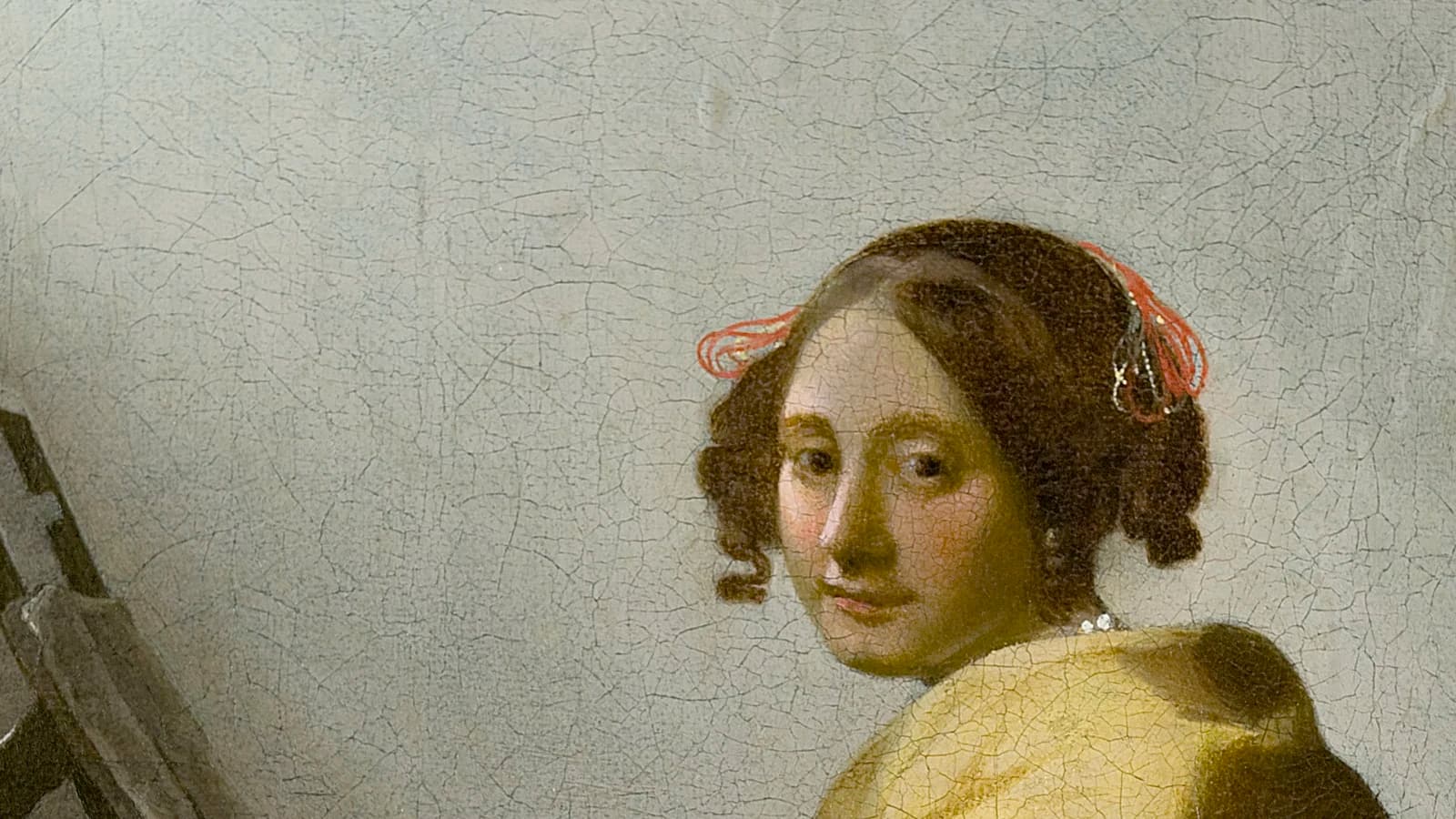
A Young Woman Seated at the Virginals
DisputedAbout this painting
A small oil of a solitary young woman at a virginal, sometimes called the ‘Baron Rolin Vermeer’ after a twentieth-century owner. At roughly twenty-five by twenty centimeters it is the smallest work ever proposed for Vermeer, and its composition is correspondingly spare, with little of the narrative detail that fills his other keyboard scenes.
A disputed attribution
The picture surfaced in the Beit collection and was accepted as a Vermeer after 1904, but it fell into doubt in the middle of the century, a period when the forgeries of Han van Meegeren had made attributions of this kind suspect. Baron Frédéric Rolin, who owned it from 1960, commissioned technical research in the 1990s, and a sequence of examinations gradually persuaded a number of specialists that the painting was autograph. Sotheby’s offered it as a Vermeer in 2004, when it sold for around £16.5 million to Steve Wynn, and it later passed to The Leiden Collection, which displays it as autograph.
The technical case
Much of the argument for Vermeer rests on physical evidence. The canvas is a coarse weave that appears to come from the same bolt as The Lacemaker, and the ground matches that of accepted Vermeers. Analysis found the costly pigments associated with him, natural ultramarine in the gray of the back wall and lead-tin yellow in the shawl, while an X-radiograph revealed a small pinhole at the vanishing point, the trace of the pin Vermeer used to lay out his perspective.
Reservations and dating
Acceptance has not been universal. Critics have pointed to the awkwardly drawn arms, a thinly rendered yellow shawl, and a face that some find lacking in finesse, and Walter Liedtke, while including the work, called it a minor late piece. The costume historian Marieke de Winkel dated the sitter’s hairstyle to a fashion current only around 1670, which has anchored the dating to the close of Vermeer’s career, near the two London keyboard pictures, A Lady Standing at a Virginal and A Lady Seated at a Virginal. The painting hung under the theme of music in the National Gallery’s 2013 exhibition Vermeer and Music: The Art of Love and Leisure.
Attribution debate
The painting passed through several collections under doubt before being submitted to Sotheby’s London in 2004. A team of specialists convened by the auction house concluded, on the basis of pigment analysis, canvas weave, and close stylistic comparison with accepted Vermeers, that the picture was autograph. It sold that July for £16.5 million. The Leiden Collection, which subsequently acquired it, displays the work as Vermeer and has commissioned ongoing technical research in support of the attribution.
Walter Liedtke of the Metropolitan Museum of Art was among those who expressed reservations, arguing that the picture’s quality and thinly applied paint did not meet the standard of Vermeer’s accepted late works. Several Dutch scholars have likewise withheld full acceptance, and the attribution has not achieved the consensus that surrounds the core catalogue.
- Date
- 1670
- Medium
- Oil on canvas
- Dimensions
- 25.2 × 20 cm