The 2024 Restoration of A Young Woman Seated at the Virginals
The smallest painting attributed to Vermeer, and the only one still in private hands, was cleaned in 2024. Particles of feldspar in the paint and a yellow shawl added over an earlier bodice point to a late date, and have prompted the suggestion that it was his final picture. The attribution to Vermeer remains disputed.
The only Vermeer in private hands
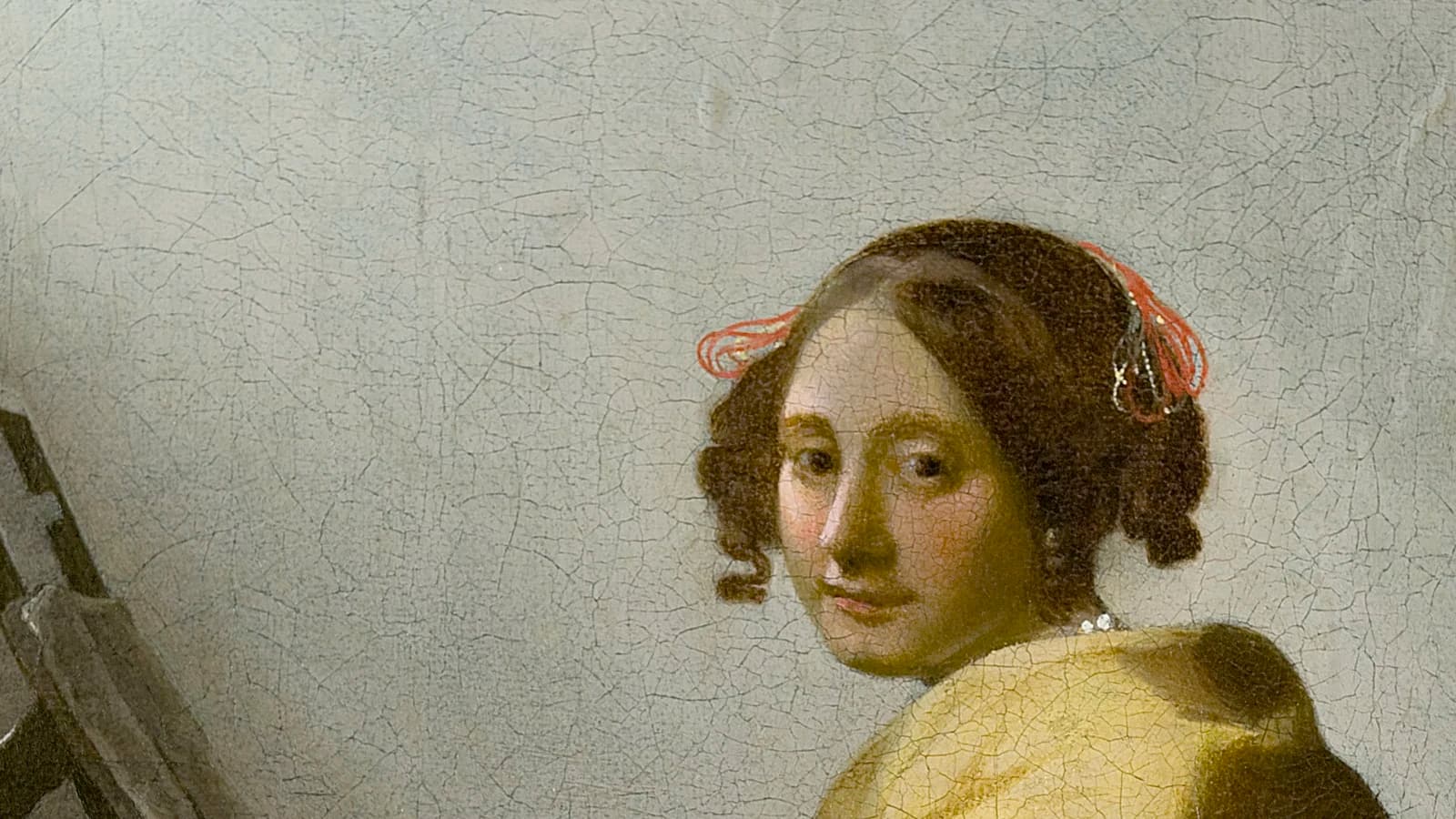
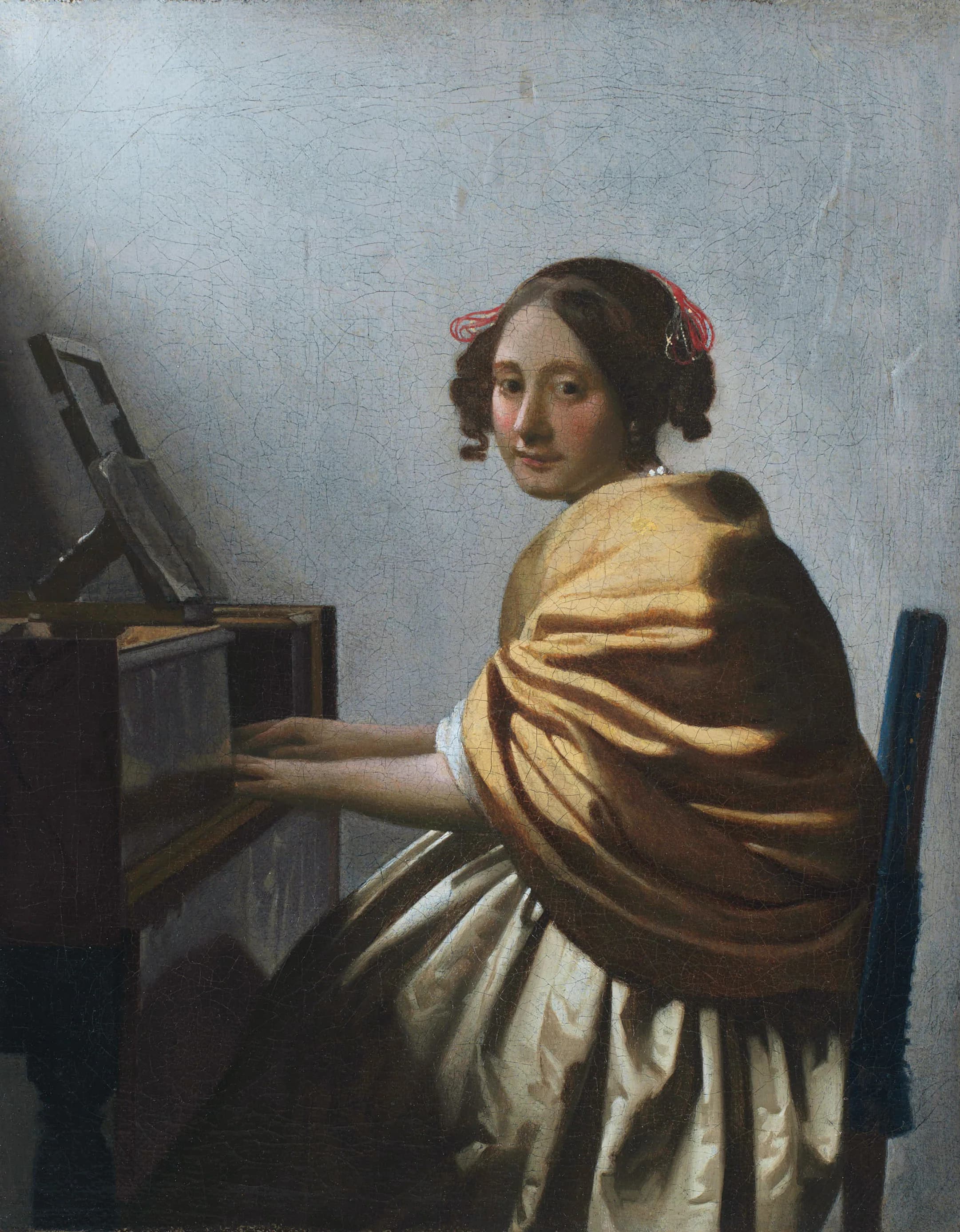
Most accepted Vermeers hang in public museums. A Young Woman Seated at the Virginals is the exception. A small oil of a solitary woman who turns from her keyboard toward the viewer, it is the smallest picture ever attributed to Vermeer, and the only one of his works still in private hands, now in The Leiden Collection in New York.
In 2024 the painting was cleaned by the conservator David Bull, who died at the end of that year; it was among his last works. The treatment was a cleaning, not a search for hidden figures or a reattribution: a removal of later varnish and overpaint. It also yielded two findings, a scatter of mineral particles in the paint and an earlier garment beneath the yellow shawl, which have led the painting’s cataloguers to propose that it may be Vermeer’s last picture. Whether Vermeer painted it at all, however, is disputed.
An attribution in dispute
The findings that follow carry weight only if the picture is by Vermeer, and that has never been settled. The painting was doubted through much of the twentieth century, when the forgeries of Han van Meegeren had made attributions of this kind suspect. A decade of technical research, the canvas it shares with an accepted Vermeer, a matching ground layer, and the costly pigments natural ultramarine and lead-tin yellow persuaded many specialists, and it sold as a Vermeer at Sotheby’s in 2004. Acceptance has not been universal: Walter Liedtke included the painting but judged it a minor late work.
The fullest dissent comes from Jonathan Janson, a painter and the author of the Essential Vermeer website, who rejects the attribution. His first objection concerns method: scientific analysis, he argues, can show only that the materials and technique are compatible with Vermeer, not that Vermeer’s hand made the picture. He points out that a comparable investigation led the National Gallery of Art in Washington to move Girl with a Flute from Vermeer to an associate.
Science can tell which materials and which methods are compatible or not with those of a given artist, but for the moment it still can’t guarantee the authenticity of a work of art or if it’s highly creative or is simply aped, exceptional or blandly ordinary.
His other objections concern quality. Janson describes the head as “Byzantine flat,” its shadows a muddy brown without Vermeer’s translucency, the arms awkwardly drawn and the pearls perfunctory, and he reads the picture as “a modest collection of timidly re-elaborated motifs” drawn from stronger works. Where The Leiden Collection sees Vermeer working economically at the end of his life, Janson sees a later follower. The cleaning did not resolve the question; it returned the surface to a clearer state in which it could be judged.
The 2024 cleaning
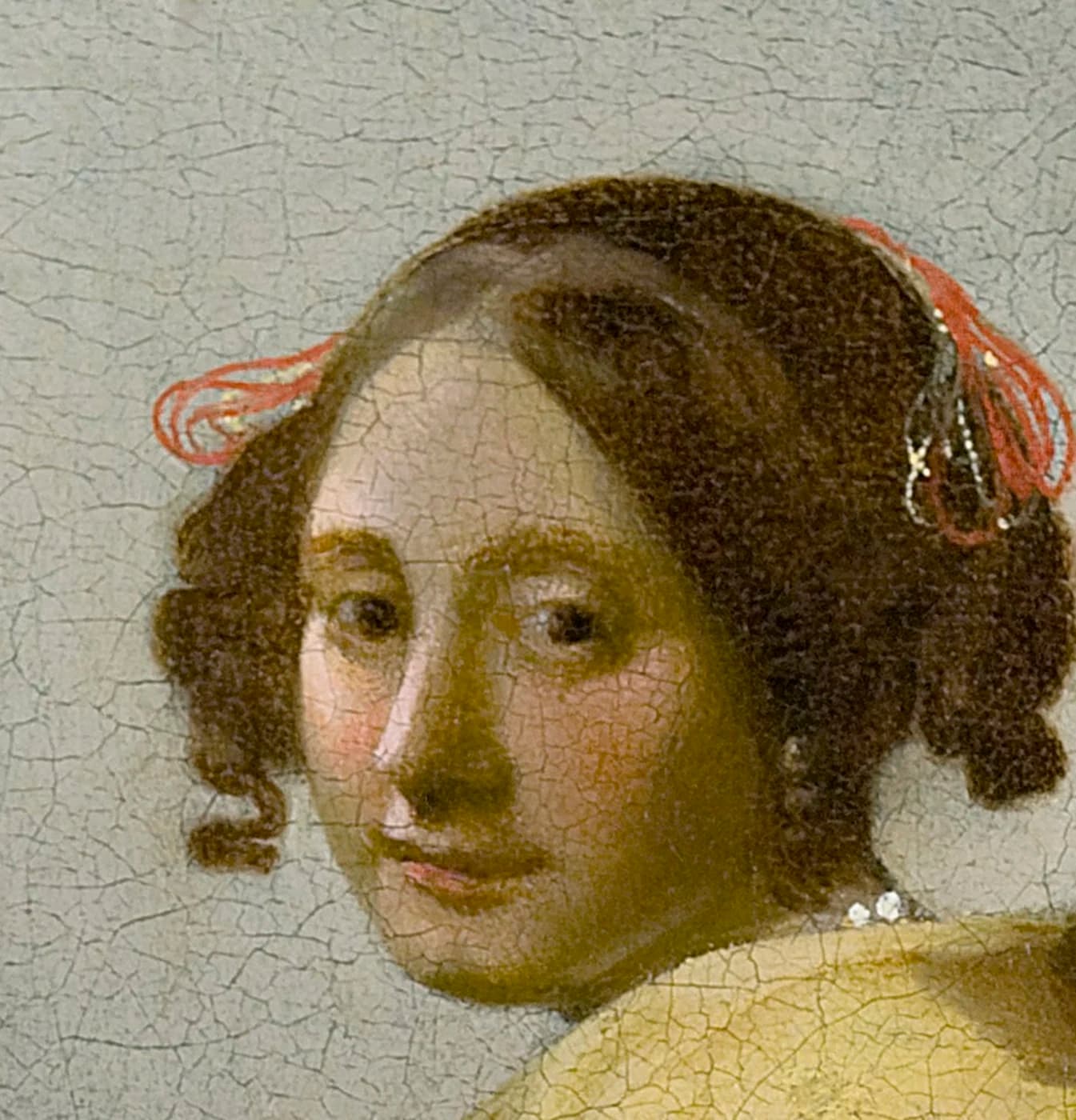
A cleaning removes the layers that sit above the original paint: the varnish that yellows and clouds with age, and overpaint, the additions applied by later hands to cover damage or freshen the picture. None of Vermeer’s own paint is removed. Bull lifted aged varnish, old retouchings, and overpaint from the lips and eyebrows, and took off varnish that earlier treatments had left in the shadowed part of the shawl.
The cleaning recovered several details: the reflections of the woman’s arms on the wooden case of the virginal, and the depth of the blue cloth on the chairback. It also showed that she sits upright, in a pose close to that of the seated woman in The Girl with a Wine Glass. The tonal range of the picture, muted under the old varnish, became legible again.
Particles of feldspar
Examined in cross-section, the paint was found to contain large particles of feldspar, a common rock-forming mineral, lying between two layers of Vermeer’s paint. The likely source is the potteries of Delft, whose kilns, firing the blue-and-white earthenware now called Delftware, released mineral dust into the air; some of it appears to have settled on the picture while it stood in Vermeer’s studio.
Because the feldspar lies between two paint layers, it can only have settled while the surface was exposed, during a pause in the work. The picture was therefore not painted in a single campaign: it was laid in, left uncovered for a time, and completed later.
A shawl over a bodice
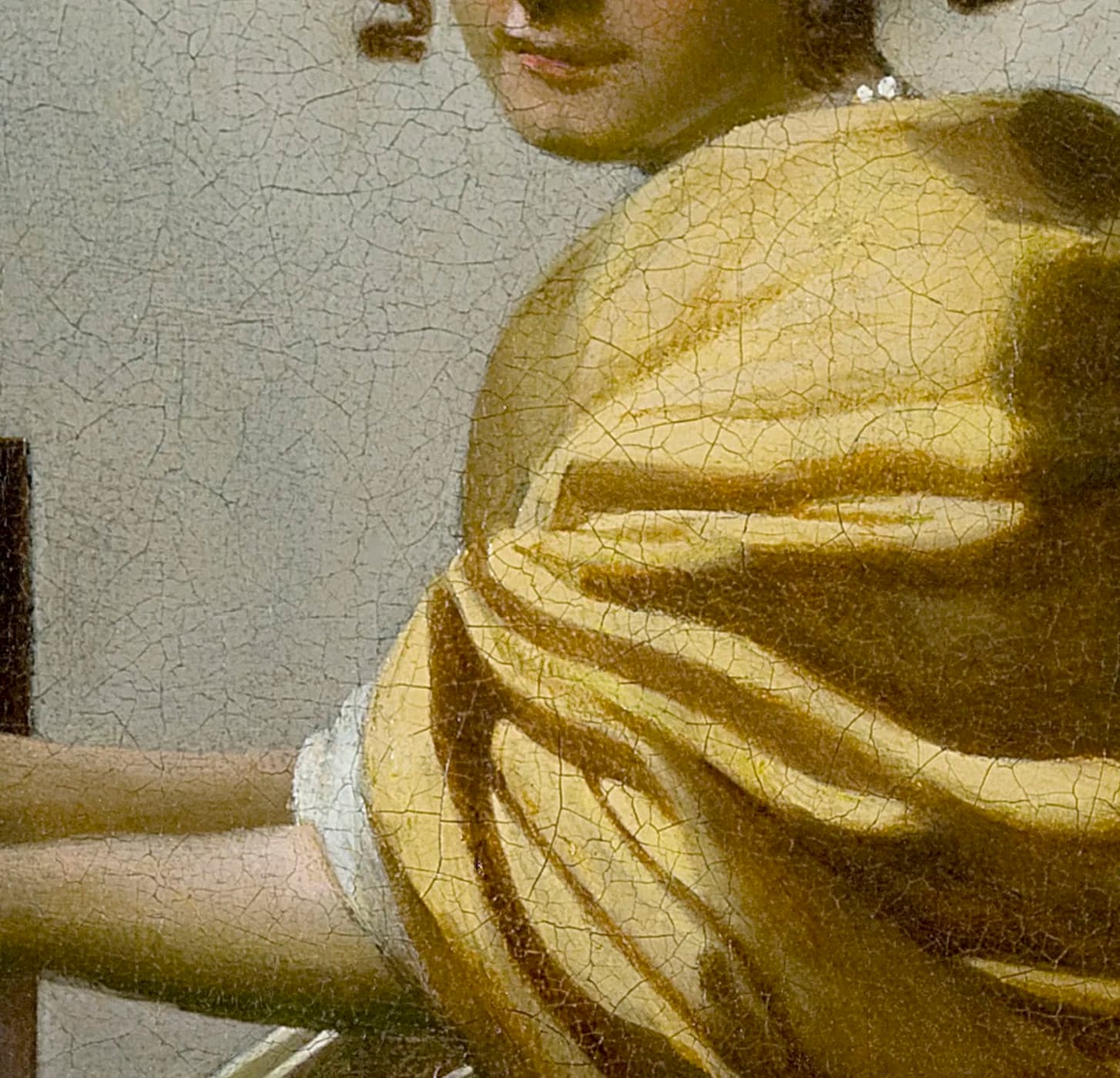
Beneath the broad yellow shawl around the woman’s shoulders, technical imaging shows an earlier garment, a bodice modelled in full. The feldspar lies between that bodice and the shawl painted over it, which places the shawl in the later campaign.
Arthur Wheelock, who wrote The Leiden Collection’s catalogue entry, dates the shawl to about 1673 to 1675. He suggests it reflects a style of dress that became fashionable after the French invasion of the Netherlands in 1672, the crisis the Dutch called the rampjaar, or disaster year, and adds that the looser garment gave the figure a more timeless, classical appearance.
Begun around 1670
Set beside the other evidence, the feldspar supports a late date. The canvas was cut from the same bolt of cloth as The Lacemaker in the Louvre, generally placed around 1669 to 1671, and the handling resembles that of The Guitar Player. On this account the picture was begun around 1670 to 1672, left standing while the feldspar settled, and finished, with the added shawl, around 1675.
Vermeer died on 15 December 1675. If the picture is his, and if the shawl was added in his final year, it would be the latest work to leave his hand. The conclusion is an interpretation drawn from the conservation rather than a documented fact, and it depends on an attribution that not all scholars accept.
Back on a private wall
Being privately owned has not kept the picture off public view. As the only Vermeer in The Leiden Collection, it has travelled widely with the collection’s loan exhibitions, shown in Paris, St Petersburg, Beijing and Abu Dhabi among other cities. It hung among the keyboard scenes in the National Gallery’s Vermeer and Music in 2013, beside the two London virginal pictures, A Lady Standing at a Virginal and A Lady Seated at a Virginal, and in 2023 it joined the Rijksmuseum’s Vermeer, the largest exhibition of his work ever mounted. After the 2024 cleaning it returned to The Leiden Collection.
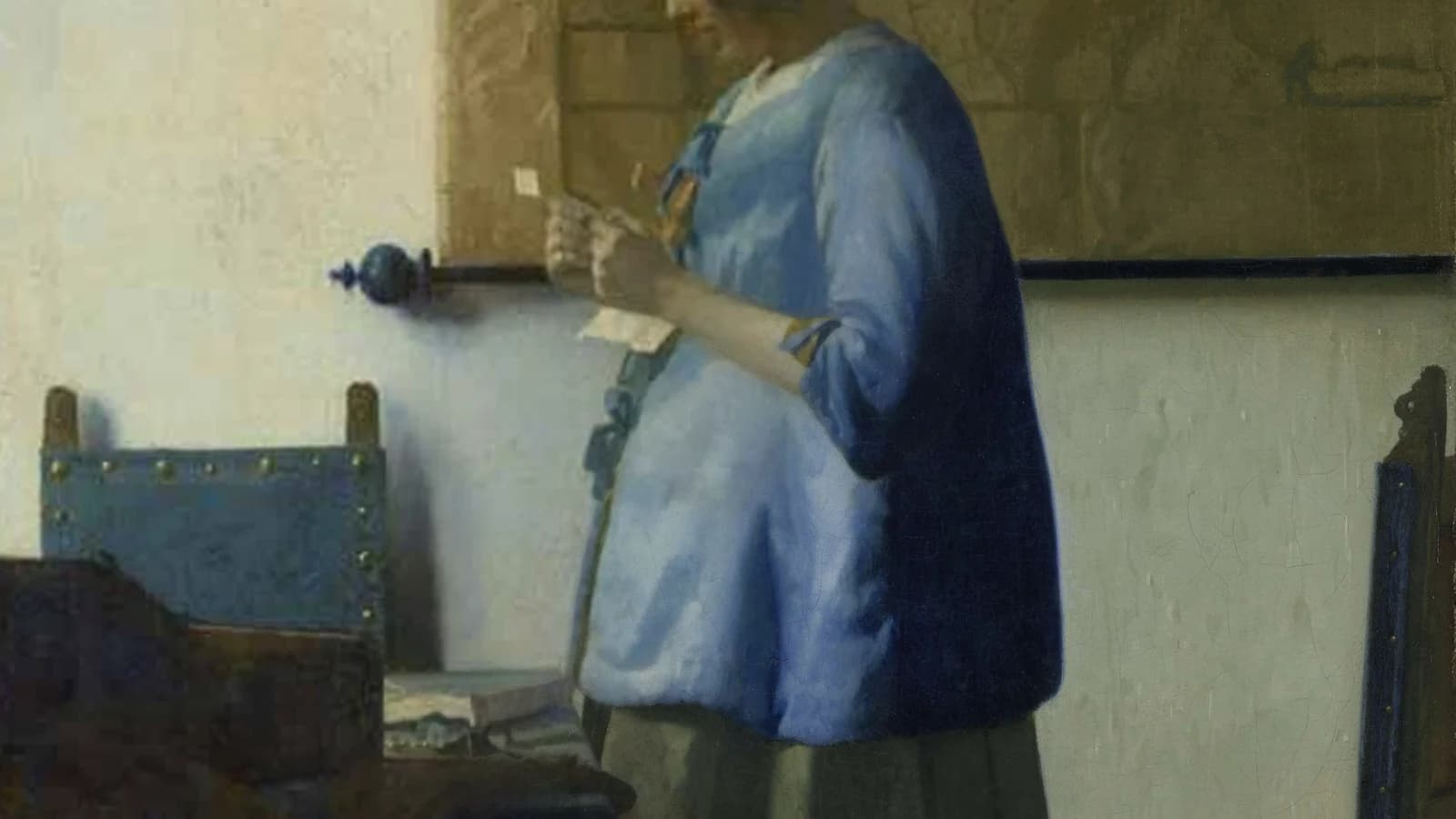
Other recent cleanings have changed the reading of a Vermeer by removing later additions rather than uncovering hidden ones: the overpaint stripped from Girl Reading a Letter at an Open Window in Dresden, and the discoloured varnish lifted from Woman in Blue Reading a Letter in Amsterdam.
Notes
- 1.At roughly twenty-five by twenty centimeters it is the smallest picture ever attributed to Vermeer, and the only one of his accepted works still in private hands. The catalogue history and current ownership are set out in The Leiden Collection’s online entry, Walter A. Liedtke and Arthur K. Wheelock Jr., “Young Woman Seated at a Virginal” (rewritten by Wheelock, 2024), and were summarised in The Art Newspaper, “Conservation on mysterious Vermeer painting reveals it may have been his final work” (11 April 2025).
- 2.The painting was widely doubted through the middle of the twentieth century and was reaccepted only after a decade of technical research, culminating in the 2004 Sotheby’s sale, when it fetched more than £16 million and passed by way of Steve Wynn to The Leiden Collection. Walter Liedtke included it but judged it a minor late work, and acceptance has never been universal. The attribution history and the technical case (the shared canvas, the ground, the costly pigments) are set out in the Leiden Collection catalogue entry.
- 3.Jonathan Janson, a painter and the author of the Essential Vermeer website, set out the case against the attribution in a lecture, “Questions of Authenticity: What Science Can’t Tell Us,” International Vermeer Symposium, Rijksmuseum, Amsterdam (28 March 2023), and at greater length in Young Woman Seated at a Virginal: A Second Look (2024). The phrases “Byzantine flat” and “a modest collection of timidly re-elaborated motifs” are his, from the lecture.
- 4.The 2024 treatment removed aged varnish, old retouchings and overpaint, including overpaint on the lips and eyebrows, and took off varnish left in the shadowed part of the yellow shawl by earlier treatments. With it the reflections of the figure’s arms on the wooden casing of the virginal and the velvety blue of the chairback re-emerged. See the Leiden Collection catalogue entry. The conservator David Bull died on 28 December 2024; the cleaning was among his last work, as reported in The Art Newspaper.
- 5.Examination found large particles of feldspar, a common mineral, lying between two layers of paint, presumably blown from the kilns of nearby Delftware production and settling onto the surface while the picture lay uncovered in Vermeer’s studio. See the Leiden Collection catalogue entry and the collection’s account of the conservation.
- 6.Beneath the yellow shawl the technical images show a bodice that was modelled first; the feldspar lay between the two campaigns. Wheelock dates the shawl to about 1673 to 1675, possibly reflecting a style of dress fashionable after the French invasion of the Netherlands in 1672. See the Leiden Collection catalogue entry and The Art Newspaper’s report. Janson, who rejects the attribution, notes that the same Rijksmuseum examination found the shawl was elaborated at the same stage as the skirt, and so by the same hand as the rest of the picture.
- 7.The canvas was cut from the same bolt of cloth as The Lacemaker in the Louvre, generally dated about 1669 to 1671, and the picture is stylistically close to The Guitar Player. The feldspar, together with the absence of later pollutants, supports a finish near 1675; Vermeer died on 15 December 1675, which leads Wheelock to call it most likely his final picture. See the Leiden Collection catalogue entry and The Art Newspaper.