Girl Reading a Letter at an Open Window
About this painting
Painted around 1657–1659, early in Vermeer’s turn from history painting to domestic genre scenes, the picture shows a young woman standing at an open window, absorbed in a letter. Her face is given twice, once in profile and once as a faint reflection in the leaded glass, and the whole room is bathed in the cool daylight that would become the hallmark of his interiors.
A new direction
Essential Vermeer describes the painting as the work in which Vermeer found his “definitive artistic direction,” setting a single figure within a coherent, light-filled space rather than the classical and biblical subjects of his earliest years. The heavy ochre curtain at the right is a repoussoir, a framing device that pushes the viewer’s eye into the room; it is the last of his paintings to use one, a motif he would later abandon. Beneath the surface, technical study has shown that Vermeer first included a large drinking glass, a roemer, on the table and then painted it out, one of several changes he made as he refined the composition.
The hidden Cupid
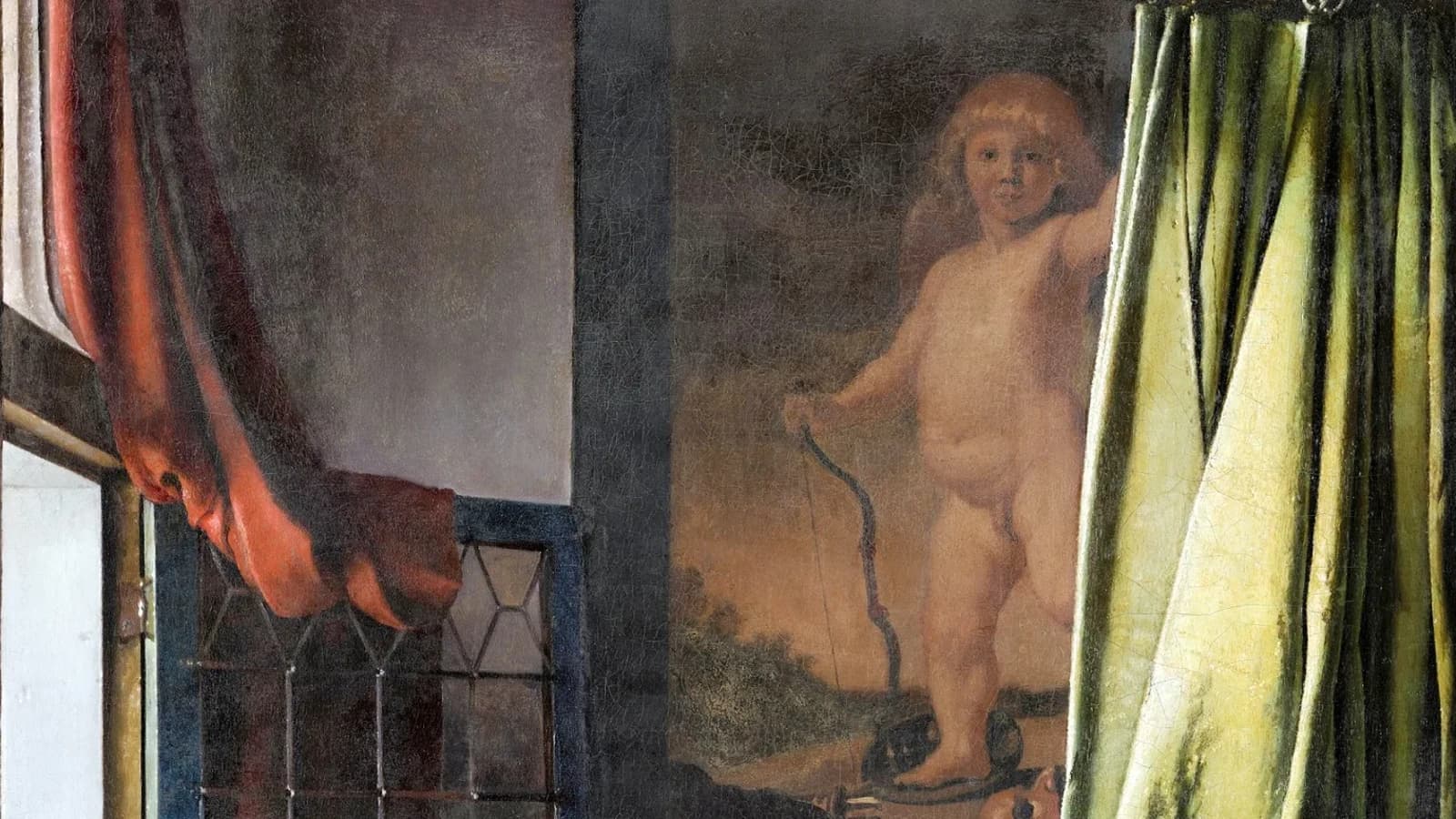
For most of its history the back wall behind the woman was blank, but X-radiography had long revealed a large painting of a standing Cupid hidden beneath the upper layers. It was long assumed that Vermeer himself had painted the figure out, yet conservators in Dresden found aged dirt and varnish sandwiched between his paint and the overpaint, proving that another hand had obscured the Cupid decades after the canvas left his studio. Between 2017 and 2021 the conservator Christoph Schölzel removed that later layer under the microscope with a scalpel, uncovering the ebony-framed Cupid and brighter original colors long buried under yellowed varnish.
A letter about love
The recovered Cupid, who treads on a fallen mask as he draws his bow, makes explicit what was always implied: the letter the woman reads is a love letter. Letters carried romantic and even erotic associations in Dutch genre painting, and the bowl of ripe fruit spilling across the foreground, a Chinese Wan-Li dish of peaches, plums, apples, and a halved peach, reinforces the theme of desire and readiness for love. The picture belongs to Vermeer’s long series of women absorbed in correspondence, a subject he returned to in works such as Woman in Blue Reading a Letter.
From Rembrandt to Dresden
The canvas may have passed through the 1712 Pieter van der Lip sale in Amsterdam before it was acquired in 1742 for Augustus III, Elector of Saxony, who bought it as a work by Rembrandt. It was later catalogued as a Pieter de Hooch until the French critic Théophile Thoré-Bürger restored it to Vermeer around 1860. Requisitioned by the Soviet Union after the Second World War, it was returned in 1955 to the Gemäldegalerie Alte Meister in Dresden, where it hangs today.
- Date
- 1657–1659
- Medium
- Oil on canvas
- Dimensions
- 83 × 64.5 cm