View of Delft
About this painting
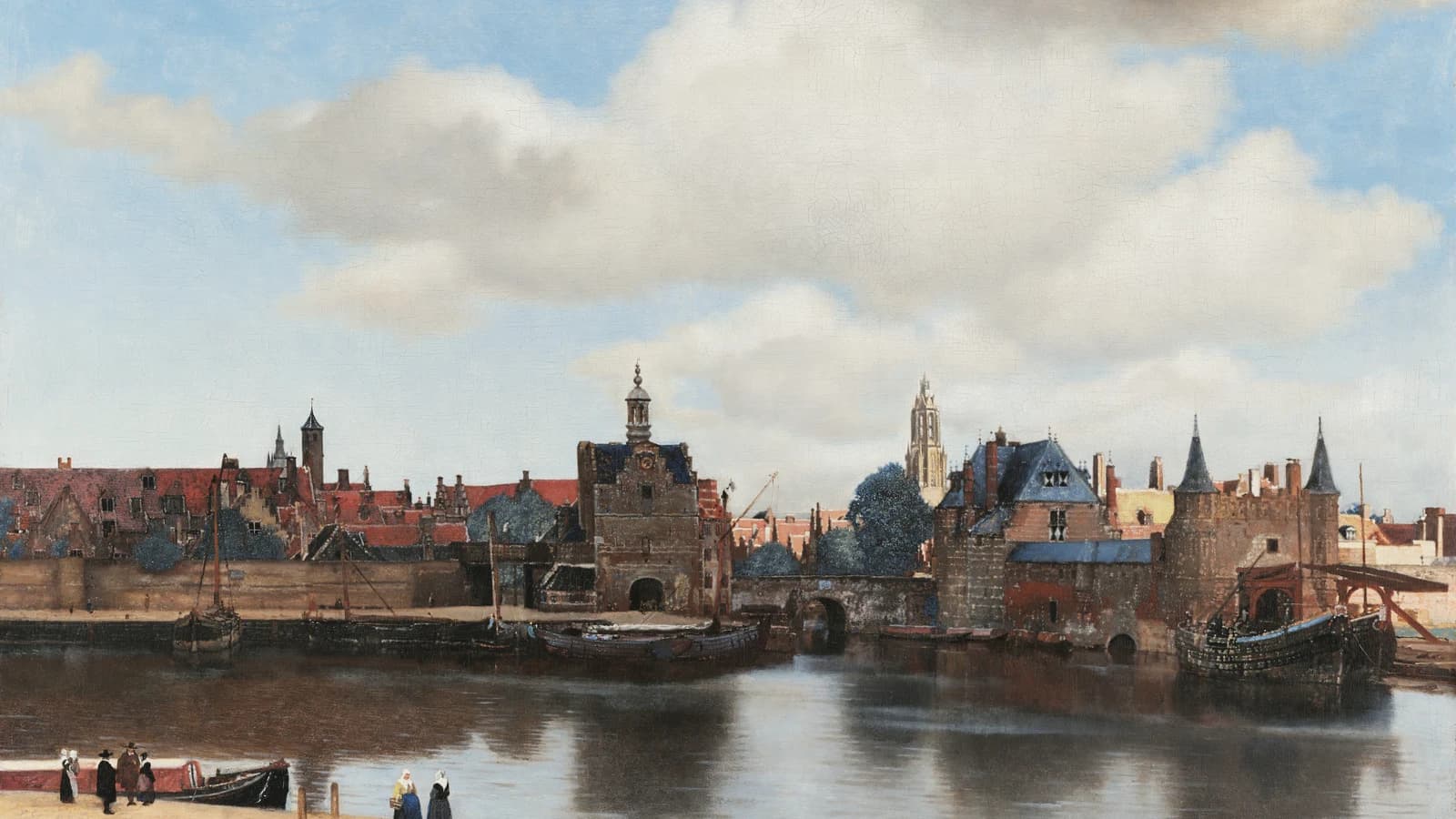
Painted in the early 1660s, View of Delft is Vermeer’s only known cityscape and one of the most celebrated topographical paintings in Western art. The city is seen across the water from the south, with the Schiedam Gate near the center and the twin-turreted Rotterdam Gate to the right, the sunlit tower of the Nieuwe Kerk rising behind it and the spire of the Oude Kerk just visible in the distance. In the foreground the harbor known as the Kolk is dotted with moored boats and a scattering of small figures, several of them waiting on the near bank for a passenger barge.
Light and weather
The picture is built around its sky. A bank of billowing cumulus cloud throws the foreground ramparts into shadow while early morning sunlight catches the rooftops and the tower of the Nieuwe Kerk beyond, so that the city seems to emerge from shade into light. The handling of the diffused, rain-washed atmosphere and the still water that mirrors the architecture is among the qualities most often singled out by critics, and it gives the scene a freshness rarely matched in seventeenth-century Dutch townscape.
Topography and invention
View of Delft is broadly faithful to the actual prospect of the city, and Vermeer may have observed it from an upper window across the Schie, but it is not a literal record. He adjusted the buildings for compositional effect, drawing the Nieuwe Kerk tower closer to the center, broadening and lowering it slightly, and all but concealing the Oude Kerk, so that the eye is led across the horizontal sweep of walls and water rather than fixed on any one landmark. The scattered highlights on the boats and water, applied as small bright dots of paint, have long been read as evidence that Vermeer studied the scene through a camera obscura, whose lens can spread points of light into soft discs, though the question remains debated. It belongs to the same Delft years as his other surviving outdoor scene, The Little Street.
Proust and the patch of yellow wall
The painting’s modern fame owes much to Marcel Proust, who saw it in The Hague and called it the most beautiful painting in the world. In La Prisonnière, the volume of his novel in which the writer Bergotte collapses and dies before the canvas, his eyes fixed on a “little patch of yellow wall,” Proust turned the picture into a meditation on art and mortality, and the phrase has clung to it ever since.
Provenance
The painting is thought to have belonged to Vermeer’s Delft patron Pieter Claesz van Ruijven and to have passed through his heirs to the 1696 Dissius sale in Amsterdam, where it sold as lot 31 for 200 guilders. After passing through several Dutch collections it came up at theStinstra sale in Amsterdam in 1822, where it was bought for the Mauritshuis in The Hague, which has held it ever since.
- Date
- 1660–1663
- Medium
- Oil on canvas
- Dimensions
- 98.5 × 117.5 cm
- Home
 Mauritshuis