The 1994 Restoration of View of Delft
In 1994 the Mauritshuis lifted a yellowed varnish from Vermeer's only cityscape. The cleaning gave back its morning light, and the study around it read the chemistry of its ageing and the marks of a picture reworked.
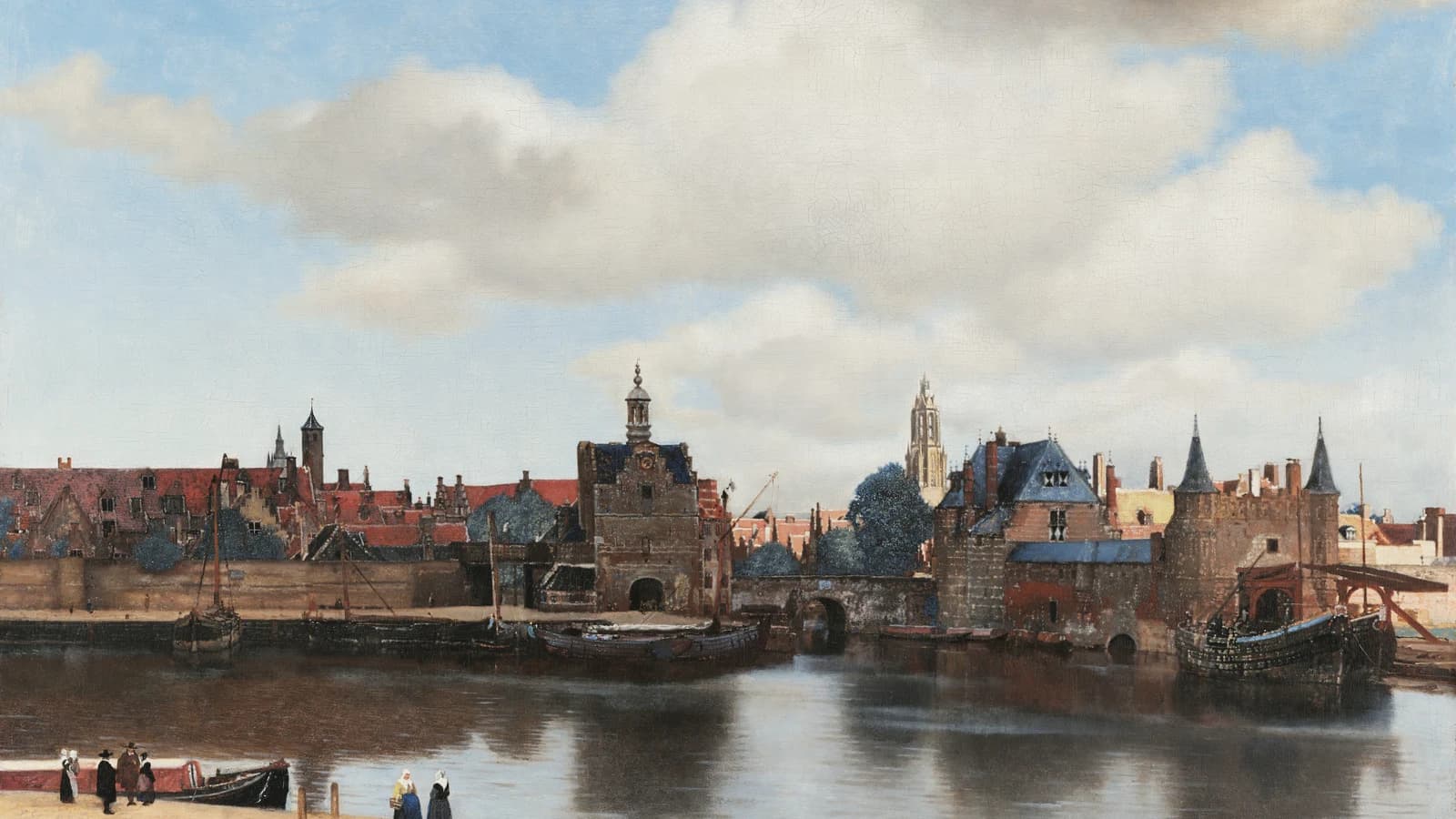
Two Vermeers on the table
In 1994 the Mauritshuis took two of its Vermeers off the wall at once and set them side by side in a conservation studio: the small Girl with a Pearl Earring and the much larger View of Delft, his only known cityscape. The work was done in a temporary studio the public could watch through a glass wall, part of a research and restoration project the museum called Vermeer Illuminated and led by its chief conservator, Jørgen Wadum. It was timed to ready both pictures for the large Vermeer exhibition that toured Washington and The Hague in 1995 and 1996.
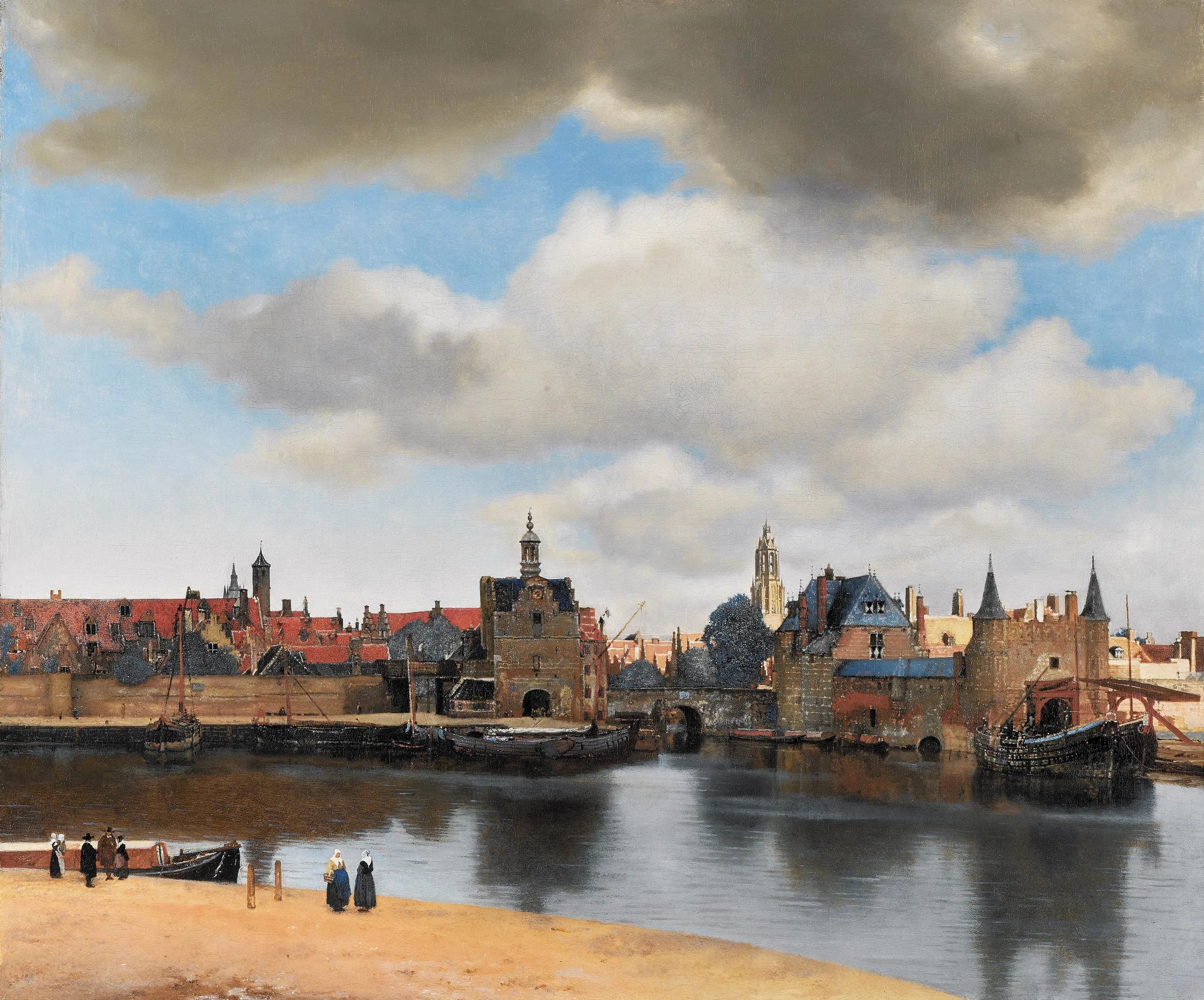
Removing the varnish
The central task was the varnish. Like most old oil paintings, View of Delft carried a protective coat that had yellowed and darkened with age, warming its cool blues and dulling the contrast between the shadowed foreground and the sunlit town beyond. Wadum’s team took the discoloured layer off with solvents, lifting the film without disturbing the paint below it.
What came back was the light. The picture turns on a broad, cloud-filled sky that throws the near walls into shadow while the sun catches the roofs and the tower of the Nieuwe Kerk behind them, and the cleaning sharpened that division of shade and light. A fresh varnish, this time with an ultraviolet stabiliser to slow the next round of yellowing, was laid over the recovered surface.
Before and after the cleaning
The difference the cleaning made is easiest to weigh across the whole view. Under the old varnish the picture wore a warm, brownish cast that muffled the sky and softened the step from shadow into sun. Lifting the film returned the cooler daylight, the depth in the clouds, and the sharp division between the shaded near bank and the sunlit town.
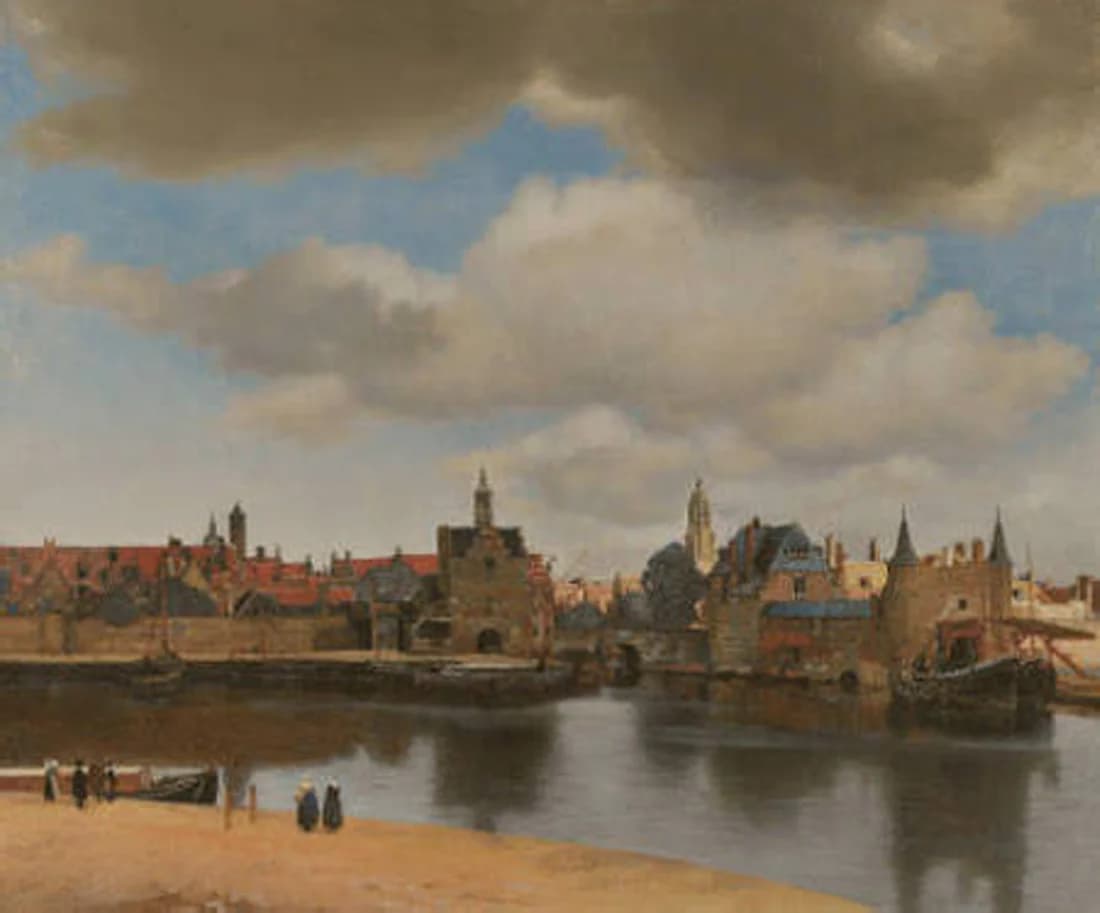
A cleaner surface is also a more legible one, and the recovered clarity brought up things the varnish had hidden, some of them Vermeer’s doing and some the work of time.
The chemistry of ageing
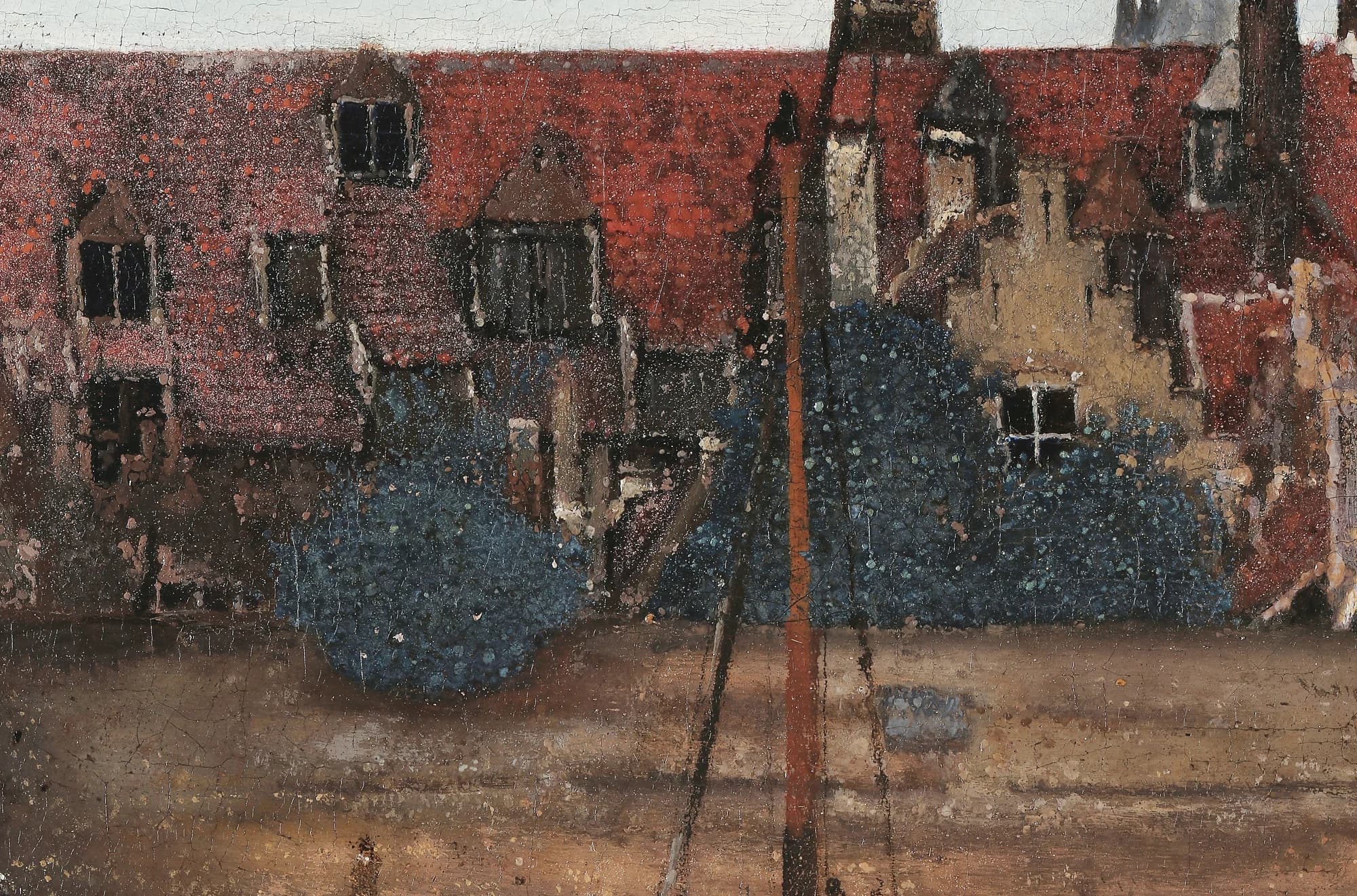
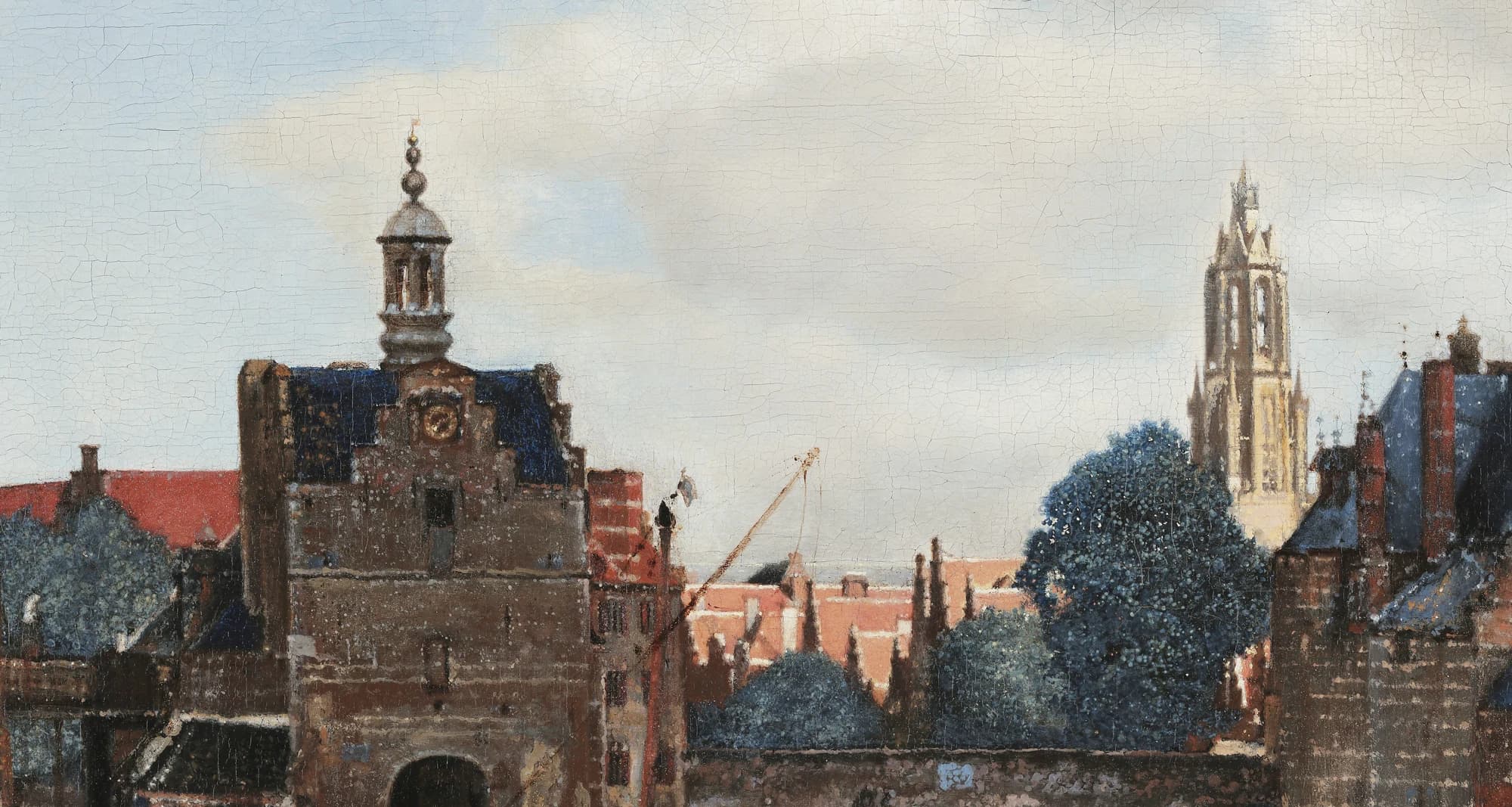
One of those was a change Vermeer never intended. The red roofs are dotted with small pale lumps, so that the tiles read as grainy and slightly pink. These are metal-soap aggregates: over the centuries, metal from a pigment such as lead white reacts with the fatty acids in the oil that binds the paint, and the products gather into little protruding grains that push up through the surface.
It is a common form of ageing in old oil paintings, and it leaves its own trace in the technical images, where the grains show as tiny light spots in an X-radiograph. A conservator can record and understand it, but not undo it; the roofs of Delft will keep their grain.
A hole in the sky
Not all of the painting’s history is chemical. In 1876 a curtain rod fell in the Mauritshuis galleries and punched a hole in the centre of the sky. The museum’s nineteenth-century conservator, W.A. Hopman, repaired it the same year, and his mend is invisible to a visitor standing in front of the picture. It survives only in the X-radiograph, where the old damage still reads as a dark shape against the bright lead white of the clouds, a scar the eye cannot find but the instruments can. When the picture came to the studio in 1994 the old patch behind it was found sound and left in place.
Signs of a second campaign
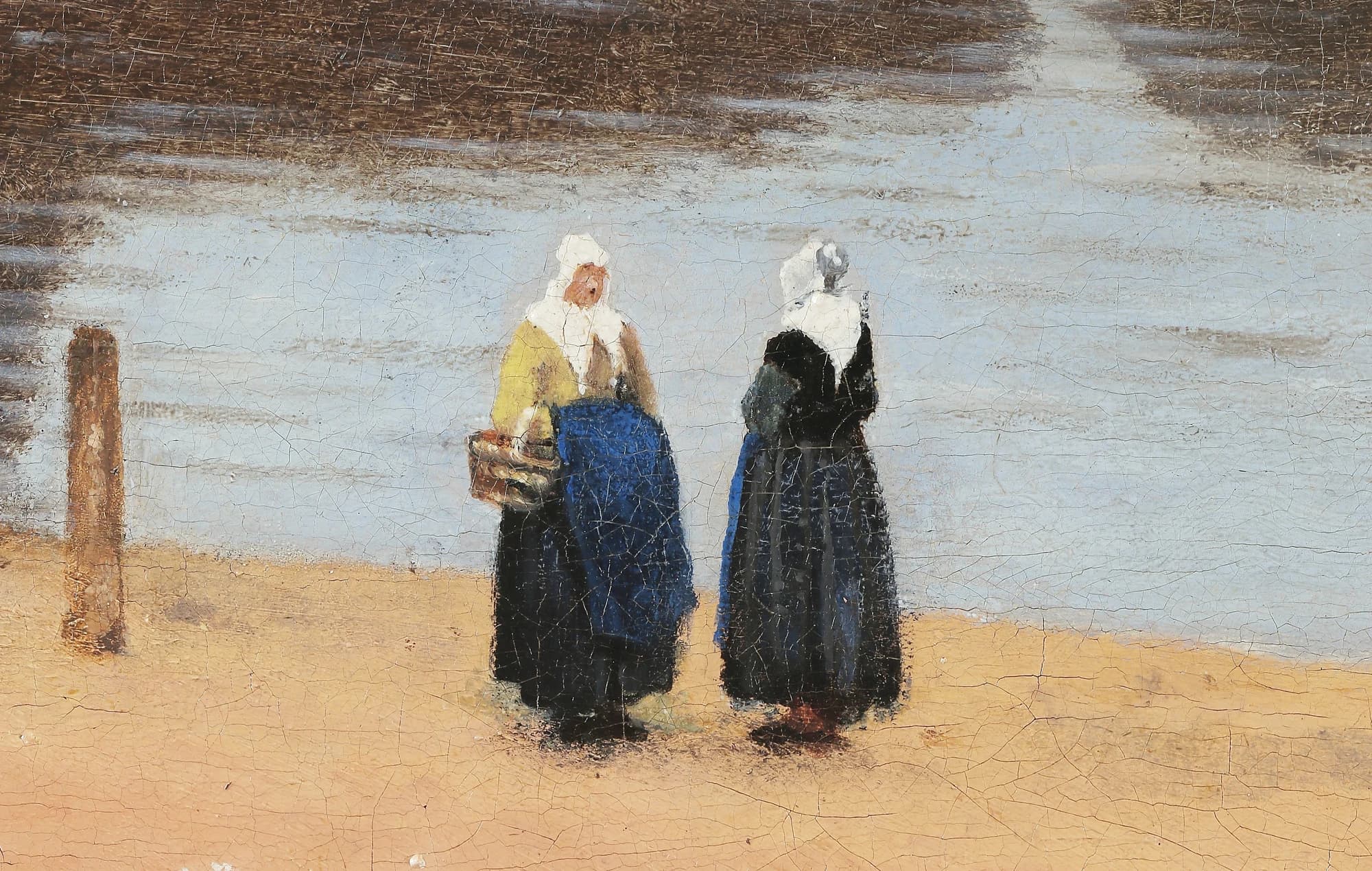
The close looking that a restoration allows turned up a small clue to how Vermeer worked. On one of the little women who wait on the near bank for a barge, Wadum found that Vermeer had drawn fine grey vertical lines over cracks that had already opened in the black paint of her skirt.
Drying cracks do not form overnight. For Vermeer to have painted into cracks that were already there, he must have come back to the finished picture a good while after he began it, touching in these figures in a later sitting. It is a reminder that a painting so often described as a single caught moment was built up in more than one campaign.
Points of light
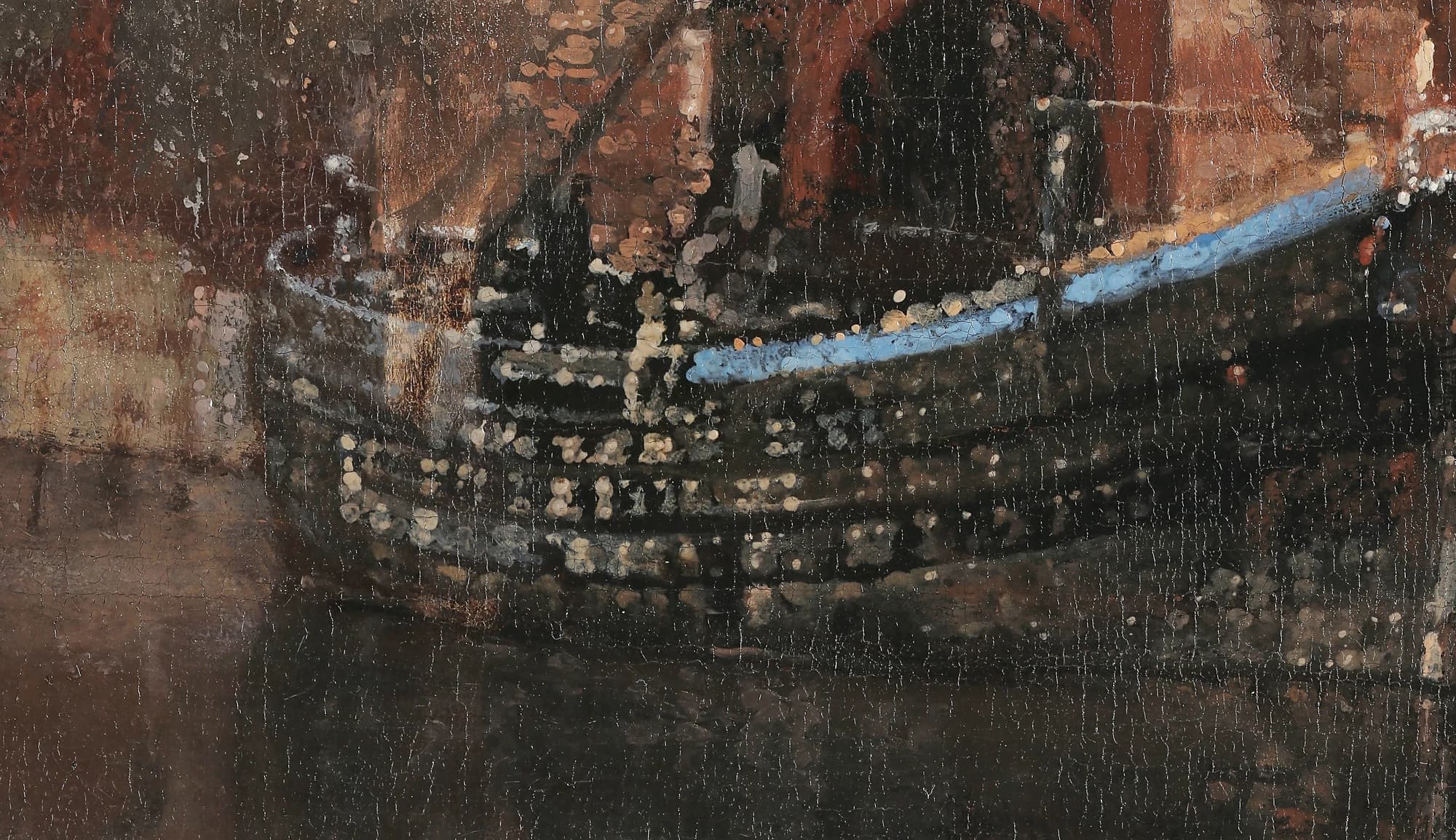
With the varnish gone, one of the picture’s most discussed features read clearly again. Along the dark hull of the herring boat moored below the Rotterdam Gate, and across the water, Vermeer strung small soft dabs of bright paint. Looked at closely they are not sharp dots but little glowing discs.
Those discs have long been treated as a clue to method. A camera obscura, the lens-and-mirror box that throws a scene onto a surface, can spread a single point of light into a soft halo of exactly this kind, and scholars have taken the highlights here as a sign that Vermeer studied the view through such a device. It cannot be proved from the paint alone, and the question is still argued, but the cleaned surface let the evidence be seen for what it is.
After the cleaning
The 1994 treatment did not alter what the painting is, a broadly faithful prospect of Delft seen across the water, adjusted here and there for the sake of the composition. What it altered is how it reads: a brighter, cooler, more sunlit picture than the yellowed one visitors had known, and a better understood one, its ageing chemistry and its two campaigns of work now on the record. Cleaned and revarnished, it took its place in the 1996 Vermeer exhibition in The Hague.
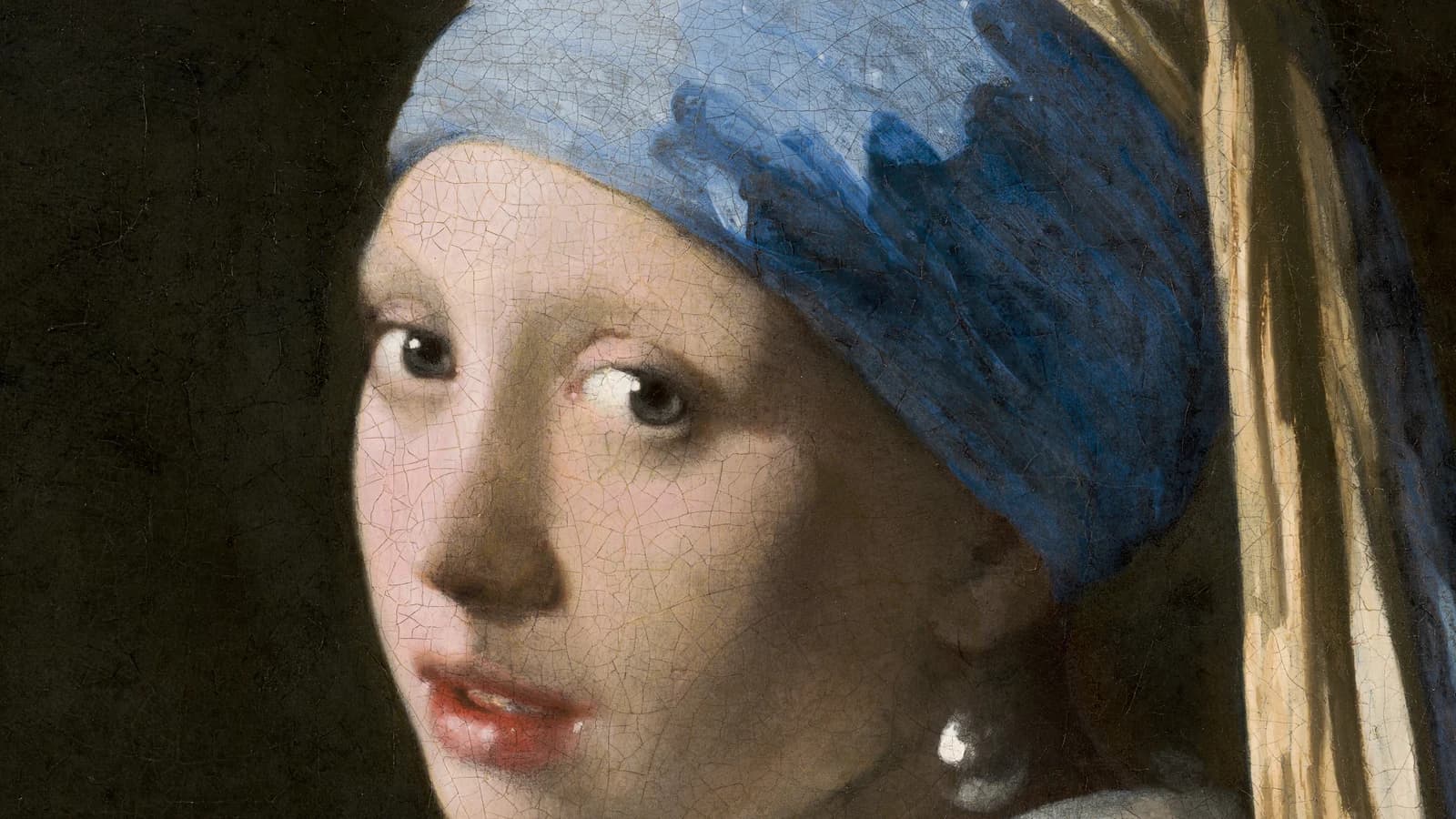
Its companion on the studio table went on to a second life in the laboratory. A quarter of a century later the Mauritshuis returned to Girl with a Pearl Earring with a battery of scanners and imaging techniques, this time to examine rather than to clean.
Notes
- 1.The 1994 treatment of View of Delft, carried out with Girl with a Pearl Earring, was led by the Mauritshuis chief conservator Jørgen Wadum and published as Jørgen Wadum et al., Vermeer Illuminated: Conservation, Restoration and Research (The Hague: Mauritshuis, 1994). It prepared both pictures for the exhibition “Johannes Vermeer” shown at the National Gallery of Art, Washington, and the Mauritshuis, The Hague, in 1995 and 1996. See the Mauritshuis account, “Vermeer Illuminated.”
- 2.The removal of the discoloured varnish is described in Wadum et al., Vermeer Illuminated (The Hague, 1994): yellowed varnish from earlier treatments was taken off with solvents, recovering the cool light of the sky and the warmth of the sunlit far bank, and the painting was given a fresh varnish containing an ultraviolet stabiliser to slow future yellowing.
- 3.The pale lumps in the red roofs are metal-soap aggregates, a common form of chemical ageing in which metal ions from a pigment such as lead white react with the fatty acids in the oil binder and gather into protruding grains. The Mauritshuis records that they give the roofs a grainy texture and a pinker tone and show up as tiny light spots in X-radiographs. See the Mauritshuis object page, “View of Delft,” and the technical study Petria Noble et al., Bewaard voor de eeuwigheid: het natuurwetenschappelijk onderzoek van de schilderijen van het Mauritshuis (2008).
- 4.The Mauritshuis records that in 1876 a curtain rod fell in the galleries and made a hole in the centre of the sky, which the conservator W.A. Hopman (1828 to 1910) repaired the same year; the damage is invisible on the surface but still reads as a dark shape in the X-radiograph. See the Mauritshuis object page, “View of Delft.”
- 5.In Vermeer Illuminated (The Hague, 1994) Wadum noted that on one of the small women on the foreground bank Vermeer painted grey vertical lines over drying cracks that had already opened in the black of her skirt, evidence that he returned to the picture well after first laying it in, since drying cracks take time to form. See the interview with Jørgen Wadum at Essential Vermeer.
- 6.The soft discs of light on the boats and water, applied as small dabs rather than sharp points, have long been read as evidence that Vermeer studied the scene through a camera obscura, whose lens can spread a point of light into a glowing halo. The classic account is Arthur K. Wheelock Jr. and C. J. Kaldenbach, “Vermeer’s View of Delft and his Vision of Reality,” Artibus et Historiae 3, no. 6 (1982), pp. 9 to 35. The question remains debated.