The 2018 Examination of Girl with a Pearl Earring
In 2018 a team of scientists examined Girl with a Pearl Earring in front of the public at the Mauritshuis, mostly without touching the paint. They found a green curtain behind her, eyelashes long thought absent, and a pearl made of a few strokes of paint.
The 2018 examination
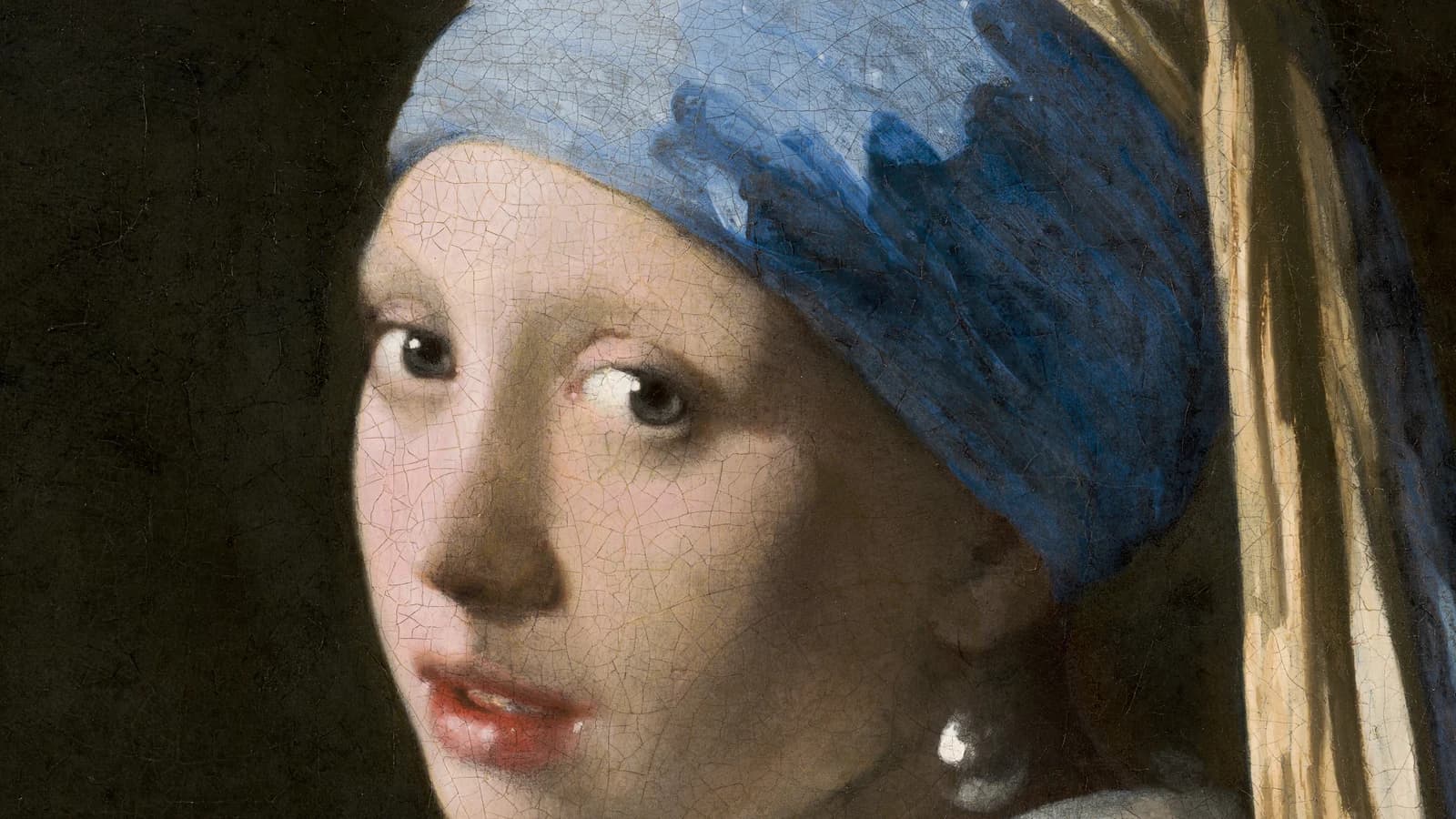
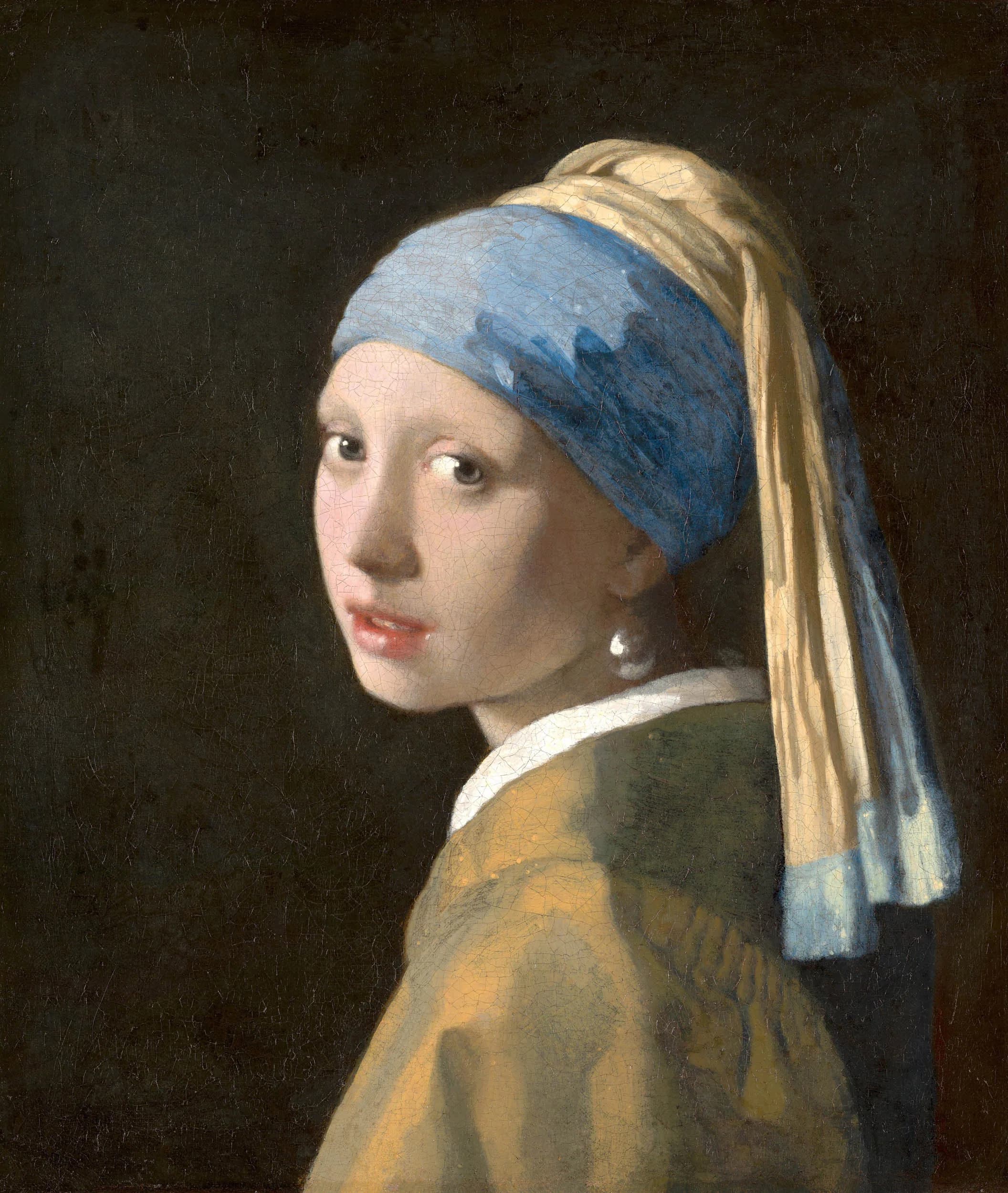
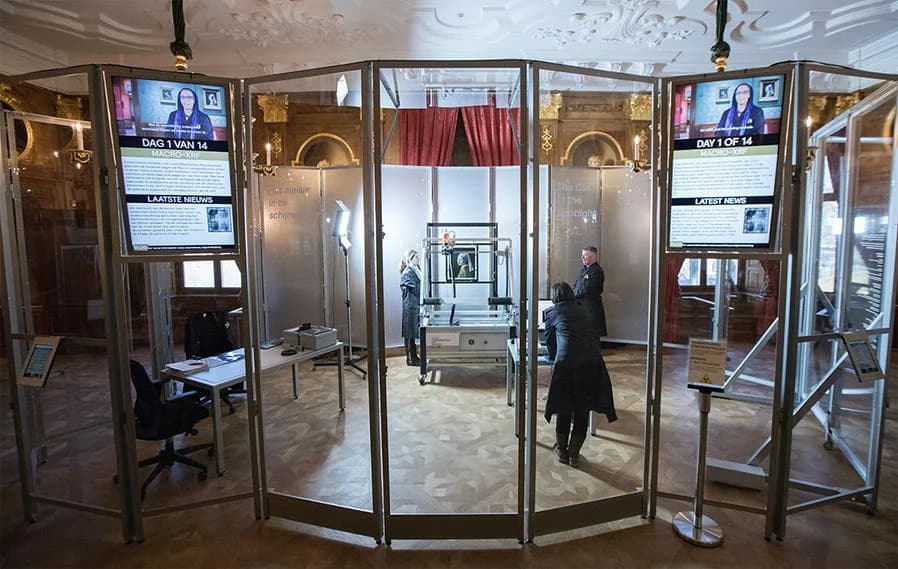
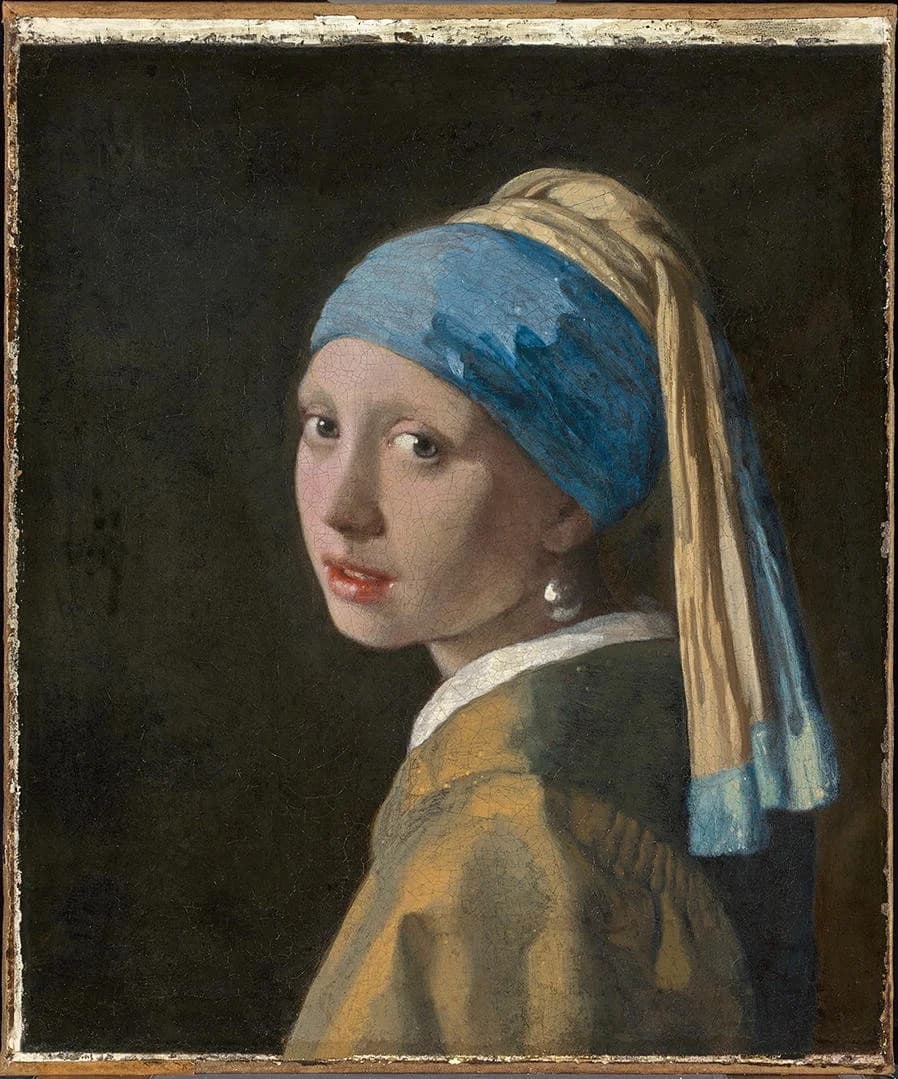
For two weeks in late February and early March 2018, the most famous face in the Mauritshuis was not on the wall. Girl with a Pearl Earring had been lifted into an enclosure in the museum’s Golden Room, where visitors could stand and watch an international team examine her with cameras, scanners and microscopes. They called the project The Girl in the Spotlight, and it was led by the Mauritshuis conservator Abbie Vandivere.
The painting had last been cleaned in 1994, in the treatment known as “Vermeer Illuminated”. The 2018 study was an imaging campaign whose methods were chosen so that none of them touched the paint, read alongside a fresh analysis of paint samples taken in earlier decades and four tiny new ones. What they read turned out to be a quietly different picture from the one the world thinks it knows.
Non-invasive imaging
The point of the project was that you no longer have to cut into a painting to study it. The team brought a stack of non-invasive instruments to bear on a single small canvas: infrared cameras to see under the surface, hyperspectral imaging to map colour, optical coherence tomography to read the painting in cross-section like a medical scan, 3D digital microscopy, and macro X-ray fluorescence scanning to chart which chemical elements, and so which pigments, sit where. A handful of questions about the layer structure could still only be answered by lifting and studying real samples, which is why a few were taken at the end.
No single museum owns all of that. The work was run through NICAS, the Netherlands Institute for Conservation, Art and Science, pulling in specialists from the Rijksmuseum, Delft University of Technology, the Dutch Cultural Heritage Agency and several universities, with help from partners as far afield as the National Gallery of Art in Washington.
A green curtain behind the figure
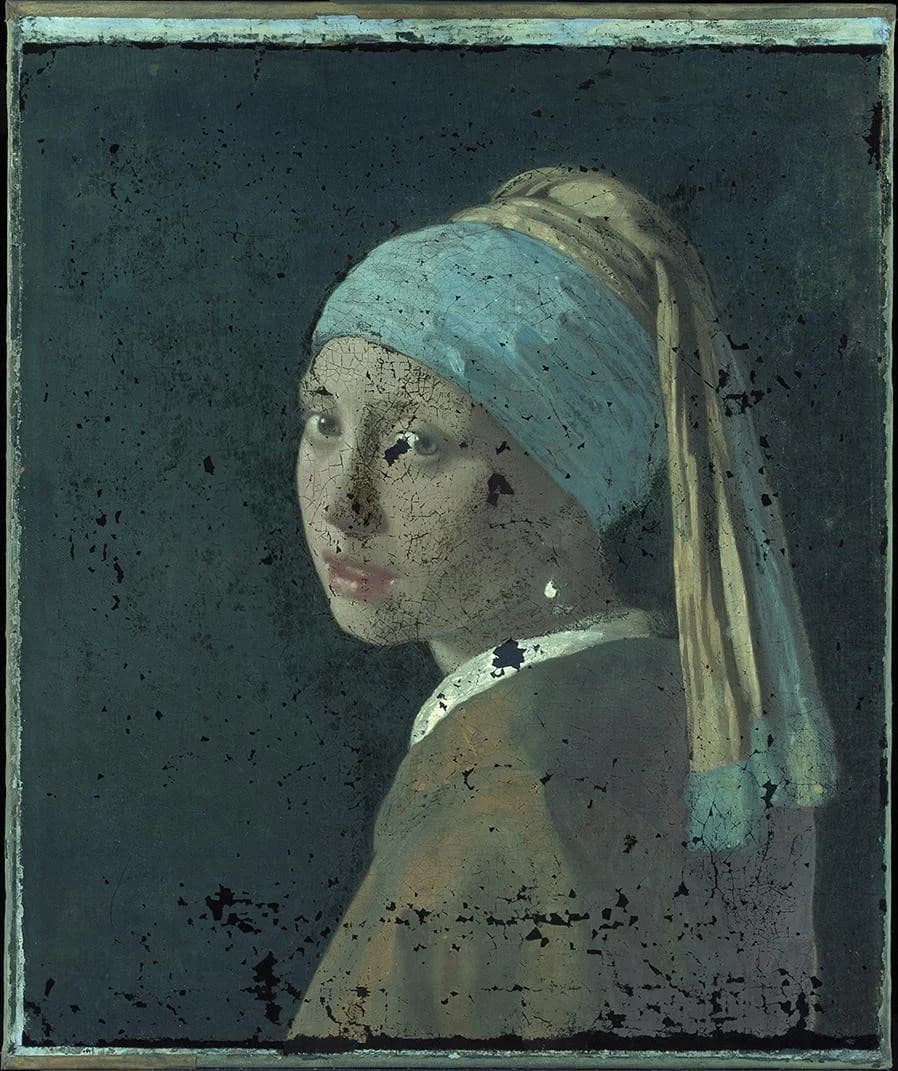
One of the most surprising findings was behind her. The background that everyone reads as a flat, empty darkness was not painted that way. In the upper right corner the imaging picked out faint diagonal lines and colour variations down the right side, the soft geometry of hanging cloth. Vermeer seems to have set the Girl in front of a green curtain.
It reads as dark now for a chemical reason. The background is a translucent green glaze, mixed from blue indigo and a yellow plant dyestuff called weld, laid over a black underlayer. Those organic colourants fade with light over the centuries, and as the green collapsed the folds went with it, leaving the curtain to read as a void. What feels like Vermeer’s bold choice of near-black was, in part, the work of time.
Eyelashes and the modelling of the face
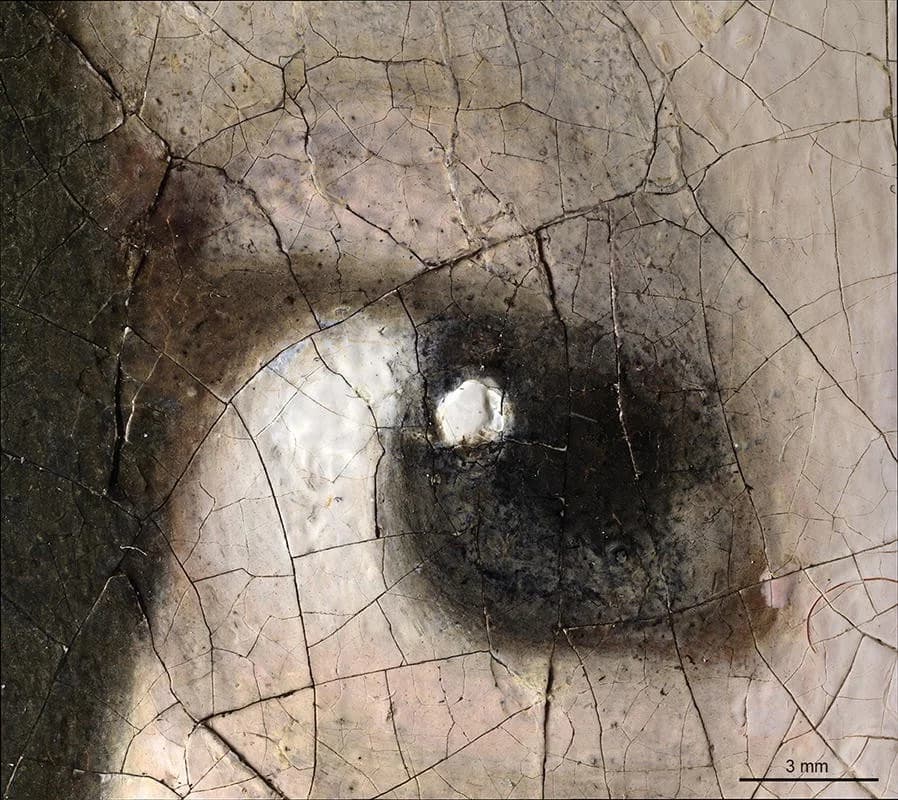
Look at the Girl and she seems to have no eyelashes at all, part of the smooth, almost photographic stillness of her face. She does have them. The examination visualised, for the first time, the fine lashes Vermeer had painted around her eyes, too faint to register from across a room.
It is a small thing that says something larger. Vermeer was not simplifying the face into an icon; he kept its transitions free of sharp lines on purpose, even leaving brush hairs caught in the wet paint where light passes into shadow. What reads as a deliberate blur is partly his hand and partly four centuries of ageing paint.
The pearl earring
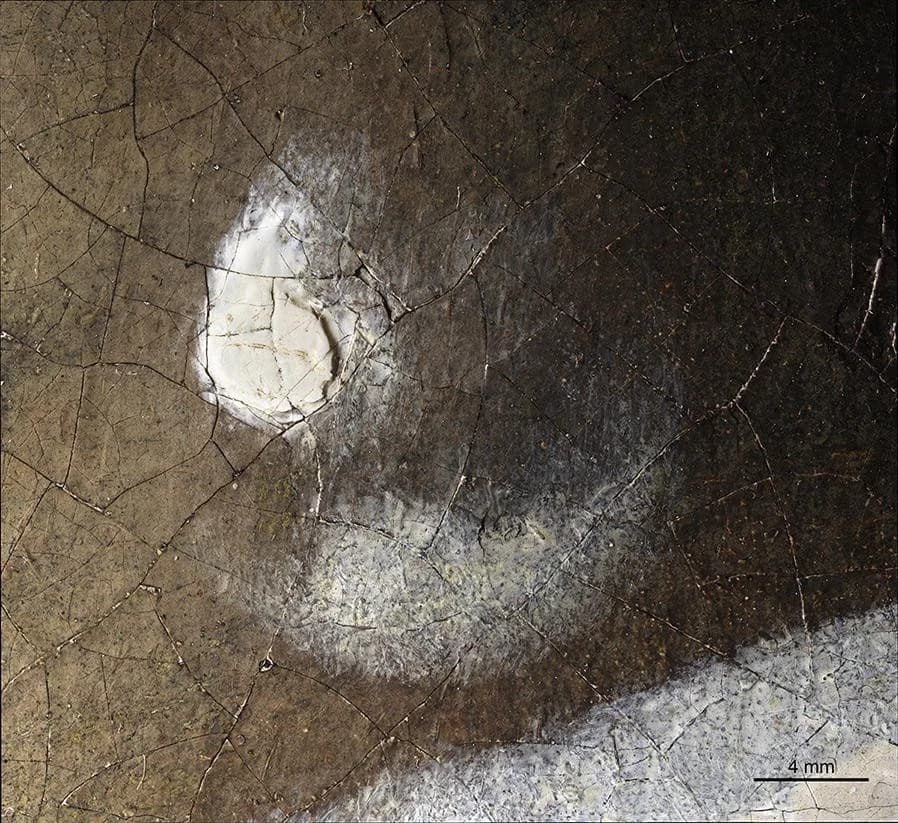
Then there is the pearl itself, the thing the painting is named for. Up close it dissolves. It is not a carefully modelled sphere but a couple of touches of paint sitting on the surface: a soft scumble near the bottom that catches the counter-reflection of her white collar, and above it a teardrop-shaped highlight laid on in thick impasto.
That is all. There is no drawn rim, no setting, nothing that fixes it as an object hanging from her ear. As a physical thing the most famous pearl in art is barely present, just two strokes of paint that the eye assembles into something round and lustrous.
Pigments and their origins
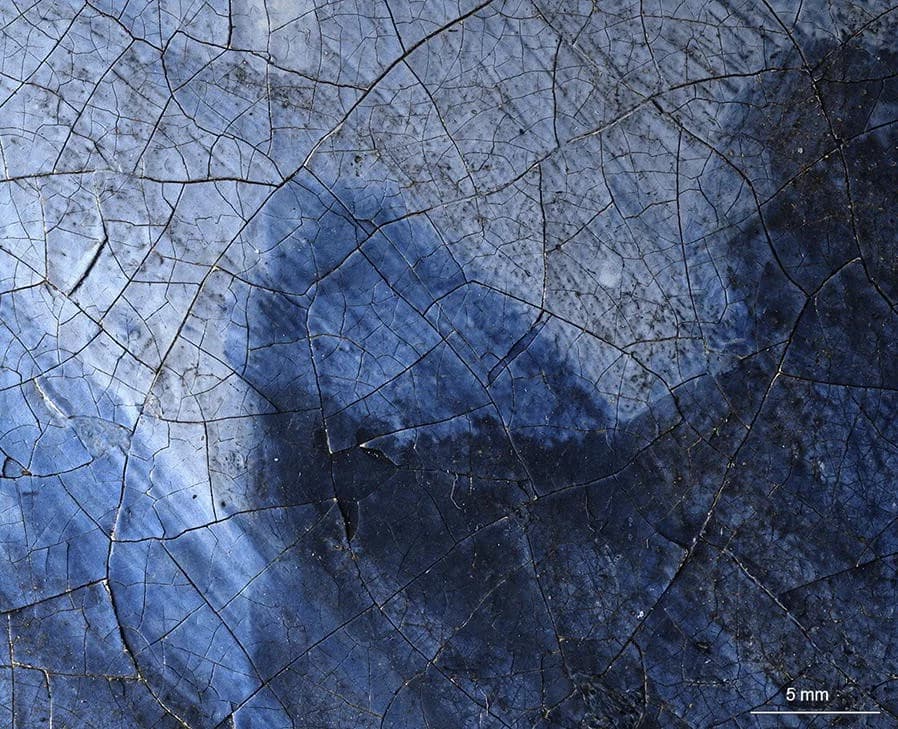
Mapping the pigments turned the small canvas into a kind of trade map. The blue of the turban is natural ultramarine, ground from lapis lazuli from what is now Afghanistan and the most expensive colour on Vermeer’s palette. The warm yellow is lead-tin yellow, found for the first time in the border of the headscarf. The lips and the flush of the skin draw on vermilion and a red lake made from American cochineal, an insect dyestuff of the New World, and the whites are lead white whose ore, lead isotope analysis showed, came from England. Some materials were closer to hand: the weld in the curtain grew in the Netherlands, and the vermilion was almost certainly made there too.
How the painting has changed
When the results were published, in a special issue of scientific papers across 2019 and 2020, the headline was not a hidden figure or a dramatic reveal. It was subtler, and in a way more interesting: the painting we love is partly the painting time has made. The dark void was a green curtain. The lashless gaze had lashes. The solid pearl is two dabs of paint and a trick of the eye. None of it was repainted; the examination changed nothing on the canvas and a good deal about how we read it.
Everyone can continue to look at Girl with a Pearl Earring with sheer enjoyment, and sense the intimacy Vermeer created between her and the beholder
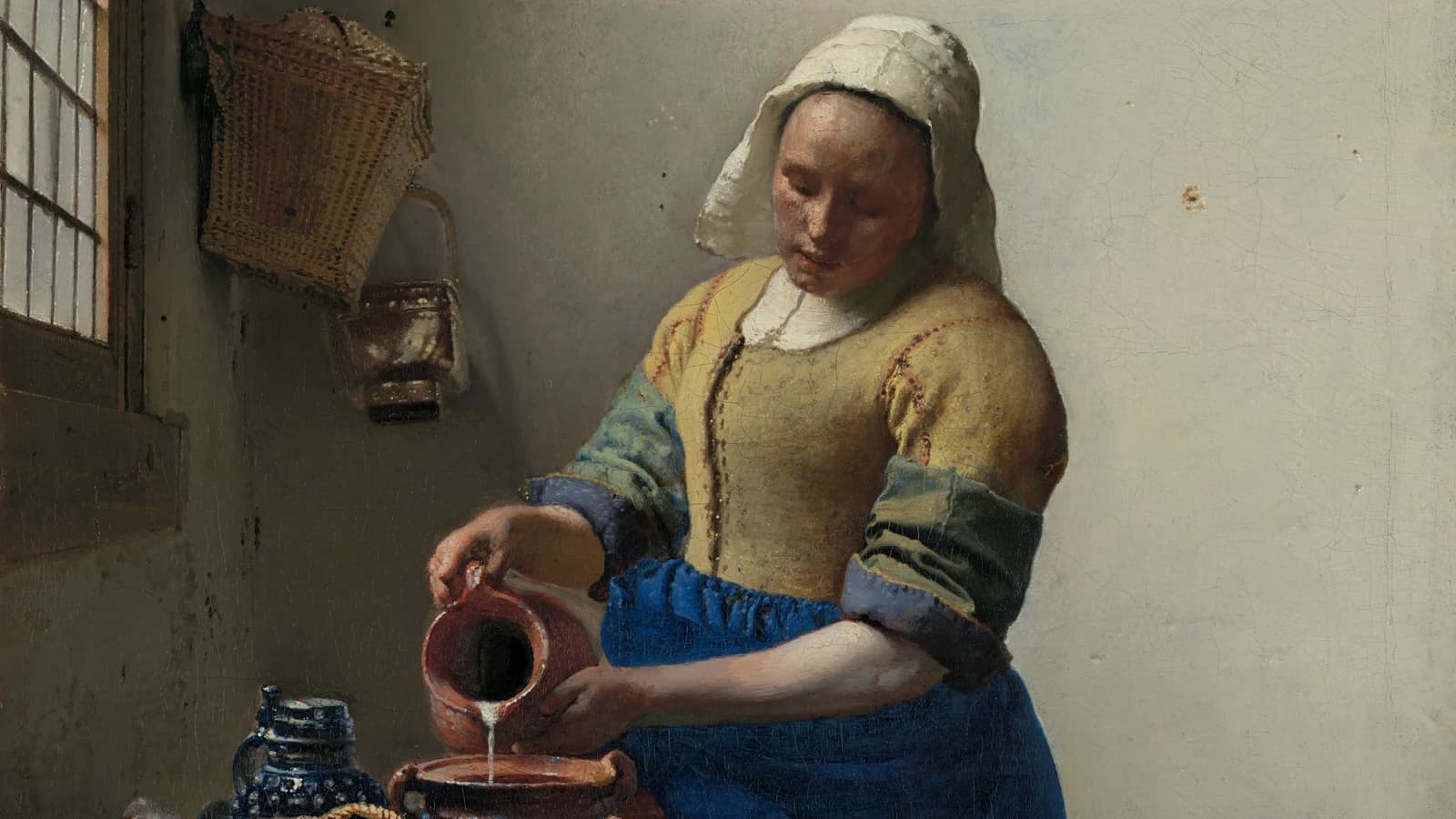
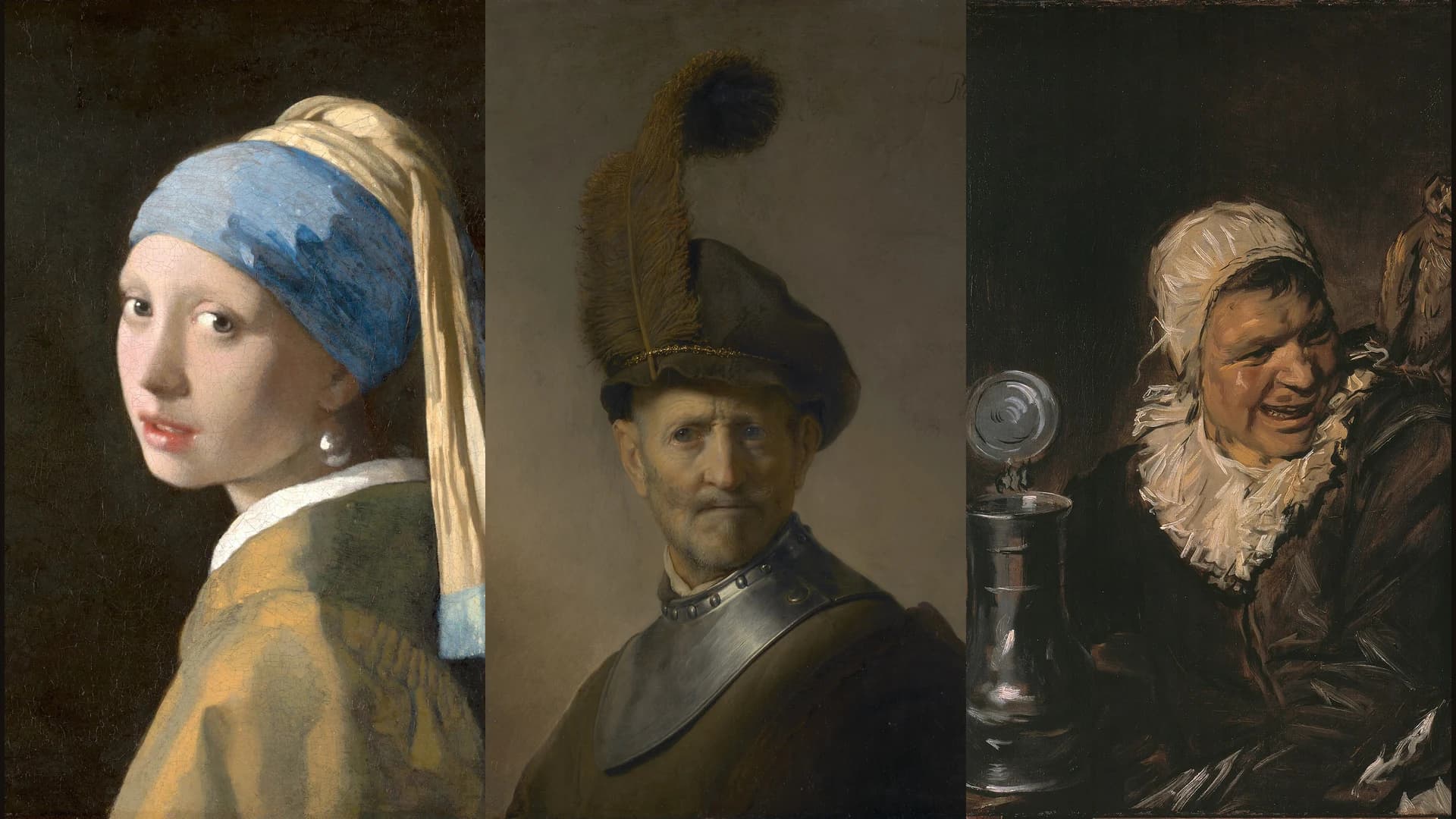
The Girl was later shown in the 2021 Mauritshuis exhibition Facelifts & Makeovers, which put the museum’s conservation studio, and questions exactly like these, in front of the public. The curtain she lost joins a growing list of things imaging has recovered from Vermeer; when the Rijksmuseum scanned The Milkmaid it found objects he had painted out. And the face the cameras studied so closely belongs, in the end, to nobody in particular: the Girl is a tronie, a study of a head rather than a portrait of a named sitter.
Notes
- 1.The technical examination ran in late February and early March 2018, around the clock for two weeks, inside an enclosure in the Golden Room of the Mauritshuis where the public could watch. It was led by Mauritshuis paintings conservator Abbie Vandivere. See Abbie Vandivere, Jørgen Wadum, Klaas Jan van den Berg and Annelies van Loon, “From ‘Vermeer Illuminated’ to ‘The Girl in the Spotlight’,” Heritage Science 7, 66 (2019).
- 2.The imaging methods were chosen so that none of them made contact with the paint. They were combined with a re-analysis of micro-samples taken by Hermann Kühn in 1968 and during the 1994 restoration, plus four small new samples lifted from under-studied areas afterwards. The 2018 project was not a cleaning; the last cleaning was the 1994 “Vermeer Illuminated” treatment. See Vandivere et al., Heritage Science 7, 66 (2019) and Abbie Vandivere, Jørgen Wadum and Emilien Leonhardt, “The Girl in the Spotlight: Vermeer at work,” Heritage Science 8, 20 (2020).
- 3.The non-invasive toolkit included high-resolution technical photography, X-radiography, multispectral infrared reflectography, reflectance and fluorescence imaging spectroscopy (hyperspectral imaging), fibre-optic reflectance spectroscopy, multi-scale optical coherence tomography, 3D scanning, high-resolution 3D digital microscopy, macro X-ray fluorescence (MA-XRF) and macro X-ray powder diffraction. The full list is in Table 1 of Vandivere et al., Heritage Science 7, 66 (2019).
- 4.The work was carried out within the Netherlands Institute for Conservation, Art and Science (NICAS), with the Rijksmuseum, Delft University of Technology, the Cultural Heritage Agency of the Netherlands and the University of Amsterdam, plus the University of Antwerp, the Vrije Universiteit Amsterdam, Shell, Hirox and the National Gallery of Art, Washington. See the acknowledgements in Vandivere et al., Heritage Science 8, 20 (2020).
- 5.In the upper right corner the imaging found diagonal painted lines and colour variations on the right side of the painting, suggesting the backdrop was originally a green curtain. The background is a green glaze of indigo and weld, a yellow plant dyestuff, over a black underlayer; the organic colourants have faded, masking the folds. See Vandivere et al., Heritage Science 8, 20 (2020) and Abbie Vandivere et al., “Revealing the painterly technique … the dark space surrounding Vermeer’s Girl with a Pearl Earring,” Heritage Science 7, 89 (2019).
- 6.The Girl’s eyelashes were visualised for the first time as part of this study, and brush hairs were found embedded in the soft transitions of her skin, which Vermeer worked to keep free of sharp lines. See Vandivere et al., Heritage Science 8, 20 (2020) and Annelies van Loon et al., “Beauty is skin deep: the skin tones of Vermeer’s Girl with a Pearl Earring,” Heritage Science 7, 102 (2019).
- 7.The earring sits on the surface of the paint: a scumble creates the soft counter-reflection from her white collar, and a teardrop-shaped highlight was applied in thick impasto. See Vandivere et al., Heritage Science 8, 20 (2020).
- 8.Lead isotope analysis traced the lead white to ore from England; the ultramarine was ground from lapis lazuli from what is now Afghanistan; American cochineal was identified in her clothing and vermilion in her skin (the vermilion almost certainly made in the Netherlands); lead-tin yellow was found in the headscarf border for the first time. See Vandivere et al., Heritage Science 8, 20 (2020), John Delaney et al., “Mapping the pigment distribution of Vermeer’s Girl with a Pearl Earring,” Heritage Science 8 (2020) and Annelies van Loon et al., “Out of the blue: Vermeer’s use of ultramarine,” Heritage Science (2020).
- 9.The findings appeared across a special issue of Heritage Science in 2019 and 2020, with a concluding paper drawing them together. See Vandivere, Wadum and Leonhardt, Heritage Science 8, 20 (2020).