Tronies: Faces of No One
The most famous face in Dutch art belongs to nobody. Girl with a Pearl Earring is a tronie, a study of a head invented rather than copied from a paying sitter, and Vermeer was one of many painters who made them.
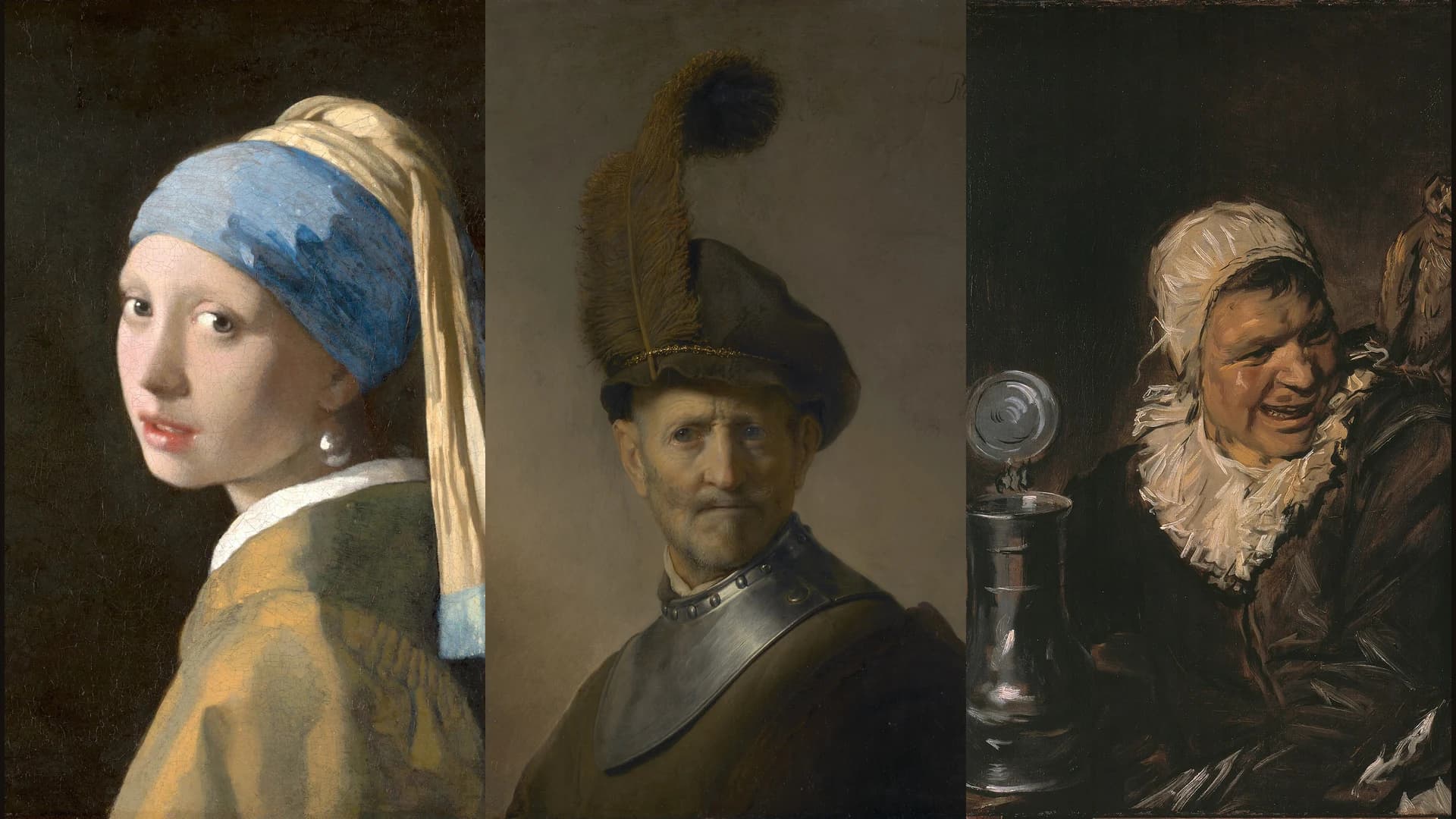
A face, not a person
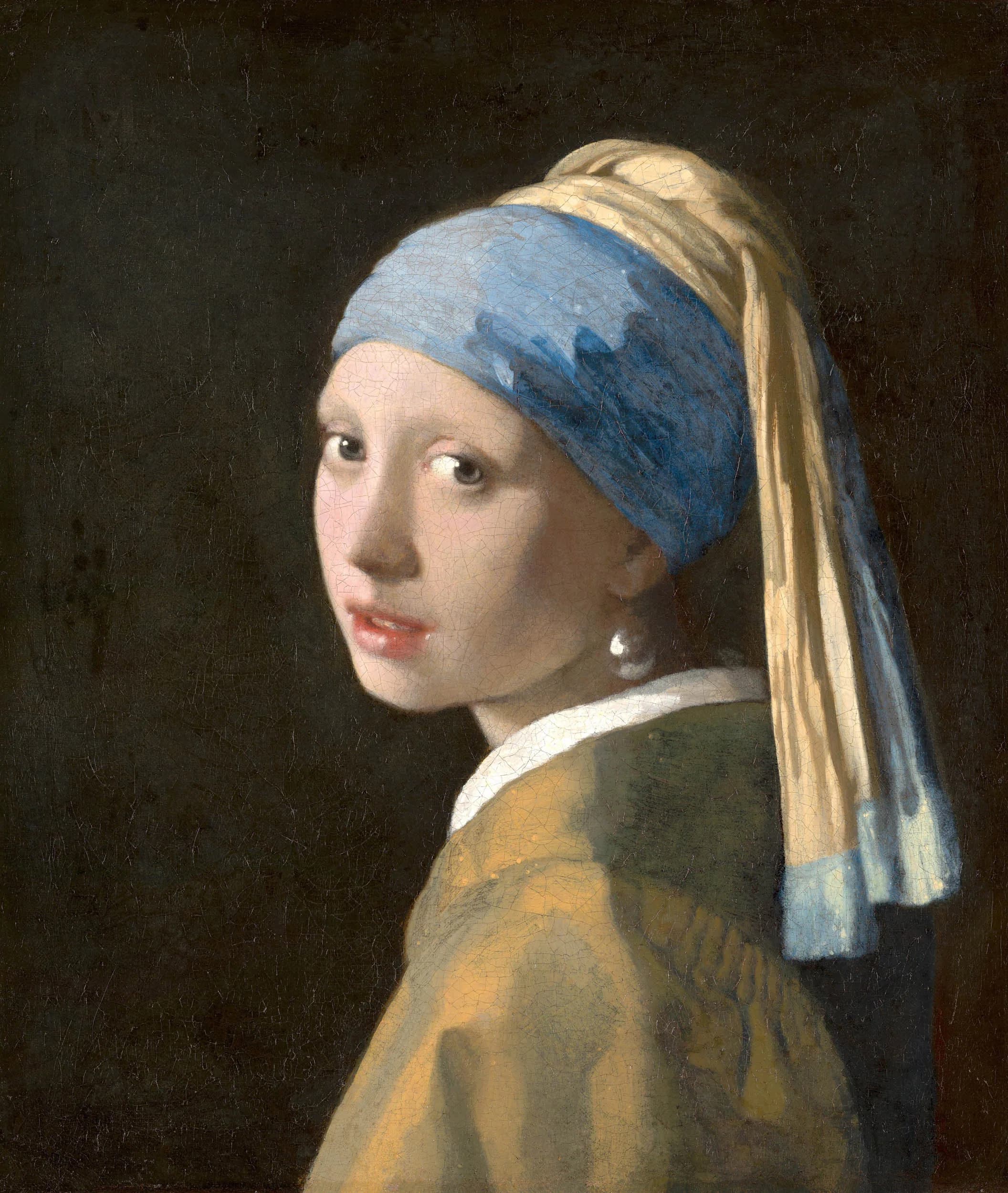
Almost everyone knows the painting. A girl turns her head over her shoulder out of a plain dark background, lips parted as if to speak, a single large pearl glowing at her ear. We call her Girl with a Pearl Earring, and she has been treated as one of the great portraits in European art, a real young woman whose name we have simply lost.
She is not a portrait at all. Johannes Vermeer, working in the Dutch city of Delft in about 1665, never set out to record a particular person. The painting has no name attached to it because it never had one, and the museum that owns it is careful to say so: there are no moles, no scars, no freckles, none of the small individual marks a portrait would carry. It is a study of a head, an invented face. In the language of the time it was a tronie.
What a tronie was
The word looks strange to us now, but it was everyday Dutch. A tronie meant a head, a face, an expression. It came from an old French word, trogne, closer to “mug” than to anything grand, and it named a whole category of picture that hung in seventeenth-century Dutch homes alongside landscapes and still lifes.
A tronie sits between two things we understand more easily. It is not a portrait, because it is not a likeness of a named sitter who commissioned it and took it home. And it is not a history painting, one of those crowded scenes from the Bible or the ancient world. Instead it is a single head, studied for its own sake: an old man, a laughing child, a soldier, a young woman in a turban. What the painter is really showing off is skill, the way light falls across a cheek, a wrinkle, a wisp of fur, a glint of metal, a strange and costly hat.
Because no one ordered them, tronies were painted to be sold on the open market, kept around the studio as showpieces, or used as ready models when the painter needed a face for a larger work. They were cheap, far cheaper than a proper portrait, which is part of why so many people owned one. The type took shape in the 1620s, above all in Leiden, where a young Rembrandt shared a workshop with Jan Lievens, and in Haarlem around Frans Hals. Those painters turned the old practice of sketching heads into pictures worth selling in their own right.
The faces other painters made
To see what Vermeer was joining, it helps to look at the tronies his contemporaries were turning out, often with far more noise and bustle than anything he ever painted. The most ambitious of them belonged to Rembrandt.
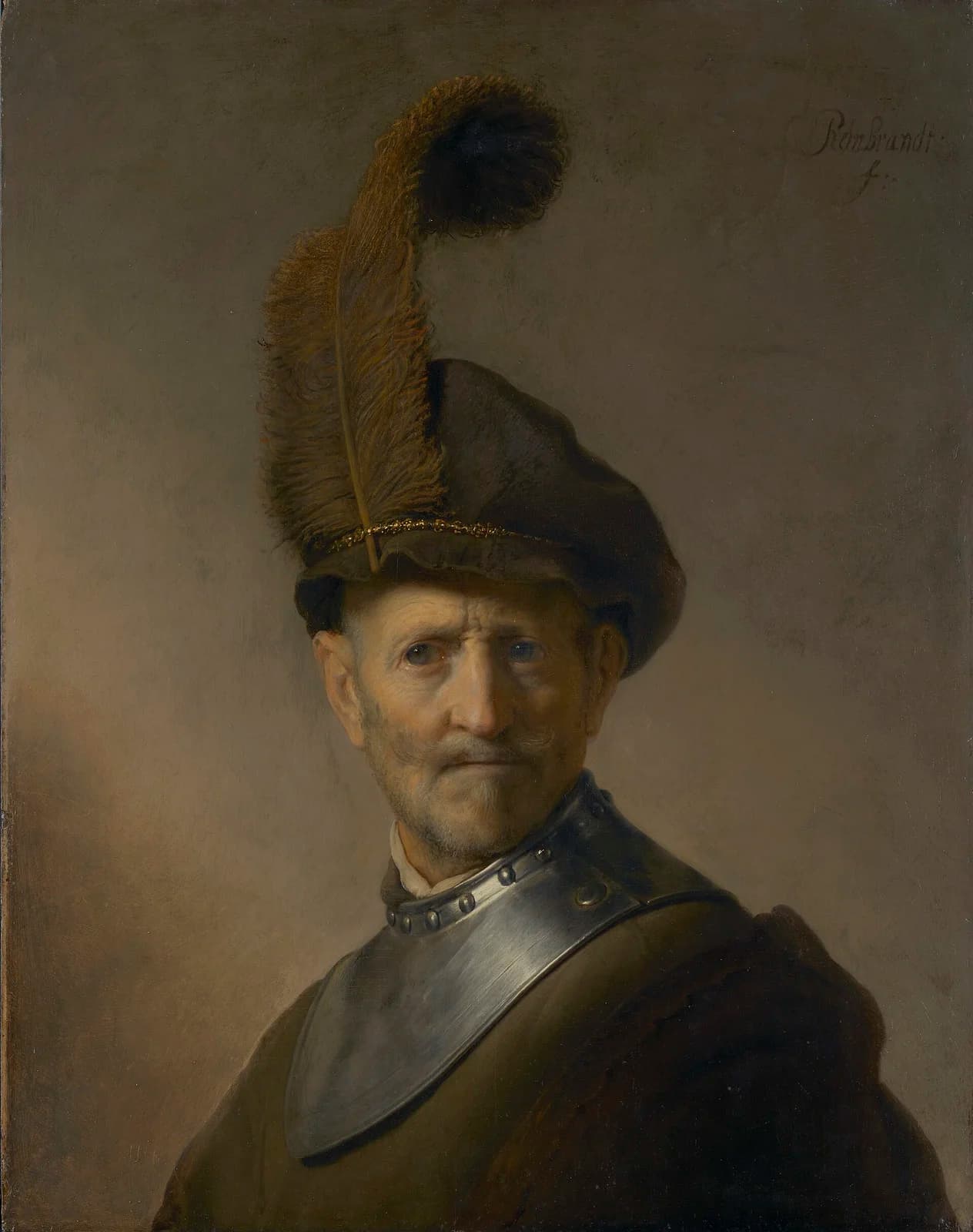
In his early twenties in Leiden, Rembrandt painted heads by the dozen. An old man poses in a steel gorget and a beret topped with a curling feather, costume props the model never owned and the painter kept in a chest. The face is nobody in particular, and that is the point: it is an excuse to render age, the loose skin, the tired eyes, the dull shine of armour.
Look beneath the surface and the studio shows through. An X-ray of this very panel reveals another head underneath, painted out and painted over. A tronie was working material as much as a finished object, something a painter could reuse, recycle and sell.
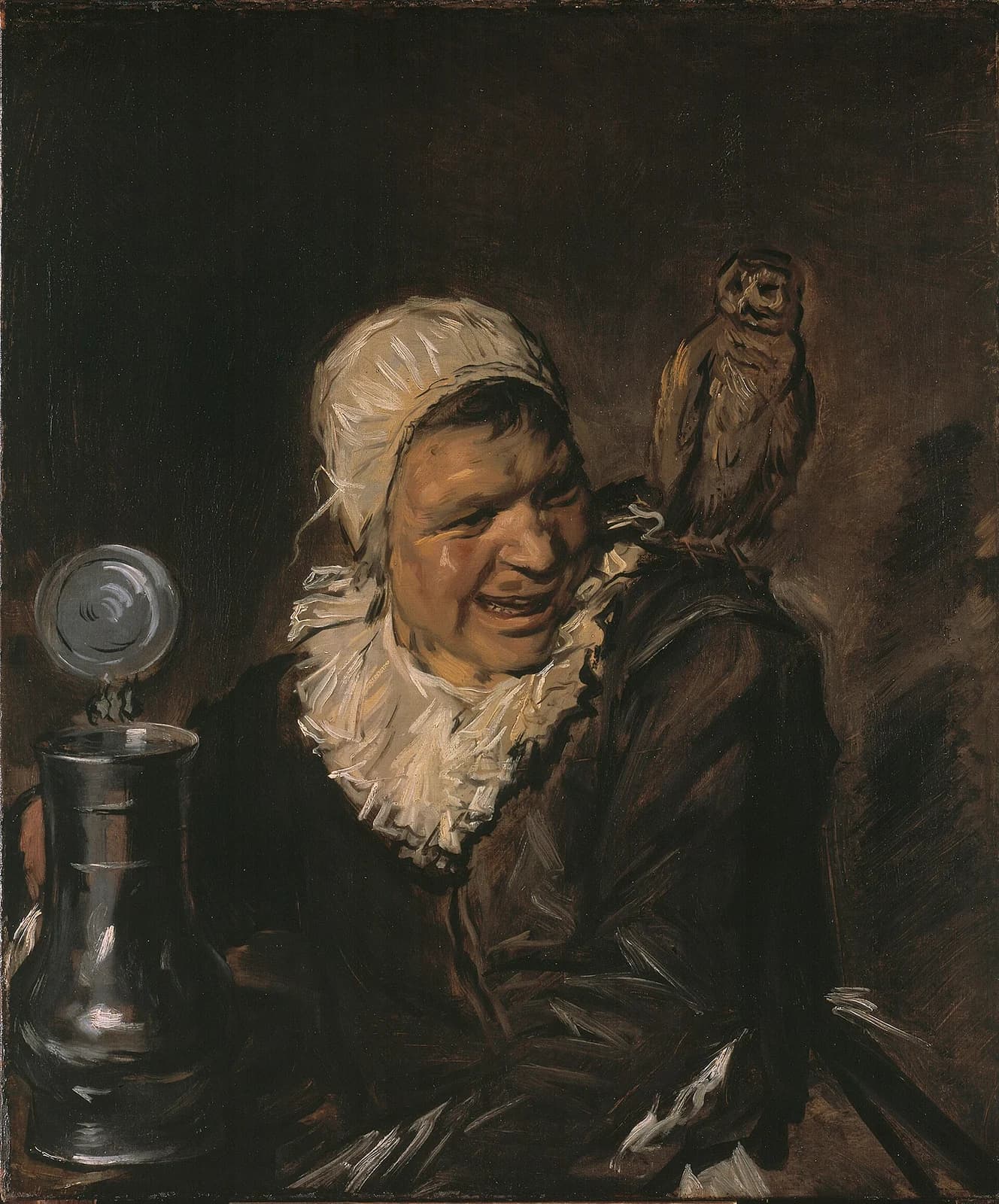
In Haarlem, Frans Hals made tronies that grin and shout. His Malle Babbe, “mad Babbe,” is an old woman caught mid-cackle, a pewter tankard in front of her and an owl perched on her shoulder. She may well have been a real person from the town, but Hals paints her the way he paints all his heads, as a type, a burst of character rather than a careful likeness. He did the same with children: his little round panel of a Laughing Boy is pure high spirits and almost nothing else.
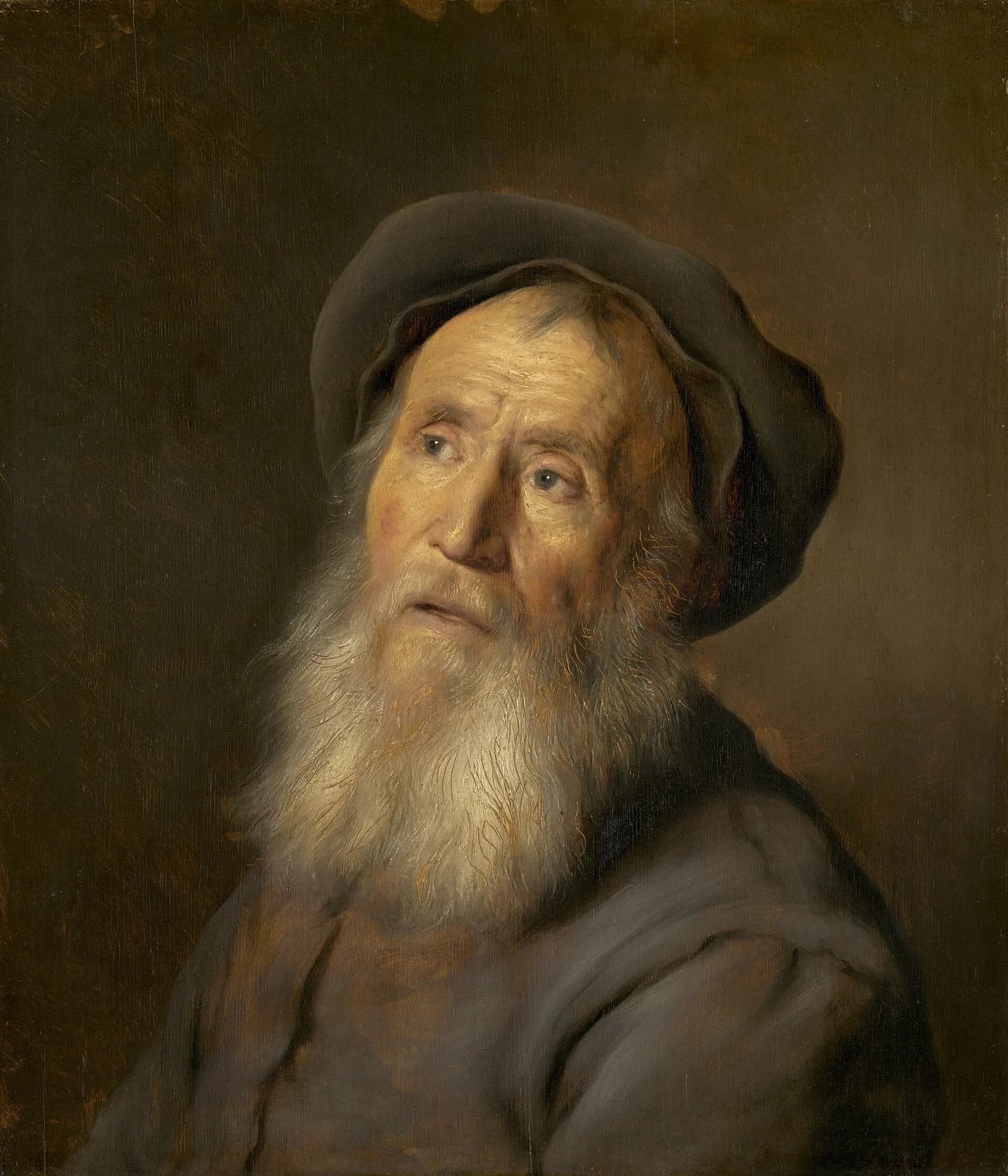
Rembrandt’s studio partner Jan Lievens was just as devoted to the form. His Bearded Man with a Beret is exactly the kind of head the genre loved: an old man, no name given, his white beard and thin skin built up in glazes and quick flecks of thick paint. The beret hints that he might be a scholar, or a painter, but the hint is all we get.
Heads like these were everywhere in the Dutch Republic. They taught a young painter his craft, they sold for modest sums, and they let buyers hang a vivid human face on the wall without paying portrait prices.
Vermeer's quiet version
Vermeer came to the tronie a generation later, and he stripped away the noise. Where Hals shouts and Rembrandt piles on the costume, Vermeer gives us stillness, a single face emerging from the dark. But the ingredients are the same, exotic dress and all.
That pearl-wearing girl wears a turban, wound in blue and yellow. No young woman in Delft dressed like that to go about her day. It is a costume, a touch of the exotic, and it is one of the surest signs that we are looking at a tronie and not a portrait.
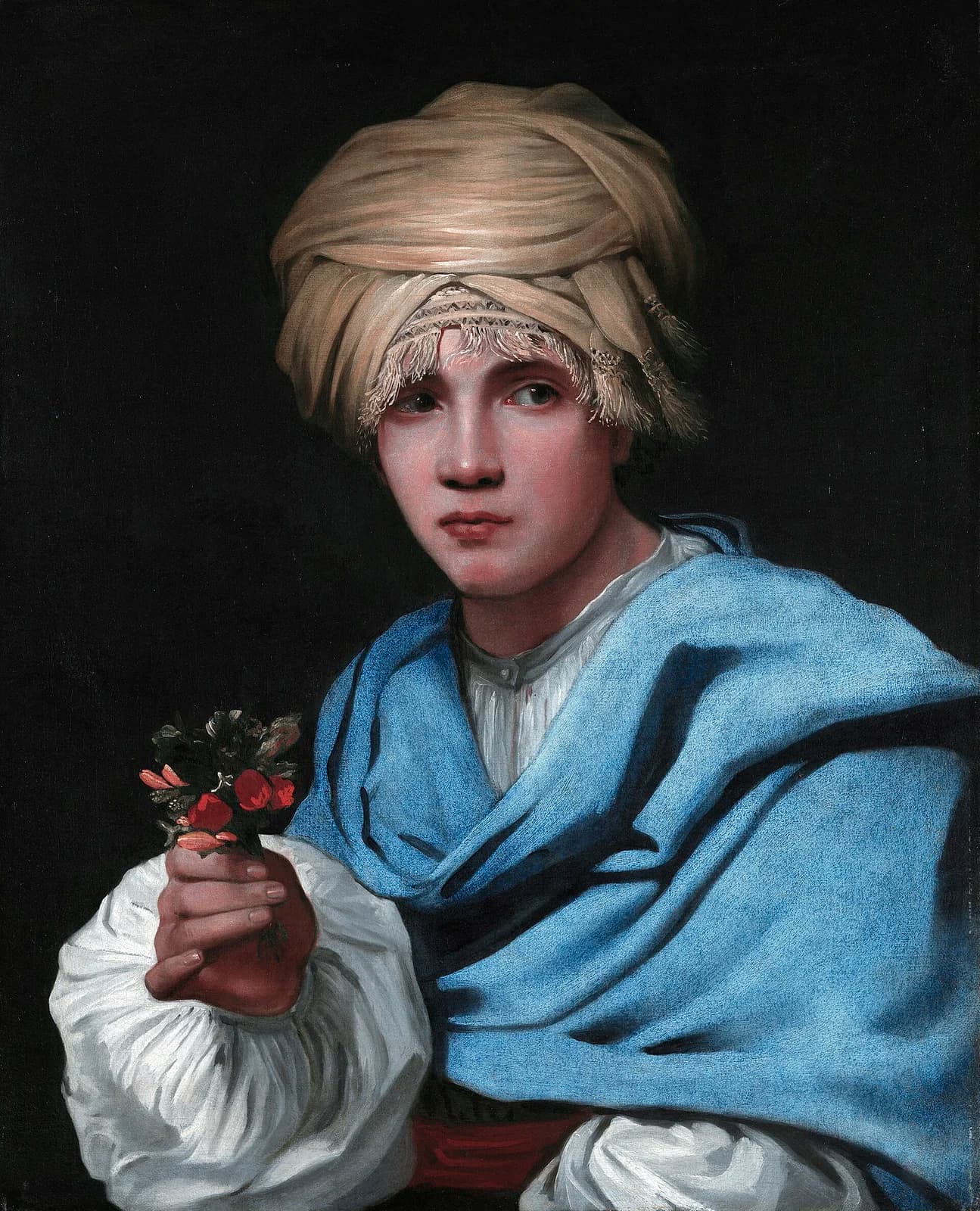
Vermeer seems to have borrowed the idea rather than invented it. Painters such as the Fleming Michael Sweerts were making tronies of young figures in turbans, set against plain dark grounds, in the years before Vermeer painted his. Put Sweerts’ boy beside Vermeer’s girl and the family resemblance is hard to miss.
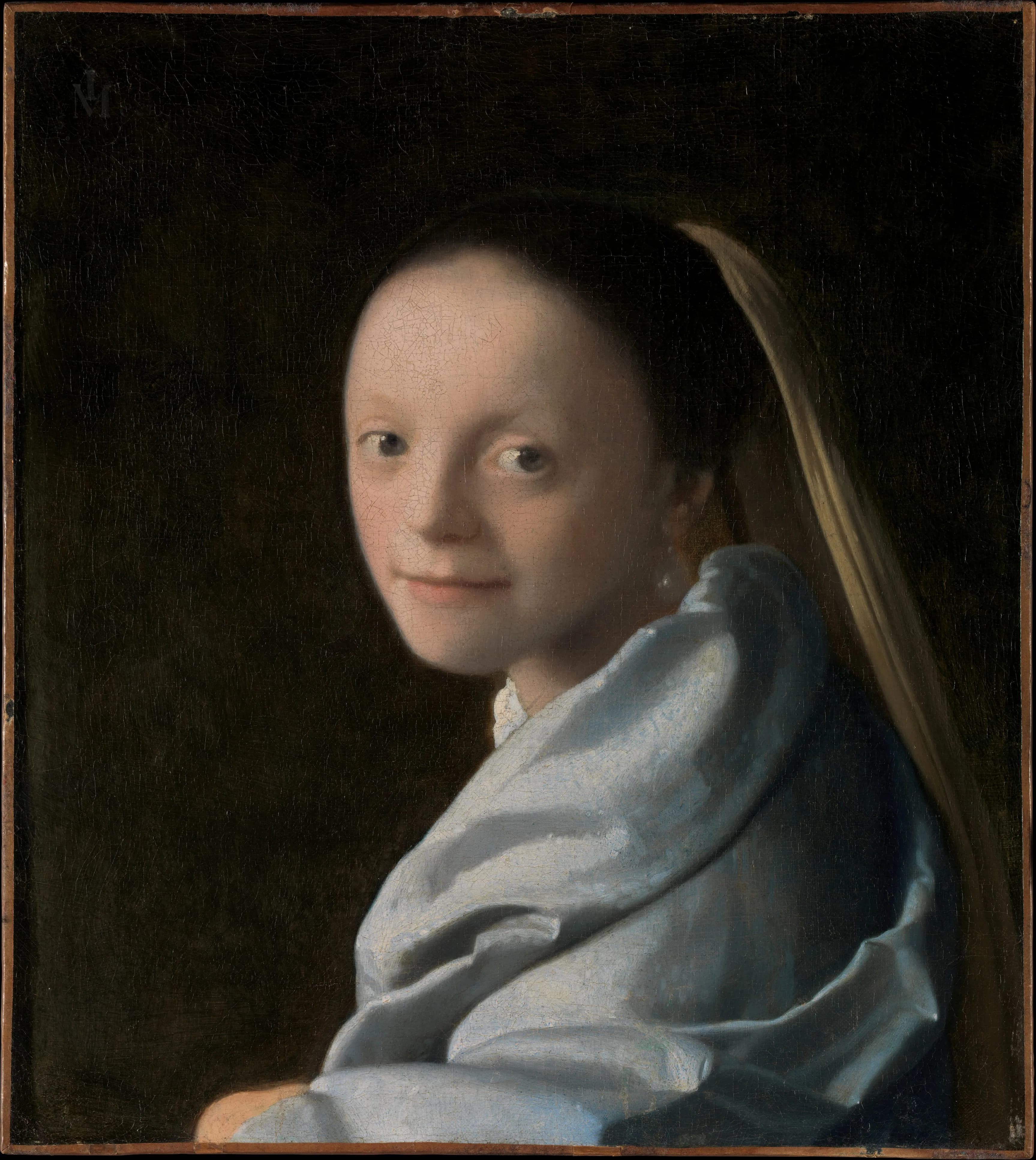
The pearl girl was not his only one. Vermeer painted at least a small group of these heads. The Study of a Young Woman in New York is plainer and more pensive, again wearing a pearl, again a made face rather than a named one. The museum that owns it calls it, plainly, a tronie.
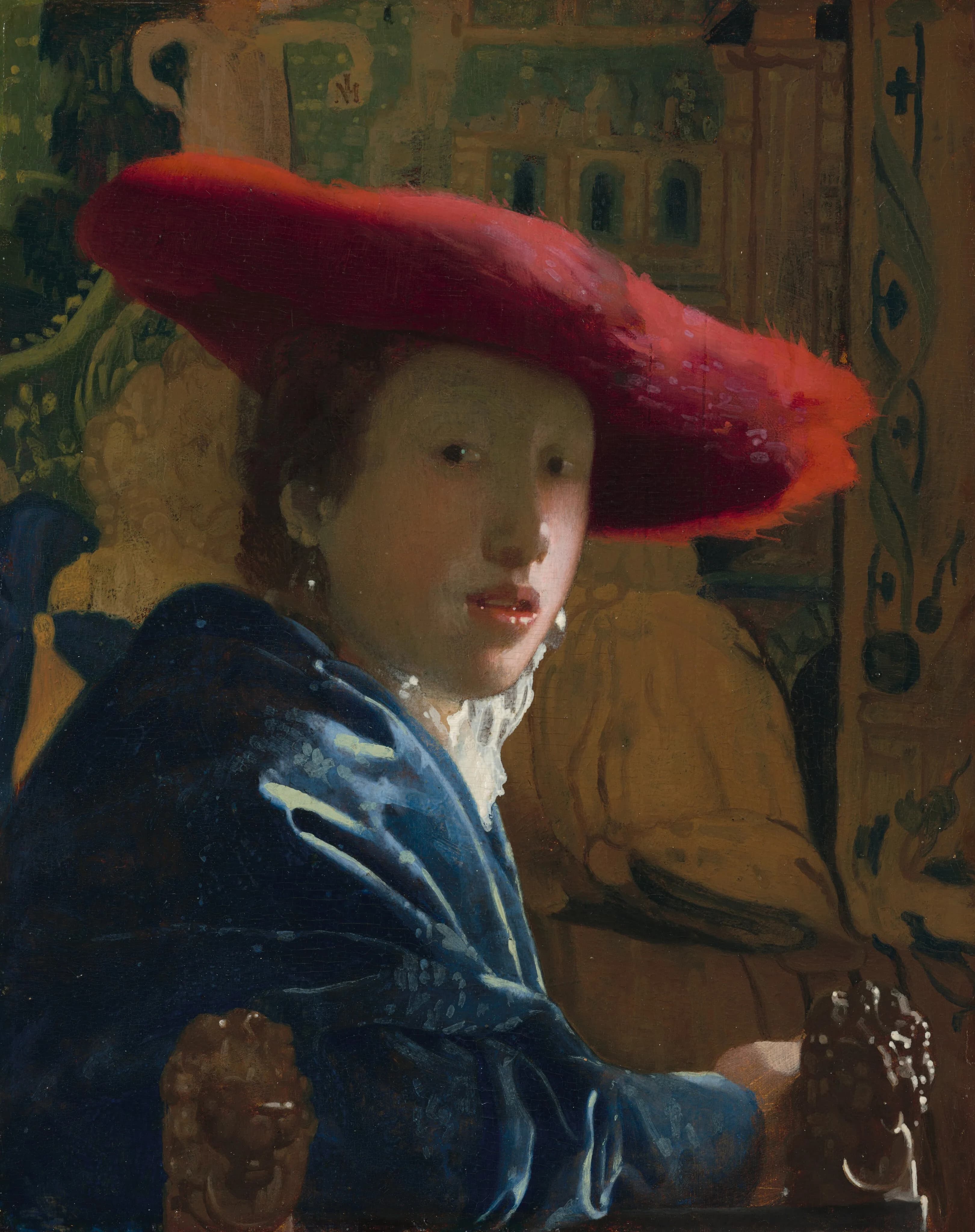
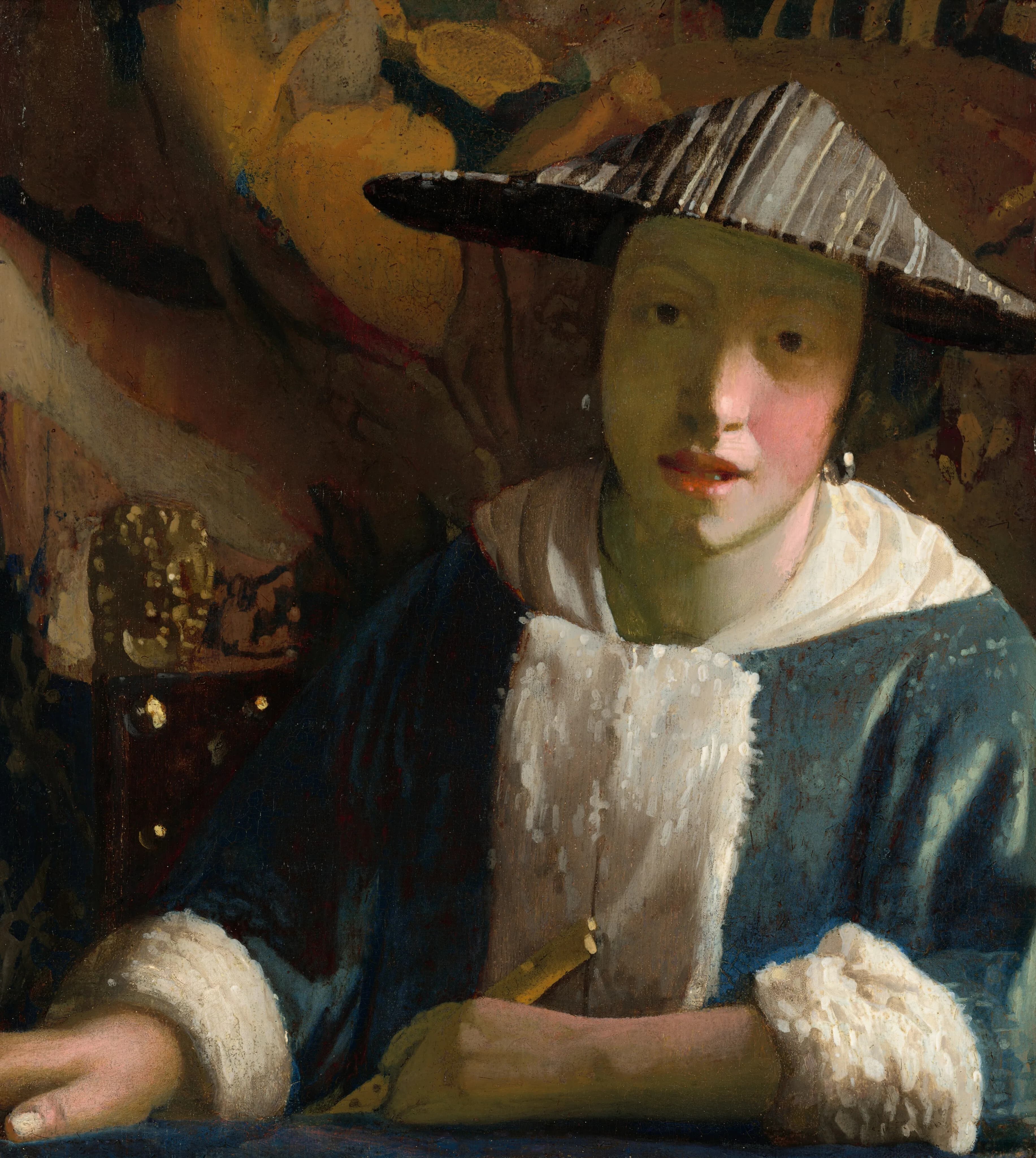
Two more are oddities: small pictures painted on wooden panel instead of Vermeer’s usual canvas, both barely the size of a sheet of paper. The bright, freely brushed Girl with a Red Hat and the much-argued-over Girl with a Flute show young women under outsized, fanciful hats, gazing straight out at us. Both are tronies in the fullest sense, and the Flute is now thought by its museum to be the work of someone close to Vermeer rather than the master’s own hand.
Recorded as a tronie, even then
We are not guessing about any of this. Vermeer’s contemporaries used the word too. The very first time a Vermeer painting appears in the written record, in 1664, it is described as a tronie: a sculptor in The Hague named Jean Larson owned “een tronie van Vermeer,” a head by Vermeer, valued at ten guilders. That painting has never been found.
And when a large group of Vermeers came up for auction in Amsterdam in 1696, the catalogue singled out three of them as tronies. The first was listed as “a tronie in antique dress, uncommonly artful,” the antique dress being exactly the kind of fanciful, out-of-time costume we have been tracing. The clerks writing that catalogue did not see portraits. They saw faces of no one, well made.
Why it matters that she is nobody
It can feel like a letdown to learn that the girl with the pearl is not a real person we might one day identify. It should feel like the opposite. Because no one commissioned her, Vermeer owed nobody a likeness. He could light her exactly as he wished, dress her in a turban no one really wore, leave the background bare, and chase only the thing he cared about, the way a face turns toward the light.
That freedom is what the tronie offered every painter who made one, from Rembrandt’s old soldiers to Hals’s cackling Babbe. Vermeer used it more quietly than any of them, and ended up with the most famous face of all, a face that has the strange power of belonging to no one and therefore, a little, to everyone who looks.
Notes
- 1.The Mauritshuis describes the painting as a tronie, “the Dutch 17th-century description of a ‘head’ that was not meant to be a portrait,” and notes that it shows too few distinctive features, no moles, scars or freckles, to be a likeness of a particular person. See Mauritshuis, “Girl with a Pearl Earring”.
- 2.The word derives from the Middle French trogne, meaning “mug” or “snout,” and in seventeenth-century Dutch meant simply a head, face or facial expression. On the term and the genre, see Wikipedia, “Tronie”.
- 3.Tronies were made for the open market rather than to commission, kept as studio showpieces, and used to demonstrate skill at rendering flesh, expression and exotic costume. They sold cheaply: prices were lower than for other kinds of painting, putting them within reach of a wide public. See Wikipedia, “Tronie”.
- 4.The independent tronie emerged in the Dutch Republic in the 1620s, above all in Leiden, where Jan Lievens and the young Rembrandt shared a studio from about 1626 to 1631, and in Haarlem around Frans Hals. It built on sixteenth-century study heads and on the tradition of expressive and grotesque heads reaching back to Leonardo. See Wikipedia, “Tronie”.
- 5.A Vermeer tronie was valued at ten guilders in the 1664 Larson inventory, and the three tronies in the 1696 Dissius sale fetched between seventeen and thirty-six guilders each, at a time when an unskilled labourer might earn a few hundred guilders a year. See Essential Vermeer, “The Dissius Auction” and Essential Vermeer, “Study of a Young Woman”.
- 6.An Old Man in Military Costume (c. 1630–1631, J. Paul Getty Museum, Los Angeles) is generally regarded as one of Rembrandt’s many tronies. An X-ray shows it was painted over an earlier study of an old man’s head, the kind of reuse common in studio work. See the Getty Museum record.
- 7.Malle Babbe (c. 1633–1635, Gemäldegalerie, Berlin) has long been read as a tronie, though it seems to depict a real woman of Haarlem recorded as “Malle Babbe.” See Wikipedia, “Malle Babbe”. The round Laughing Boy (c. 1625, Mauritshuis) is likewise classed as a tronie; see Wikipedia, “Laughing Boy”.
- 8.Bearded Man with a Beret (c. 1630, National Gallery of Art, Washington) is a tronie of an unidentified old man; the beret may mark him as a scholar or an artist. See the National Gallery of Art record.
- 9.The turban worn by Vermeer’s girl has no real parallel in Dutch dress of the time, and scholars have suggested he took it from art rather than life, in particular from Michael Sweerts’ tronies of young figures in turbans. On the turban as exotic costume and the Sweerts connection, see Wikipedia, “Girl with a Pearl Earring”.
- 10.Girl with a Red Hat and Girl with a Flute (both National Gallery of Art, Washington) are small tronies on panel rather than canvas. The National Gallery calls them “informal, anonymous head studies that offered artists a vehicle for exploring physiognomy, facial expressions, unusual costumes, and striking effects of light and shadow,” and now gives the Flute to an associate of Vermeer rather than to the master himself. See the National Gallery of Art record.
- 11.The Metropolitan Museum calls Study of a Young Woman “most likely not a commissioned portrait, but rather a so-called tronie, a portrayal of an intriguing individual, often in fanciful costume.” See the Metropolitan Museum of Art record.
- 12.The earliest dated reference to any Vermeer is to a tronie. An inventory of the sculptor Jean Larson’s goods, drawn up in The Hague on 4 August 1664, lists “een tronie van Vermeer,” a head by Vermeer, valued at ten guilders; the picture has never been traced. See our record of the lost work and Essential Vermeer, “Vermeer’s Clients and Patrons.”
- 13.The 1696 Dissius auction in Amsterdam listed three Vermeer tronies together, the first described as “a tronie in antique dress, uncommonly artful.” See Essential Vermeer, “The Dissius Collection.”