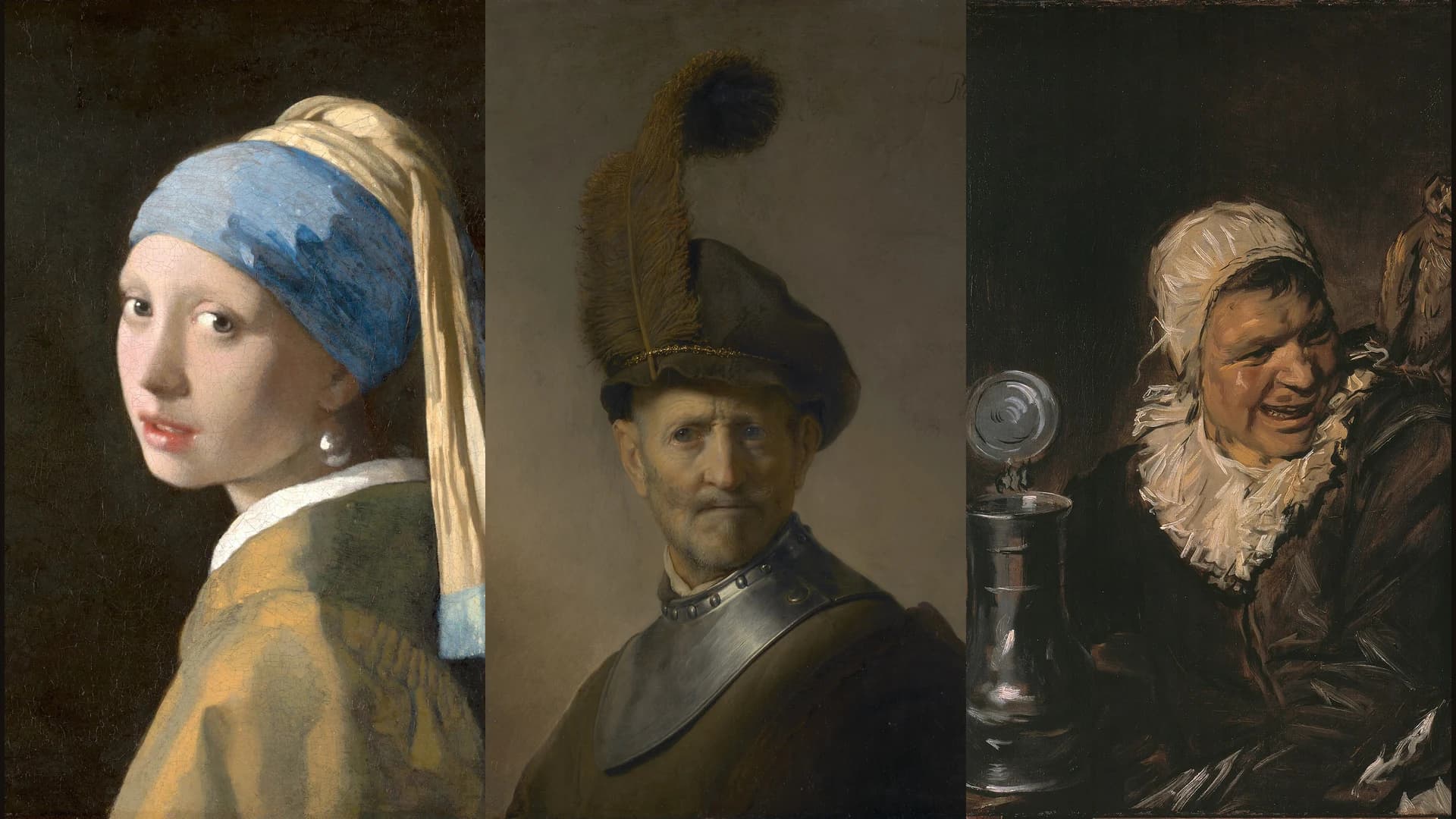
Study of a Young Woman
About this painting
A young woman turns to look out at the viewer, a pale satin wrap over her shoulders and a large drop pearl at her ear. A seventeenth-century viewer would have recognized this kind of picture not as a portrait but as a tronie, a study of a head valued for its handling and character rather than as the likeness of a named sitter. The painting is signed at the upper left with Vermeer’s monogram and measures only about forty-four by forty centimeters.
A face, not a beauty
The woman’s features are unidealized: widely spaced eyes, a small nose and thin lips set in a relatively large head, with the forehead and eyebrows plucked in the manner then fashionable. Vermeer builds the face almost entirely through shifts in tone rather than sharp drawing, an approach Lawrence Gowing described as an indifference to the whole linear convention, so that tone carries the full weight of the modeling. The flesh is laid in with a restricted palette of lead white touched with vermilion, omitting the usual yellow ocher, which lends the skin the cool, milk-white quality admired in Dutch women of the period.
Sister to the girl in The Hague
The picture invites comparison with Girl with a Pearl Earring: the two canvases are nearly the same size, and both set a turning figure with a pearl earring and a draped scarf against a dark ground. The dark background follows the old principle that a darker field makes a lighter object stand forward, isolating the head and giving it relief. The two were once thought to be pendants, but recent scholarship has complicated that idea, in part because the background of the Mauritshuis picture was originally a deep green curtain rather than plain black.
Vermeer’s daughter?
Because the face is so plainly observed, some have read it as a likeness of someone in Vermeer’s own circle. The archival scholar John Michael Montias proposed that the sitter might be the painter’s daughter Maria, noting a resemblance between her widely spaced eyes and those of the young man in The Procuress. The drop pearl, like the one in the Mauritshuis painting, was probably invented by the artist rather than a real jewel, since convincing imitation pearls were made cheaply from glass coated with ground fish scales. The dating is unsettled, ranging from the mid-1660s to the early 1670s; the later end would fit better if the sitter is indeed the young Maria.
From the Dissius sale to the Met
The painting most likely belonged to Vermeer’s Delft patron Pieter Claesz van Ruijven and passed through his heirs to the 1696 Dissius sale in Amsterdam, where it appears to have been catalogued as a tronie. It later spent more than a century with the Arenberg family in Brussels and Germany before being acquired by Mr. and Mrs. Charles Wrightsman, who gave it to the Metropolitan Museum of Art in 1979 in memory of the curator Theodore Rousseau Jr.
- Date
- 1665–1674
- Medium
- Oil on canvas
- Dimensions
- 44.5 × 40 cm