The Procuress
About this painting
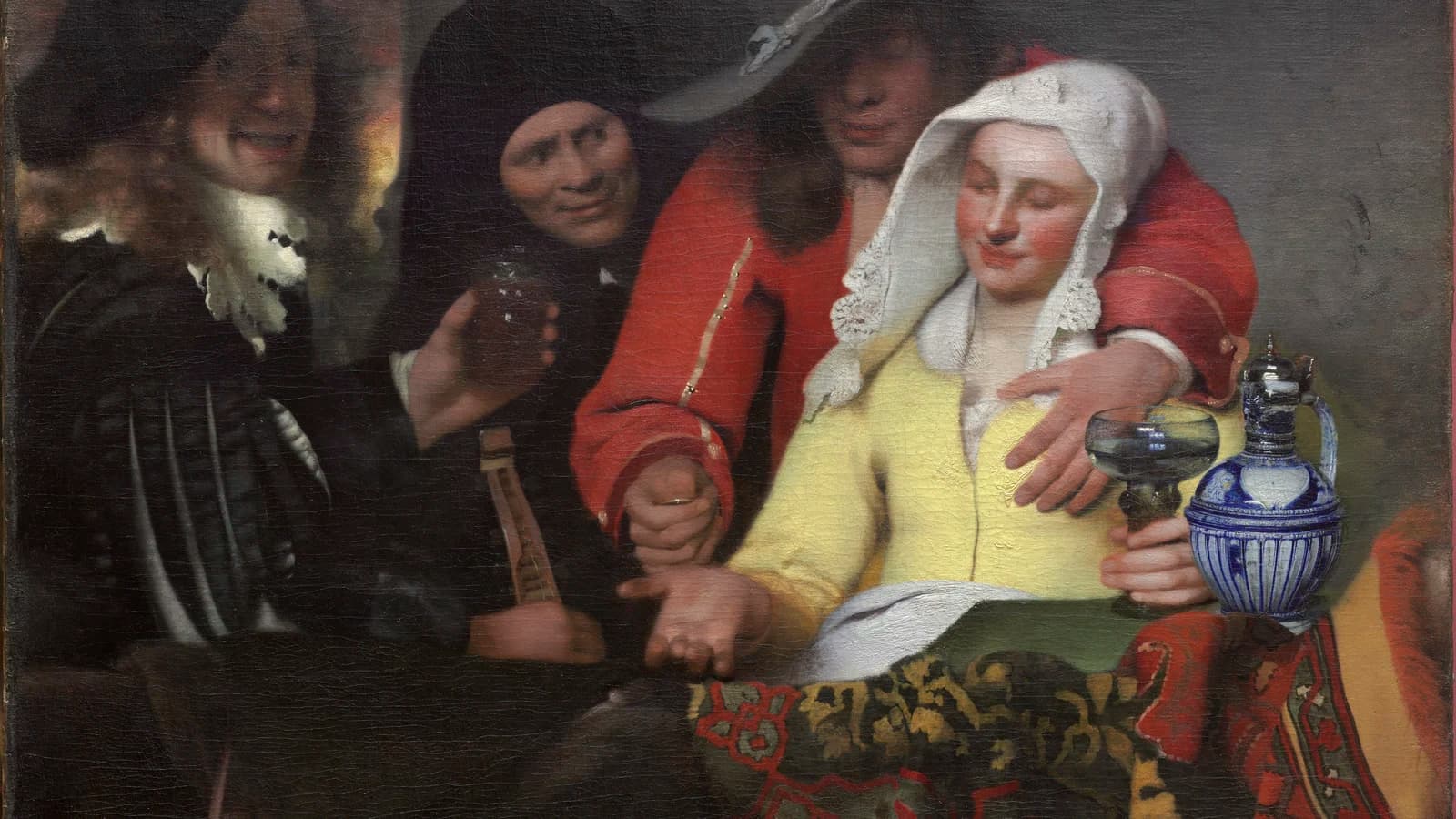
Signed and dated 1656 at the lower right, The Procuress is one of only a handful of works whose date Vermeer applied himself, and it stands as his earliest dated painting. At 143 by 130 centimeters it is among his largest canvases, and it marks the pivot in his career from the biblical and mythological subjects of his first years toward the genre scenes for which he is now known. A soldier in red drops a coin into the hand of a young woman in yellow while a procuress in black looks on, and a fourth figure at the left raises a glass toward the viewer.
A brothel scene in the Utrecht manner
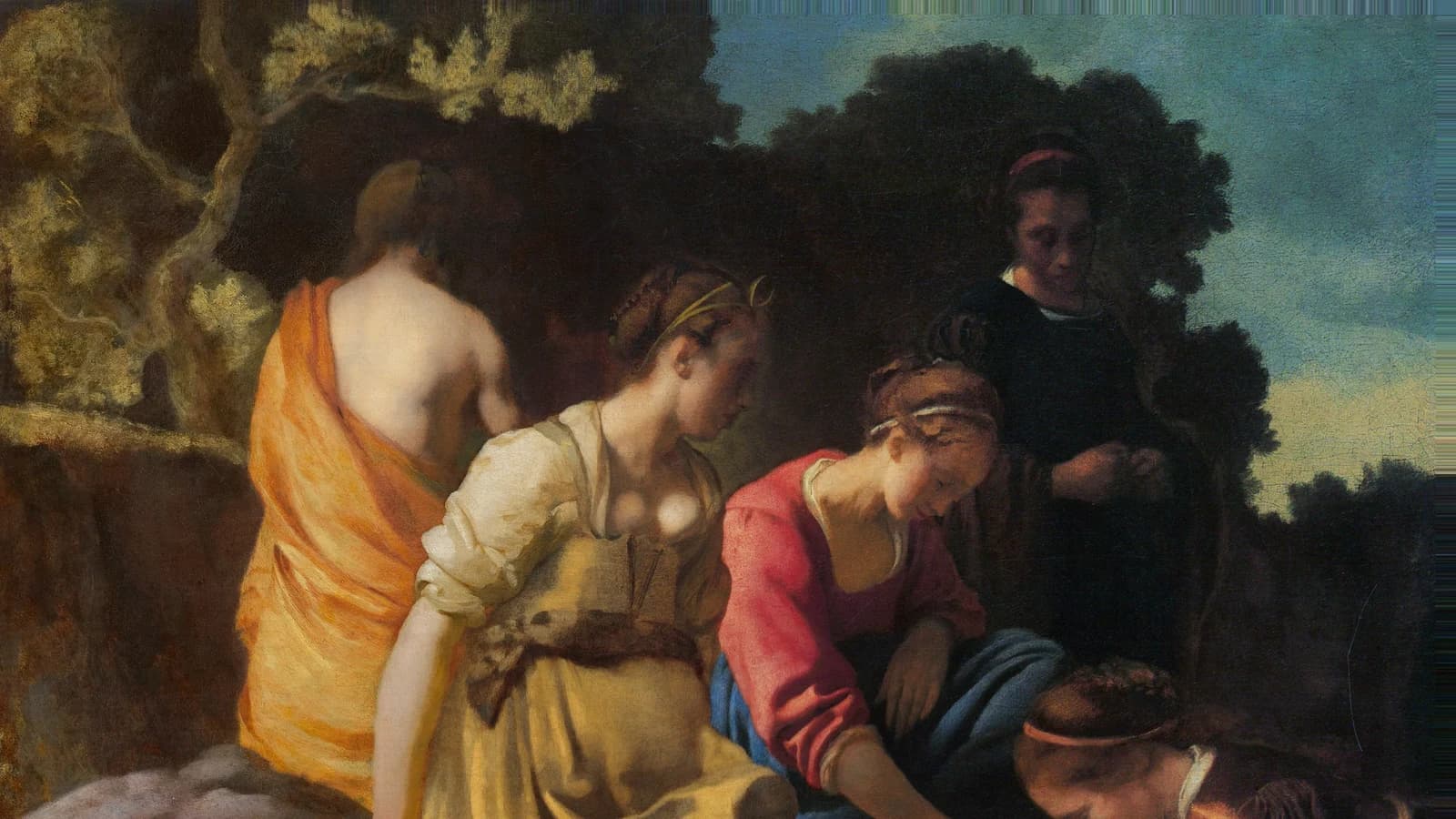
The picture belongs to the bordeeltje, the low-life brothel scene that Dutch painters inherited from the Utrecht followers of Caravaggio. Its closest model is Dirck van Baburen’s Procuress of about 1622, a painting owned by Vermeer’s mother-in-law Maria Thins and hung in her house, where the young artist would have known it well. Vermeer turned to genre only after the ambitious history paintings of his debut, among them Diana and Her Companions and Christ in the House of Martha and Mary.
The figure at the left
The grinning man at the left, who holds a cittern and a beer glass and wears a black beret and a doublet with slashed sleeves, is a stock type of the Caravaggesque brothel scene. Many scholars have read him as a self-portrait, noting his resemblance to the painter seen from behind in The Art of Painting, though the identification remains disputed.
Technique and color
Vermeer worked here largely alla prima, laying in broad, covering strokes with wide brushes rather than the patient glazes of his maturity. The palette runs from vermilion and lead-tin yellow in the figures to ultramarine and smalt elsewhere, with a rare, light-sensitive vivianite in the carpet, and he used a compass to lay out the wine jug’s decorated body with notable precision. X-radiographs show that he reworked the composition, adding the soldier’s hat and fur coat, which originally were absent.
From Bohemia to Dresden
The painting belonged to the Waldstein collection at Dux castle in Bohemia before it was bought in 1741 for Augustus III, Elector of Saxony and King of Poland. Carried off to the Soviet Union as a spoil of war in 1945, it was restituted ten years later and hangs today in the Gemäldegalerie Alte Meister in Dresden.
- Date
- 1656
- Medium
- Oil on canvas
- Dimensions
- 143 × 130 cm