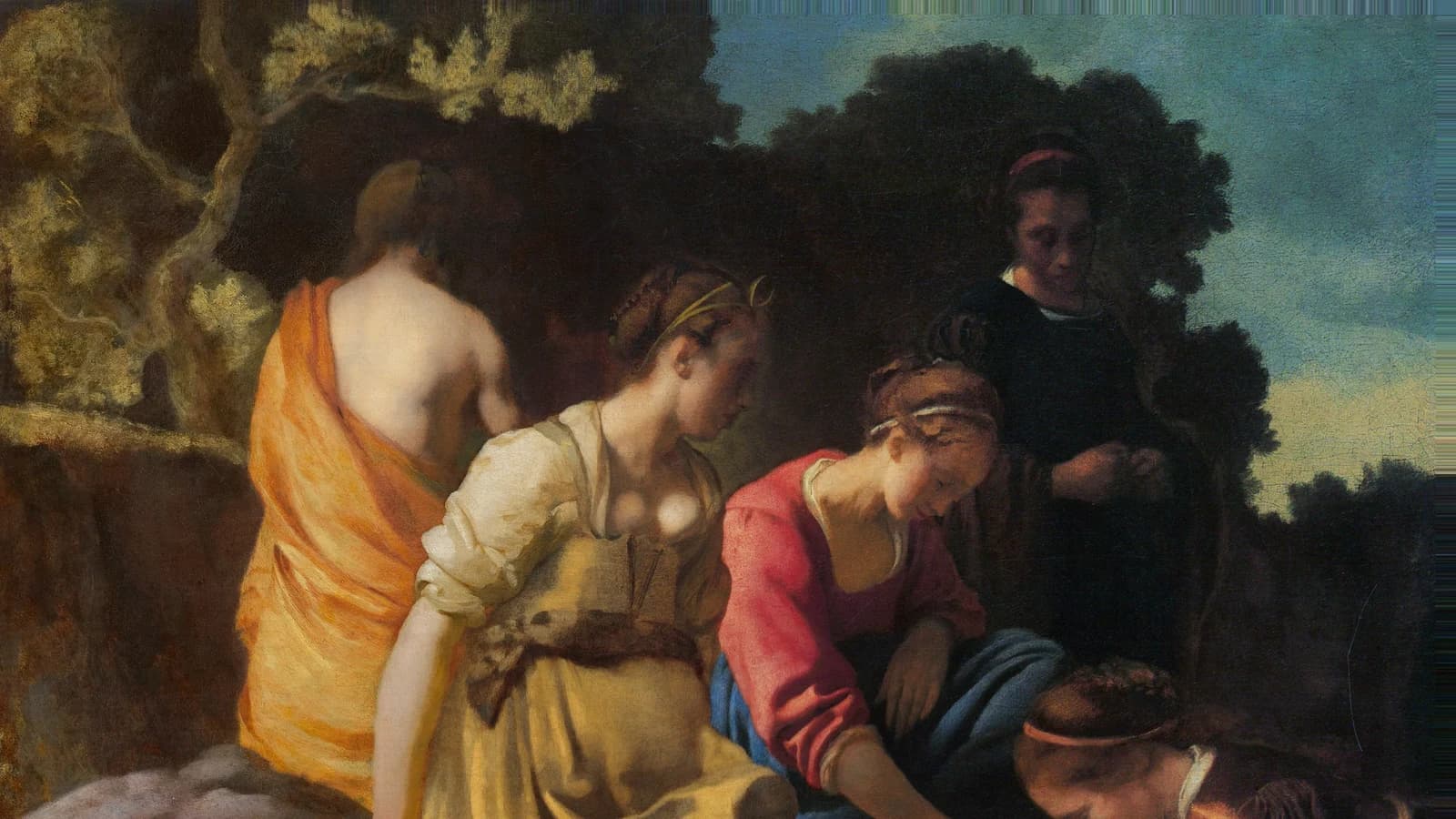
Diana and her Companions
About this painting
Diana and her Companions is one of Vermeer’s earliest surviving paintings, made around the time he registered with the Delft Guild of Saint Luke in December 1653, and by some accounts his very first. Drawn from Ovid’s Metamorphoses, it shows the goddess Diana resting with four nymphs after the hunt, identified only by the small crescent moon on her forehead rather than the usual bow, arrows, or slain game. One nymph kneels to wash the goddess’s foot with a brass basin and a white cloth, while the others sit absorbed in their own thoughts, their faces largely in shadow.
A history painter’s ambition
The picture belongs to Vermeer’s brief period as a painter of history subjects, alongside Christ in the House of Martha and Mary, before he turned to the domestic interiors for which he is now known. Several models stand behind it: the kneeling nymph echoes a figure in Jacob van Loo’s treatment of the same theme, while the sombre mood and shadowed faces recall Rembrandt, whose Bathsheba of 1654 Vermeer may have known through Carel Fabritius, Rembrandt’s former pupil then working in Delft. Rather than a dramatic mythological episode, Vermeer gives a quiet, contemplative scene whose restraint sets it apart from the more sensual Diana paintings of his contemporaries.
A contested signature
The painting’s authorship was long uncertain. It was sold at the Goldsmid sale in Paris in 1876 as a work by Nicolaes Maes, Rembrandt’s pupil, and bought for the Dutch State by Victor de Stuers. De Stuers later found that the signature’s “NM” lay over an underlying “IVM,” for Johannes Vermeer, though Abraham Bredius for a time reassigned the work to Jan Vermeer of Utrecht on account of its Italian character. The attribution to the Delft Vermeer was settled around the turn of the century by comparison with his signed Martha and Mary; the signature itself is no longer legible after later cleaning.
A cut-down canvas and a false sky
The work has not survived intact. A strip of roughly fifteen centimetres was removed from one edge, reducing the composition, and a passage of blue sky in the upper corner proved to be a nineteenth-century addition painted with Prussian blue and chrome green, pigments unavailable in Vermeer’s day. During the restoration of 1999–2000 at the Mauritshuis in The Hague, conservators could not safely strip the added sky and instead toned it down with foliage and a dark neutral layer, which made the background nymph, often identified as Callisto, far more prominent.
An early eye for surface
For all its rough patches, the painting already shows the eye for texture and light that would define Vermeer’s later work. The brass basin is among the earliest passages in his oeuvre to dwell on the feel of a material surface, and Diana’s yellow satin dress announces a lifelong attachment to that colour. Vermeer laid in the design with dark brown outlines, leaving pentimenti visible in the foot-washer’s skirt, and drew the handle of his brush through the wet paint to scratch the hairs on the dog’s ear, a technique he would use again.
- Date
- 1653–1656
- Medium
- Oil on canvas
- Dimensions
- 98.5 × 105 cm
- Home
 Mauritshuis