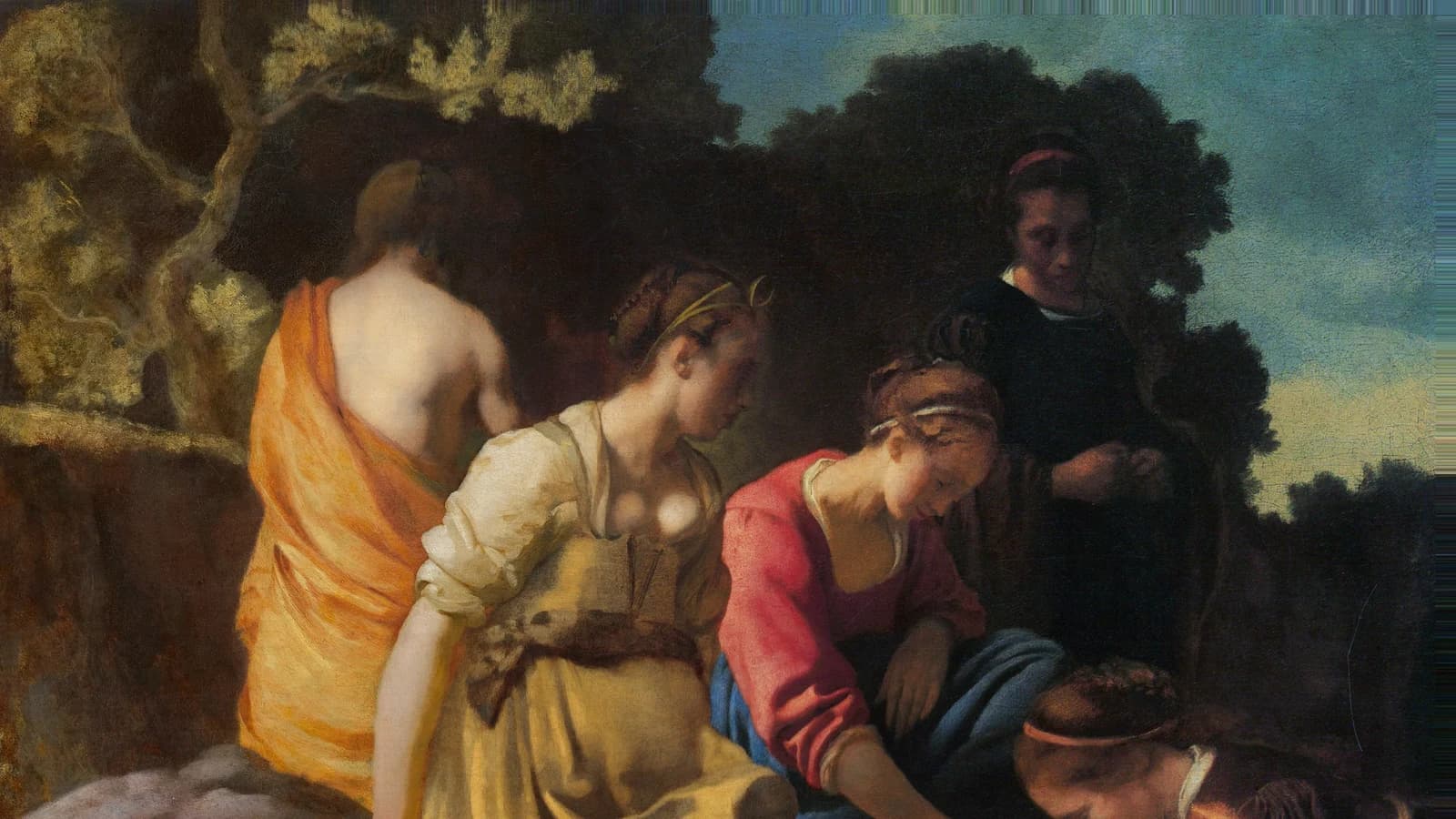
Christ in the House of Martha and Mary
About this painting
Painted around 1654–1655, when Vermeer was barely in his twenties, Christ in the House of Martha and Mary is the largest of his surviving paintings and the only one with an overt biblical subject. At 160 by 142 centimetres it dwarfs the small domestic interiors for which he became known, and it belongs to the short history-painting phase of his early career alongside Diana and her Companions and the contested Saint Praxedis.
The active and the contemplative life
The scene illustrates the story from the Gospel of Luke (10:38–42), in which Christ visits the sisters Martha and Mary at their home in Bethany. Mary sits at his feet, listening, while Martha, busy with the household, brings a basket of bread and complains that she has been left to serve alone; Christ’s reply, that Mary has chosen the better part, became a standard emblem of the contemplative life set against the active one. The theme touched a live theological nerve in the seventeenth-century Netherlands, where the relative worth of works and devotion divided Catholic and Protestant readers.
An early, borrowed manner
The broad, fluid brushwork and warm palette show a young painter still absorbing the lessons of others. Scholars connect the figure types and dramatic lighting to Utrecht Caravaggism and to history painters such as Hendrick ter Brugghen, while the overall composition appears to draw on a Flemish model by Erasmus Quellinus. The handling is freer and less controlled than in his mature work: the drapery and headgear are laid in wet-in-wet, and the bread basket is only summarily defined, far from the precision Vermeer would soon bring to the same motif in The Milkmaid. Tellingly, Christ’s robe is painted not in Vermeer’s costly ultramarine but in a cheaper mixture of smalt, indigo and lead white.
Signature and rediscovery
The painting is signed at lower left on the bench, “IVMeer,” with the first letters in ligature. It surfaced only in the later nineteenth century, recorded with the Abbot family in Bristol by about 1880, and passed through the London dealers Forbes and Paterson, who sold it in 1901 to the Scottish collector William Allan Coats. His sons presented it to the National Gallery of Scotland in Edinburgh in 1927, where it remains.
- Date
- 1654–1656
- Medium
- Oil on canvas
- Dimensions
- 160 × 142 cm