Woman Holding a Balance
About this painting
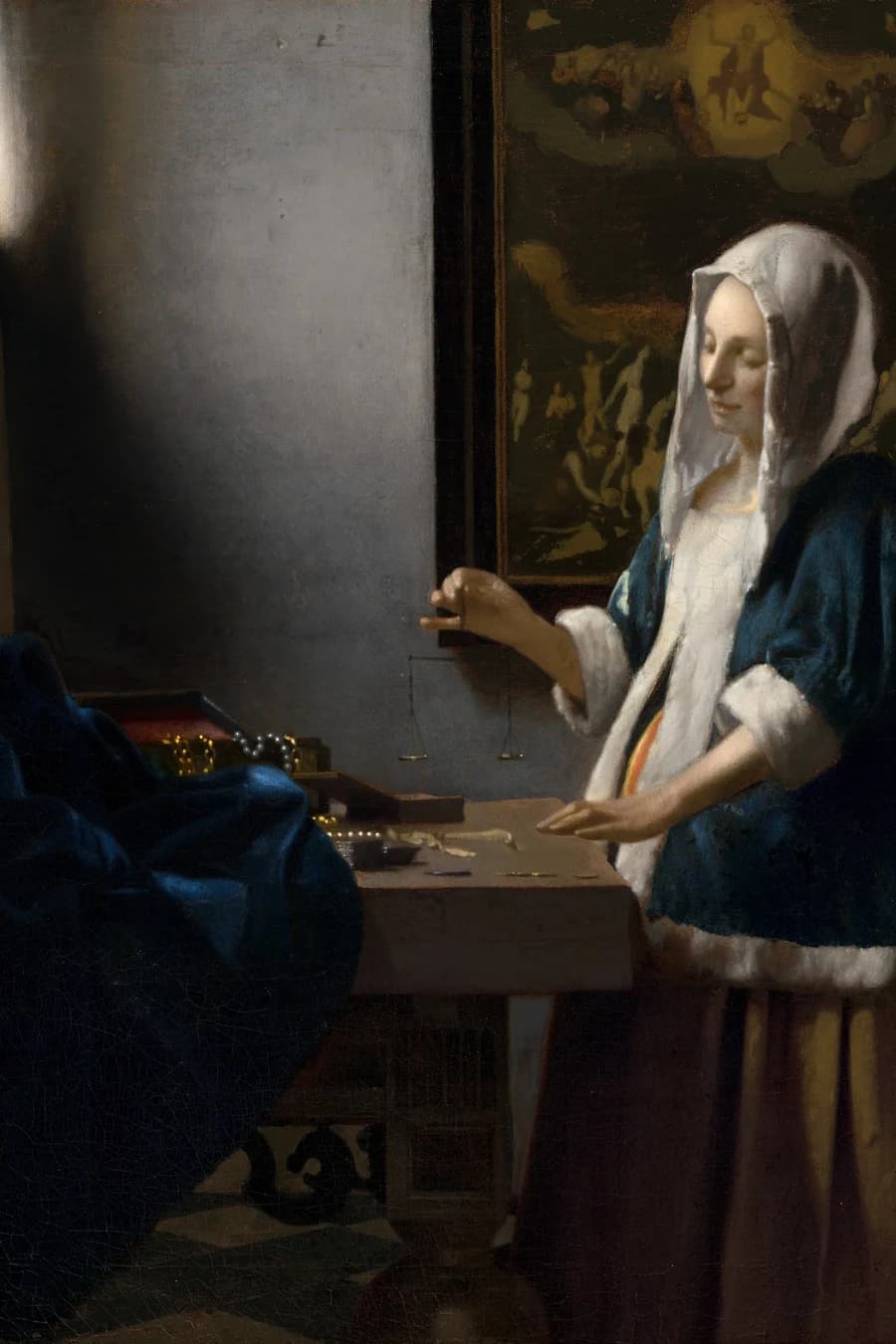
Painted around 1662–1664, Woman Holding a Balance shows a young woman in a blue jacket standing at a table in the corner of a quiet room, a small balance poised between the fingers of her right hand. Light falls from a window at the left, screened by an orange curtain, and catches her lowered eyes and the rim of the scale. An open jewelry box, strands of pearls, and gold coins lie on the table before her, yet she does not touch them.
An empty balance
For a long time the picture was called Woman Weighing Gold or Woman Weighing Pearls, on the assumption that she was measuring out the riches on the table. Microscopic examination settled the matter: the pans of the balance are empty, and the yellowish glints once read as gold are only highlights on the metal itself. She is, in the catalogue’s phrase, “portrayed in the act of balancing rather than weighing,” holding the scale level so that it hangs in perfect equilibrium.
The Last Judgment behind her
On the wall behind the woman hangs a large painting of the Last Judgment, a c. 1580 composition in the manner of Jacob de Backer, with Christ enthroned and arms outstretched above the rising dead. Her upraised hand falls just below that figure, and the scene sets the ordinary act of weighing against the day on which souls themselves are weighed and judged. A small mirror hangs on the same wall, an attribute long associated with Prudence and with self-knowledge rather than vanity alone.
Temperance and the moral balance
The picture has been read in several ways: as a vanitas warning against worldly attachment, as a meditation on divine justice, and as an image of measured, temperate conduct. Many modern scholars, Arthur K. Wheelock Jr. among them, set aside the sterner vanitas reading and stress the work’s “pervasive serenity,” taking the empty, balanced scale as an emblem of the responsibility to weigh one’s own actions with care before the final reckoning. Scholars have debated whether the woman is pregnant; the costume historian Marieke de Winkel argues that the bulky silhouette reflects the fashion of the 1660s rather than any condition.
Composition and afterlife
Vermeer draws the picture’s geometry, its vanishing point, and its moral focus together at the woman’s poised hand, so that composition and meaning coincide. Technical study has found ultramarine in the blue cloth and lead-tin yellow in the curtain, and a 1994 cleaning removed later overpaint to recover the golden highlights along the frame. The painting passed through the 1696 Dissius sale in Amsterdam, where it fetched 155 guilders, more than most of the lots but below The Milkmaid, and came at last to the National Gallery of Art in Washington with the Widener Collection in 1942.
- Date
- 1662–1665
- Medium
- Oil on canvas
- Dimensions
- 42.5 × 38 cm