The 2022 Examination of Girl with a Flute
Over two years, the National Gallery of Art examined its four Vermeers without taking a scalpel to any of them, and reattributed the smallest, Girl with a Flute, to a studio associate. The Rijksmuseum and many scholars still call it a Vermeer.
Four Vermeers in Washington
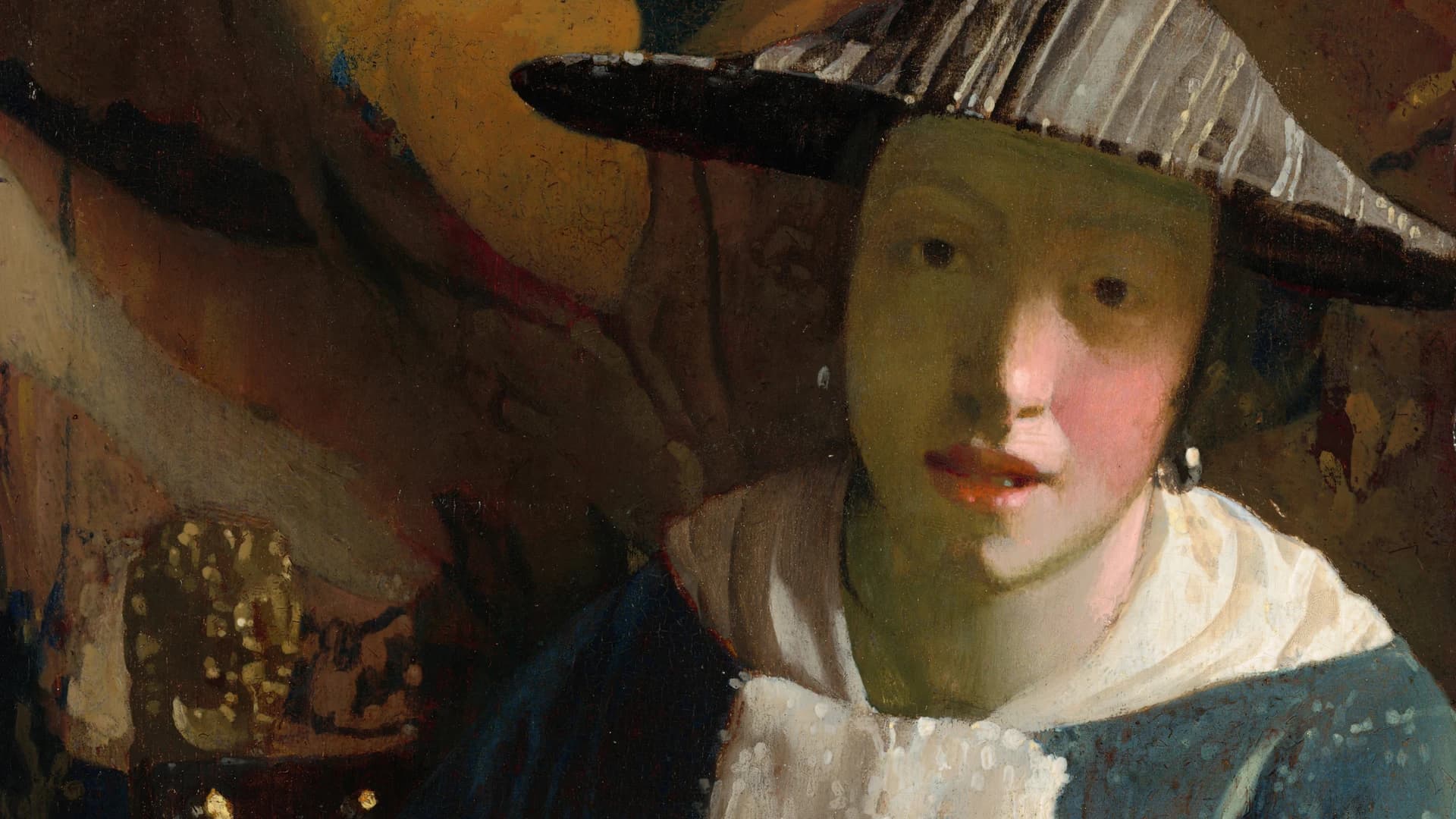
When the National Gallery of Art in Washington closed to the public during the pandemic, its curators, conservators and scientists used the quiet to do something they could rarely attempt: take all four of the museum’s paintings by and attributed to Vermeer off the wall at the same time and study them together, side by side with two twentieth-century forgeries. The guiding question was a simple one, what makes a Vermeer a Vermeer, and the answer was clearest in the smallest picture of the group.
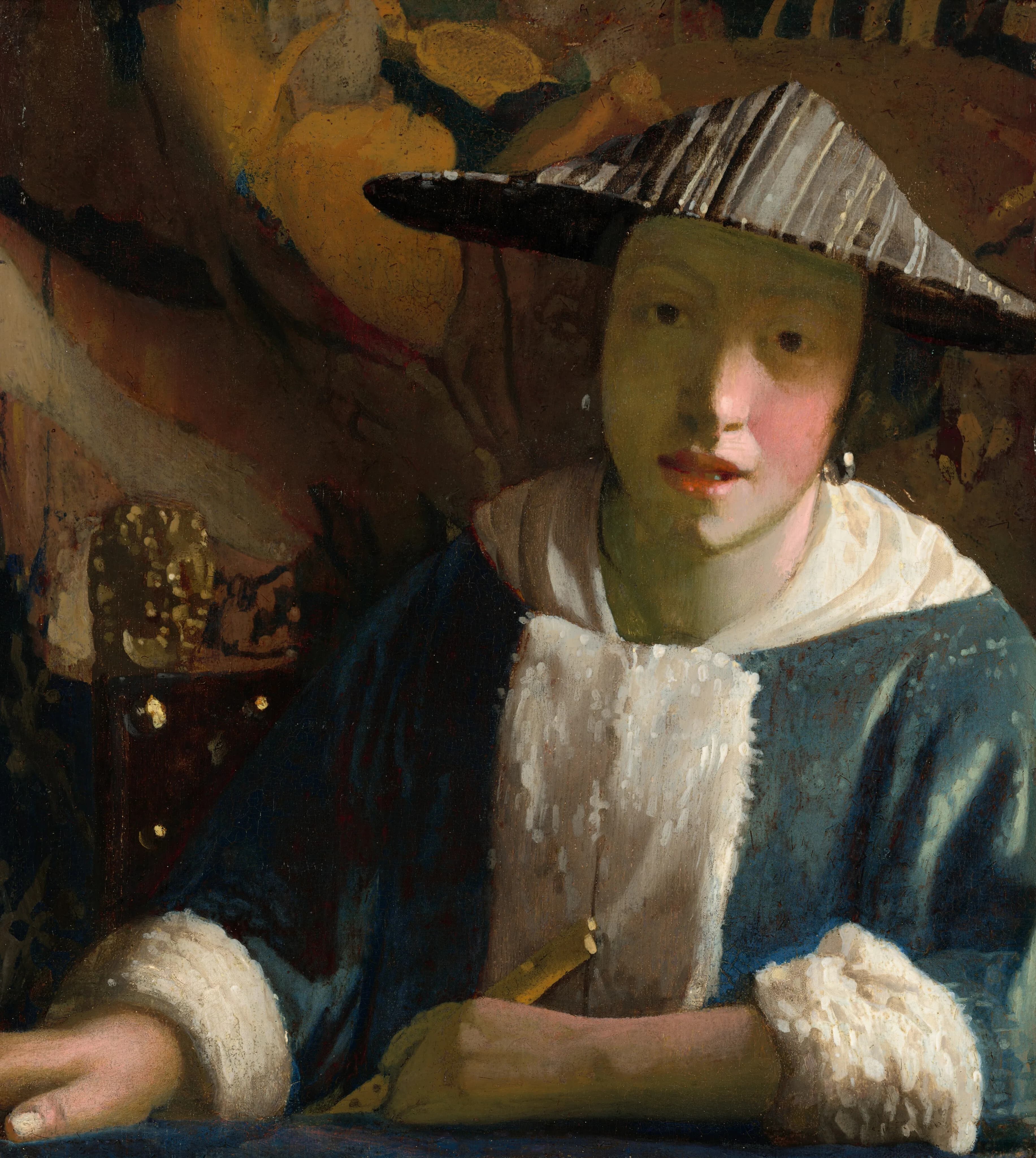
That picture is Girl with a Flute, a panel barely eight by seven inches showing a young figure in a striped conical hat and a fur-trimmed jacket, holding a recorder. It is a tronie, not a portrait but a study of a head or costumed character made for the open market. After two years of work, the team concluded that Vermeer himself did not paint it. It is a conclusion that other Vermeer specialists, the Rijksmuseum among them, have not accepted, and the attribution remains open.
A companion to the Red Hat
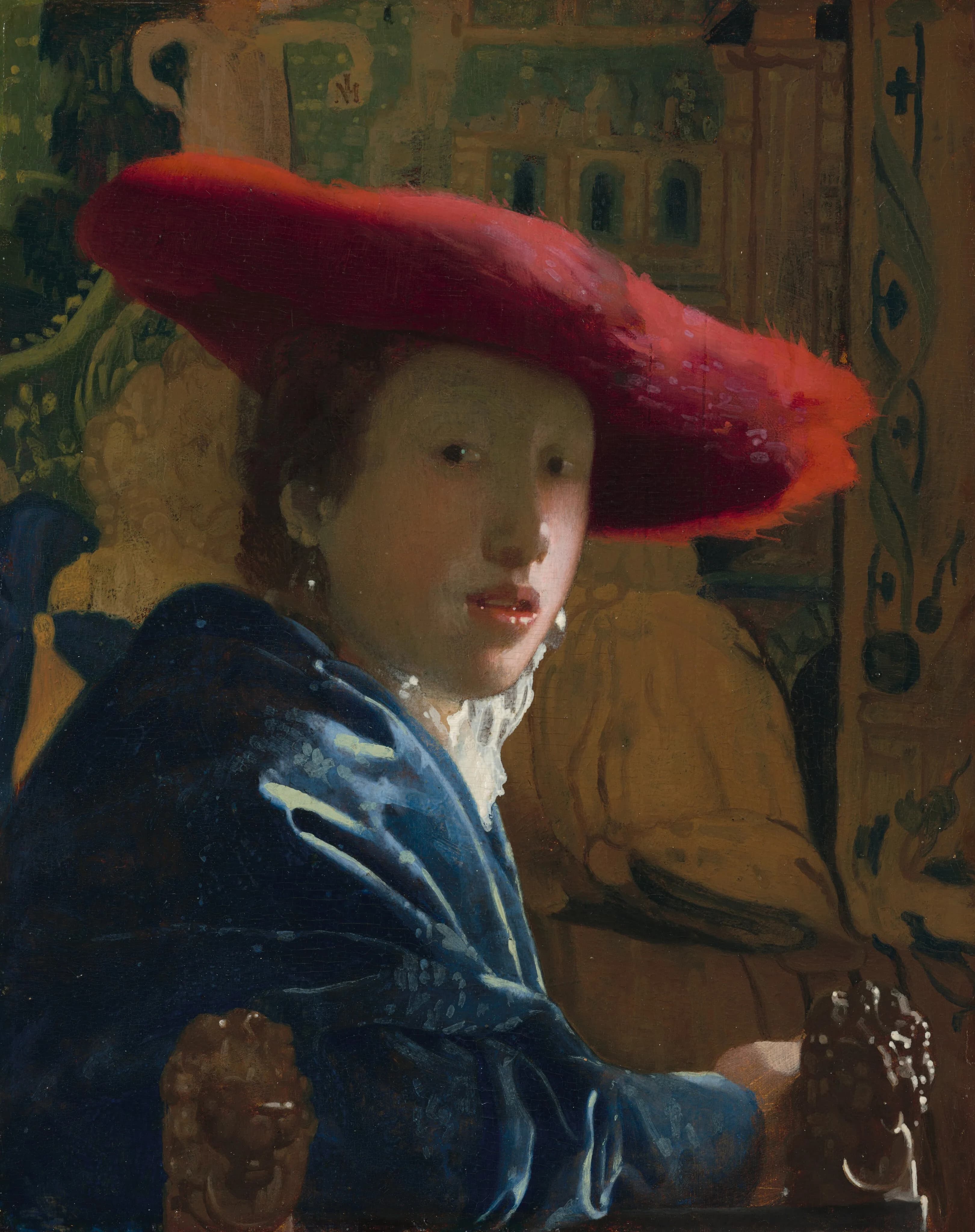
The Flute has always been read against Girl with a Red Hat, the only other small Vermeer-related picture on a wooden panel. The two are close in size and share a tapestry backdrop, a chair with carved lion’s-head finials and a figure in exotic headwear, and have often been treated as a matched pair. Yet there is no record linking them before they reached Washington, and they differ enough in shape that an original pairing looks unlikely.
The difference in quality is plain even without instruments. The Red Hat’s sitter turns and glances over her shoulder; the Flute’s figure sits frontal and static, her arms and hands awkwardly placed, the chair and tapestry behind her blocky and flat. Scholars have doubted the picture for decades on looks alone.
Those doubts have a long paper trail. The panel was hailed as the museum’s fifth Vermeer when it arrived in 1942, but a quarter of a century later scholars began to argue it was too weak to be his, and some dismissed it as a later imitation. A study in the early 1970s found its materials consistent with the seventeenth century, confirmed by dendrochronology, the dating of a panel by the growth rings in its oak, which put the likely felling of the tree between 1651 and 1661. The same study placed the work in the “circle of Vermeer.” In 1995 the curator Arthur Wheelock settled on “attributed to Vermeer,” suggesting Vermeer had begun the panel and a later hand had finished it.
Reading the painting without touching it
The team did not clean or repaint the panel; they examined it as it stood, pairing microscopic analysis of a few paint samples with imaging methods that survey the whole surface without contact. X-ray fluorescence mapping charts which chemical elements, and so which pigments, lie where across the picture; reflectance imaging spectroscopy identifies colours by the way they absorb light; and infrared reflectography sees through upper layers to the work underneath. Read together with the painting under high magnification, these let the researchers follow how the picture was built, layer by layer, and compare it step for step with Vermeer’s secure works.
The ground and the underpaint
The departures from Vermeer began at the very bottom. Both panels were prepared with a double ground, the priming laid over the wood before any painting. On the Flute, though, the upper ground is a coarse, dark grey layer with a brushmarked texture, where Vermeer and his contemporaries worked over a smooth tan priming that let them build a refined finish. No securely autograph Vermeer shows so rough a ground. The authors read it as the work of someone who prepared the panel poorly, perhaps an amateur.
The underpaint, the rough first lay-in of the shapes before the final colours go on, told the same story. Like Vermeer, this artist sketched the design in brown and blocked in the forms, but the handling is lumpy and clumsy, with strokes that wander instead of following the folds of the jacket. The paint cracked and wrinkled as it dried, and a band of vermilion that never set properly kept oozing up through the layers above. A map of the copper in the paint shows a hesitant pattern of brushwork, nothing like the quick, sure underpainting with which Vermeer modelled the rounded folds in Woman Holding a Balance.
The final paint
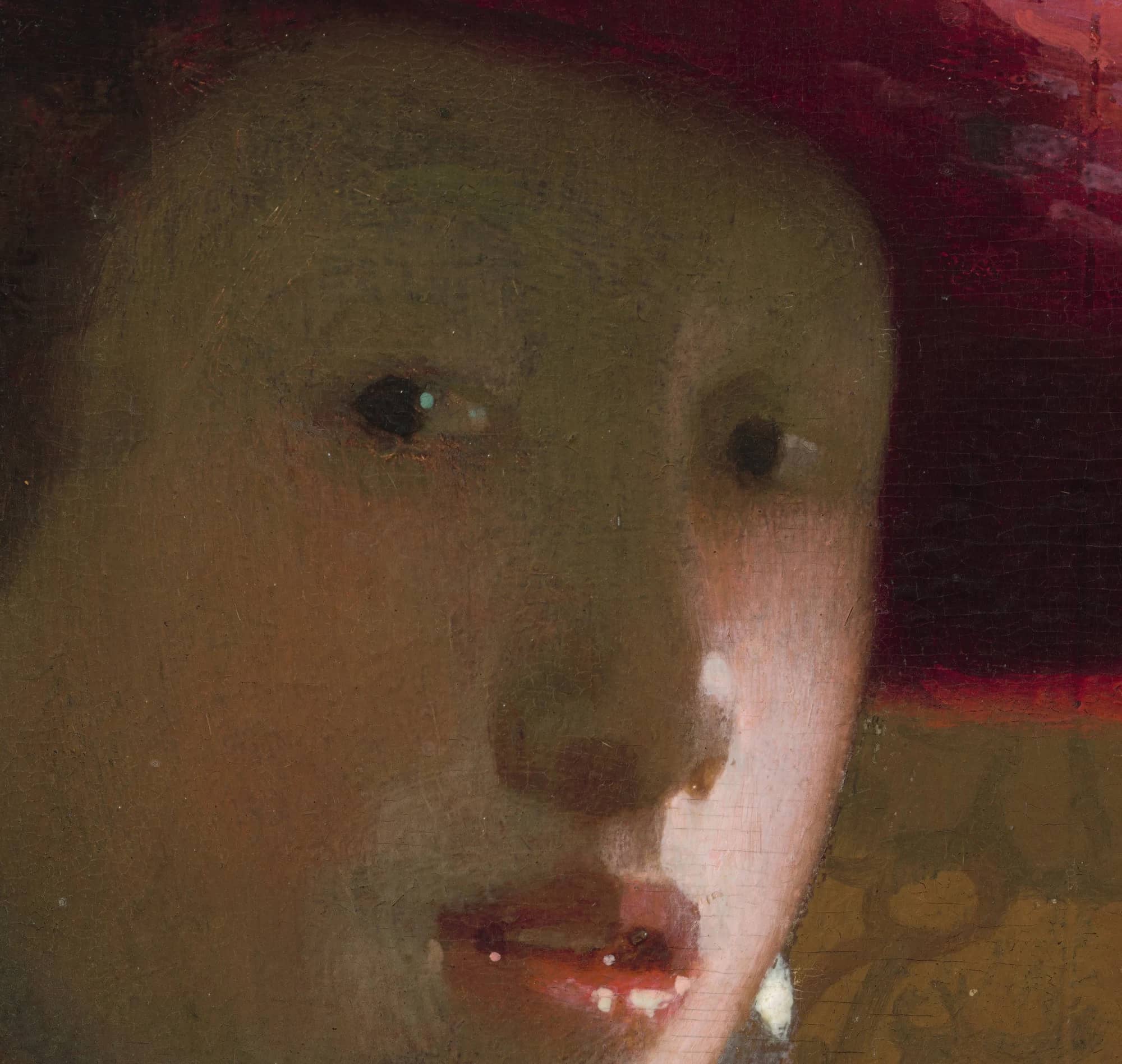
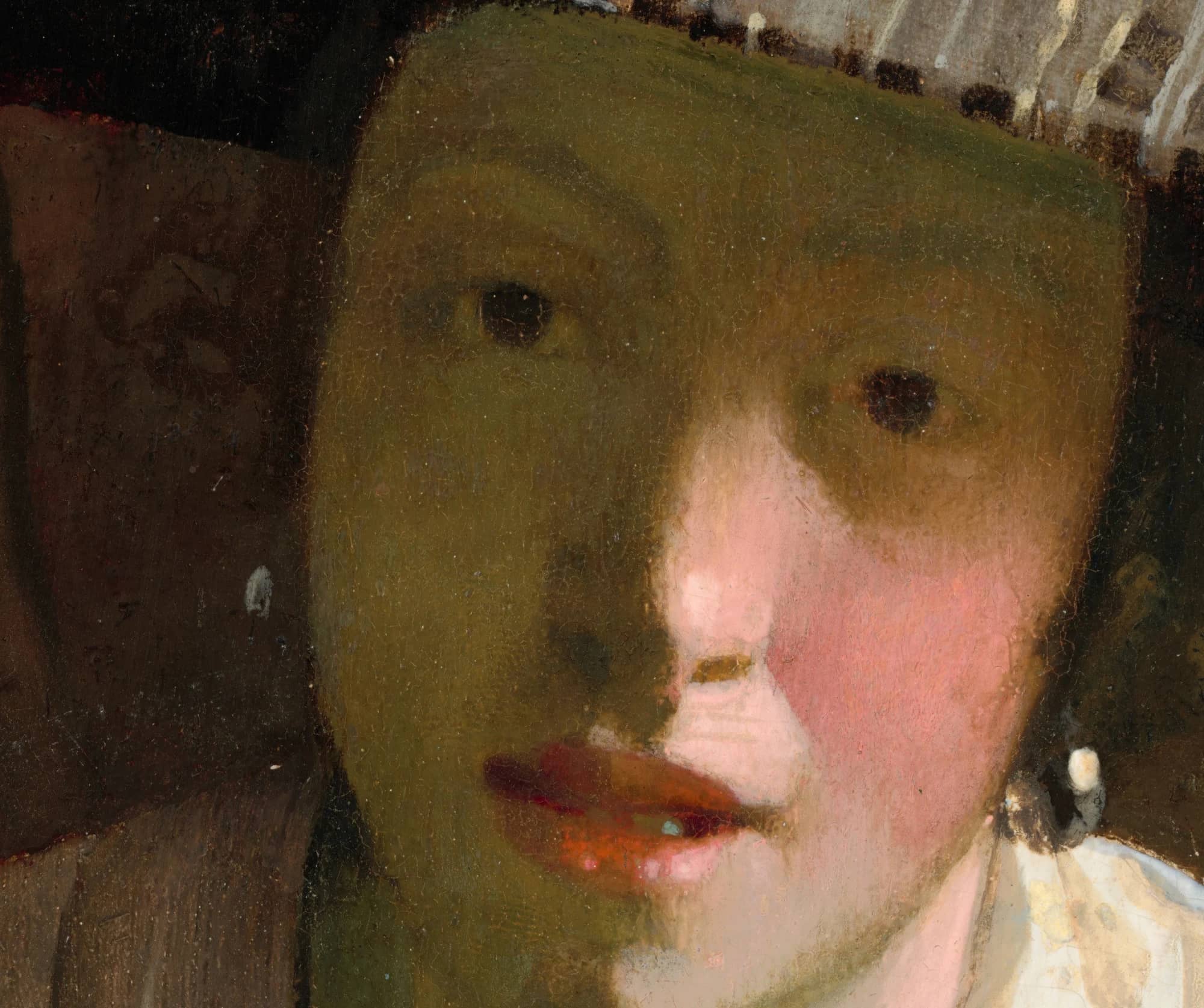
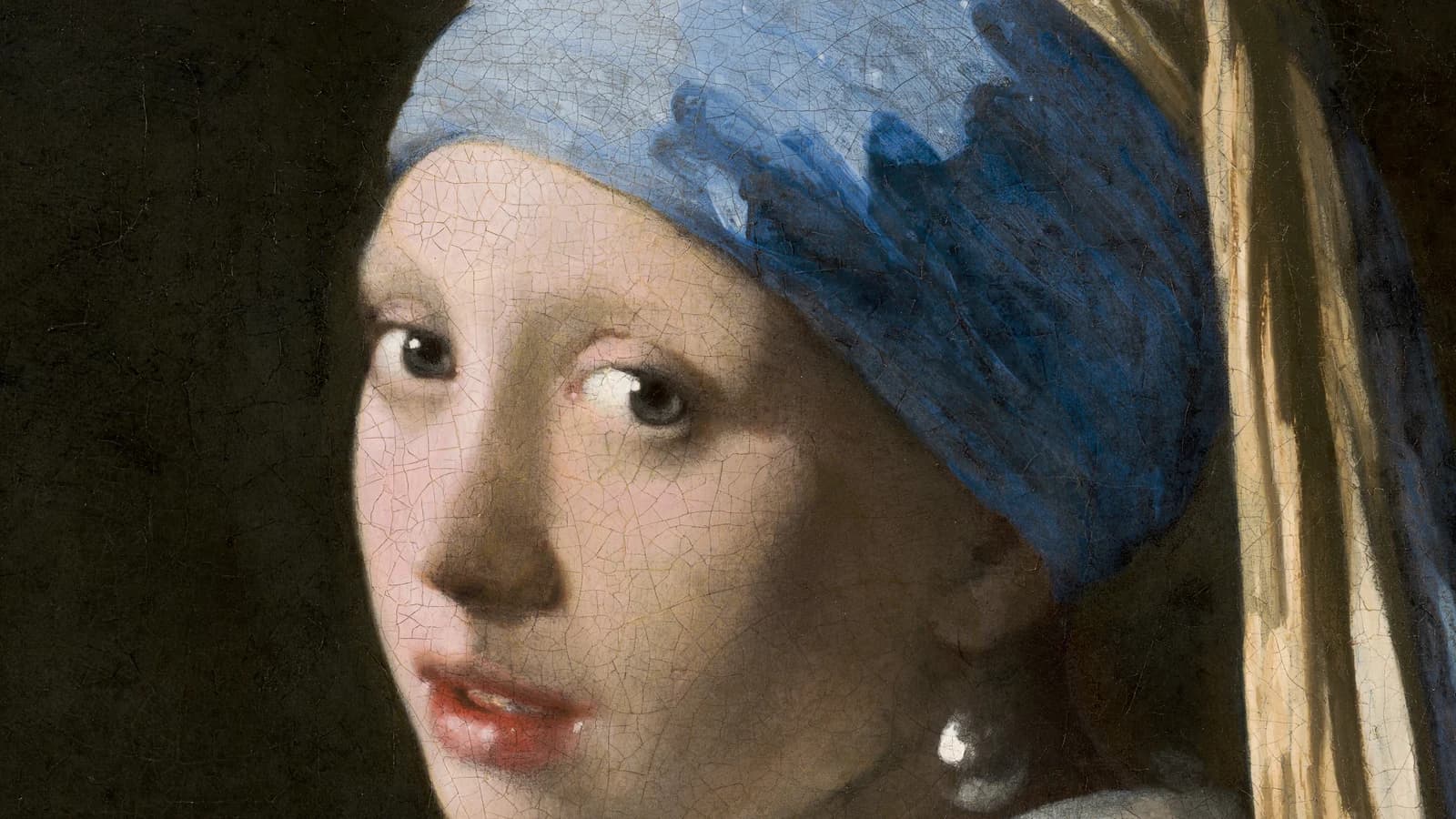
The surface paint widened the gap. Vermeer ground his pigments coarsely for the underpaint and finely for the final layer, so the last touches could be delicate; the Flute’s painter reversed this, working the top paint so coarsely that the surface turns almost granular, with broken brush bristles left stuck in it. The clearest tell is in the face. In A Lady Writing and the Red Hat, Vermeer feathered the greenish shadow under the cheek and curved his highlights softly around the nose and mouth. On the Flute the shadow is flat and heavy, laid on so thickly that it pooled and almost dripped, and the highlights sit as hard-edged planes of unvaried pink and grey.
The two faces, seen at the same scale, make the point on their own. Both use green earth, a green clay pigment, in the shadows of the skin, an unusual choice for flesh that Vermeer turned to late in his career. But the Flute’s green earth is a paler grade with large glassy particles not found in the Red Hat, so the two painters seem to have drawn on different stocks of the colour. And where Vermeer placed tiny coloured highlights with care, the Flute’s painter, imitating the trick, dropped a blue-green dot incongruously inside the pink of the mouth.
The studio hypothesis
From the rough ground to the coarse final paint, the National Gallery team read these features as the work of a single hand throughout, following Vermeer’s manner and using the same materials but never reaching his finesse. On their reading the picture was not a Vermeer that a later restorer had spoiled, as Wheelock had supposed, but the work of someone who knew Vermeer’s methods intimately and copied them as best they could. That intimacy is the striking part of their argument: it implies that Vermeer, long imagined as a solitary genius, had someone close enough to watch him paint.
The artist who created this work was intimately familiar with Vermeer’s unique working methods and used the same materials and techniques but was unable to achieve Vermeer’s level of delicacy or expertise.
Who that artist was, the study does not claim to know. The authors set out the possibilities, a pupil, a well-off amateur paying for lessons, a hired journeyman, or a member of the family, and decline to choose; they report, without endorsing, an earlier suggestion that the painter was Vermeer’s eldest daughter, Maria. The panel was re-catalogued as Studio of Johannes Vermeer, painted around 1669 to 1675. The same research firmed up its companion in the other direction: the Red Hat now reads as a securely autograph work and a turning point in Vermeer’s late style, his experiment with abstracted form and strong contrasts of light and dark.
A contested attribution
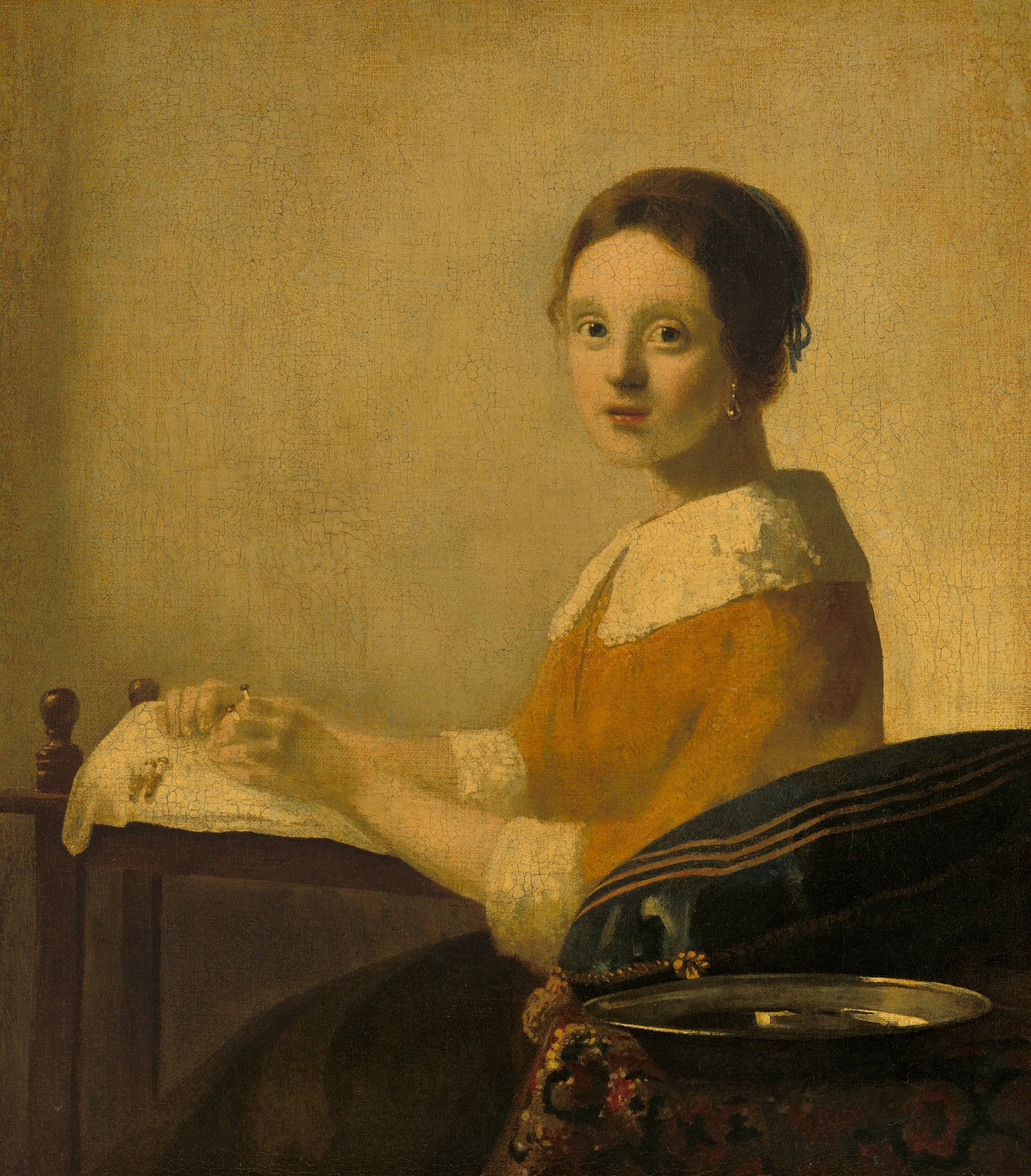
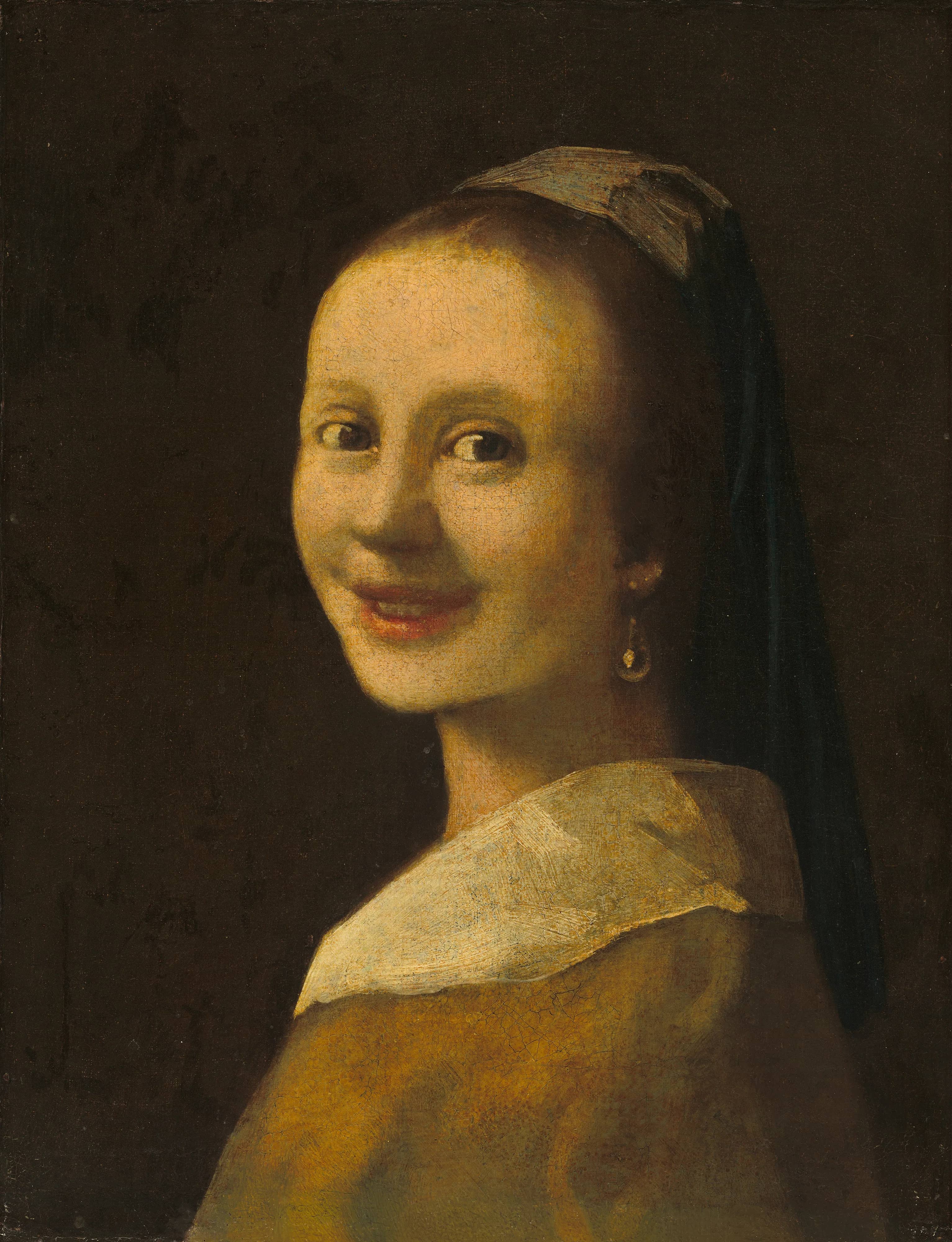
The exhibition that presented these findings, Vermeer’s Secrets, hung the four paintings beside two outright fakes to sharpen the question of authenticity. The Lacemaker and The Smiling Girl, long since recognised as forgeries probably painted around 1925 by the Dutch restorer Theo van Wijngaarden, stitch together motifs lifted from genuine Vermeers. The Flute was never in that category: its oak places it firmly in the seventeenth century, and even the National Gallery agrees its maker knew Vermeer’s method from the inside. The dispute is not whether it is old or genuine, but whose hand held the brush.
On that question the National Gallery stands in the minority. After its own study, carried out with the Mauritshuis and the University of Antwerp, the Rijksmuseum reaffirmed the panel as an autograph Vermeer and borrowed it for its 2023 Vermeer retrospective, hanging it as his with Washington’s contrary conclusion recorded in the catalogue but not on the wall. Many Vermeer scholars have kept the attribution as well, a common view being that the small tronie was an early study that preceded his other works in the format.
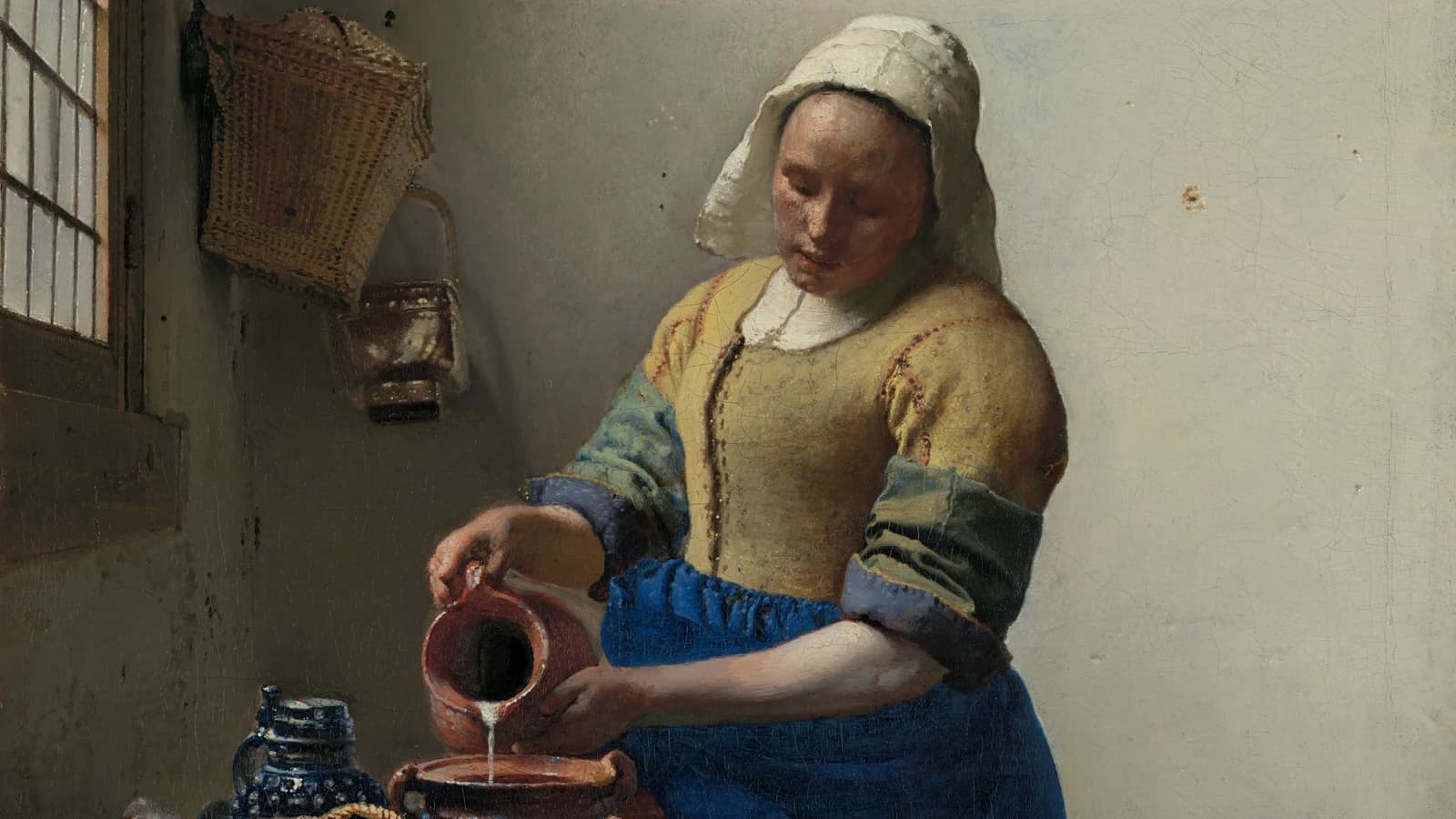
The Rijksmuseum’s curators, Pieter Roelofs and Gregor Weber, set out specific objections. Several of the traits the National Gallery flagged as un-Vermeerlike, a coarse upper layer with visible brushstrokes and thickly applied green earth around the face, they also find in an undisputed Vermeer, The Love Letter; an excess of broken brush bristles has turned up in Girl with a Pearl Earring and The Milkmaid. Most telling for them, the panel carries pentimenti, the painter’s own changes of mind, with the fur trimmings laid over the jacket’s original V-neck, the left shoulder lowered, and a finger added onto the flute. Those are the corrections of someone working out a composition, they argue, not copying a finished one.
Two important questions are how an inexperienced assistant or amateur was able to achieve this innovative composition and why Vermeer, as an instructor or mentor, did not alert the painter in question to the ‘mistakes’ he or she was making.
So the examination settled a great deal about how the panel was made without settling whose hand made it, and the picture now sits between two respected institutions that read the same evidence differently. The result joins a run of recent imaging studies that have changed how we read Vermeer without touching the paint: the Mauritshuis recovering a lost curtain behind Girl with a Pearl Earring, and the Rijksmuseum finding objects painted out of The Milkmaid.
Notes
- 1.The study ran over roughly two years, taking advantage of the museum’s COVID-19 closures in 2020 and 2021 to bring the four paintings by and attributed to Vermeer off the wall at once, alongside two twentieth-century forgeries. It was led by curators Marjorie E. Wieseman and Alexandra Libby with conservator Dina Anchin and scientist E. Melanie Gifford, and presented in the exhibition Vermeer’s Secrets (8 October 2022 to 8 January 2023). See Marjorie E. Wieseman, Alexandra Libby, E. Melanie Gifford and Dina Anchin, “Vermeer’s Studio and the Girl with a Flute: New Findings from the National Gallery of Art,” Journal of Historians of Netherlandish Art 14, no. 2 (Summer 2022) and the National Gallery’s press release, “New Findings by National Gallery of Art Suggest the Existence of a Studio of Vermeer”.
- 2.Both are small tronies on oak panel of nearly the same size, each showing a figure in a fanciful hat before a tapestry in a lion’s-head finial chair, and the two have long been discussed as a pair, accepted or rejected together. The authors note there is no documentary evidence linking them before they entered the National Gallery in 1942 and 1937, and that the panels differ enough in height to make an original pairing unlikely. See Wieseman et al., Journal of Historians of Netherlandish Art 14, no. 2 (2022), paragraphs 4 to 5.
- 3.The panel was acclaimed as the National Gallery’s fifth Vermeer when it arrived in 1942 with the Widener collection. A 1973 to 1974 study by Arthur K. Wheelock Jr. and others judged its materials consistent with a seventeenth-century origin but placed it in the “circle of Vermeer”; dendrochronology then gave a likely felling date for the oak between 1651 and 1661. In 1995 Wheelock re-catalogued it as “attributed to Vermeer,” proposing that Vermeer had blocked it in and another hand finished it. See Wieseman et al., Journal of Historians of Netherlandish Art 14, no. 2 (2022), paragraphs 6 to 8.
- 4.The team paired microanalysis of a few paint samples (polarising light microscopy of pigment grains, light microscopy of paint cross-sections, and scanning electron microscopy with energy-dispersive spectroscopy) with non-invasive imaging across the whole panel: X-ray fluorescence element mapping, reflectance imaging spectroscopy, and multispectral infrared reflectography. The methods are set out in the companion paper, “Methodology & Resources: New Findings from the National Gallery of Art,” Journal of Historians of Netherlandish Art 14, no. 2 (2022), and in Wieseman et al., paragraphs 9 to 12.
- 5.The panel carries a double ground, but its upper layer is a coarsely ground, darker grey layer with a brushmarked texture, unlike the smooth tan ground on commercially prepared panels and not found on any securely autograph Vermeer. The authors read it as inexpertly prepared, perhaps by an amateur. See Wieseman et al., Journal of Historians of Netherlandish Art 14, no. 2 (2022), paragraph 13.
- 6.The underpaint, the rough first lay-in of the forms, is lumpy and clumsily applied, with arbitrary strokes that do not follow the jacket’s folds, wide drying cracks and wrinkles, and a swath of vermilion that dried imperfectly and oozed up through later layers. The X-ray fluorescence copper map shows a pattern of brushwork far less assured than the soft, fluid underpaint Vermeer used to model the folds in Woman Holding a Balance. See Wieseman et al., Journal of Historians of Netherlandish Art 14, no. 2 (2022), paragraphs 14 to 16.
- 7.In the final paint the artist used pigments ground so coarsely that the surface is almost granular, with broken brush bristles embedded in it, and reversed Vermeer’s practice of grinding the final paint more finely than the underpaint. Where Vermeer feathered the greenish shadow of the cheek, the Flute’s shadow was laid on flat and heavy, so that it pooled and almost dripped. See Wieseman et al., Journal of Historians of Netherlandish Art 14, no. 2 (2022), paragraphs 18 to 21.
- 8.Both faces carry green earth in the shadows, an unusual pigment for flesh that Vermeer favoured late in his career, but polarising light microscopy found the Flute’s green earth to be a paler grade with large glassy particles absent from Girl with the Red Hat, suggesting a different batch or source. The Flute’s painter also copied Vermeer’s trick of a coloured highlight dot but misplaced a blue-green dot inside the pink of the mouth. See Wieseman et al., Journal of Historians of Netherlandish Art 14, no. 2 (2022), paragraphs 17, 22 and 23.
- 9.The authors conclude that a single hand made the painting, following Vermeer’s manner and using equivalent materials, but unable to master his finesse, and that this points to a studio. They are explicit that the identity cannot be recovered: a pupil, an amateur paying for lessons, a hired journeyman, or a family member are all canvassed, and Benjamin Binstock’s proposal of Vermeer’s daughter Maria is reported without endorsement. The panel is now catalogued as “Studio of Johannes Vermeer,” ca. 1669 to 1675. See Wieseman et al., Journal of Historians of Netherlandish Art 14, no. 2 (2022), paragraphs 24 and 33 to 42.
- 10.The study treats Girl with the Red Hat as the autograph benchmark, noting a scholarly consensus that it is by Vermeer, and frames it as a turning point in his late style, an experiment in abstracted form and strong contrasts of light and dark. See the companion paper, “Experimentation and Innovation in Vermeer’s Girl with the Red Hat,” and Wieseman et al., Journal of Historians of Netherlandish Art 14, no. 2 (2022), paragraph 5, with the National Gallery’s press release.
- 11.The two forgeries shown beside the Vermeers, The Lacemaker and The Smiling Girl, were likely painted around 1925 by Theo van Wijngaarden, a Dutch restorer and occasional forger, and combine motifs lifted from genuine Vermeers. Dendrochronology firmly dates the Girl with a Flute panel to the seventeenth century, separating it from such modern fakes. See Wieseman et al., Journal of Historians of Netherlandish Art 14, no. 2 (2022), paragraph 26.
- 12.Following its own integrated study with the Mauritshuis and the University of Antwerp, the Rijksmuseum reaffirmed Girl with a Flute as an autograph Vermeer, one of three attributions it announced ahead of its 2023 retrospective, and exhibited it as his, with the National Gallery’s contrary conclusion recorded in the catalogue but not on the wall text. Essential Vermeer notes that most Vermeer scholars have not accepted the National Gallery’s reattribution. See the Rijksmuseum press release, “Rijksmuseum Announces List of Vermeer Paintings in Landmark Exhibition”, with the reporting in NL Times (2 November 2022) and The Art Newspaper (29 November 2022).
- 13.The Rijksmuseum curators Pieter Roelofs and Gregor Weber set out their objections in the exhibition catalogue (Pieter Roelofs and Gregor Weber, eds., Johannes Vermeer, Rijksmuseum, 2023): that anomalies the National Gallery treated as un-Vermeerlike, including the coarse upper layer with visible brushstrokes and the thickly applied green earth around the face, also appear in The Love Letter; that an excessive number of broken bristles has been found in Girl with a Pearl Earring and The Milkmaid; and that the panel’s pentimenti (the fur trimmings over the original V-neck, the lowered left shoulder and the finger added onto the flute) argue against a copy or replica. The statement is quoted in the catalogue and reported by The Art Newspaper (29 November 2022) and NL Times.