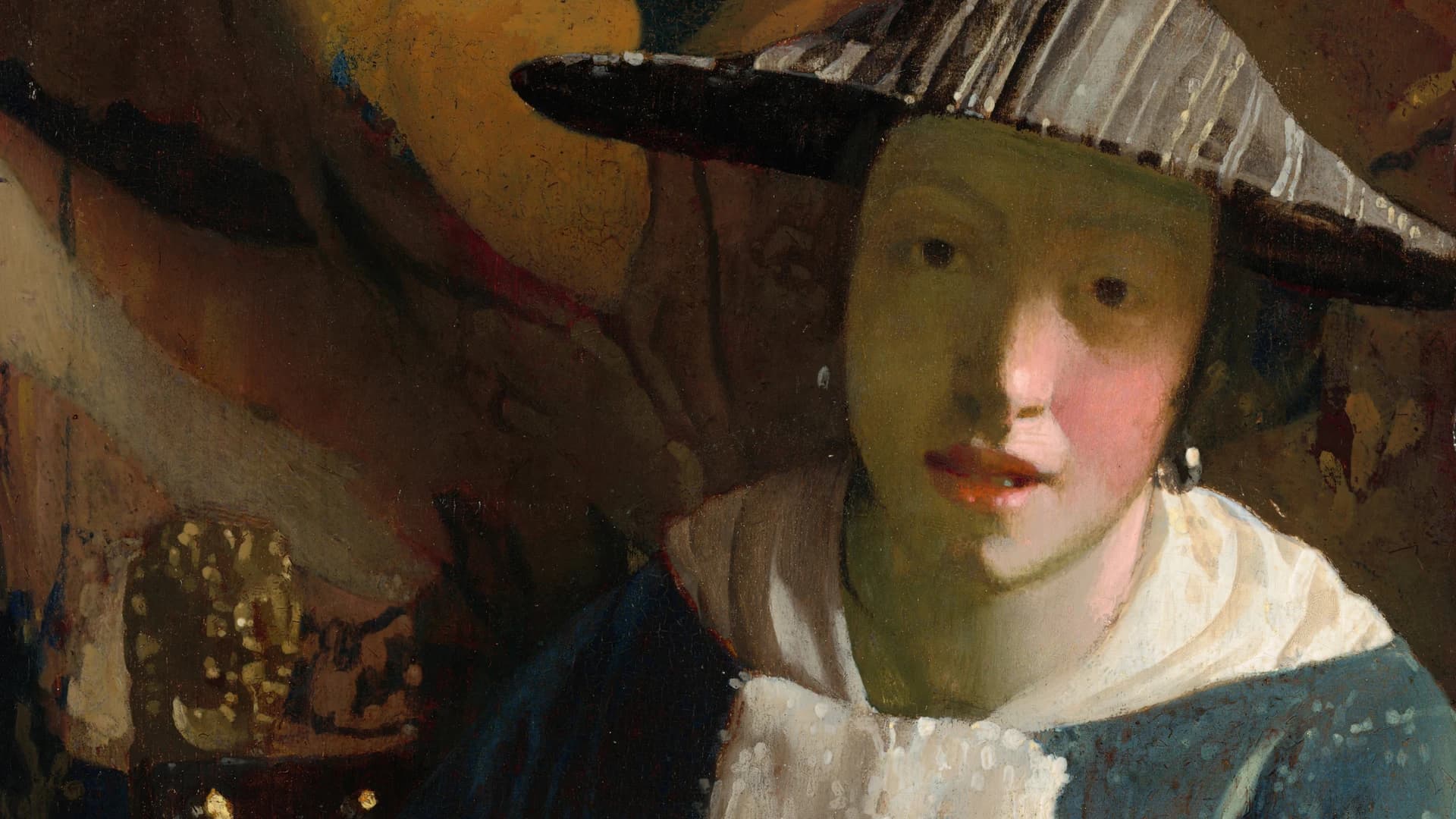
A Lady Writing
About this painting
Painted in the mid-1660s, A Lady Writing shows a young woman in a lemon-yellow jacket who pauses mid-letter and turns her head to look directly out at the viewer, with the suggestion of a smile. The corner composition centers her face and makes the meeting of her eyes the heart of the picture, which has led some to ask whether the work edges toward portraiture rather than pure genre.
The yellow jacket and the pearls
The fur-trimmed yellow jacket is one of Vermeer’s recurring studio properties, appearing in roughly five of his pictures and matching the “yellow satin mantle with white fur trimmings” listed in the artist’s 1676 inventory; the trim is more likely cat, squirrel, or mouse than the ermine of older descriptions. Her pearl jewelry and the strand of pearls with a lemon-yellow ribbon on the table reappear in Woman Holding a Balance, and the woman has sometimes been identified, without firm evidence, as Vermeer’s wife Catharina.
The still life behind her
A writing set and a dark, probably Indo-Portuguese ebony box sit on the table before her. On the back wall hangs a vanitas still life with a large bass viol and a skull, which scholars connect to a painting recorded in Vermeer’s posthumous inventory; its theme of mortality plays quietly against the luxury and intimacy of the scene.
Light and technique
Vermeer builds the luminous jacket from two preparations of lead-tin yellow, the highlights laid on in thick impasto, while the whitewashed wall is modulated in thin grays so that raking light seems to graze its uneven plaster. X-ray examination shows that he adjusted the angle of the quill and the contour of the hand, a sign that the figure is reviewing or pausing over her letter rather than setting down fresh words.
From Delft to Washington
The painting most likely belonged to Vermeer’s Delft patron Pieter Claesz van Ruijven and passed through his heirs to the 1696 Dissius sale in Amsterdam. After a long line of European and American owners, including the banker J. Pierpont Morgan, it was given by Horace Havemeyer’s family to the National Gallery of Art in Washington in 1962.
- Date
- 1662–1667
- Medium
- Oil on canvas
- Dimensions
- 45 × 39.9 cm