The Lacemaker
ForgeryAbout this painting
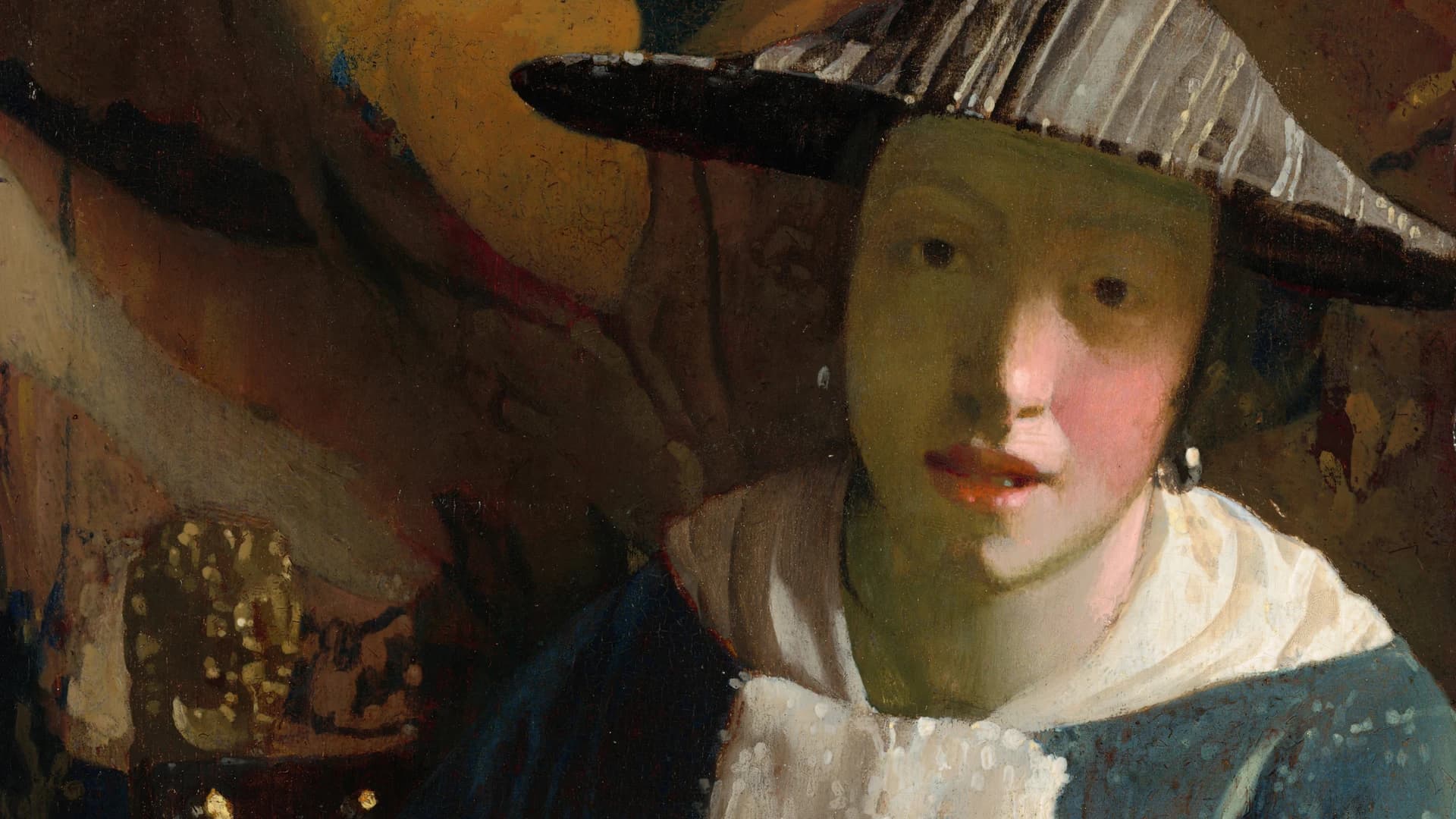
This small Lacemaker is not a Vermeer at all but a twentieth-century forgery, painted around 1925 in the manner of the Delft master and now catalogued by the National Gallery of Art in Washington as the work of an imitator of Johannes Vermeer. It is generally attributed to Theodorus (Theo) van Wijngaarden, a Dutch restorer and forger who was a friend and partner of Han van Meegeren. It should not be confused with Vermeer’s autograph Lacemaker in the Louvre, whose intent, intimate image of a young woman bent over her bobbins it loosely echoes.
A companion to the Smiling Girl
The picture has a twin in deceit. It was conceived as a companion to The Smiling Girl, a second false Vermeer of the same moment and circle, and the two were long treated as a pair. Where the Smiling Girl borrowed the look of Girl with a Pearl Earring, this canvas reached instead for the quiet domestic subject of the Louvre Lacemaker, a combination calculated to flatter the taste of collectors then hungry for new Vermeers.
Sold to Mellon as a Vermeer
The deception worked. The painting passed through the dealers Duveen Brothers and was bought in 1927 by the American financier Andrew W. Mellon as an autograph Vermeer. It came to the National Gallery of Art with the Mellon gift in 1937, as accession 1937.1.54, and was for decades shown there as the real thing. Connoisseurship and laboratory study eventually told against it: in his 1995 account of the two forgeries, Arthur K. Wheelock Jr. set out the case for a modern hand, and the Gallery reclassified the picture as the work of an imitator rather than of Vermeer himself.
- Date
- 1925
- Medium
- Oil on canvas
- Dimensions
- 23.8 × 18.4 cm