Girl with a Red Hat
About this painting
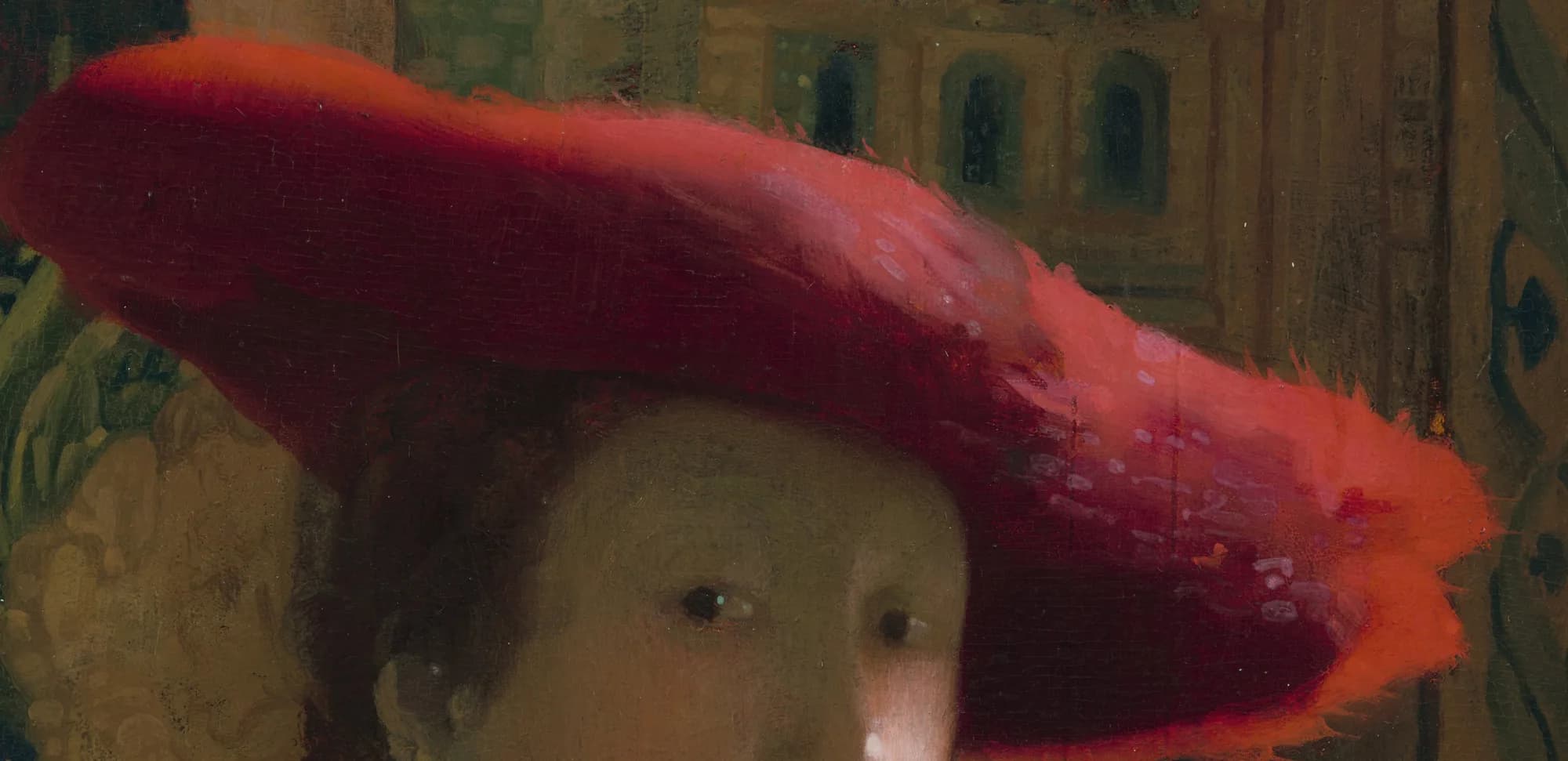
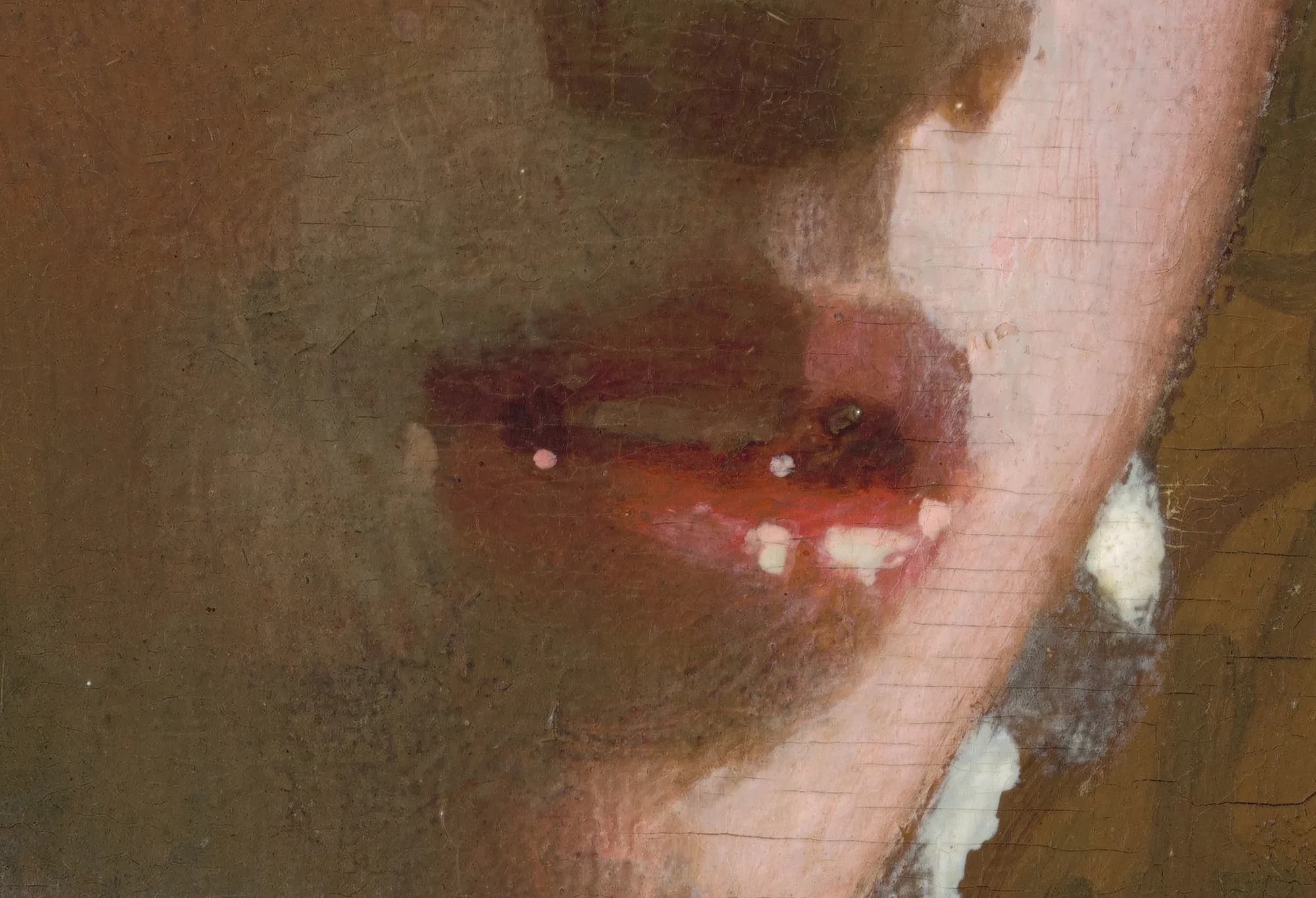
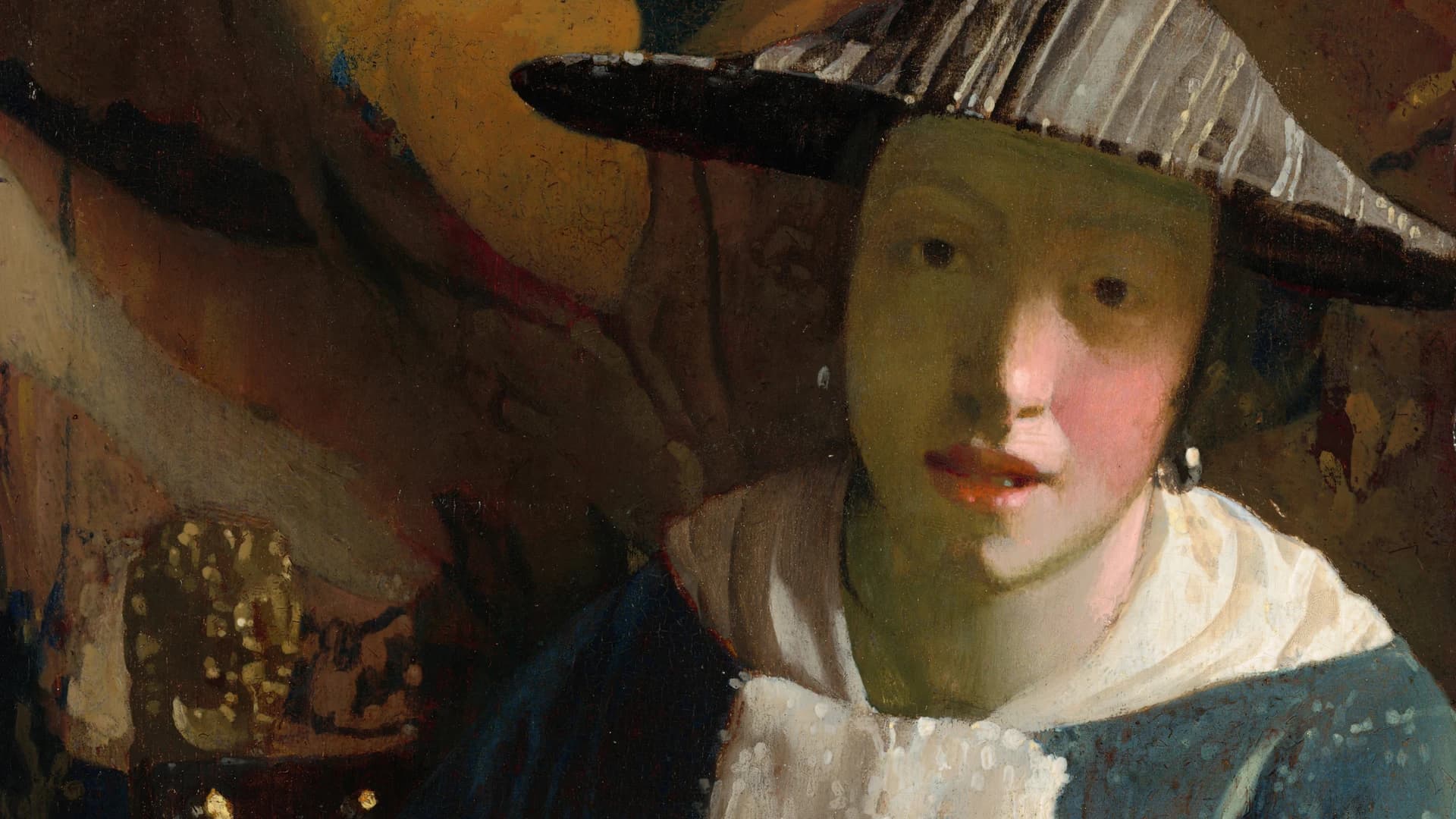
Painted around 1665–1667, Girl with a Red Hat is a small tronie, a Dutch study of a fancifully dressed model rather than a commissioned likeness of an identifiable sitter. A young woman in a brilliantly lit, plumed red hat turns toward the viewer over the back of a tapestry-draped chair, her lips parted and a single pearl glinting at her ear. At roughly nine by seven inches it is one of only two paintings generally attributed to Vermeer that are painted on panel rather than canvas, the other being Girl with a Flute.
A reused panel hidden beneath the surface
Beneath the girl, X-radiography has revealed an earlier, bust-length portrait of a man in a wide-brimmed hat, laid in with broad, thick brushstrokes; Vermeer turned the panel upside down before painting his own composition over it. Scholars have long debated whether that buried image was Vermeer’s own or by another hand, with Walter Liedtke doubting that the painter would have obliterated a work he admired. A multidisciplinary technical study undertaken for the National Gallery of Art’s 2022 exhibition Vermeer’s Secrets reaffirmed the attribution of the surface painting to Vermeer himself.
An unusual composition
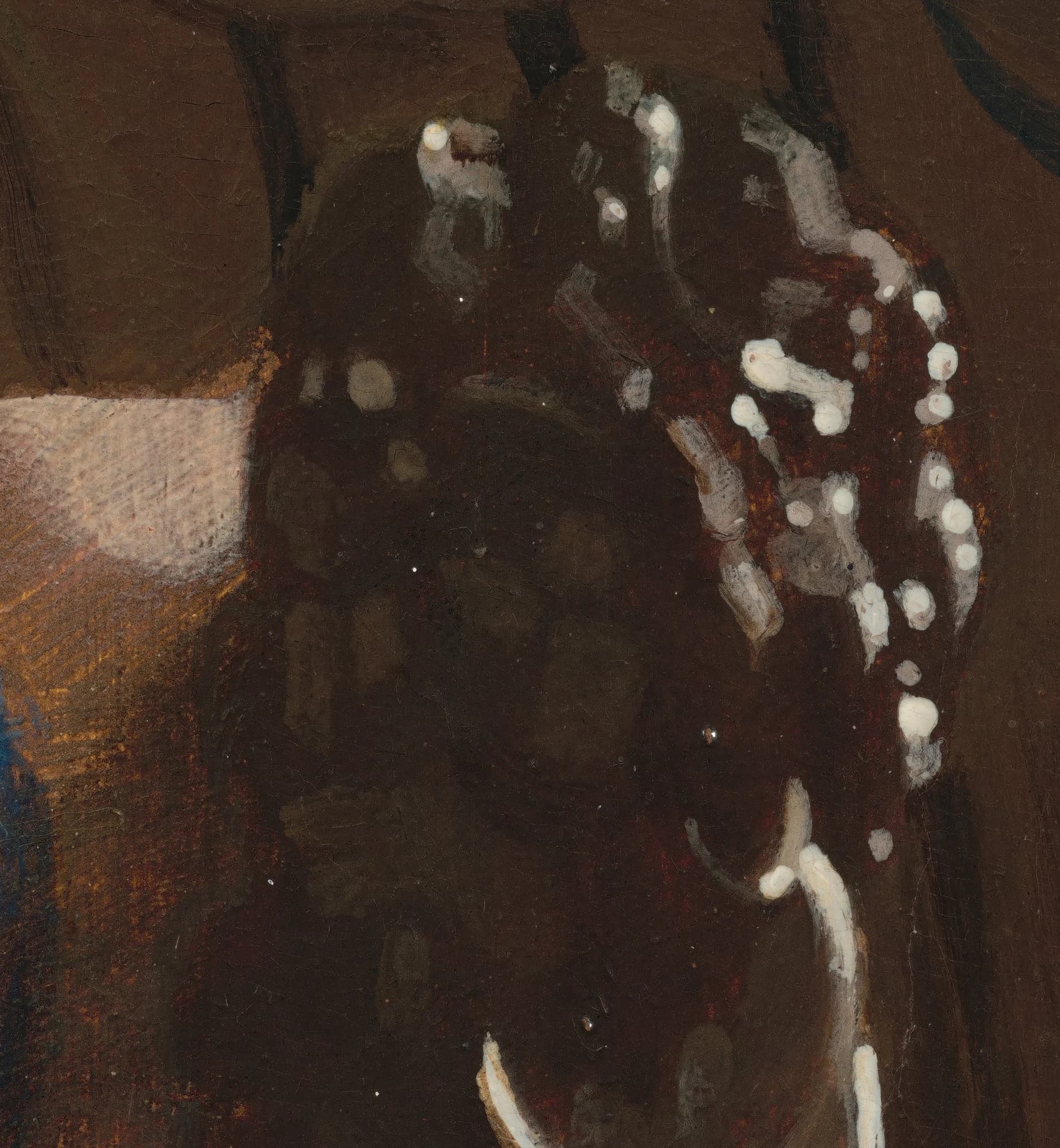
Where most of Vermeer’s women are absorbed in a world of their own, this one turns outward and meets the viewer’s gaze. The motif of a girl glancing over her shoulder recurs across his work, but nowhere else does she lean an arm on the back of a chair, and the orientation of that chair has long puzzled scholars. Because the two lion-head finials face outward rather than toward the girl, they cannot belong to the seat she occupies; the most convincing reading is that the chair faces out of the picture, its seat extending, unseen, into the viewer’s own space. The back she leans on is, in effect, the back of our chair, a repoussoir that draws us into the scene. Elsewhere Vermeer more often set an empty chair between us and his figures to hold the viewer at a polite distance; here he does the reverse, closing the gap until she seems to lean forward and speak.
Signs of a camera obscura
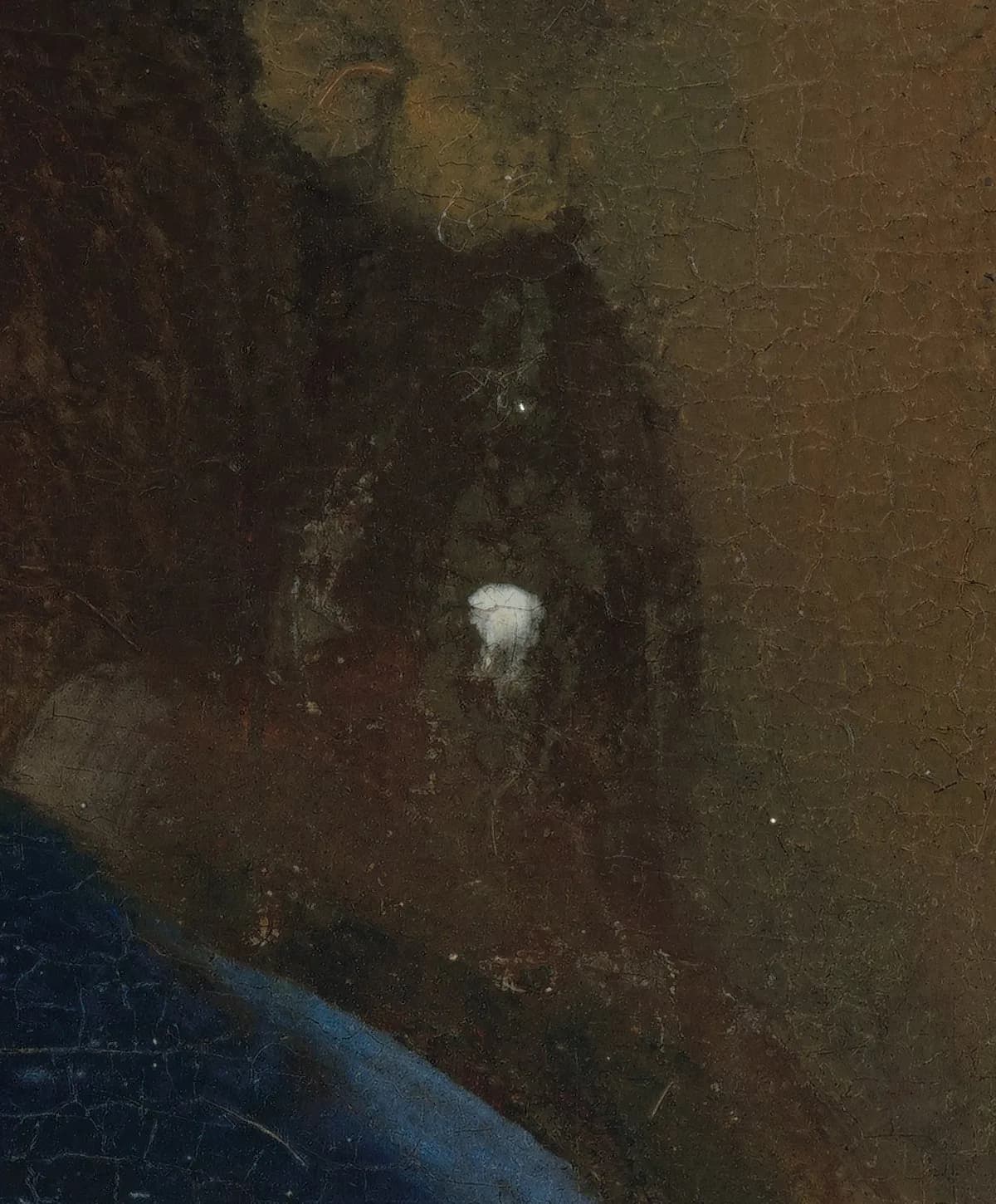
The two carved lion-head finials of the chair sit in the immediate foreground, and their fragmented tones and soft, spherical highlights are often cited as evidence that Vermeer studied the image cast by a camera obscura. Charles Seymour compared genuine nineteenth-century camera obscura images with the picture and found that the blurred, light-rimmed finials closely resembled what such an instrument produces.
How Vermeer layered the pigments
The hat’s glow was built up in stages, its form first set down in vermilion and black and then deepened with a translucent red madder glaze, while the blue-green wrap over her shoulders combines azurite with yellow ochre. For the white cravat Vermeer cut the shadows not by adding gray but by scoring into the wet white paint with the wooden tip of his brush handle to expose the darker layer beneath, one of several inventive touches that mark the picture as a deliberate experiment in rendering light.
Provenance: from the Dissius sale to Washington
The painting most likely belonged to Vermeer’s Delft patron Pieter Claesz van Ruijven and passed through his heirs to the 1696 Dissius sale in Amsterdam, where it may have been one of the three tronien listed together as lots 38, 39 and 40. It surfaced again at the La Fontaine sale in Paris in 1822, then spent nearly a century with the Atthalin family of Colmar before the dealers Knoedler brought it to Andrew W. Mellon, whose collection formed the founding gift of the National Gallery of Art in Washington in 1937. A companion panel of similar scale, Girl with a Flute, hangs in the same collection and has figured in the recent technical study of Vermeer’s working methods.
- Date
- 1665–1667
- Medium
- Oil on panel
- Dimensions
- 23.2 × 18.1 cm