Girl with a Flute
DisputedAbout this painting
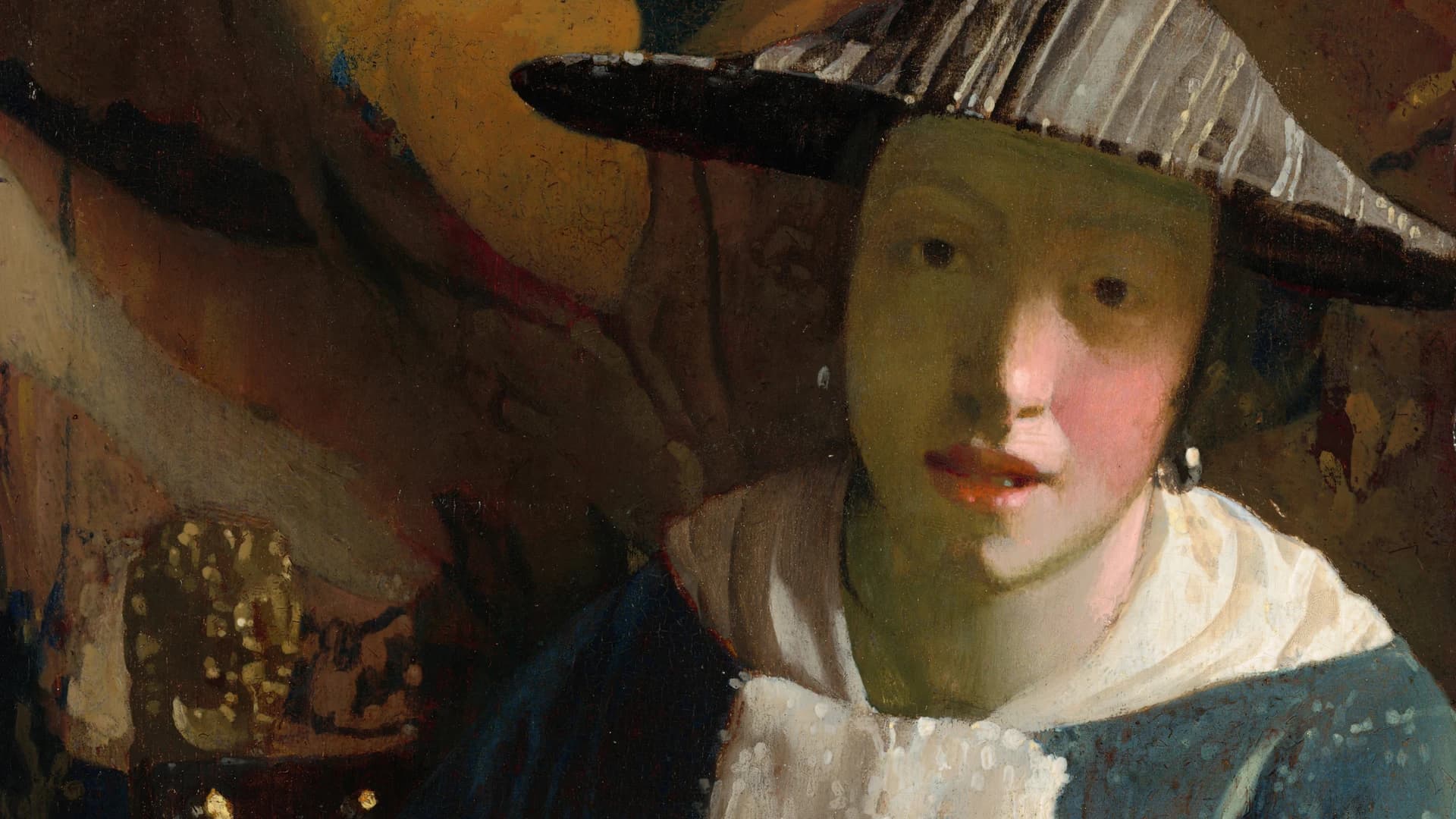
A small tronie on oak panel, barely eight by seven inches, showing a young figure in a conical striped hat and a fur-trimmed jacket, holding a recorder. A tronie is not a portrait but a study of a head or stock character in costume, made for the open market rather than to commission. The wide brim throws the eyes into shadow, a Rembrandtesque device, while the parallel stripes of the hat sit oddly against the rules of perspective.
A pendant to the Red Hat
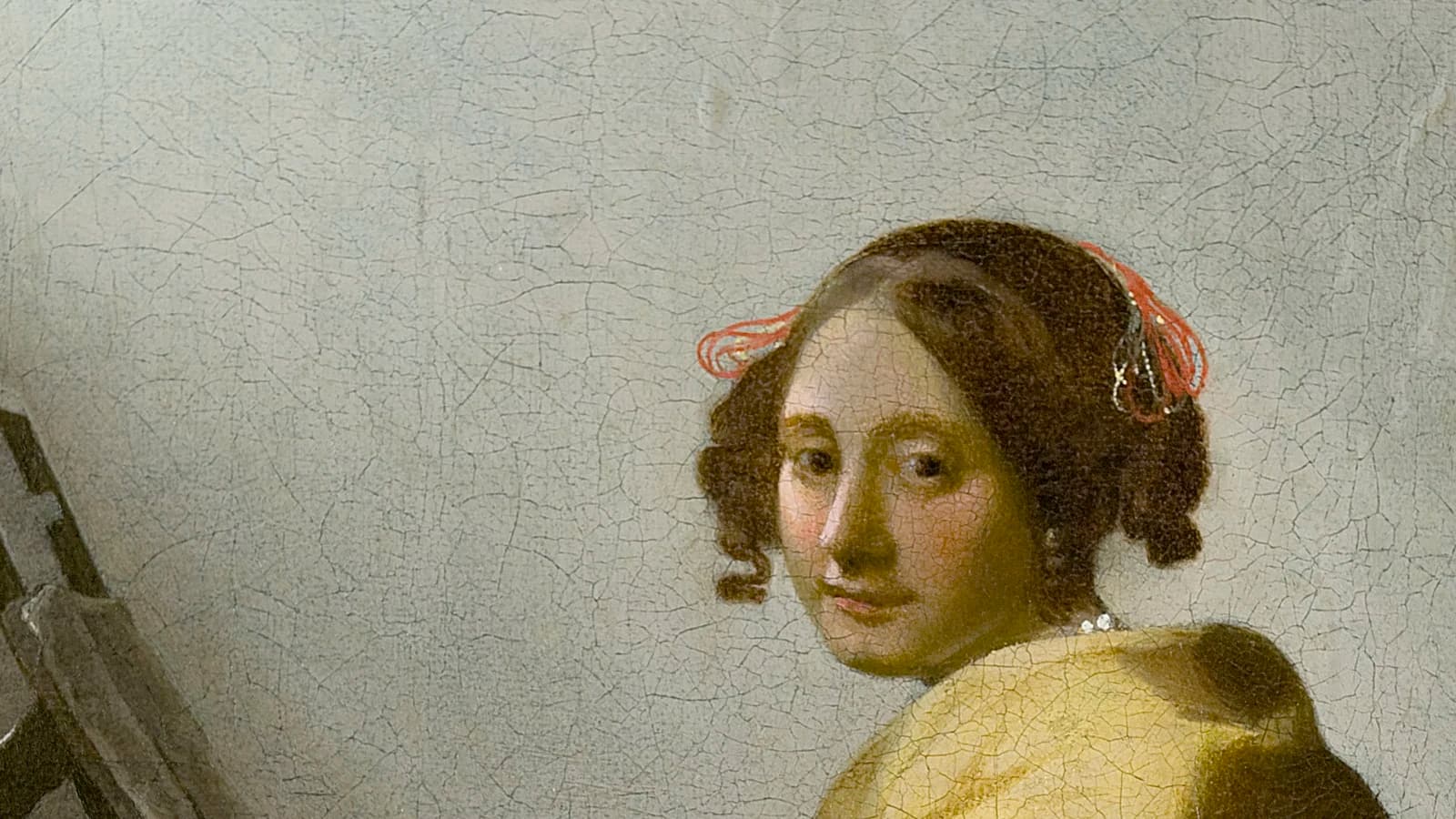
The picture is closely bound up with Girl with a Red Hat, the only other small panel associated with Vermeer. The two share a tapestry-like background, a lion-finial chair, exotic headwear, and the same cool, turquoise-tinted treatment of the lips, and are often discussed as a pair. The Red Hat, slightly larger, remains attributed to Vermeer, which sharpens the question of who painted its companion.
The 2022 reattribution
For most of the twentieth century the work passed as Vermeer, but a technical study undertaken by the National Gallery of Art in Washington reached a different conclusion. Using microscopic pigment analysis and advanced imaging, the research team led by Marjorie Wieseman found what they described as flaws in every layer of the picture: an underdrawing, ground, and paint handling unlike Vermeer’s, with passages that pooled and almost dripped rather than being laid down with his usual delicacy. X-radiography showed that the fur panel of the jacket was added at a late stage, and the finger on the recorder appeared not to be by Vermeer’s hand.
A disputed verdict
In 2022 the Gallery presented these findings in the exhibition Vermeer’s Secrets and revised the attribution to a contemporary working in close association with Vermeer, perhaps a pupil, an assistant, or a member of his household. Not everyone accepted the verdict. The following year the Rijksmuseum’s landmark Vermeer retrospective hung the panel as an autograph work, with its curators pointing to pentimenti and stylistic ties to accepted paintings, so the picture sits today between two respected institutional positions.
Attribution debate
The Vermeer attribution was accepted through most of the twentieth century and championed by Arthur K. Wheelock Jr., the National Gallery of Art’s Curator of Northern Baroque Paintings, who included the work in his catalogue raisonné. Earlier generations of scholars, including Wilhelm von Bode and Abraham Bredius, had likewise accepted it without reservation.
Technical examination carried out in connection with the NGA’s 2021 study of Vermeer’s working methods revealed anomalies in the underdrawing, ground preparation, and paint application that set the picture apart from Vermeer’s securely autograph works. Infrared reflectography found none of the compositional adjustments typical of Vermeer’s process. In 2022 the NGA revised its attribution to “An Associate of Johannes Vermeer,” the first major institutional reversal of a Vermeer attribution in decades. Wheelock himself endorsed the conclusion. Some independent scholars continue to accept autograph status.
- Date
- 1665–1670
- Medium
- Oil on panel
- Dimensions
- 20 × 17.8 cm