The 2022 Examination of The Milkmaid
Vermeer's Milkmaid stands against a famously bare wall. In 2022 the Rijksmuseum scanned through the paint and found the things he had taken out: a rack of jugs and a basket for warming a baby.
The emptiness was the point
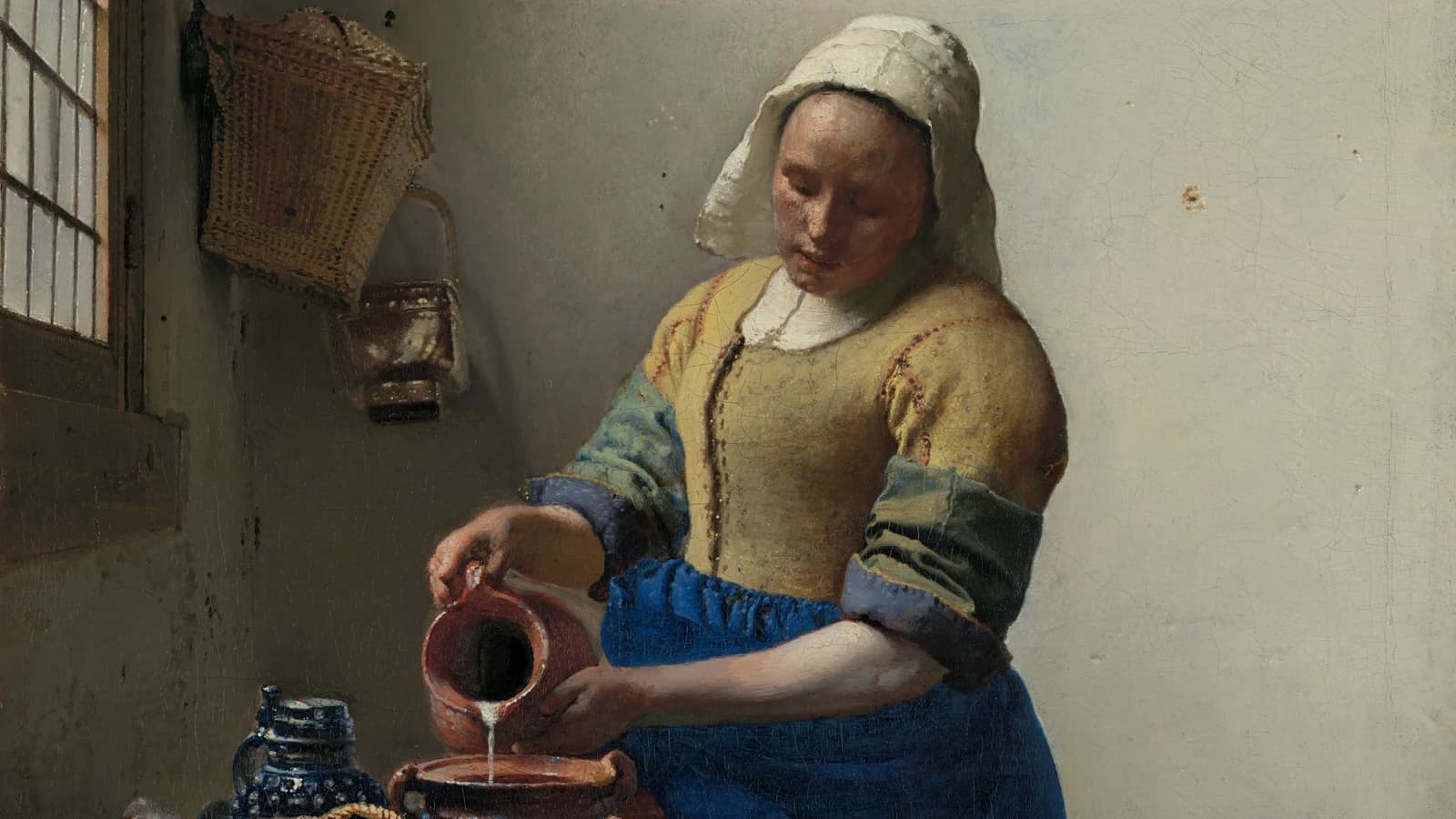
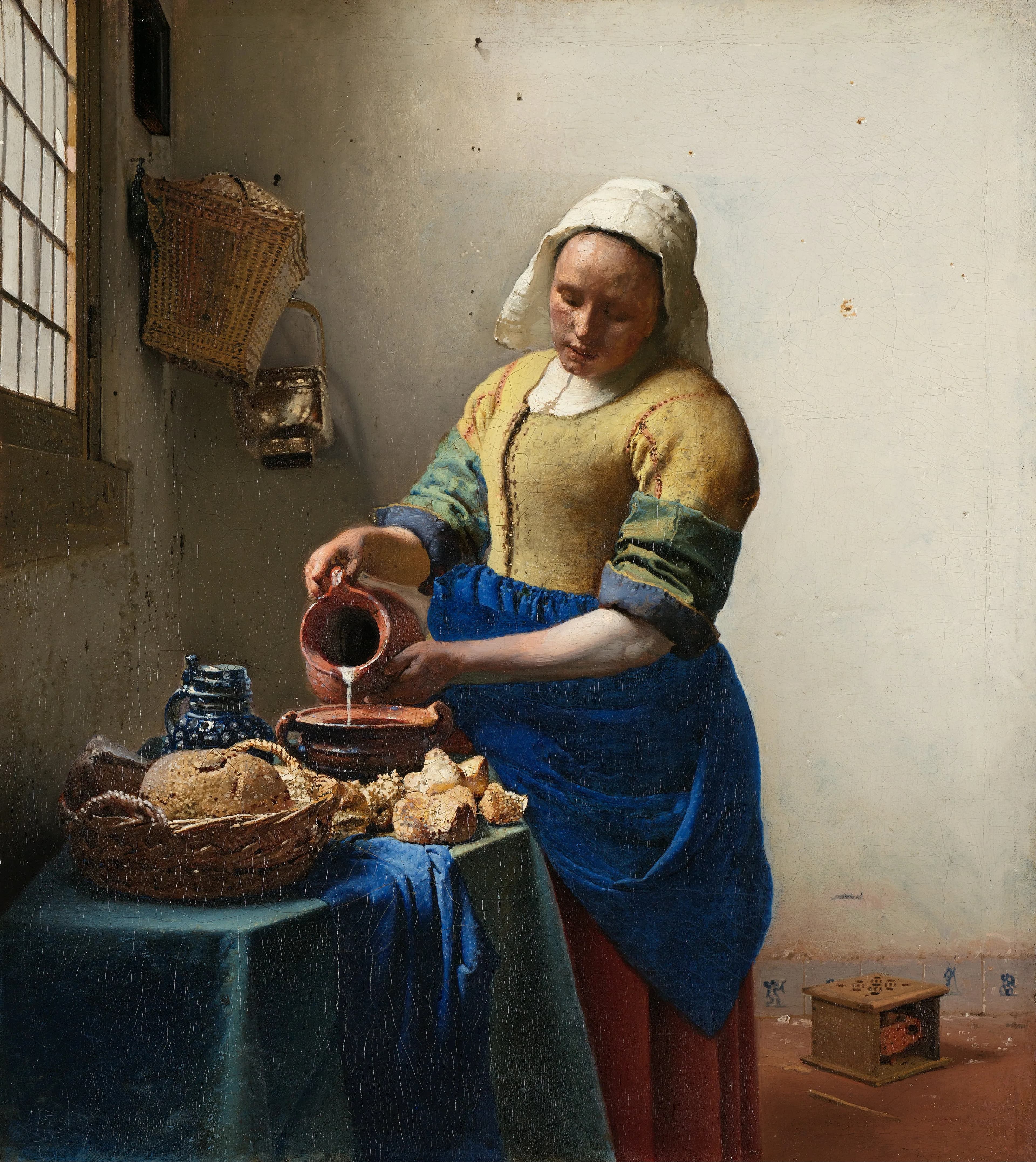
Part of what makes The Milkmaid so quietly monumental is how little is in it. A sturdy young woman pours a thin thread of milk into a bowl, a basket and a loaf of bread on the table in front of her, and behind her a large, plain, sunlit wall. Painted around 1658 to 1659, it is a picture built on subtraction: one figure, one task, almost nothing to distract from either.
It turns out that emptiness was earned. In September 2022 the Rijksmuseum, which has owned the painting since 1908, announced that new scans had seen straight through the surface and found two everyday objects Vermeer had drawn in and then painted out, a rack for hanging jugs and a basket for warming a baby. He had cleared the room himself.
Seeing through the paint
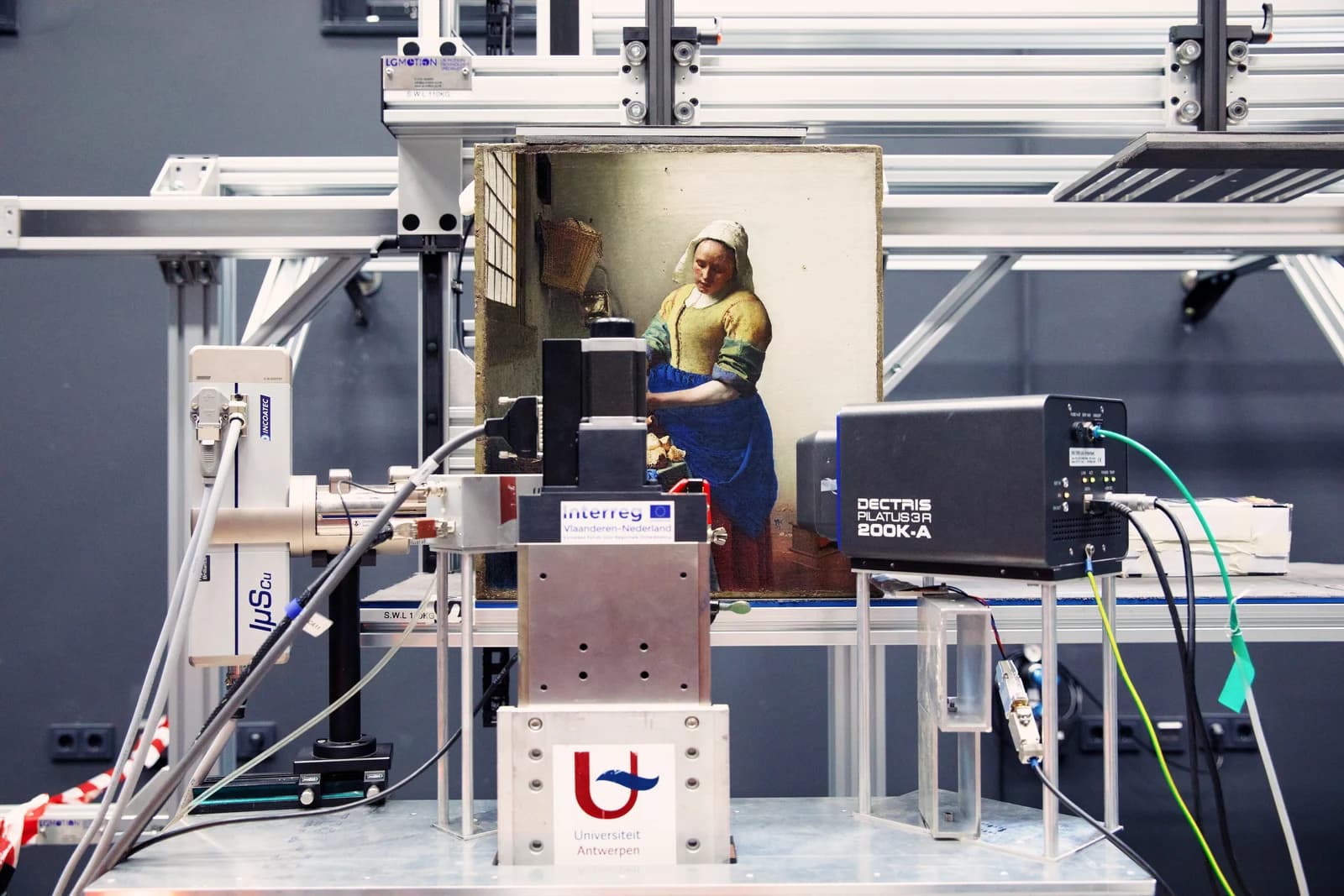
The tools were the same family the Rijksmuseum had just used on Rembrandt’s Night Watch. Macro X-ray fluorescence scanning, or MA-XRF, sweeps the whole canvas and maps where each chemical element sits, so a buried layer betrays itself by its materials. Alongside it, reflectance imaging and short-wave infrared reflectography reach down past the upper paint to the dark underdrawing. The scanning was done with the University of Antwerp. The surface itself was left untouched; the buried objects were read through the paint that still covers them.
None of this was the first attempt. Older X-rays had registered faint shapes in these very spots, and the changes to the composition were already discussed when the painting travelled to the Metropolitan Museum of Art in New York in 2009. But the earlier imaging could not say what the shapes were. The newer scans finally made them legible.
A rack of jugs on the wall
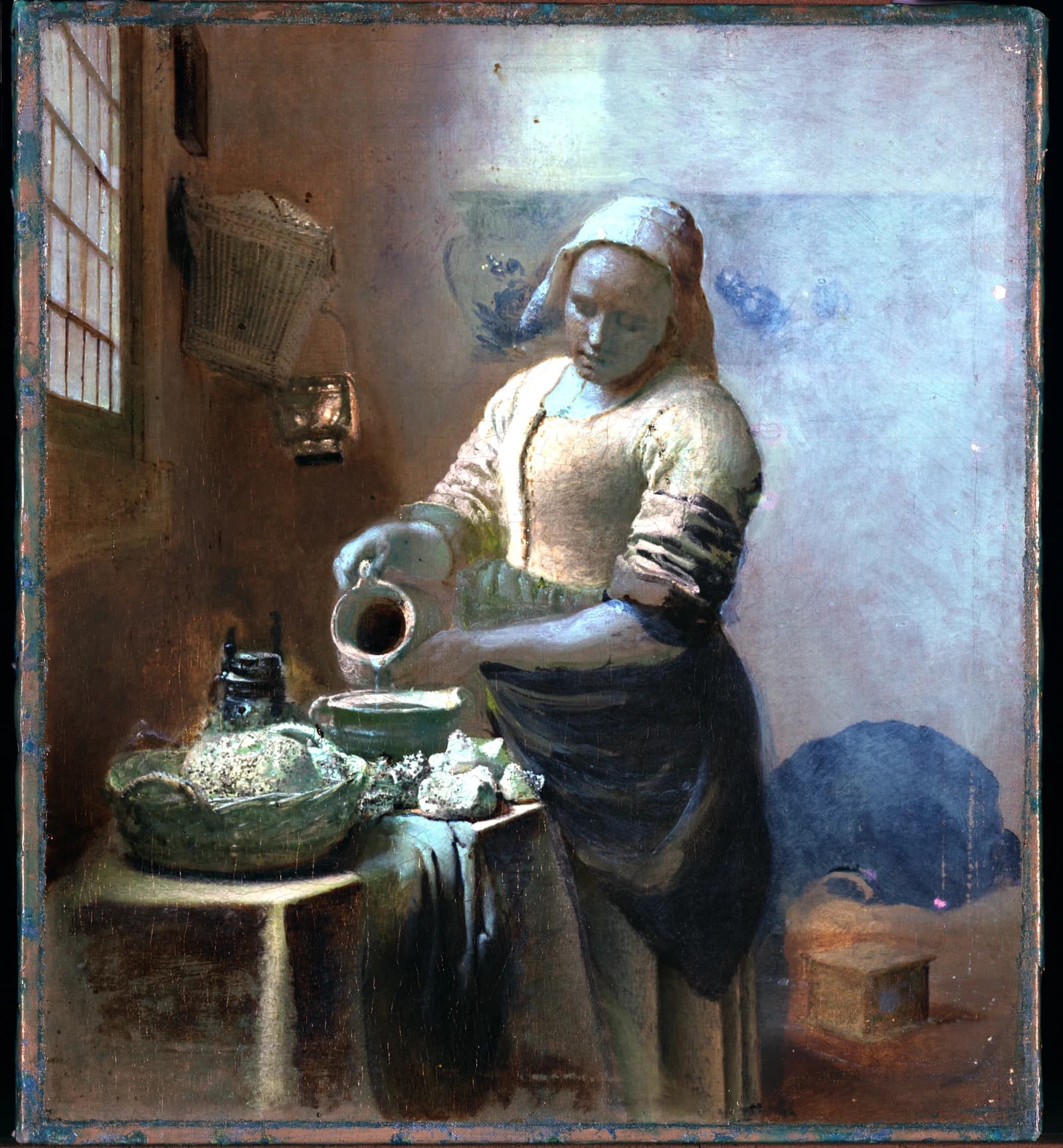
The first thing the scans turned up was on the wall behind the maid’s head, where now there is only bare plaster. Vermeer had sketched a jug holder there in black paint, a plank of wood fitted with knobs so that several ceramic jugs could hang from it by their handles, the kind of thing that lined a working seventeenth-century kitchen. He drew it in and went no further, painting it out before it was ever finished.
It was a real object, not an invention. A near-identical rack of hanging jugs survives in the famous dolls’ house of Petronella Oortman, also in the Rijksmuseum, a tiny model of a wealthy Dutch home of the period. Vermeer was sketching the ordinary furniture of the rooms he lived in, then deciding the picture was better without it.
A basket for a baby
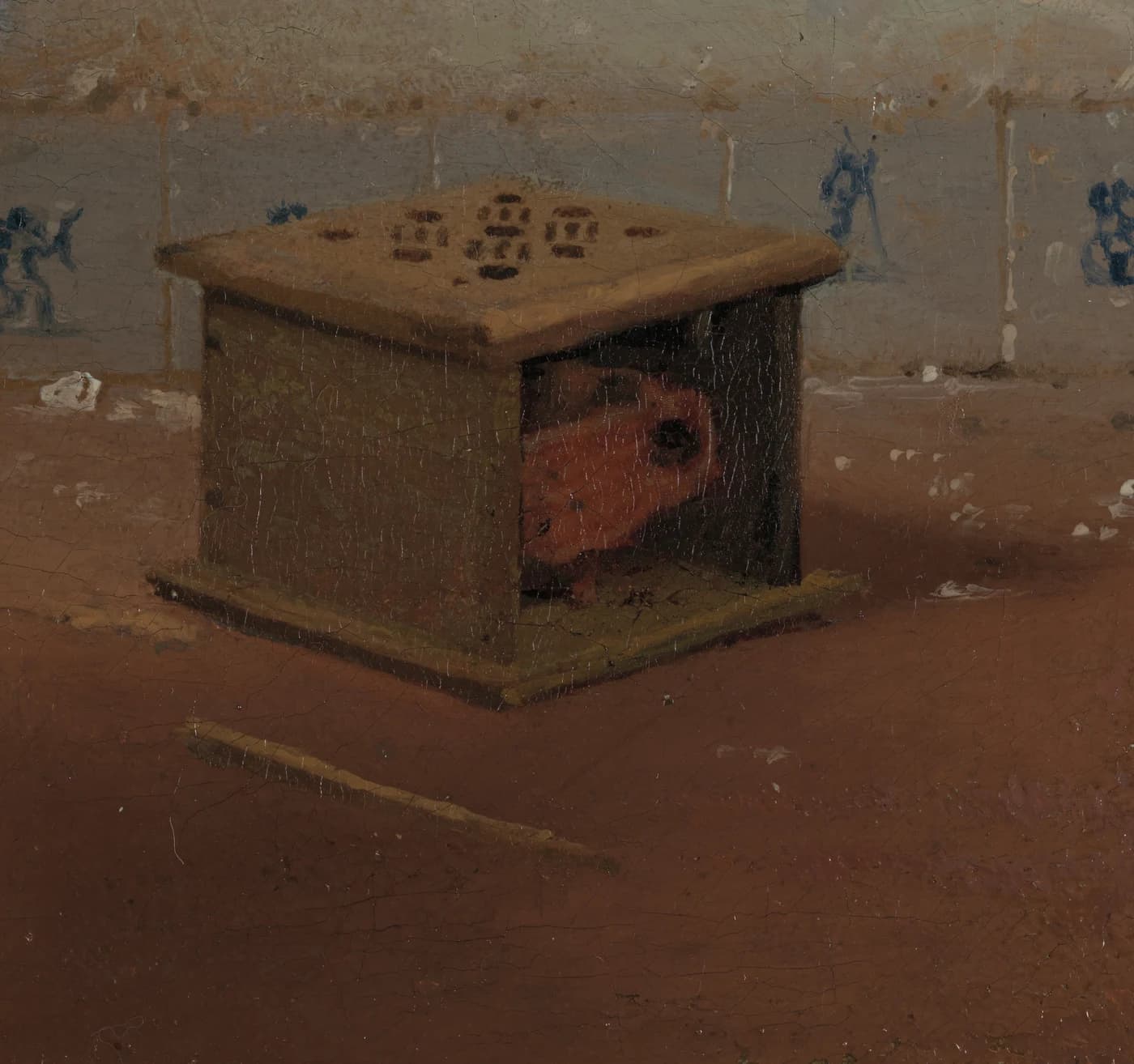
The second object sat in the lower right corner, where the finished painting shows a small wooden foot stove and a row of blue Delftware tiles along the floor. Beneath them the scans found a basket, and the museum could now identify it properly. What had been loosely read in the past as a clothes basket is a fire basket, a vuurmand, woven from willow stems into a tall domed cage that held a pot of glowing coals.
These were used to warm women in childbed and to dry an infant’s swaddling clothes over the heat. The detail lands close to home: an inventory of Vermeer’s own estate lists just such a basket, in a house he shared with a large family of children. He had it in mind, set it into the corner, and then covered it with the foot stove, the tiles and the floor.
How Vermeer began
The scans did more than recover two props. They caught Vermeer in the act of starting. Running underneath the maid’s left arm is a thick, hastily brushed line of black paint, and a similar rough sketch lies under the wall behind her. He blocked the whole scene out in broad strokes of light and dark first, and only then worked the detail up on top.
That cuts against a long-held picture of Vermeer as a painter who inched forward with extreme precision from the very first mark. The underdrawing shows a quicker, more decisive opening move, a fast tonal map laid down before the slow refinement began. For a body of work as small and as studied as his, a glimpse of the rough first stage is rare.
So much work had already been done on the painting that we never anticipated something so definitive would surface thanks to modern technology.
The Rijksmuseum’s director, Taco Dibbits, put the surprise plainly: a painting this famous, examined this often, was not supposed to have anything this clear left to give up.
Less, on purpose
Put the findings together and they tell a single story about how the picture was made. Vermeer started with a fuller, busier room, a rack of jugs on the wall, a fire basket in the corner, the clutter of a real kitchen, and then took almost all of it away. The bare wall that makes the painting feel so still is not a blank he happened to leave. It is a space he cleared on purpose.
That habit of paring back runs through his work, and the timing made it public. The discoveries were announced in the run-up to the Rijksmuseum’s Vermeer exhibition in 2023, which brought together 28 of the roughly 35 surviving paintings, the largest gathering of his work ever staged.
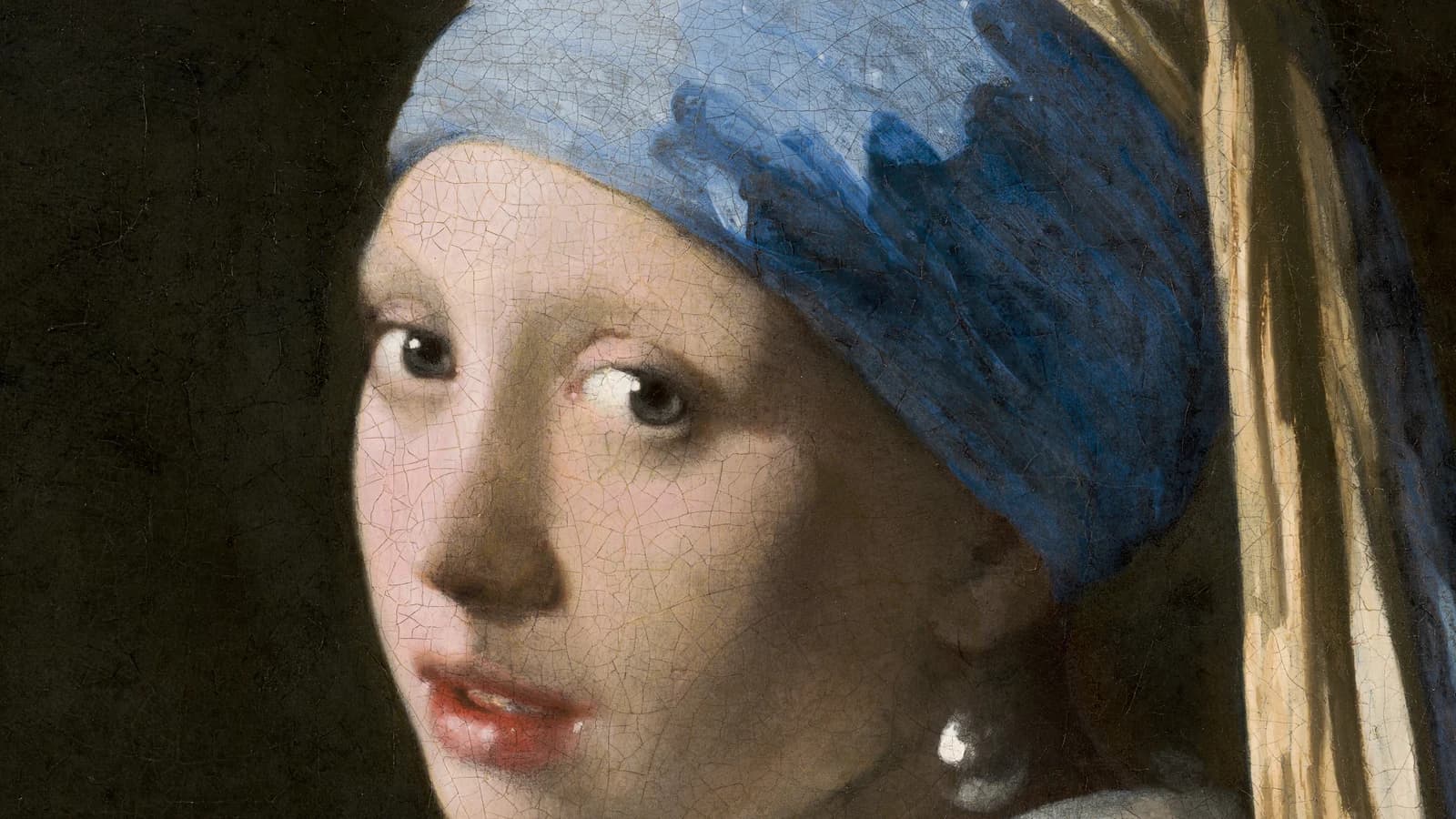
The same kind of imaging has pulled other secrets from beneath Vermeer’s surfaces. A few years earlier it found a green curtain hanging behind the Girl with a Pearl Earring, in a room everyone had taken for plain dark space.
Notes
- 1.The Rijksmuseum announced the findings on 8 September 2022, ahead of its Vermeer exhibition. See the museum’s press release, “Rijksmuseum reveals major discoveries on Vermeer’s painting The Milkmaid”, and The Art Newspaper, “Investigation of Vermeer painting reveals ‘startling discoveries’ about his technique.”
- 2.This was a non-invasive imaging study, not a cleaning or an overpaint removal: the surface was left untouched, and the buried objects were read through it rather than uncovered. The techniques are described in the Rijksmuseum press release.
- 3.Earlier X-rays had registered shapes in these areas, and Walter Liedtke’s 2009 catalogue for the Metropolitan Museum’s loan exhibition discussed the composition’s revisions, but the older imaging could not resolve what the shapes were. See Artnet News, “What Is Vermeer’s Beloved ‘Milkmaid’ Hiding?” and the catalogue Walter Liedtke, The Milkmaid by Johannes Vermeer (2009).
- 4.The 2022 study used macro X-ray fluorescence (MA-XRF), reflectance imaging spectroscopy (RIS) and short-wave infrared (SWIR) reflectography, the same family of scanners used in the Rijksmuseum’s Operation Night Watch. The scanning was carried out with the University of Antwerp. See the CODART summary of the research and the Rijksmuseum press release.
- 5.Vermeer sketched the jug holder, a plank of wood with knobs for hanging ceramic jugs by the handle, in black paint on the wall behind the maid’s head, then painted it out. A similar rack appears in Petronella Oortman’s dolls’ house, also in the Rijksmuseum. See the Rijksmuseum press release and The History Blog, “Secrets of Vermeer’s Milkmaid revealed.”
- 6.A shape long read as a clothes basket was identified as a fire basket (a vuurmand), woven from willow stems to hold a pot of glowing coals for warming infants and drying swaddling clothes; Vermeer covered it over with the foot stove, Delftware tiles and the floor. Such a basket is listed in the inventory of Vermeer’s own estate. See the Rijksmuseum press release and CODART.
- 7.A hastily applied thick black line runs beneath the maid’s left arm, and a black preliminary sketch underlies the wall behind her head, showing that Vermeer first blocked the scene out in broad light and dark before refining it. See The Art Newspaper and ARTnews, “Underpainting Discovered Beneath Johannes Vermeer ‘Milkmaid’ Painting.”
- 8.Taco Dibbits, general director of the Rijksmuseum, on the findings, quoted in the Rijksmuseum press release and The Art Newspaper.
- 9.The Rijksmuseum’s Vermeer ran from 10 February to 4 June 2023 and gathered 28 of the roughly 35 surviving paintings, the largest Vermeer show ever held. See the Rijksmuseum’s announcement of the loan list.