The Love Letter
About this painting
Painted around 1669–1670, near the end of Vermeer’s career, The Love Letter shows a maid handing a letter to her elegantly dressed mistress, who looks up expectantly with a cittern resting in her lap. The scene is glimpsed through a doorway from a dim foreground room into a brightly lit interior, so that we seem to come upon a private moment unannounced.
A view through a doorway
The composition turns on the doorkijkje, the Dutch “view through” that frames the figures within a darkened doorway and a drawn curtain at the left. The device opens up depth and casts the viewer as a covert observer, an effect heightened by the diagonal run of the checkered marble floor and the broom, discarded slippers, and wicker laundry hamper piled in the shadowed antechamber. Conservation study has shown that the hamper and the blue sewing cushion were added at a later stage, painted in over floor tiles that were already finished.
The sea as an emblem of love
Two framed pictures hang on the back wall, and both carry the theme of love and absence. The seascape above the woman’s head is the only marine painting to appear anywhere in Vermeer’s work; in seventeenth-century Dutch thought the sea was likened to love and the lover to a ship, so the calm or stormy water stands in for an absent beloved. Below it a landscape with a lone traveler in an idyllic setting echoes the same idea of separation and longing for reunion. The instrument in the mistress’s lap is a cittern rather than the lute it is often taken for, its metal strings and flat back giving a brisk, almost banjo-like sound; music in Vermeer’s interiors regularly carries associations of love.
Mistress and maid
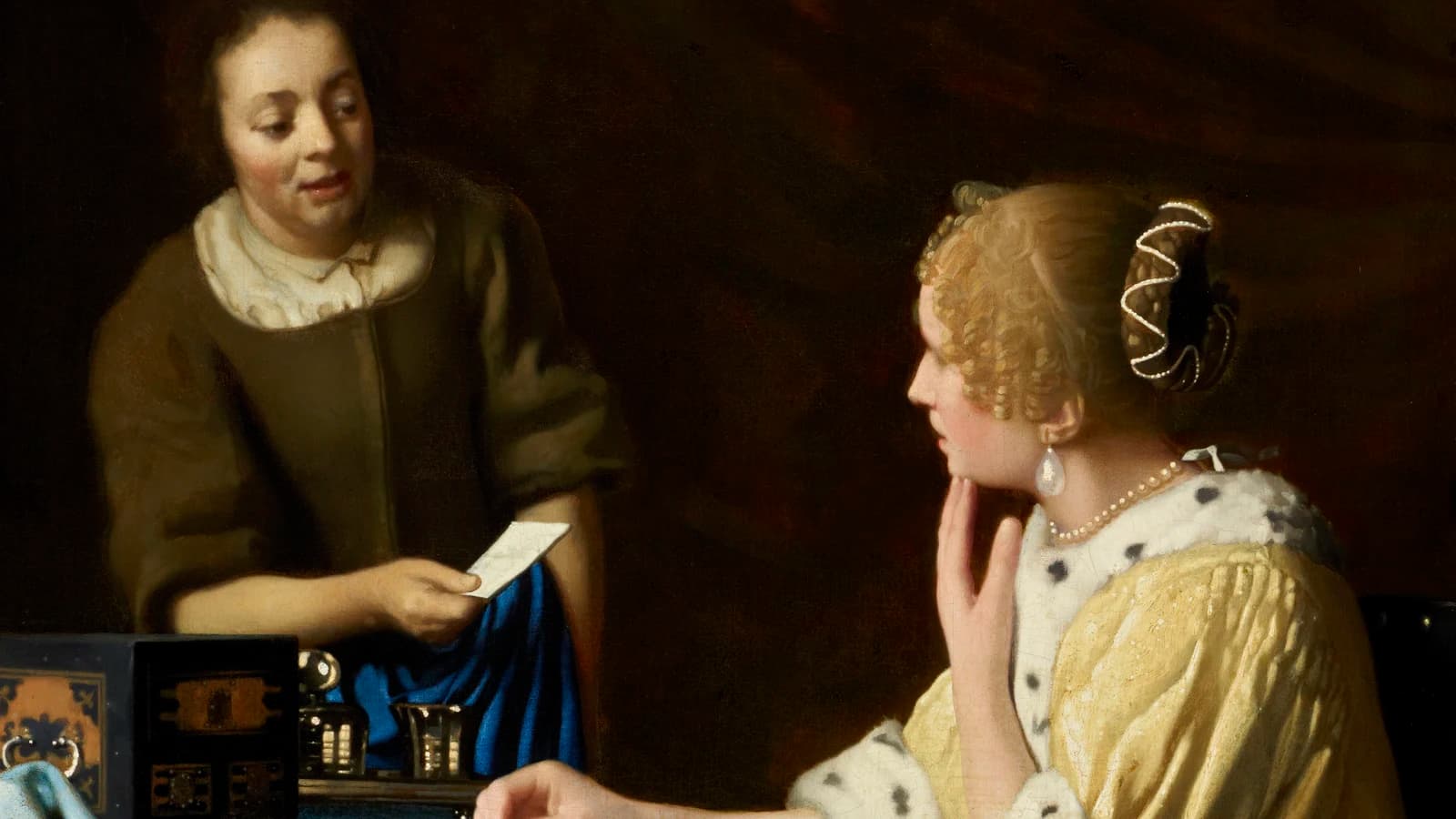
The relationship between the two women gives the picture its quiet tension. The maid stands with her arms confidently set and a faint, knowing smile, a posture the art historian Lisa Vergara notes was usually reserved for men in Dutch painting, hinting that she may grasp the letter’s contents better than her startled mistress. Vermeer returned to the bond between a letter-reading lady and her servant elsewhere, notably in Lady Writing a Letter with Her Maid and Mistress and Maid.
The 1971 theft in Brussels
On 23 September 1971 the painting was stolen while on loan to an exhibition at the Centre for Fine Arts in Brussels, cut from its stretcher by a young Belgian, Mario Pierre Roymans, who said he acted to draw attention to famine in Bangladesh and demanded a large ransom for relief. He was arrested within two weeks and the canvas was recovered on 8 October 1971, the paint loss largely confined to a narrow band along the cuts with heavier damage in the corners. After restoration it returned to the Rijksmuseum in Amsterdam, which had acquired it in 1893 and where it hangs today in the Gallery of Honour.
- Date
- 1667–1670
- Medium
- Oil on canvas
- Dimensions
- 44 × 38.5 cm
- Home
 Rijksmuseum