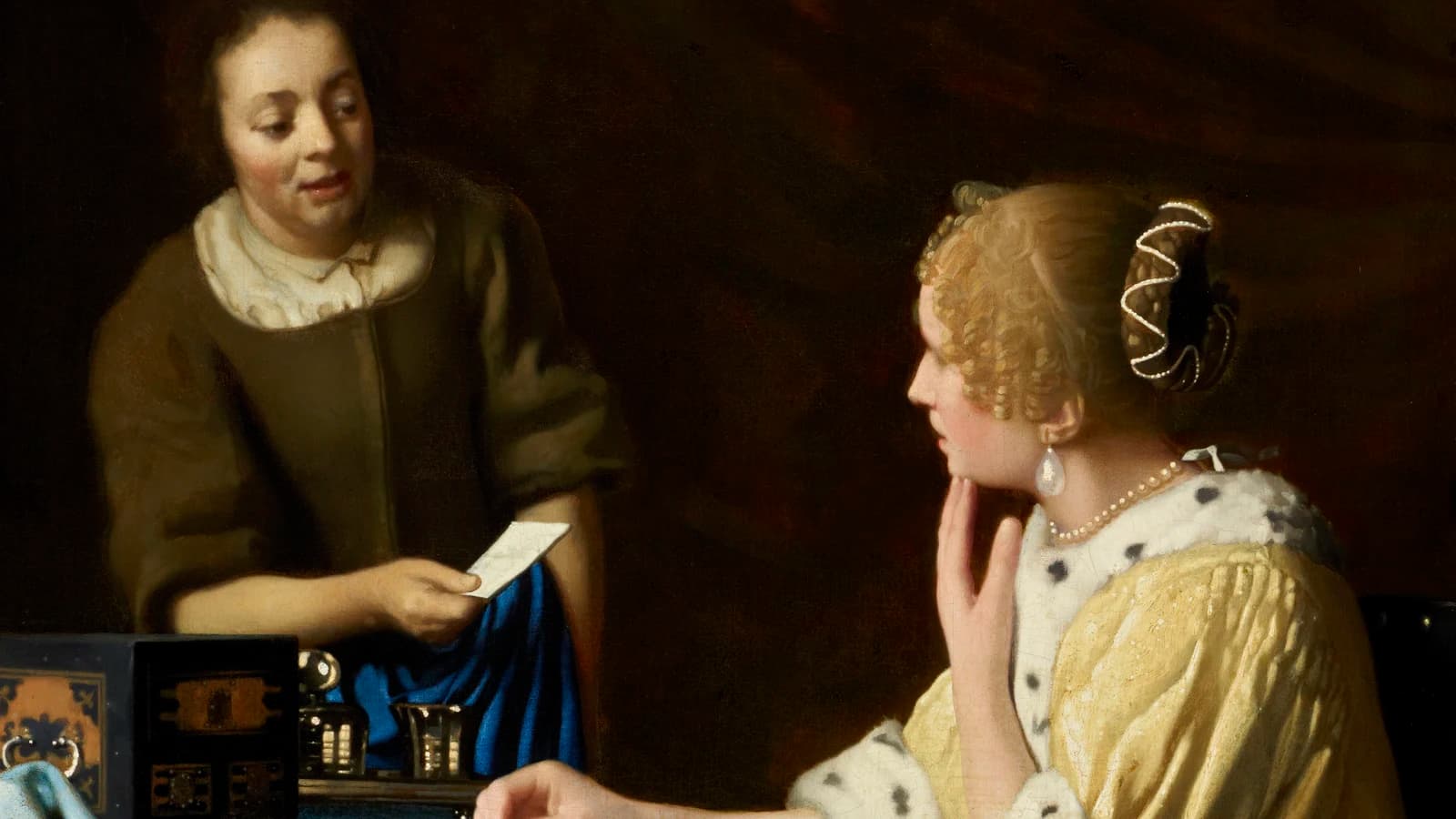
Mistress and Maid
About this painting
A seated woman in a fur-trimmed yellow jacket pauses, her fingertips lifted to her chin, as her maid leans in to hand her a letter. Painted around 1666–1667, near the height of Vermeer’s career, it is among his largest figure pieces, and the two women are the biggest figures in any of his interiors apart from The Procuress. The mistress’s parted lips and questioning hand leave the contents and consequences of the letter deliberately unresolved.
A background that changed its mind
The dark, near-black setting is unusual for Vermeer, whose interiors are normally filled with daylight and detail, and it was not his first plan. Technical examination revealed that he began with a more crowded scene: infrared and X-ray study found at least four figures, apparently a large tapestry behind the women, which he painted out in favor of a plain hanging. That hanging was originally a green curtain, now reading as black because the green pigment has darkened with age. The result throws all the light, and all the attention, onto the exchange between the two figures.
The yellow jacket and the pearl
The fur-trimmed yellow jacket appears in several other Vermeer paintings, including Lady Writing a Letter with Her Maid and Girl with a Flute, but here it is given particular care, its fur edging picked out in dark flecks and the satin caught in broad, luminous strokes of lead-tin yellow. The mistress also wears an outsized pearl earring; it is so large, and so improbably costly, that some scholars suspect it was an imitation of polished tin or glass rather than a real pearl. On the table sit a writing set and a veneered box of a type imported from Goa, small markers of the household’s wealth.
From the Dissius sale to Henry Clay Frick
Like much of Vermeer’s output, the picture is thought to have belonged to his Delft patron Pieter Claesz van Ruijven and to have descended through his heirs to the 1696 Dissius sale in Amsterdam, where it appeared as lot 7. After passing through a long line of French and English collections, it was acquired in 1919 by Henry Clay Frick, the last work he bought before his death that year, and it remains in the Frick Collection in New York.
- Date
- 1666–1668
- Medium
- Oil on canvas
- Dimensions
- 90.2 × 78.7 cm