The 2020 Examination of Mistress and Maid
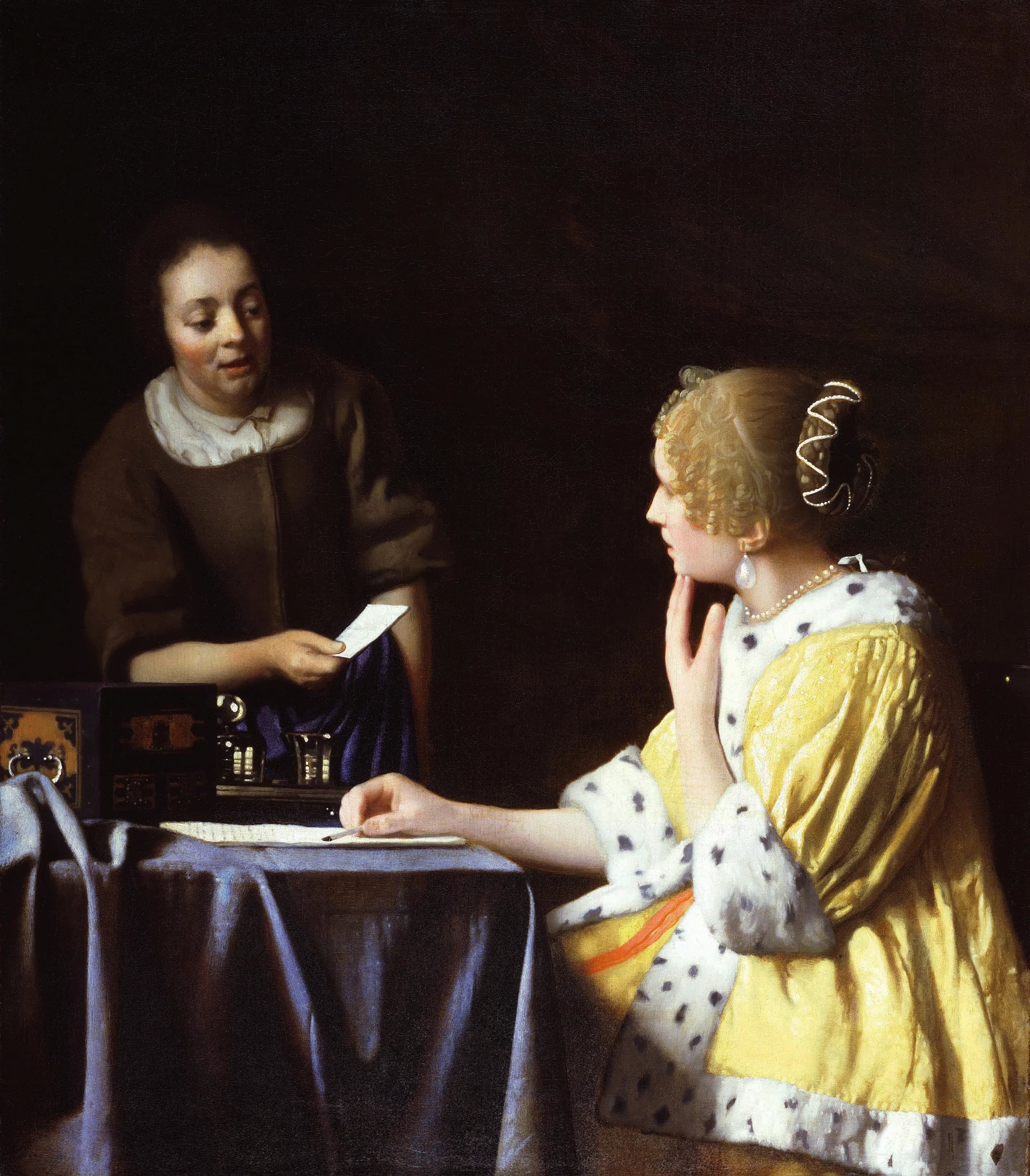
The Frick's Mistress and Maid stands against a strange, near-black void. Scientists scanning through the paint found that the darkness was once a green curtain, that four figures lie buried behind it, and that the blue tablecloth used to be green.
A picture in the dark
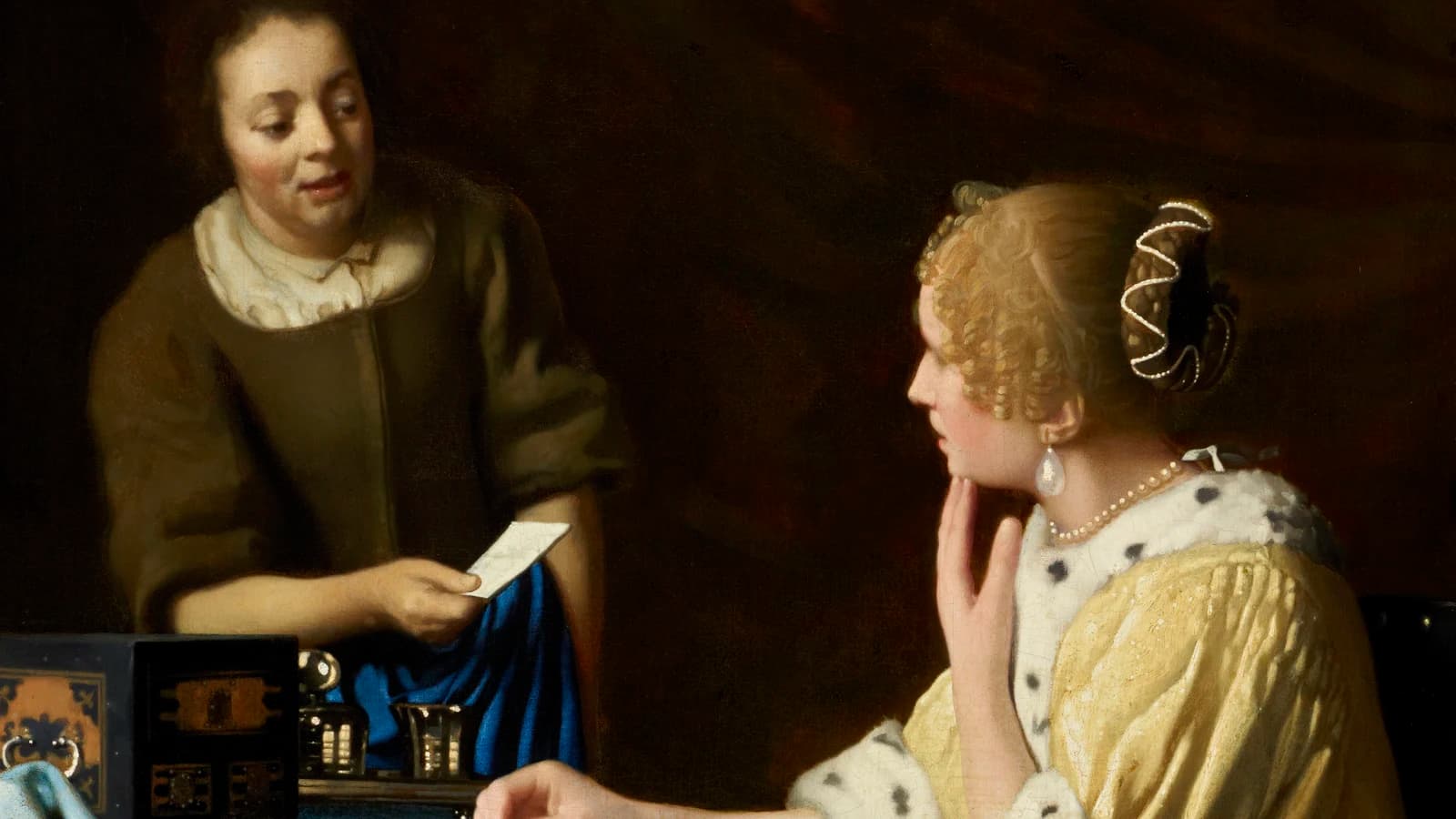
Most of Vermeer’s interiors are full of daylight. A window at the left, a pale wall, the careful furniture of a Delft house. Mistress and Maid is the great exception. A seated woman in a fur-trimmed yellow jacket pauses, her fingertips lifted to her chin, as her maid leans in to hand her a letter, and behind the two of them there is almost nothing: a deep, near-black space with no window, no wall, no detail at all.
Painted around 1666 to 1667, it is one of his largest figure pieces; the two women are the biggest figures in any of his interiors apart from The Procuress. That darkness has long puzzled viewers, and it has sometimes been read as a sign that the picture was left unfinished. A study completed in 2020 offered a different explanation. The void is not empty, and it was not always dark.
Reading the layers
Between 2017 and 2020, conservators and scientists from the Frick Collection, the Metropolitan Museum of Art and the Doerner Institut in Munich examined the painting without touching its surface. The buried layers were read through the paint that still covers them, using scanners that detect the materials lying underneath, supported by the analysis of a few tiny paint samples taken from inconspicuous edges.
What the study recovered was the sequence of choices Vermeer made on the way to the picture, and a record of what time has since done to his colours.
The curtain that had been green

The dark space is a curtain, and it was originally green. Vermeer painted it with copper-based green pigments, the kind of glaze that gave a deep, translucent colour. Those greens are notorious among conservators: pigments of the resinate, oleate and verdigris families are known to change from green to brown as they age. Over three and a half centuries the curtain has darkened and flattened, until it now reads as a formless brown void.
That is the source of the unfinished look. A green hanging with legible folds would have sat behind the women as a real piece of cloth. What we see instead is the wreckage of that passage, a colour that has collapsed in on itself. The picture is not unfinished. It has faded in a particular, chemical way.
Four figures behind the women

Before the curtain, there was something busier. Mapping the chemical elements across the canvas, the scans found that Vermeer first blocked in a large pictorial element behind the two women, either a tapestry or a painting, with at least four human figures, sketched in black and earth colours. He carried it only as far as a rough underlayer, then covered the whole thing with the plain hanging.
It is the same instinct seen elsewhere in his work, of clearing a room to concentrate attention. By replacing a crowded backdrop with a single curtain, Vermeer threw all the light and all the weight of the scene onto the exchange of the letter. The decision was deliberate. The flatness that bothers us now is the by-product of a green that did not last.
The cloth that reads blue
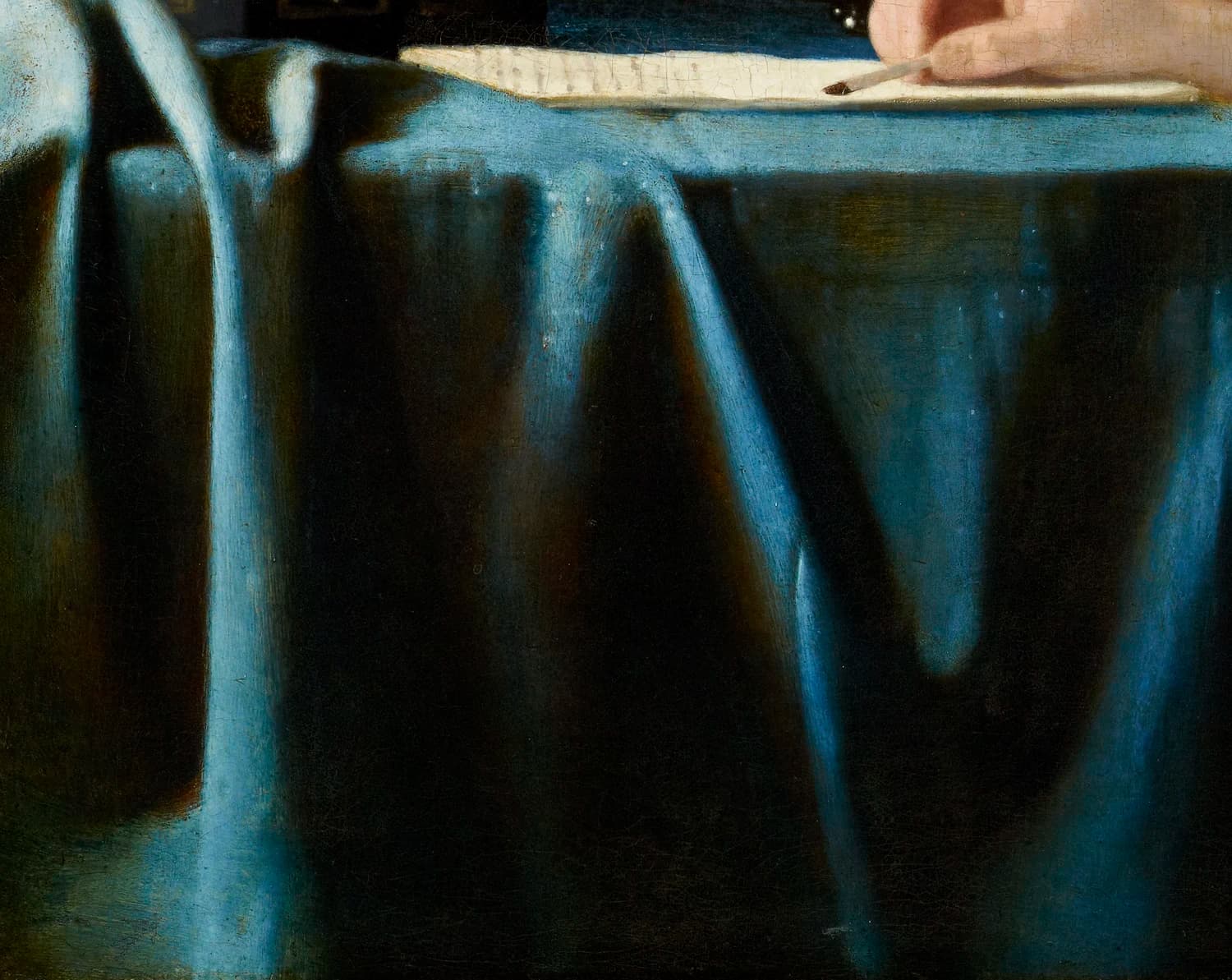
The same chemistry shows up again on the table, with a different result. The cloth that falls across the foreground reads as a cool blue today, but Vermeer mixed it as a green. He built the colour from a blue combined with a yellow lake, a translucent yellow made by fixing a plant dye onto a colourless base. The yellow has faded out over time, leaving only the blue behind.
What is striking is how differently the two passages aged. The curtain lost its very form, slumping into a brown blur, while the tablecloth kept all its modelling and still falls in convincing folds. Two greens, the same fading, and two quite separate fates for the picture.
The colours Vermeer saw
Put the findings together and the painting Vermeer finished was warmer and greener than the one that hangs at the Frick. A green curtain with soft folds stood behind the women; the cloth on the table was green rather than blue; and beneath the curtain lay the ghost of a busier first idea that he had thought better of. The drama of the picture, two women suspended around a letter, was always the point, but the room it happened in has quietly changed colour around them.
We can now confirm that this change in color and lack of form is the result of the use of a copper-based pigment, like a copper resinate.
That confirmation settles a long argument, and it also rules out an easy fix. None of this is reason to repaint the picture. The damage is in the original paint itself, not in some later varnish or overpaint that could be removed, so there is nothing to take away. The value of the study is that we can now look at the painting and supply, in the mind’s eye, the green that has gone.
On view again
The work was done largely at the Metropolitan Museum of Art, a short way up Fifth Avenue from the painting’s home, and the results were published in 2020. Since then the painting has travelled: it joined the Rijksmuseum’s record-breaking Vermeer retrospective in 2023, and after the Frick reopened from its renovation in 2025 it anchored Vermeer’s Love Letters, shown beside two other Vermeer letter scenes, The Love Letter and Woman Writing a Letter, with her Maid.
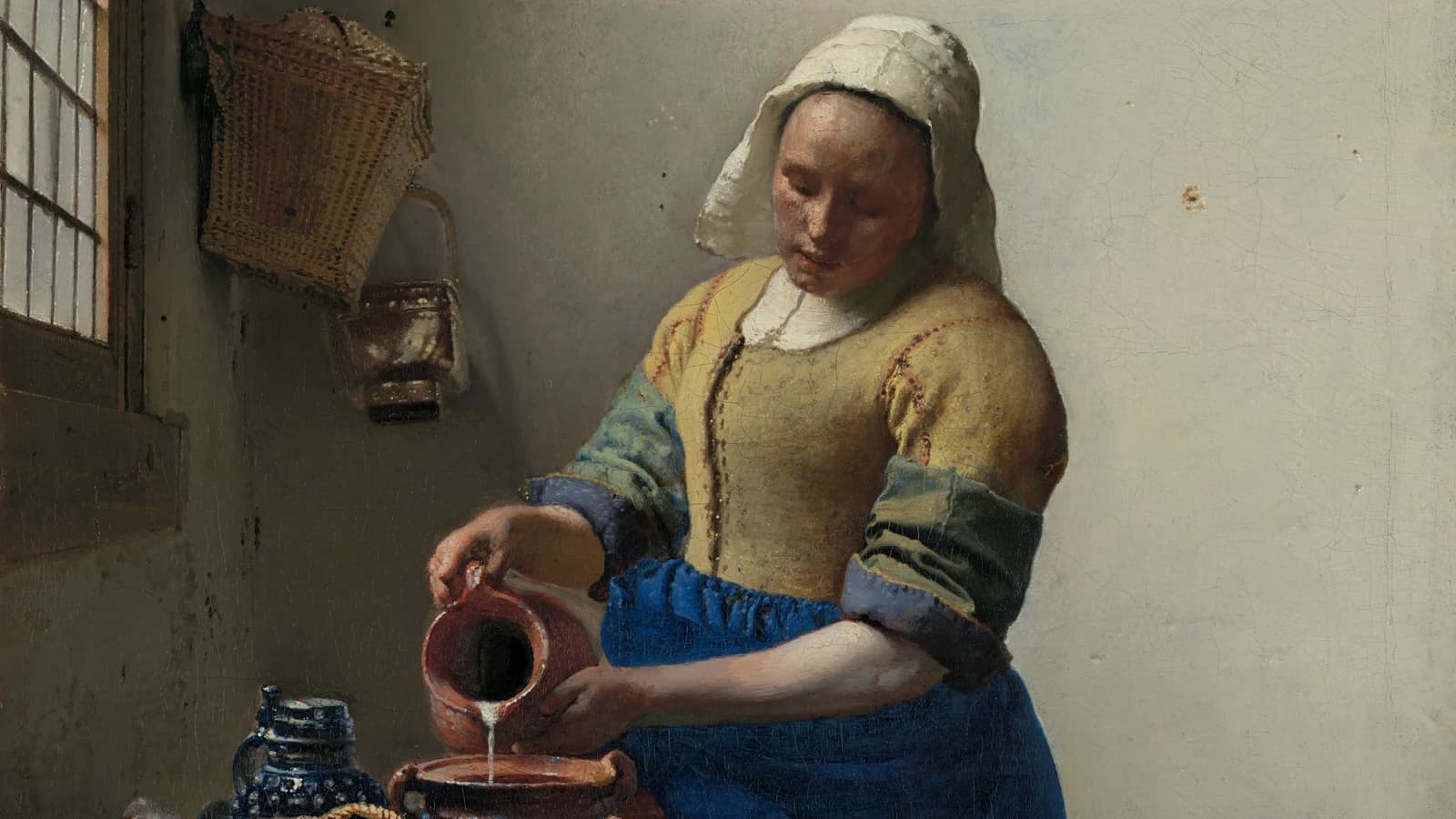
The same kind of imaging has recovered hidden things from beneath other Vermeers: a green curtain that scans found behind the Girl with a Pearl Earring, and the props he painted out of The Milkmaid. Each one shows the same painter editing his rooms down to the few things that matter.

Notes
- 1.The findings come from a technical study carried out between 2017 and 2020 by the Frick Collection, the Metropolitan Museum of Art and the Doerner Institut in Munich, published by the conservators and scientists themselves. See Dorothy Mahon, Silvia A. Centeno, Margaret Iacono, Federico Carò, Heike Stege and Andrea Obermeier, “Johannes Vermeer’s Mistress and Maid: new discoveries cast light on changes to the composition and the discoloration of some paint passages,” Heritage Science 8, no. 30 (2020), and the Metropolitan Museum’s project page on the study.
- 2.The work combined non-invasive imaging (macro X-ray fluorescence scanning, infrared reflectography and X-radiography) with the analysis of a few tiny paint cross-sections taken from inconspicuous edges. The surface itself was not cleaned or retouched. See the Heritage Science article and the Metropolitan Museum’s account of the methods.
- 3.The team identified the dark hanging as an originally green passage painted with copper-based pigments that have browned with age; greens of the resinate, oleate and verdigris families are known to shift from green to brown over time. See the Heritage Science article and the Frick Collection’s summary, “New Discoveries Offer Answers to Mystery of Frick’s Vermeer.”
- 4.The quotation is from the conservators’ and scientists’ own essay for the Metropolitan Museum, Silvia A. Centeno, Federico Carò, Dorothy Mahon, Margaret Iacono, Heike Stege and Andrea Obermeier, “Scientific Discoveries in Johannes Vermeer’s Mistress and Maid” (23 June 2020), which accompanies their Heritage Science article.
- 5.Macro X-ray fluorescence mapping showed that Vermeer first blocked in a pictorial element behind the women, either a tapestry or a painting, with at least four figures in predominantly black and earth colours, which he then painted out. See the Heritage Science article and the Metropolitan Museum’s description of the buried composition.
- 6.The study found the tablecloth was painted green and reads blue today because a yellow lake pigment in the mixture has faded, leaving the blue behind; unlike the curtain, the cloth kept its modelling. See the Heritage Science article and the Metropolitan Museum project page. The shift was also reported in The Art Newspaper, “The master’s hand: a treasured Vermeer gives up its secrets.”
- 7.The Frick Collection reopened on 17 April 2025 after its renovation, and showed Mistress and Maid in Vermeer’s Love Letters (18 June to 31 August 2025) alongside the Rijksmuseum’s The Love Letter and the National Gallery of Ireland’s Woman Writing a Letter, with her Maid. See the Frick’s press release for the exhibition.