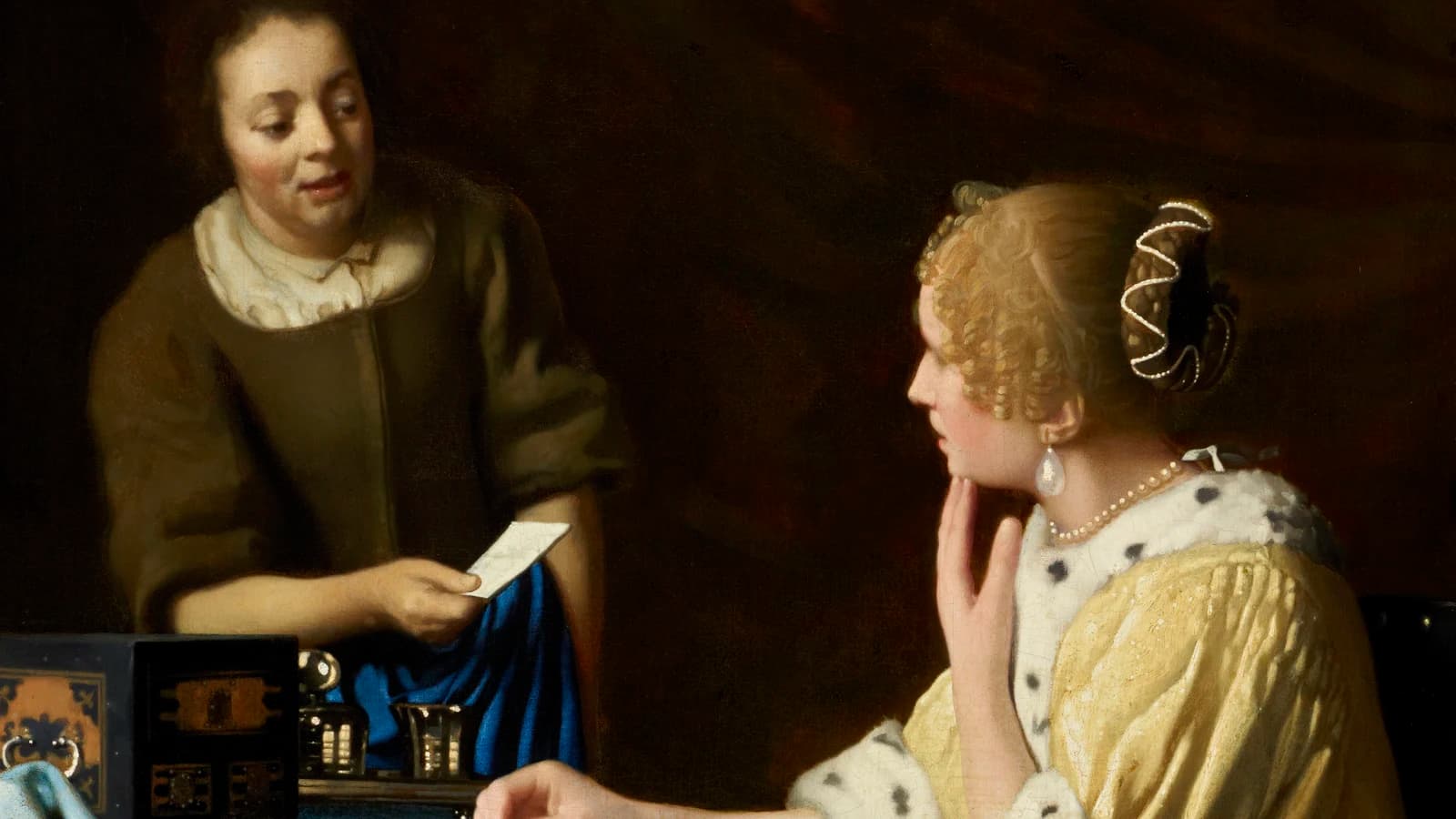
Lady Writing a Letter with her Maid
About this painting
Painted around 1670–1671, near the end of Vermeer’s career, the picture shows a seated mistress writing intently at a table while her maid stands beside her in the geometric center of the composition, arms folded, gazing out of the window as she waits. The National Gallery of Ireland calls it one of Vermeer’s “most outstanding compositions and his most ambitious depiction of the theme of letter writing.”
A letter and its silent drama
On the floor in the foreground lie a crumpled letter, a stick of red sealing wax, and a seal, objects that appear to have been discarded in some agitation and that quietly disturb the calm of the room. The maid acts as messenger and intermediary to an unseen correspondent, her crossed arms and outward gaze read by scholars as restlessness as she waits. The subject belongs to a sequence of letter pictures Vermeer returned to in his later years, among them Mistress and Maid, A Lady Writing, and The Love Letter.
The Finding of Moses on the wall
The large history painting on the back wall is a version of the Finding of Moses, after a composition associated with Pieter de Grebber, rendered by Vermeer in deliberately broad, schematic strokes. Lisa Vergara has drawn a thematic parallel between the two scenes: the Pharaoh’s daughter who rescues the infant Moses, and Moses’s sister who serves as messenger, much as the maid mediates between her mistress and an absent reader.
A late, abstracting hand
By the early 1670s Vermeer had moved toward a more generalized manner, and here the patterned carpet is set down in a calligraphic shorthand rather than described detail, the white sleeve worked wet-in-wet so that, seen close, its folds become almost unrecognizable. A sheer curtain at the left functions as a repoussoir, opening like a stage onto the scene, while the vanishing point of the perspective rests on the mistress’s eye, drawing the emotional focus to her even as the maid commands the center.
Two thefts from Russborough House
Vermeer never sold the painting in his lifetime; after his death his widow pledged it to the Delft baker Hendrick van Buyten against a bread debt. It later entered the celebrated Beit collection and hung at Russborough House near Dublin, where it was stolen twice. In April 1974 an armed gang led by the heiress Rose Dugdale cut it and other masterpieces from their frames; it was recovered in County Cork days later. In May 1986 it was taken again, this time by a gang led by the Dublin criminal Martin Cahill, who demanded a large ransom; the picture surfaced only in 1993, recovered in a sting operation at Antwerp. Sir Alfred Beit bequeathed it to the National Gallery of Ireland in 1987, where it remains.
- Date
- 1670–1671
- Medium
- Oil on canvas
- Dimensions
- 71.1 × 58.4 cm