The Thunderclap
How a gunpowder explosion tore through Delft in 1654, killed the painter Carel Fabritius, and left a question hanging over the young Johannes Vermeer.
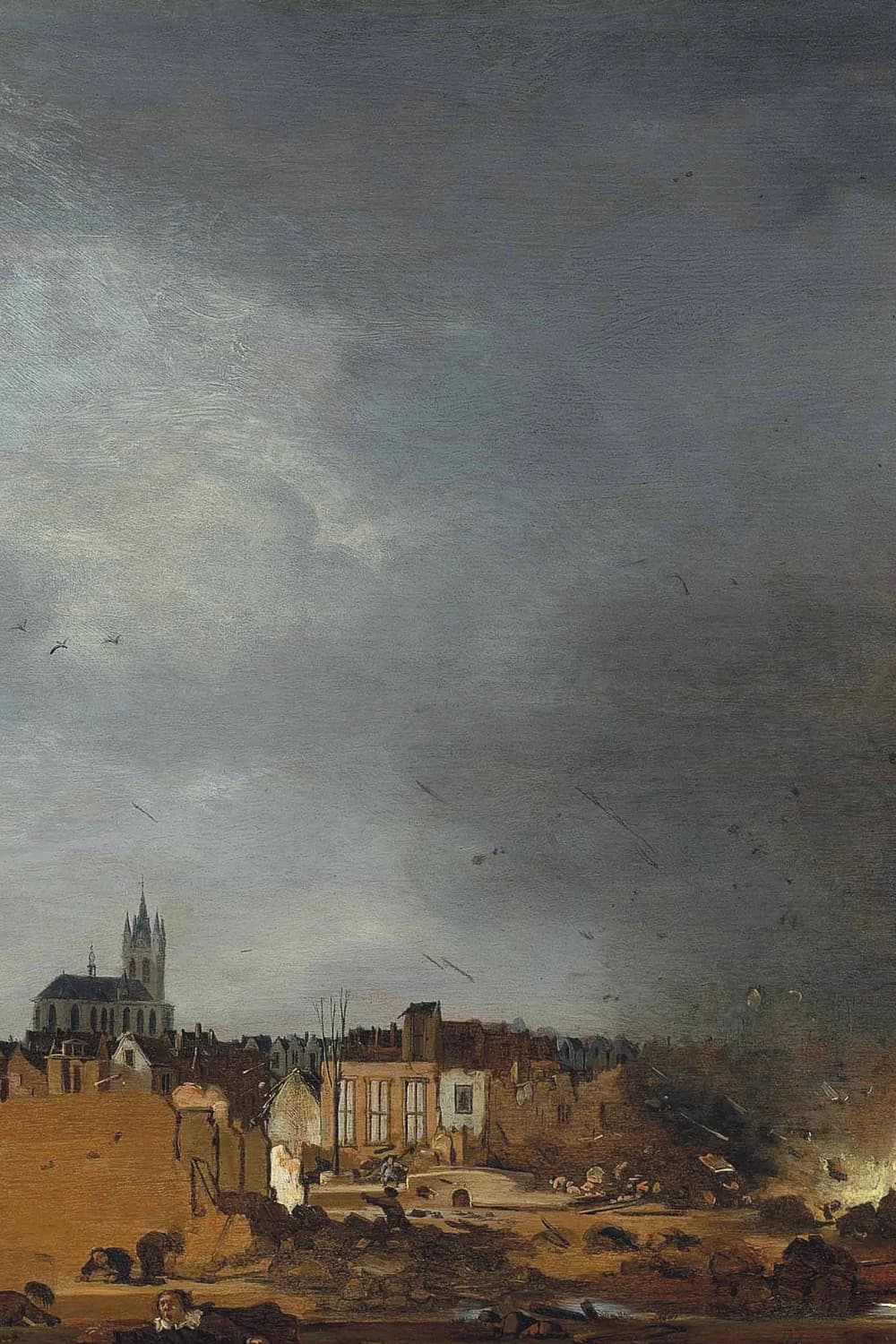
A thunderclap over Delft
On the morning of 12 October 1654, a little after ten o’clock, the Dutch city of Delft was torn open by an explosion so violent that it was heard on the island of Texel, more than seventy miles away across the North Sea. At the northeastern edge of the city, the national gunpowder store had gone up all at once. Where a quiet quarter of houses, gardens, and a former convent had stood, there was now a smoking crater. The blast flattened more than two hundred houses, blew the windows out of half the city, and threw debris across the rooftops. Contemporaries called it the Delftse donderslag, the Delft Thunderclap.
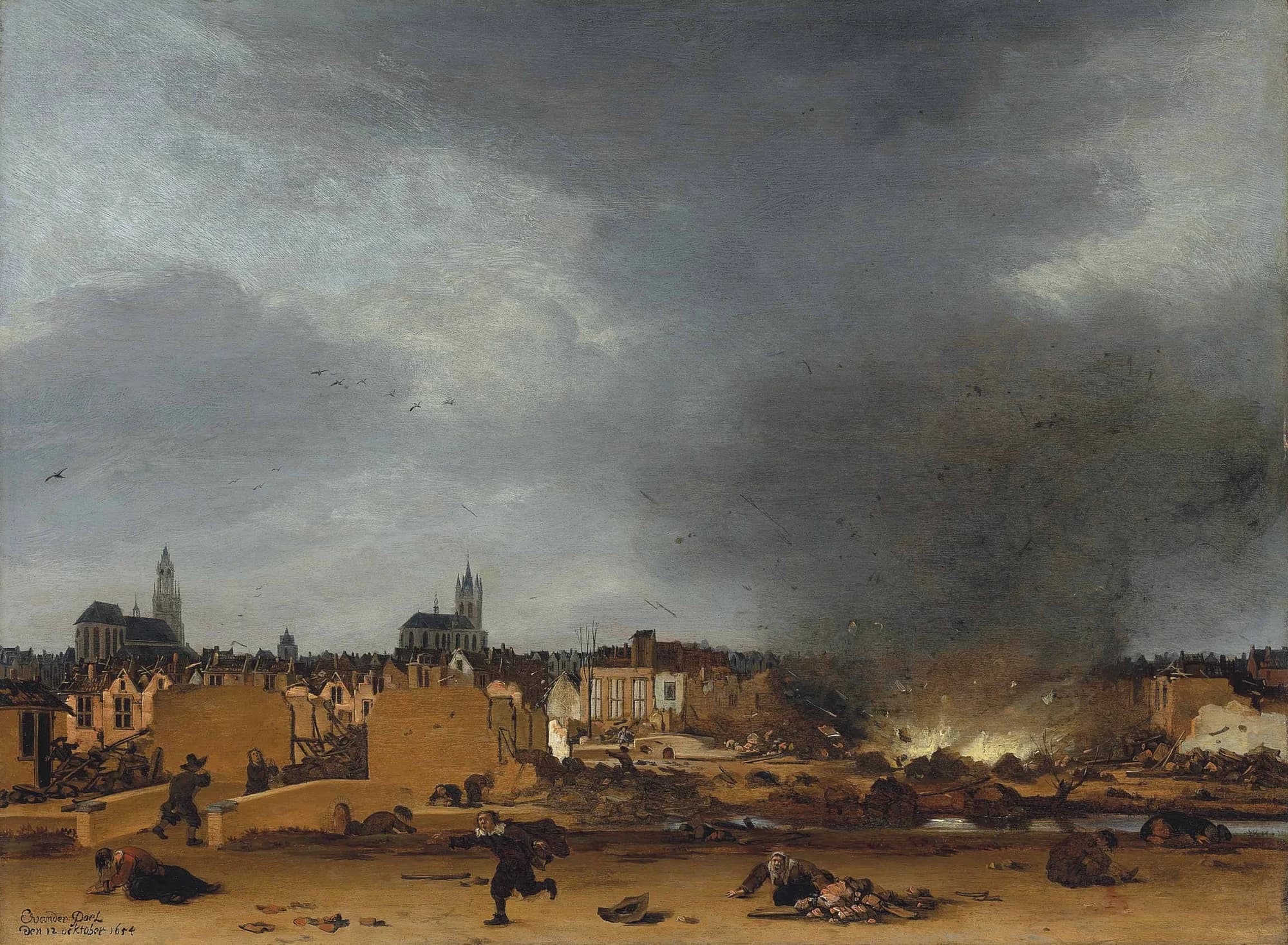
Nobody ever counted the dead with any certainty. Estimates have run from a few dozen to several hundred, and a number of those killed were never found or identified. Among them was a painter, thirty-two years old and just beginning to be spoken of as the finest in Delft. His name was Carel Fabritius, and his death is the reason this particular disaster still turns up in the story of Johannes Vermeer.
The city that kept the nation’s gunpowder
To understand why so much explosive sat in the middle of a residential city, it helps to know what Delft was. In the 1650s the Dutch Republic was at the height of what later got called its Golden Age: a small, newly independent nation of merchants and seafarers that had grown improbably rich on global trade, and that produced paintings by the hundreds of thousands. Delft was one of its prosperous towns, a place of canals, breweries, and the blue-and-white pottery that still bears its name. It was also bound up with the ruling House of Orange, whose founder, William the Silent, had been assassinated there in 1584 and lay buried in the city’s New Church.
A nation that had spent eighty years fighting Spain for its independence, and had only just ended a naval war with England in the spring of 1654, needed somewhere to keep its powder. Delft’s share of it was stored in a former convent of St Clare, a solid set of buildings at the edge of town, in a magazine known by the grand name of the Secret of Holland. On that October morning a clerk named Cornelis Soetens went in to check the stock. What happened next was never established, because Soetens did not come out. The roughly ninety thousand pounds of gunpowder beneath him, some thirty tonnes, ignited in a single instant.
Carel Fabritius
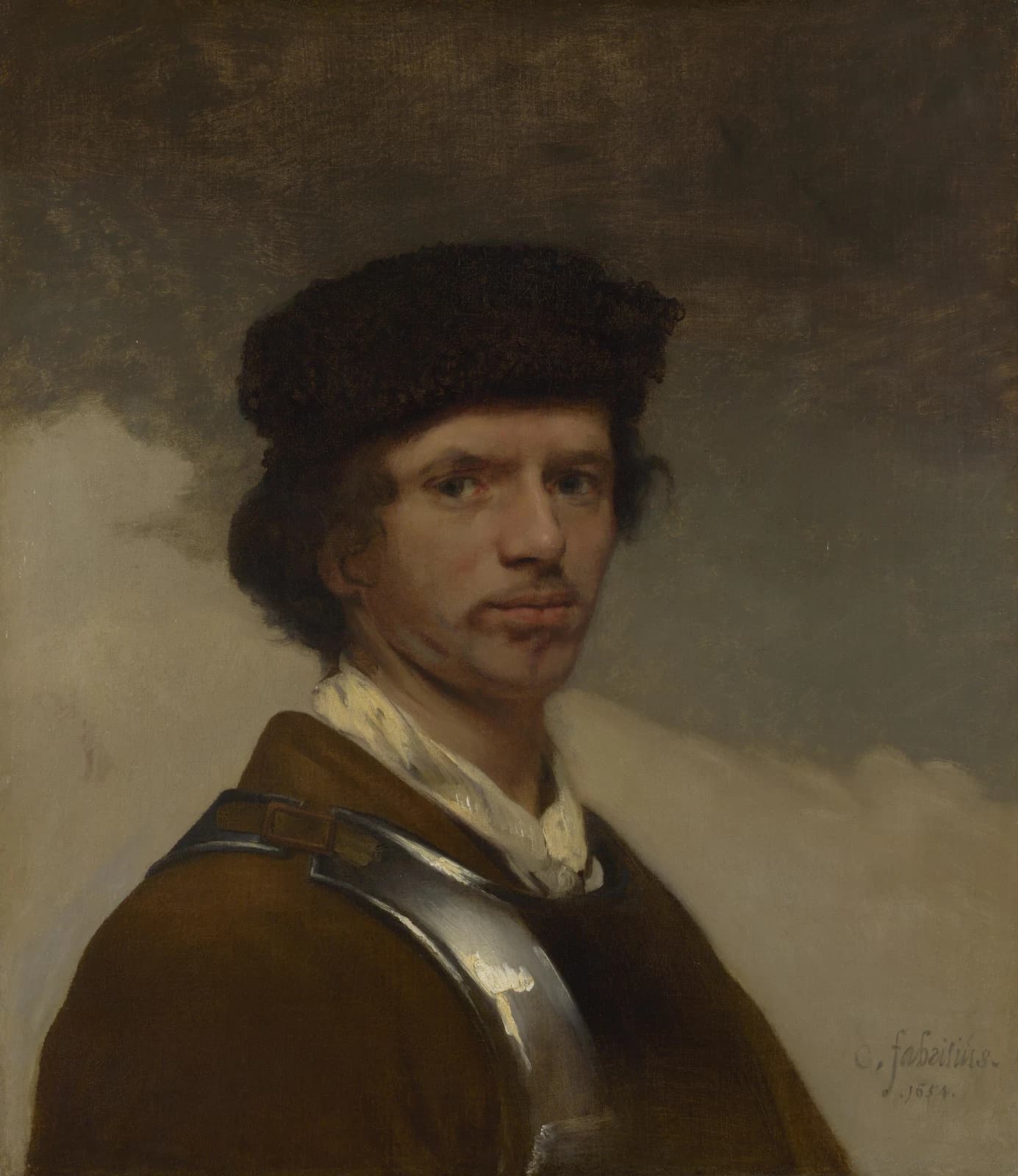
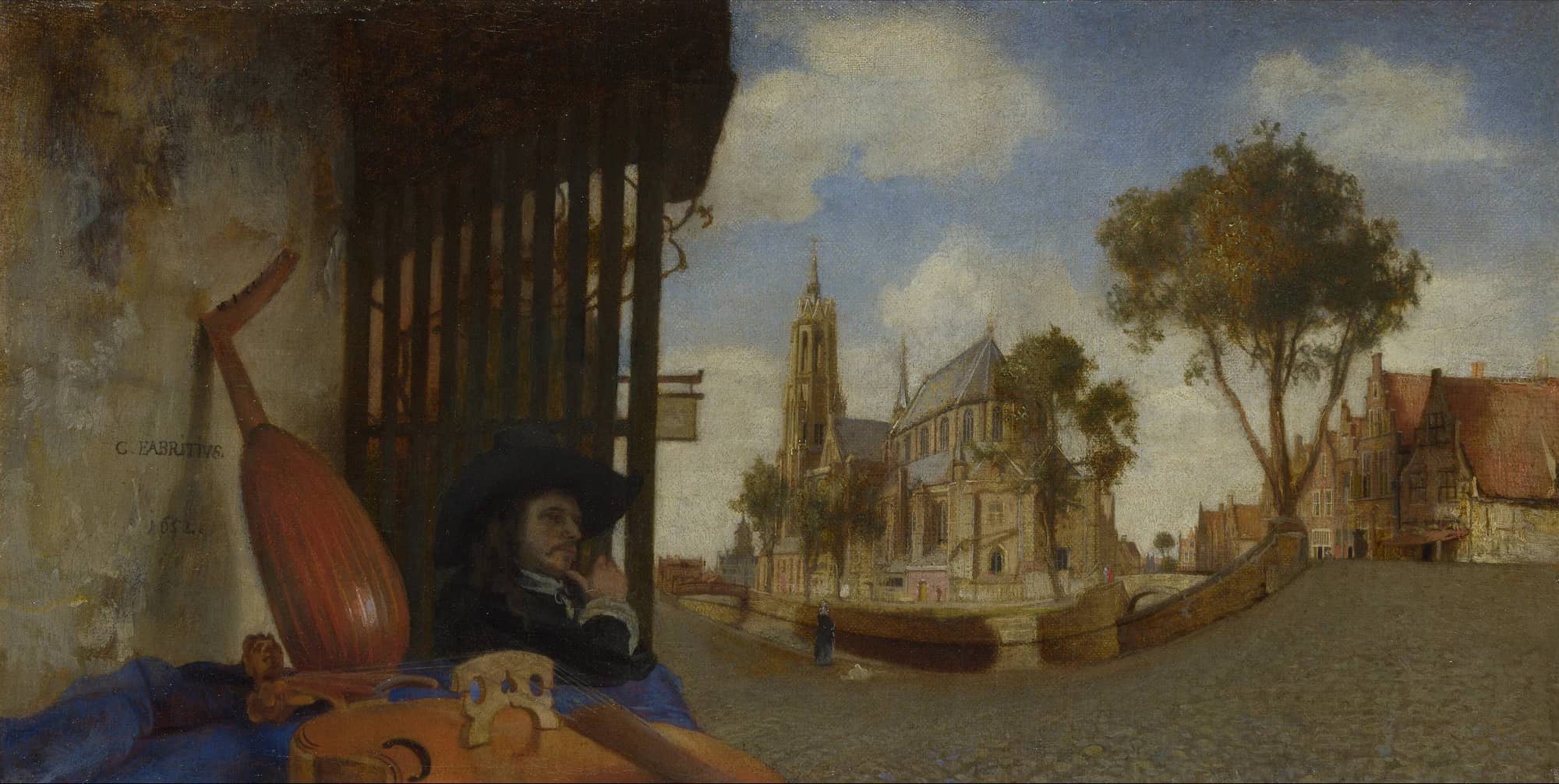
Carel Fabritius had been one of the most gifted pupils in the Amsterdam studio of Rembrandt, the towering figure of Dutch painting. Where most of Rembrandt’s students simply copied the master’s dark, dramatic manner, Fabritius pushed the other way. He set his figures against pale, light-filled walls instead of shadow, and he experimented with perspective and optical tricks, including a small view of Delft so distorted that it was probably meant to be seen through a peep-box. Around 1650 he moved to Delft and joined its painters’ guild.
On the morning of the explosion he was at work in his studio, with a pupil and a former church sexton beside him. The building came down on all three. Fabritius was dug alive from the rubble, but his injuries were too severe, and he died soon after. He was thirty-two.
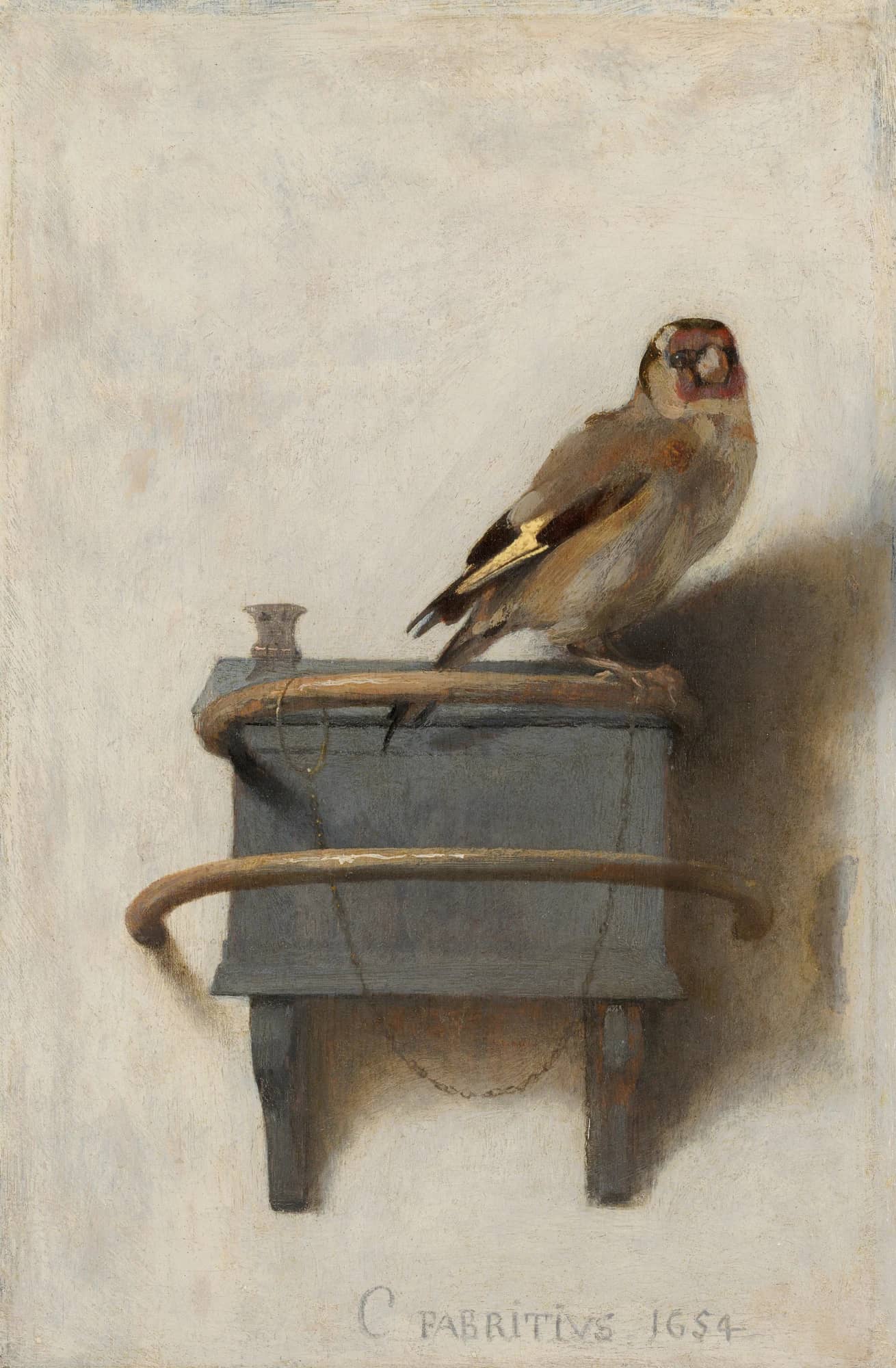
Most of what he had painted was destroyed with him. Fewer than a dozen works are accepted as his today, which makes him one of the rarest of the major Dutch painters. The most famous of the survivors is a small panel of a chained goldfinch on its feed-box, signed and dated 1654, the year of his death. It is now one of the best-loved pictures in the Mauritshuis in The Hague, and a reminder of how much light and life went out of Delft in a single morning.
The phoenix and his heir
Thirteen years later, in 1667, a Delft historian named Dirck van Bleyswijck published a thick description of his city. His printer, Arnold Bon, added a poem mourning Fabritius. Its closing lines turned the dead painter into a phoenix, the bird of legend that burns and is reborn from its own fire, and named the young artist who seemed to be rising in his place.
Thus did this Phoenix, to our loss, expire, in the midst and at the height of his powers, but happily there arose out of his fire Vermeer, who masterfully trod his path.
That single verse is the closest thing we have to a link between the two painters, and it is worth reading carefully. It says that after Fabritius died, Vermeer became the great painter of Delft. It does not say that Vermeer was ever Fabritius’s student. No document records who taught Vermeer at all, and the two men were registered in the same guild barely a year apart, which leaves little room for a long apprenticeship. Fabritius’s most distinctive ideas, the cool light and the play with perspective, surface in Vermeer’s work only years later. Most historians today put it cautiously: Fabritius was very probably an influence, perhaps the most important in the city, but the poem is a tribute, not a record of lessons given.
Vermeer in 1654
When the magazine blew up, Johannes Vermeer was a young man of almost exactly twenty-two. He had been baptised in Delft in October 1632, had married Catharina Bolnes the year before, and had registered as a master painter in the Guild of Saint Luke at the end of December 1653, which meant he was entitled to sign and sell his own work. He was, in other words, right at the start of his career on the morning the city shook.
He lived near the centre of Delft, around the great market square, where his father had kept an inn called Mechelen. The market was several hundred metres from the blast at the edge of town, far enough that the family survived, close enough to feel it. The damage to the inn was later assessed at 150 guilders, of which the city paid 60 in compensation. Whatever Vermeer was doing that morning, the explosion would have been the loudest sound of his life, and it took from his small world the one painter who might have shown him the most.
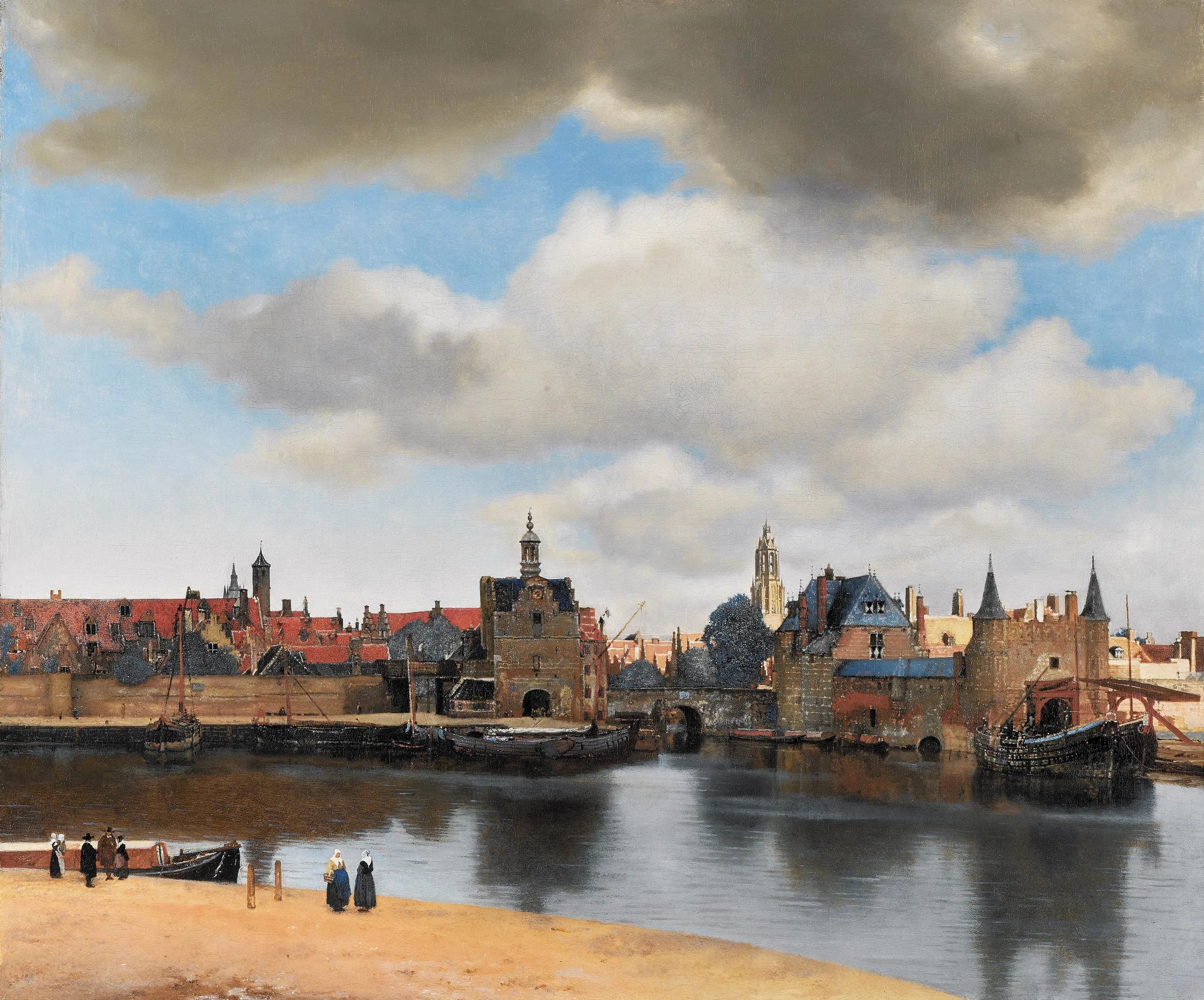
Within a few years Vermeer would paint that same city from across its harbour, in the picture now known as the View of Delft, one of the most admired cityscapes ever made. By then Delft had rebuilt the quarter the powder had destroyed, and the wound had closed over. What the thunderclap left behind was harder to see: a city missing its most inventive painter, and a younger one, just starting out, who would carry some of the same light into the quiet rooms he made his own.
Notes
- 1.The date, the time of morning, the magazine in the former convent, the clerk Cornelis Soetens, and the scale of the blast follow Essential Vermeer, “The Delft Thunderclap” and Wikipedia, “Delft Explosion”.
- 2.The death toll was never established; estimates run from a few dozen to several hundred, and many bodies were never identified. See Wikipedia, “Delft Explosion” and Essential Vermeer.
- 3.Fabritius’s training under Rembrandt, his move to Delft, and the circumstances of his death are drawn from Wikipedia, “Carel Fabritius” and the Mauritshuis biography.
- 4.The Goldfinch, signed and dated 1654, is in the Mauritshuis, The Hague; see the museum’s record.
- 5.Arnold Bon’s verse was printed in Dirck van Bleyswijck’s Beschryvinge der Stadt Delft (1667). For the Dutch text, the English translation, and its context, see Essential Vermeer, “Van Bleyswijck and Arnold Bon”.
- 6.No document records who taught Vermeer. Most scholars treat Fabritius as a likely influence rather than a proven master; see Wikipedia, “Carel Fabritius” and Britannica, “Johannes Vermeer”.
- 7.Vermeer’s baptism (31 October 1632), his April 1653 marriage to Catharina Bolnes, and his registration as a master in the Guild of Saint Luke on 29 December 1653 come from Essential Vermeer on the Guild of Saint Luke and the Vermeer life timeline.
- 8.Damage to the Mechelen inn on the Markt was assessed at 150 guilders, of which 60 was paid in compensation; see Essential Vermeer, “Delft in Vermeer’s Time”.
- 9.Vermeer’s View of Delft (c. 1660–1661) hangs in the Mauritshuis; see the museum’s record.