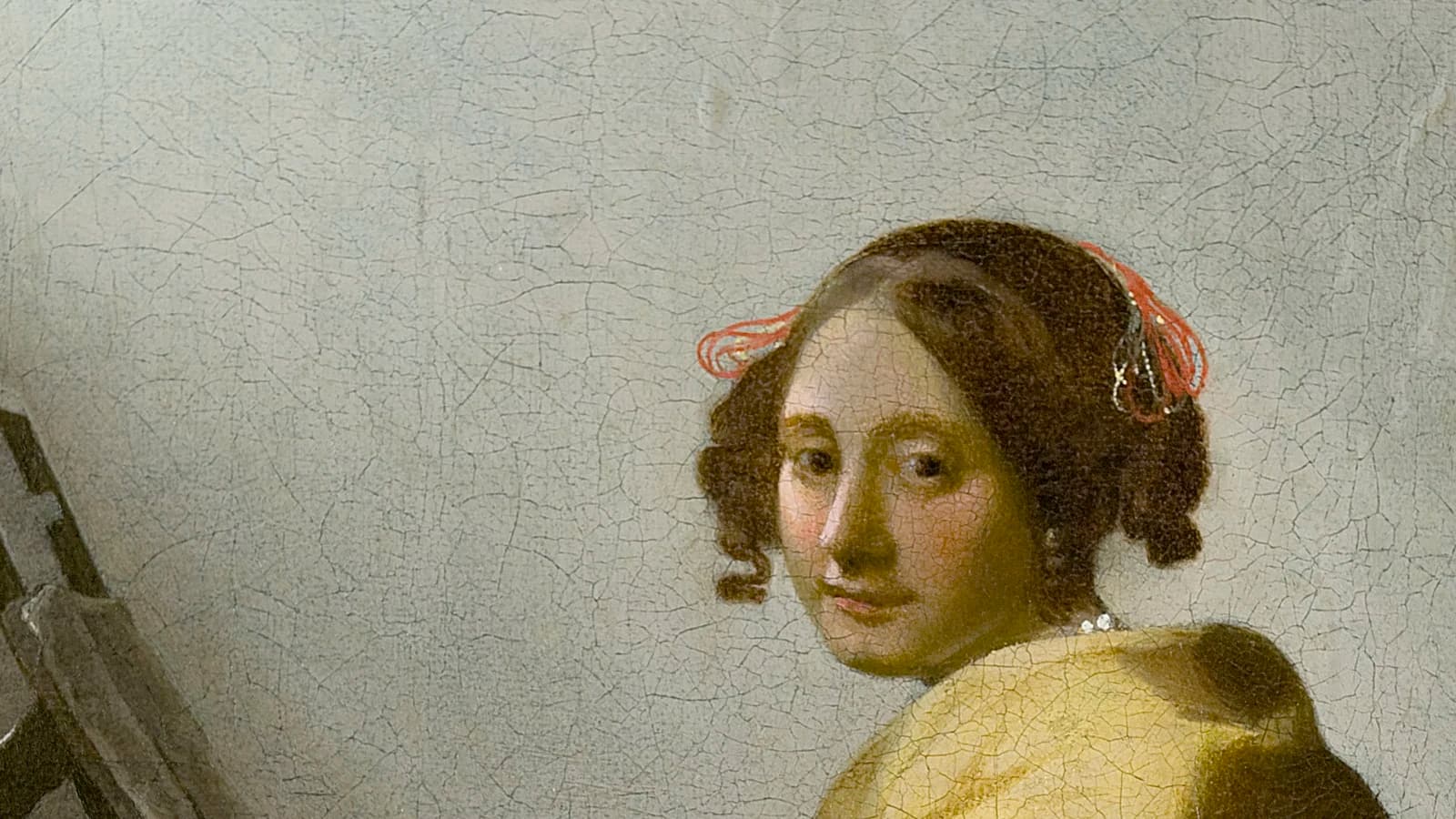
The Girl with a Wine Glass
About this painting
Painted around 1659–1660, The Girl with a Wine Glass shows three figures in a sunlit interior: a young woman in a vivid red gown who smiles candidly out at the viewer, a standing gentleman in an elegant cape who leans over her and presses a glass of wine on her, and a second man who slumps brooding at the table behind them. The Dutch title, “Dame en twee heren” (A Lady and Two Gentlemen), names the cast plainly and leaves the meaning of the encounter open.
A courtship and its warning
The picture belongs to the tradition of mid-century Dutch genre scenes of courtship and its hazards. The woman’s intense red dress, a formal gown worn for special occasions, has been read as a sign of concealed passion, while her knowing gaze toward us rather than toward her suitor complicates any simple reading of seduction or virtue. The slumped man at the rear is harder to place: his despondent pose recalls the melancholic figures of seventeenth-century painting, and Rodney Nevitt Jr. has suggested he may be under the influence of tobacco, wine, or a rejected suit.
The window and the portrait on the wall
Two details lend the merry scene a watchful, moralizing presence. The stained-glass window carries a coat of arms linked to Janetge Jacobsdr. Vogel, and at its center a female figure holding a level and bridle is traditionally read as a personification of Temperance, an emblem of restraint set against the wine on the table. Between the two men hangs an ancestral portrait, datable by its costume to the 1630s, which Arthur K. Wheelock Jr. takes to underline the artist’s concern with slackening moral restraint in the present. More recent scholarship by Ariane van Suchtelen and Huib Zuidervaart questions the moralizing reading, proposing instead that this picture and its companion may have been conceived as wedding gifts.
Color and technique
Vermeer works here in his smooth, highly finished middle manner, with natural ultramarine used freely in the shadows, the window, and the tablecloth, an extravagance rare among his contemporaries. Hermann Kühn’s pigment analysis confirmed ultramarine in the tablecloth, lead-tin-yellow in the oranges on the table, and madder lake with vermilion in the woman’s skirt.
A companion piece
The painting is closely tied to The Glass of Wine in Berlin, which treats the same theme with comparable figures and the same ceramic floor tiles, suggesting the two may have been worked up from the same interior; the Brunswick picture is the more smoothly painted of the pair. Both look back to the interior scenes of Pieter de Hooch and perhaps to Ludolf de Jongh’s The Refused Glass. Like the related Girl Interrupted in Her Music, it most likely passed from Vermeer’s Delft patron Pieter Claesz van Ruijven through his heirs before entering the ducal collection at Brunswick around 1710.
- Date
- 1659–1662
- Medium
- Oil on canvas
- Dimensions
- 78 × 67 cm