Girl Interrupted in her Music
About this painting
Painted around 1658–1661, Girl Interrupted in her Music shows a seated young woman in a red jacket and white cap who looks out toward the viewer while a standing gentleman leans in beside her, the two of them sharing a sheet of paper that has been read as either music or a letter. Her outward gaze breaks the moment, casting the viewer as the interrupting presence the title describes.
Music, wine, and courtship
A cittern lies on the table beside the sheet music, and a full, untouched wine glass stands next to a blue-and-white ewer with a European silver lid, the kind of Chinese porcelain that inspired local Delftware. In seventeenth-century Dutch painting music and wine were conventional emblems of love and seduction, and the wine left undrunk suggests a courtship still at an early, formalized stage. Vermeer returned to the same theme of a man and woman at a table with wine in The Glass of Wine, and technical study has shown that this picture once included a second window with a translucent blue curtain like the one in that work, later painted out.
The Cupid on the wall
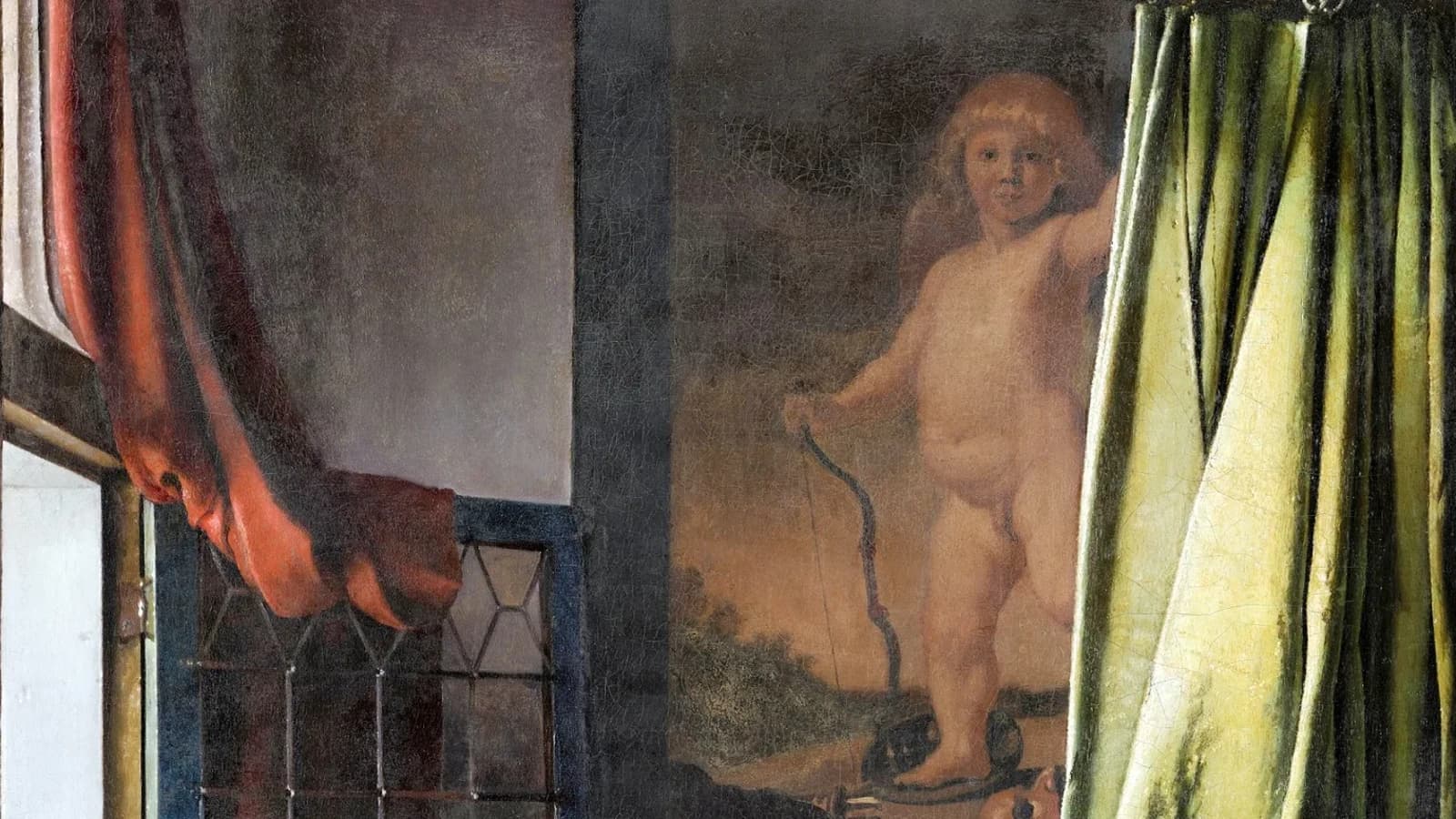
On the shadowed back wall hangs a painting of Cupid holding up a card, an image often linked to Otto van Veen’s emblem book and read as a statement that true love is directed at a single person. The Cupid had been overpainted in an earlier restoration and only came back to light after conservation work around 1907, and its battered state still makes its meaning hard to pin down. The birdcage near the window, by contrast, is now regarded by conservators as a later addition by another hand rather than part of Vermeer’s original design.
Condition and dating
The picture has suffered badly from age and heavy past restoration. The red jacket and cap, the gentleman’s cloak, and the background wall are abraded and weakly modeled by Vermeer’s standards, and the damage has long complicated its attribution, though it is generally accepted as his. Technical analysis has found that the canvas comes from the same bolt of prepared material as Young Woman with a Water Pitcher, which points to a later date than was once assumed.
From Amsterdam to the Frick
The painting passed through a string of European collections, appearing at the Van Alphen sale in Amsterdam in 1810, before Henry Clay Frick acquired it through the dealer Knoedler in 1901. It has hung in the Frick Collection in New York ever since.
- Date
- 1658–1661
- Medium
- Oil on canvas
- Dimensions
- 39.3 × 44.4 cm