Young Woman with a Water Pitcher
About this painting
A young woman stands in a corner of a sunlit room, one hand resting on the handle of a silver-gilt pitcher set in its basin, the other on the leaded casement she is about to open. Painted in the early to mid-1660s, the picture catches her in a private, unremarkable moment of the morning toilette, neither posed nor telling a story. It was the first painting by Vermeer to enter an American collection, and it remains at the Metropolitan Museum of Art in New York.
Light across the wall
The painting is built almost entirely out of light rather than line. Vermeer avoids strong linear perspective and instead lets daylight, filtered through the window’s small panes, model the figure and dissolve gradually across the whitewashed wall behind her. He worked an unusual amount of costly natural ultramarine into the picture, not only in the woman’s dark blue skirt and the blue chair but in the shadows of the wall itself, giving the whole scene its cool, even luminosity. The same restraint and clear morning light link it to his other studies of single women absorbed in everyday tasks, such as The Milkmaid and Woman Holding a Balance.
The basin, the map, and the window
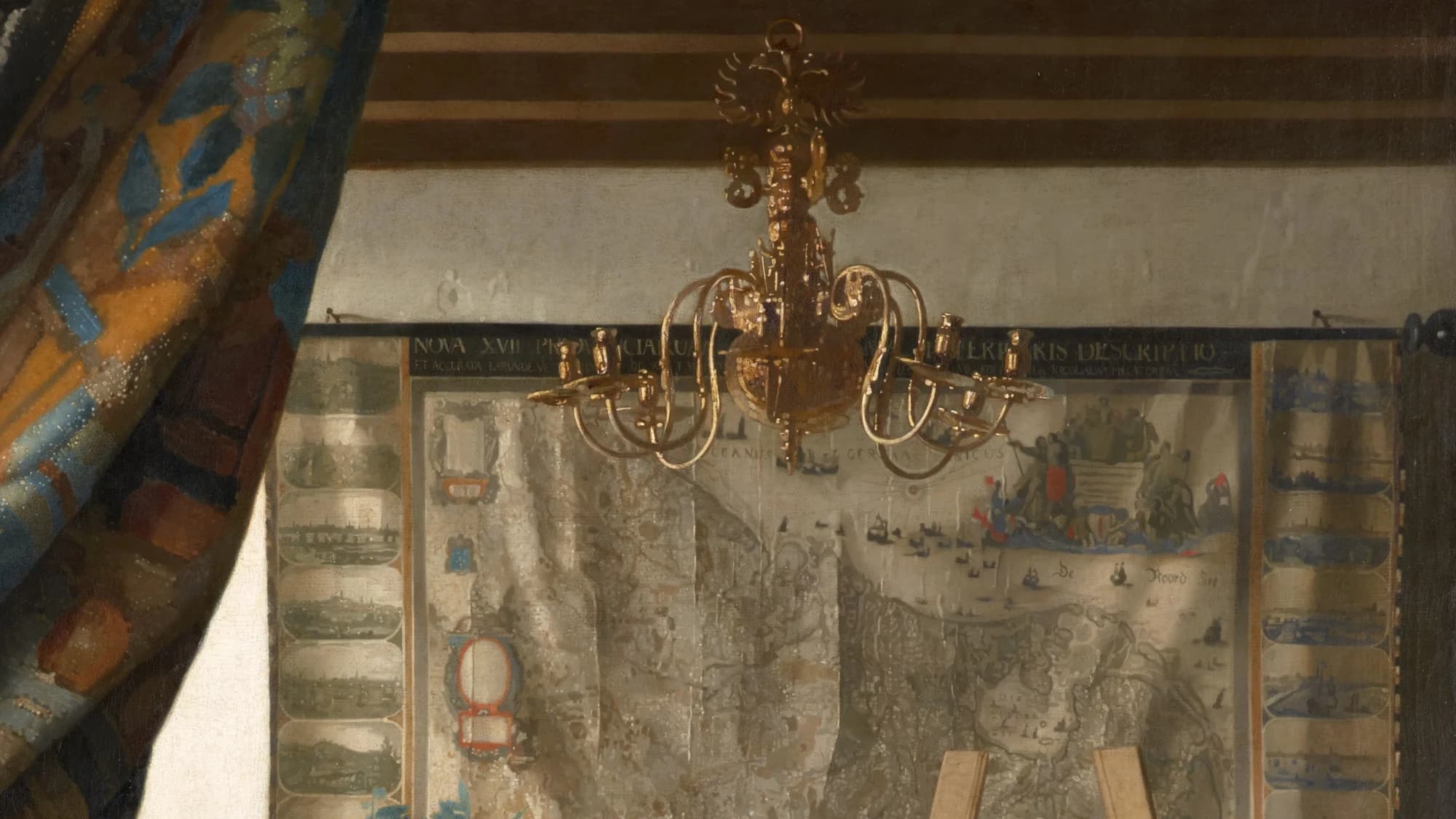
The gilded silver ewer and its basin were luxury objects associated with washing, and their polished surfaces catch the colors around them: the red of the table carpet and the blue of the cloth are both reflected in the metal. On the table, draped with a richly patterned carpet of Asian origin, sit an open jewelry box and a string of pearls. A map of the Seventeen Provinces of the Netherlands hangs on the wall at the upper right, and X-rays show that Vermeer altered the composition as he worked, shifting elements to balance the design.
The woman’s costume
She wears a lemon-yellow bodice trimmed with black over a dark blue skirt, with a crisp white linen cap framing her face and shoulders. The cap and the broadly painted skirt are handled with deliberate plainness, so that the eye settles instead on the bright accents of the metalwork, the pearls, and the light passing through the glass.
The first Vermeer in America
The picture had a long European history, passing in the nineteenth century through English and Irish hands, at one point catalogued as a work by Gabriel Metsu before being recognized as a Vermeer. In 1887 the New York financier and collector Henry G. Marquand bought it in Paris for $800, and in 1889 he gave it to the Metropolitan Museum of Art, making it the first painting by Vermeer to enter an American public collection.
- Date
- 1662–1665
- Medium
- Oil on canvas
- Dimensions
- 45.7 × 40.6 cm