A Lady Standing at a Virginal
About this painting
Painted late in Vermeer’s career, around 1670–1672, A Lady Standing at a Virginal shows a richly dressed young woman who has paused at the keyboard to turn and meet the viewer’s eye. She wears a pale satin gown, and behind her a tiled floor, a blue velvet chair, and two framed pictures fill a sunlit corner of a Delft interior. It hangs in the National Gallery in London, which acquired it in 1892 (inv. no. NG1383).
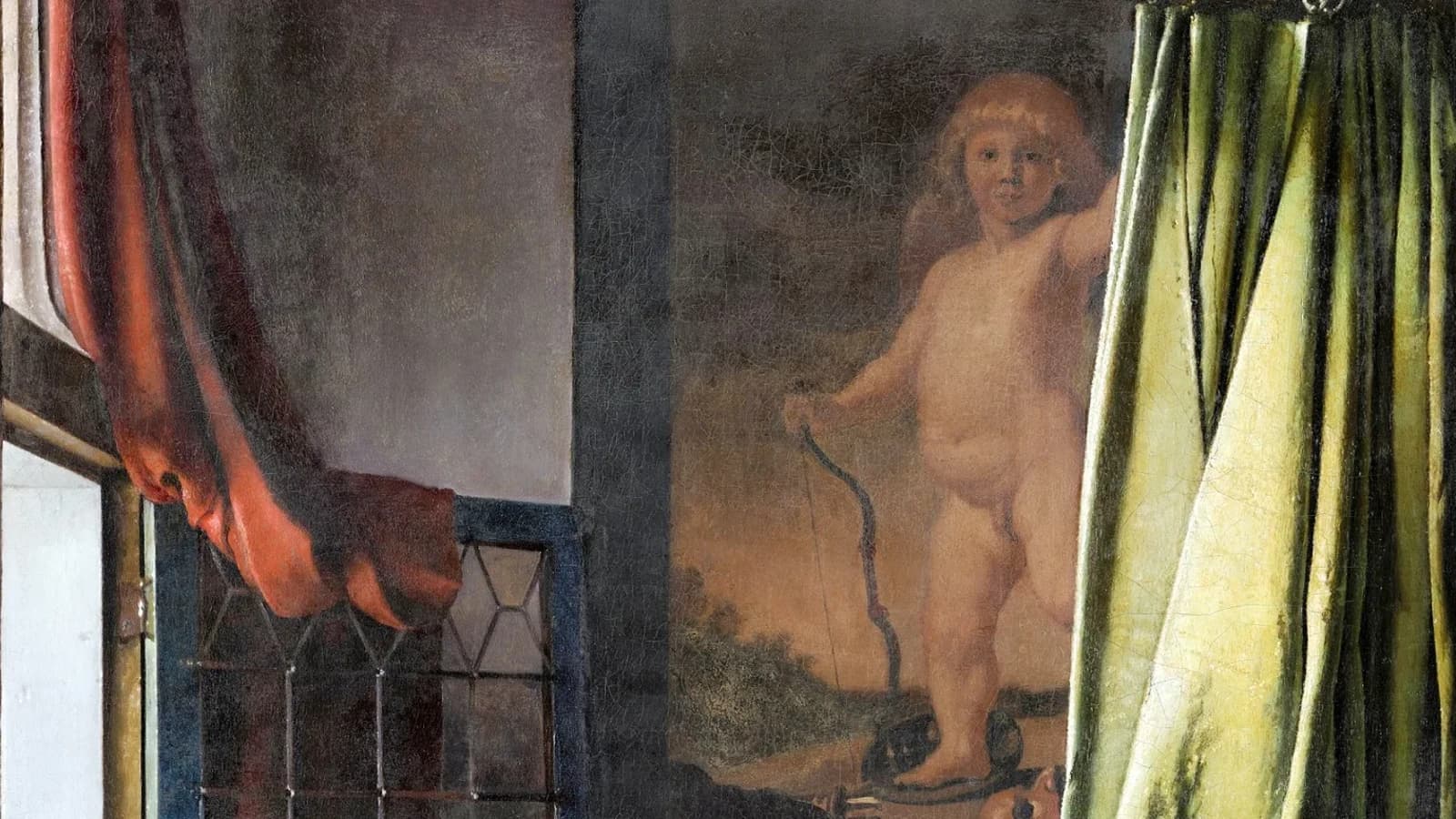
Cupid and the single love
The ebony-framed picture of a standing Cupid on the back wall sets the painting’s theme. The art historian Eddy de Jongh traced the motif to Otto van Veen’s emblem book Amorum Emblemata (1608), where Cupid holds up a single tablet under the maxim that a lover ought to love only one. The card Vermeer’s Cupid holds is left blank rather than marked with Van Veen’s Roman numeral, but the reference to faithful love and the conventional link between music and courtship still carry the meaning. The Cupid corresponds to a real painting recorded in the inventory of Vermeer’s widow in 1676, which John Michael Montias associated with the classicist history painter Cesar van Everdingen.
Late style and bright light
By the early 1670s Vermeer had moved toward a brighter, more linear manner, and here the daylight falls in crisp touches across the satin gown, the pearls, and the gilt frame. Albert Blankert compared the rendering of the gown to a fluted Greek column, and the puffed sleeve is built from dots and dashes of light paint that the catalogue calls a tour de force of brushwork. Vermeer modelled the shadows of the flesh with a dull green earth, an unusual choice he favoured in his late works, and the ultramarine of the blue chair has faded so that it now reads lighter than he intended.
A pair with the seated lady
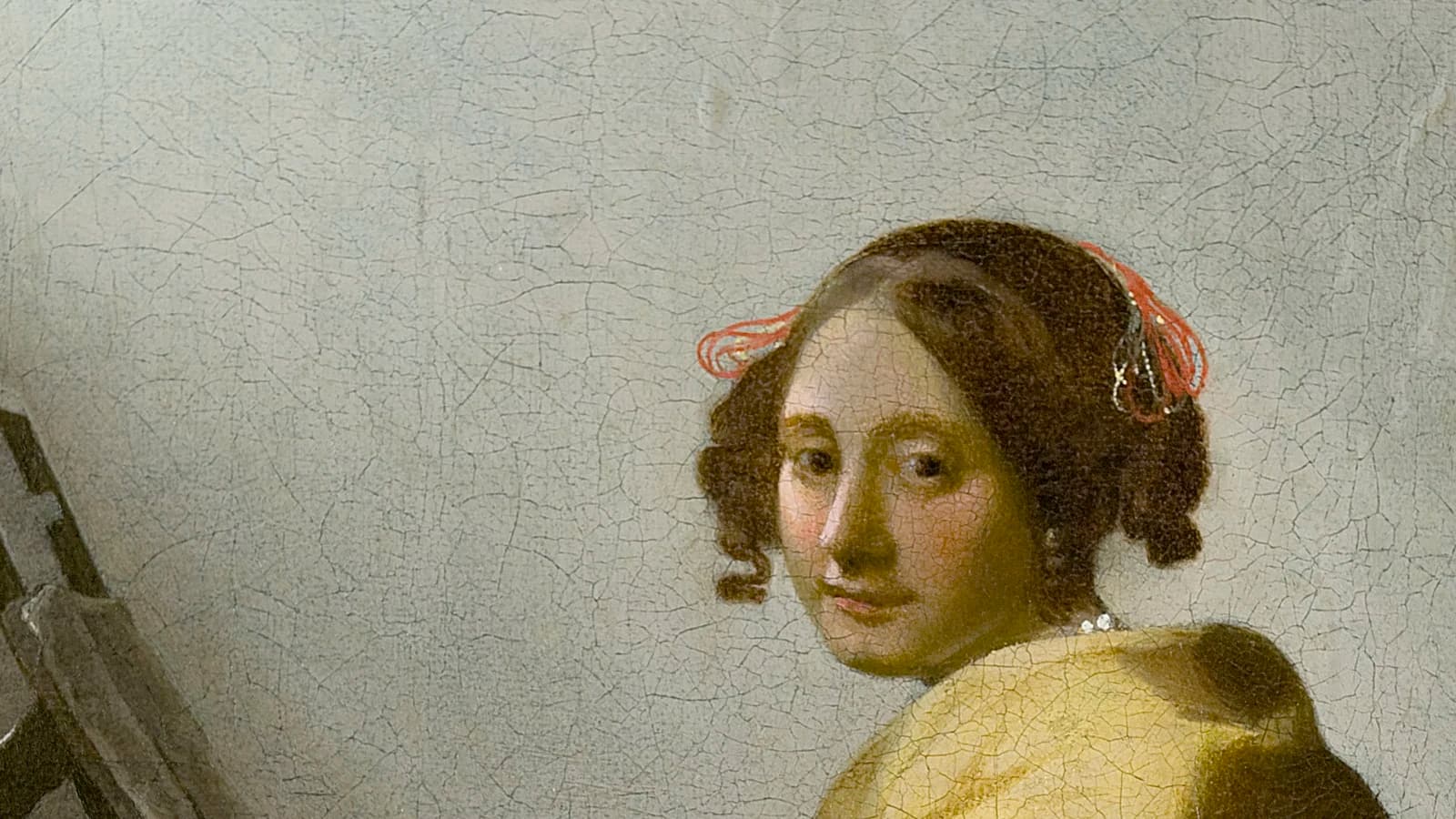
The picture is generally discussed alongside A Lady Seated at a Virginal, its near twin in the same gallery and of identical size. Technical study has shown that both were cut from the same bolt of canvas and given the same ground, and the National Gallery frames and hangs them as a pair. Their moods are opposed: the standing woman occupies a sunlit, classical space under an emblem of fidelity, while the seated figure sits in near shadow beneath a bordello scene after Dirck van Baburen. The same ground recurs in a third late keyboard picture, A Young Woman Seated at the Virginals, a sign of Vermeer’s consistent materials in these final years.
Music, love, and emblem
Music in Vermeer’s interiors carries associations of love and harmony, and the virginal, the pearls, and the two figures of Cupid all reinforce the painting’s amorous reading. Even the small Delft tiles along the baseboard join in: a Cupid fishing, to the left of the lady’s skirt, echoes the courtship-as-fishing conceit found in contemporary love emblems. The painting was shown under exactly this theme in the National Gallery’s 2013 exhibition Vermeer and Music: The Art of Love and Leisure.
- Date
- 1670–1674
- Medium
- Oil on canvas
- Dimensions
- 51.7 × 45.2 cm