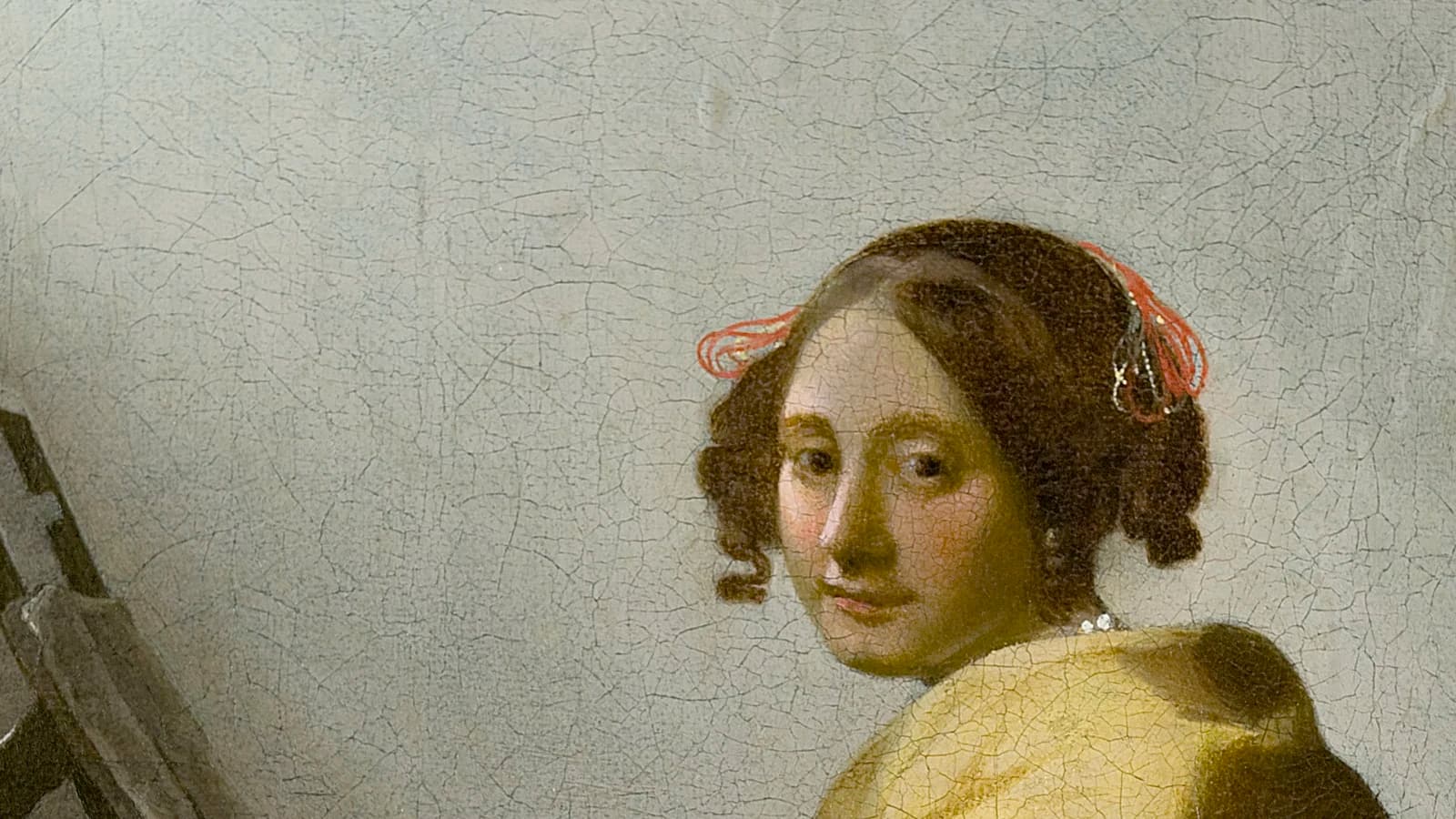
A Lady Seated at a Virginal
About this painting
Painted late in Vermeer’s career, probably between about 1670 and 1675, A Lady Seated at a Virginal shows a young woman in formal dress turning from the keyboard to meet the viewer’s eye. A viola da gamba and its bow lie unattended in the foreground, an instrument Vermeer never shows being played and one that here implies the unseen presence of a companion who will take it up and join her in music. The same bowed instrument appears in the foreground of The Music Lesson, Woman with a Lute and The Concert.
Music, love and the painting on the wall
On the back wall hangs a large picture in an Italianate frame, the original or a copy of The Procuress painted by Dirck van Baburen around 1622, a canvas that belonged to Vermeer’s mother-in-law, Maria Thins. Vermeer set the same brothel scene behind the figures of The Concert, and a version of it survives on the site as The Procuress attributed to Baburen. The juxtaposition sets up a quiet contrast: the virginal carries seventeenth-century associations of harmony, concord and virtuous love, while the mercenary transaction of Baburen’s scene sounds an undertone of venal desire.
A late style and an unfinished look
The handling is uneven in a way that has long divided viewers. The yellowish gown and blue-green overskirt are broadly blocked in with little detail, and the lady’s arms have been called crude by some critics, while the puffed white linen sleeve, laid down in bold strokes of lead white, and the marbled front of the virginal show Vermeer at his most assured. Most scholars read these inconsistencies as signs that the picture is unfinished or has not been ideally conserved rather than evidence of decline, and the darker blues have suffered from the deterioration of ultramarine. Infrared examination revealed that Vermeer painted out a mirror or frame above the lid of the virginal, an adjustment of the composition that is now barely visible as a faint diagonal band of darker gray.
A pendant cut from the same cloth
The painting is generally thought to form a pendant with A Lady Standing at a Virginal, also in London: the two are nearly identical in size, close in date and subject, and recent thread-count study has shown that their canvases were cut from the same bolt of cloth. Read as a pair, the standing figure is set beside an image promoting faithful love while the seated woman faces more worldly temptation, a dialogue of sacred and profane love.
From Thoré-Bürger to the National Gallery
Both virginal pictures passed in the nineteenth century through the French critic Théophile Thoré, who wrote under the name Thoré-Bürger and whose 1866 catalogue did much to revive Vermeer’s reputation. The seated lady came to the National Galleryin London in 1910 as part of the Salting Bequest, and it hung under the theme of music and courtship in the gallery’s 2013 exhibition Vermeer and Music: The Art of Love and Leisure.
- Date
- 1670–1675
- Medium
- Oil on canvas
- Dimensions
- 51.5 × 45.5 cm