Woman with a Lute
About this painting
A young woman in an ermine-trimmed jacket and large pearl earrings sits tuning a lute, her head turned toward a window at the left of the room. She is not playing but listening, her face lifted in expectation, and most readings take her to be awaiting a visitor glimpsed through the glass. Painted in the early to mid 1660s, the picture belongs to the same phase of Vermeer’s career as Young Woman with a Water Pitcher, when he was moving toward more muted tones and softer contours.
A map of Europe
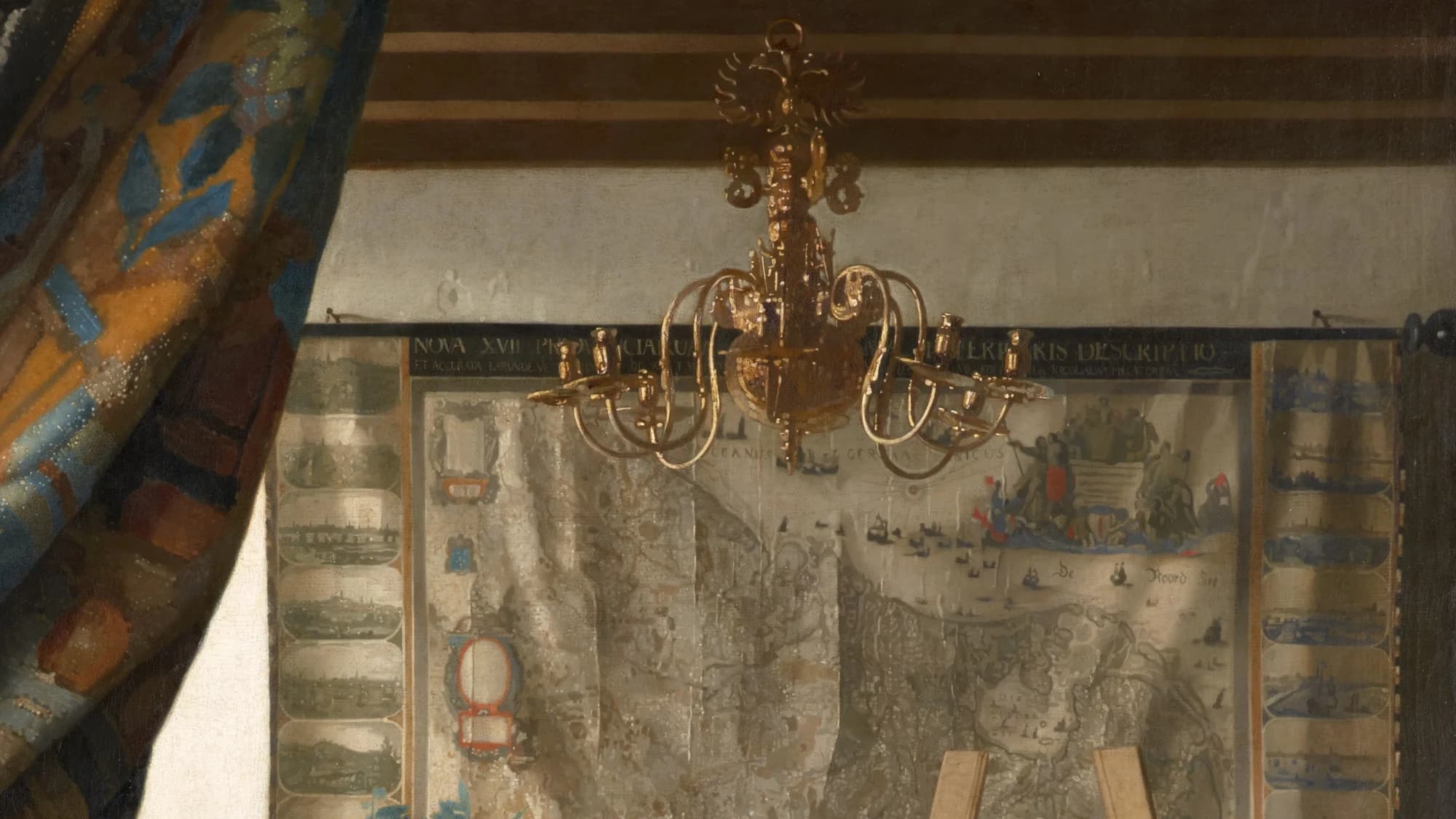
Behind her hangs a large wall map of Europe, the same map that appears in Officer and Laughing Girl, derived from an edition published by Jodocus Hondius and later reissued by Joan Blaeu. Vermeer reproduced its detail with such fidelity that Philip Steadman calculated the painted map would differ from the real one by only a few centimeters, evidence often cited in arguments that he traced from a projected image. Paired with the woman’s outward gaze, the map has been read as a sign of yearning for a world, or a person, beyond the room.
Music, courtship, and absence
The act of tuning was understood by contemporary viewers as an emblem of temperance and harmony, and the lute itself carried associations of refined courtship as well as transience. A viola da gamba lies on the floor in the foreground and songbooks spill across the table and onto the ground, props that imply a musical courtship and an expected partner for the unplayed second instrument. Lawrence Gowing noted that Vermeer’s women with lutes or guitars are rarely shown making music at all; they turn away, caught in a moment of distraction.
A damaged surface
Of all Vermeer’s paintings this is among the most worn. The foreground has been heavily abraded and the darks have sunk and darkened with age, so that the viola da gamba is now barely legible and the sense of space and atmosphere is much reduced. The map retains more of its original finesse than almost anything else in the picture. The painting entered the Metropolitan Museum of Art in 1925 through the bequest of the railroad financier Collis P. Huntington, where it remains.
- Date
- 1662–1665
- Medium
- Oil on canvas
- Dimensions
- 51.4 × 45.7 cm