Officer and Laughing Girl
About this painting
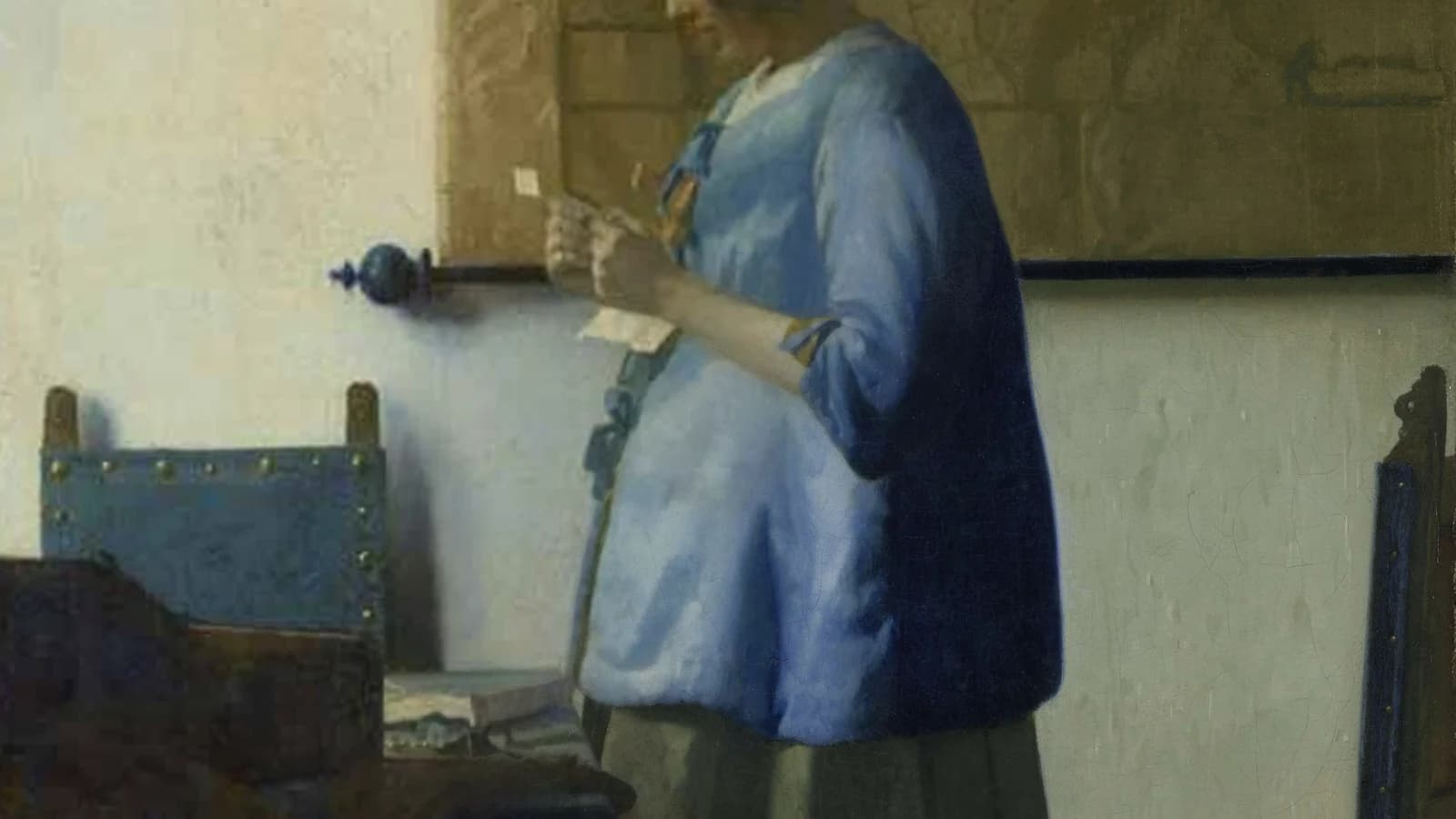
Painted around 1657, near the start of Vermeer’s career as a painter of domestic interiors, Officer and Laughing Girl shows a red-jacketed officer in a wide-brimmed hat seated with his back to the viewer, facing a young woman who smiles openly across a small table. Light pours in from a leaded casement window at the left, and a large map of Holland and West Friesland hangs on the whitewashed wall behind them.
A soldier and a girl
The picture belongs to a tradition of guardroom and courtship scenes popularized by painters such as Willem Duyster and Pieter Codde, in which soldiers appear in relaxed, domestic company rather than in battle. The officer wears an expensive red coat, an officer’s black shoulder sash, and a broad hat of beaver felt, while the woman is dressed in a yellow bodice and blue apron and holds a wine glass. What passes between them is left deliberately open: scholars have read the encounter as anything from honorable courtship to a transactional meeting, an ambiguity common to Dutch genre painting of the period.
The map on the wall
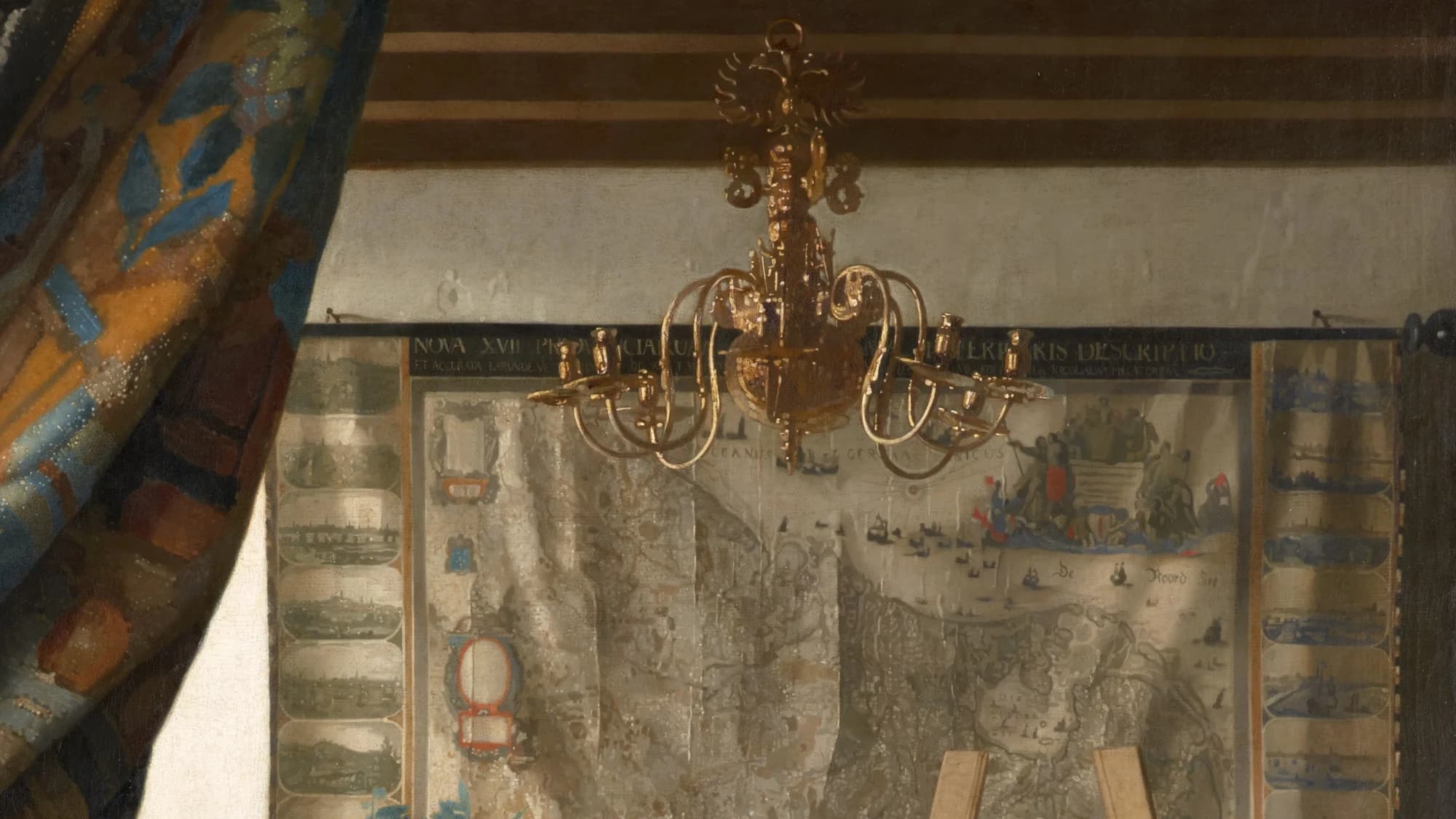
The map behind the figures depicts Holland and West Friesland and was drawn by Balthasar Florisz. van Berckenrode and published by Willem Jansz. Blaeu. Vermeer seems to have owned the map and used it in more than one painting; the same chart reappears, with its land masses turned blue, in works painted years apart. He renders its decoration and geography with great fidelity, so that the wall functions both as a precisely observed object and as a backdrop that buyers could read as Dutch pride in their homeland or as mere decoration.
The optics of the scene
The most discussed feature of the painting is the dramatic difference in scale between the two figures: the officer, close to the picture plane, looms far larger than the woman a short distance behind him. As early as 1891 the printmaker Joseph Pennell pointed to this disproportion as evidence that Vermeer had worked from a camera obscura, whose lens exaggerates the size of nearer objects in just this way. Whether or not he used the device, the effect of cool daylight is achieved with great care: Vermeer mixed ultramarine, then the most costly of pigments, into the whites of the wall and the woman’s headdress to suggest a clear morning light. The same map of Holland reappears in his later Art of Painting.
From the Dissius sale to the Frick
The painting most likely belonged to Vermeer’s Delft patron Pieter Claesz van Ruijven and passed through his heirs to the 1696 Dissius sale in Amsterdam, where it appeared as lot 11. It later surfaced in the 1861 Scarisbrick sale in London catalogued as a De Hooch, passed through the Double sale in Paris in 1881, and was bought by Henry Clay Frick in 1911. It hangs today in the Frick Collection in New York.
- Date
- 1657–1660
- Medium
- Oil on canvas
- Dimensions
- 50.5 × 46 cm