The 2011 Restoration of Woman in Blue Reading a Letter
A yellowed varnish had quietly dimmed one of Vermeer's bluest paintings. In 2010 and 2011 the Rijksmuseum lifted it off, and found a string of pearls that was never his.
Vermeer’s bluest picture
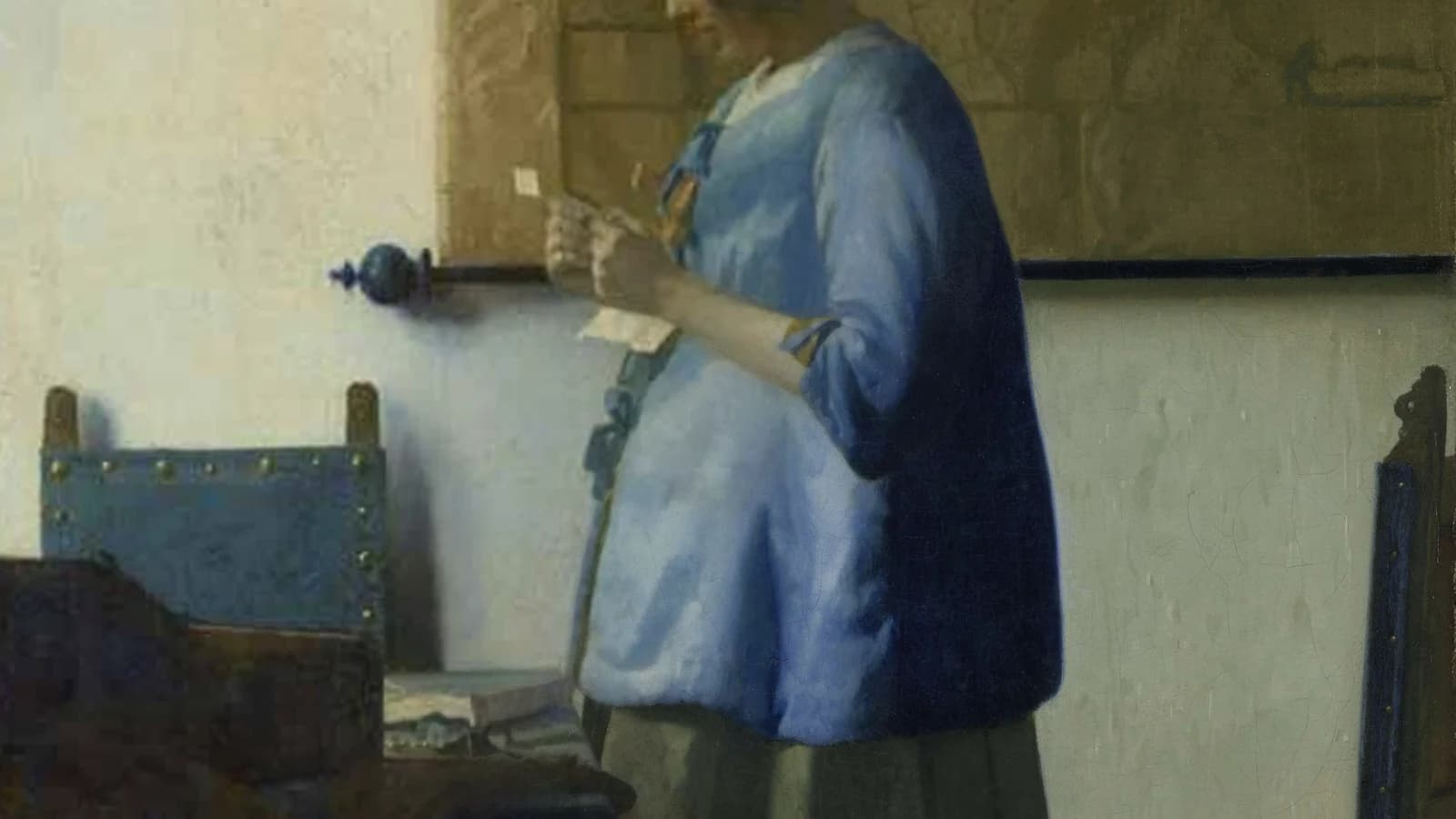
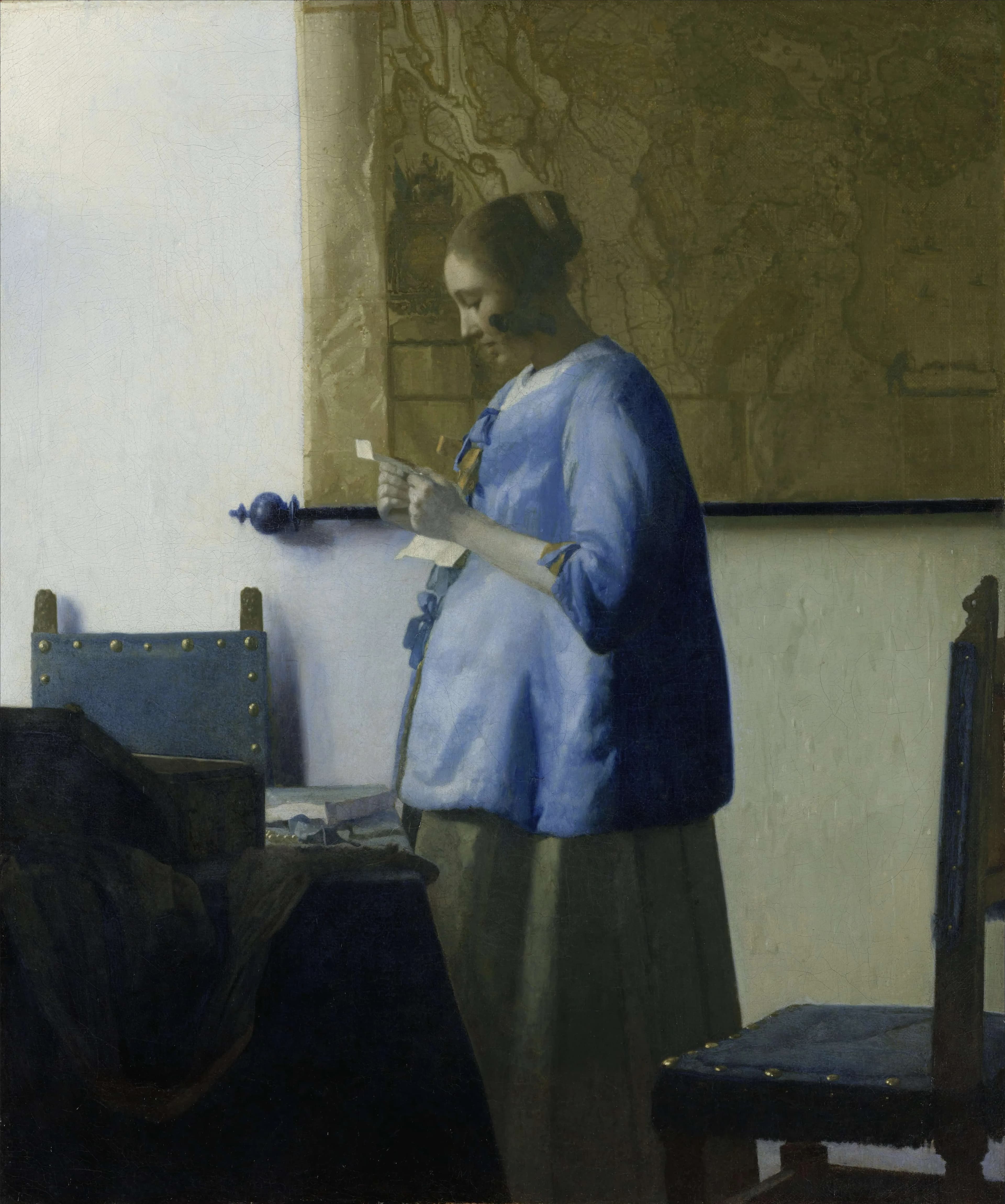
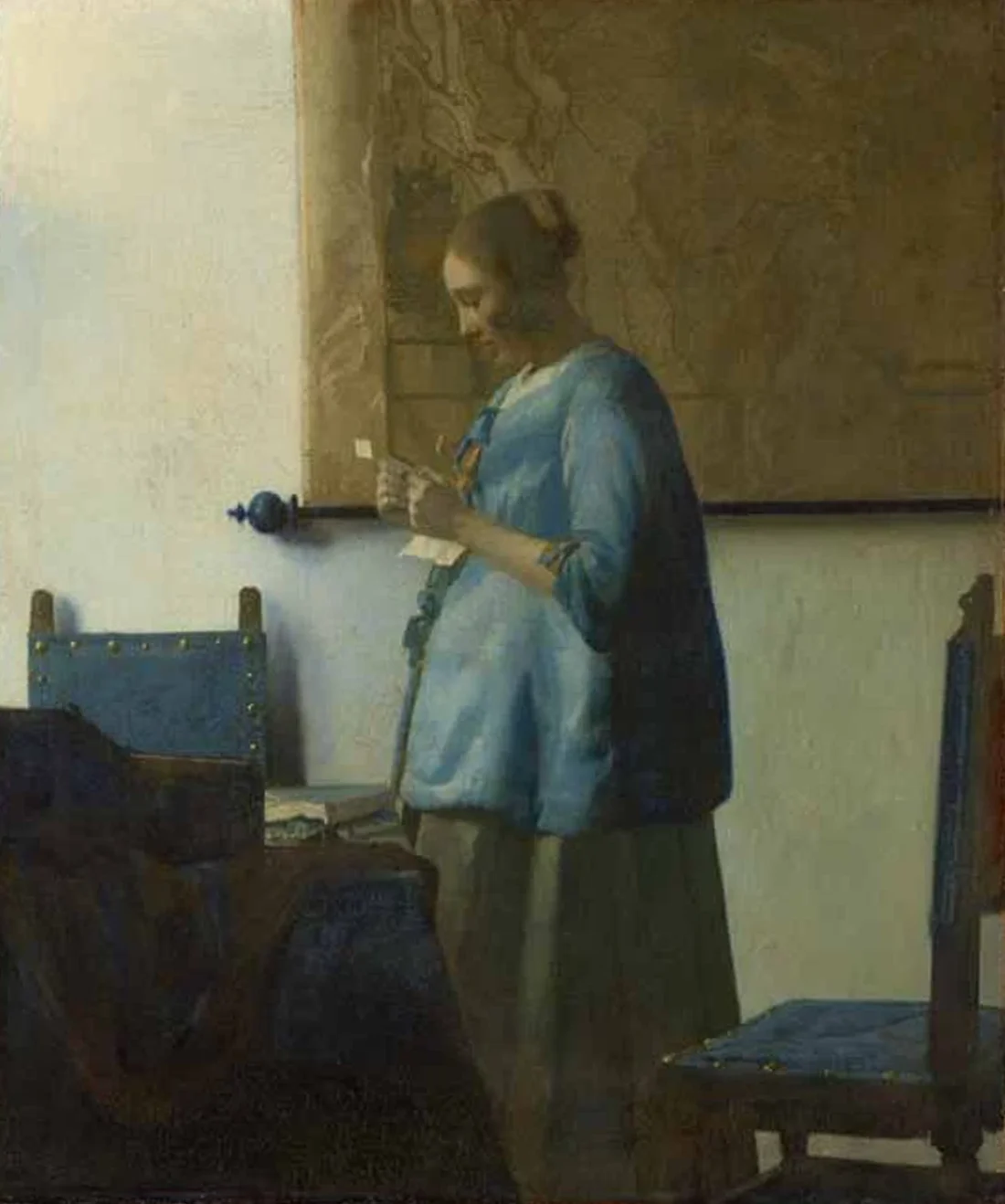
Of all the rooms Vermeer painted, Woman in Blue Reading a Letter is the one most given over to a single colour. Painted around 1663 to 1664, it shows a young woman in profile, a letter held in both hands, reading by a window we never see. Almost everything around her is blue: her loose morning jacket, the velvet on the chairs, the cloth on the table. It is, by some distance, the bluest picture he ever made.
For a long time you would not have guessed it. By the start of this century the painting wore a thick, yellowed varnish, the kind that settles over old oil paintings as the protective coat ages and discolours. It had turned the cool blues warm and muddy and flattened the differences between them, so that the shadow on the back of the jacket looked like the same dull tone as the chairs. The room had gone quietly grey.
Removing the varnish
In 2010 the Rijksmuseum decided to put that right. The work fell to the museum’s own conservator, Ige Verslype, watched over by an advisory committee that drew in curators and conservators from Washington, Vienna and Amsterdam, and it ran across the next two years.
The central task was to take off the discoloured varnish, together with old retouching and overpaint that earlier hands had added. Verslype worked with an organic solvent, chosen to keep physical contact with the fragile surface as light as possible, lifting the yellow film rather than scrubbing the paint beneath it.
Conservation history
This was far from the painting’s first trip to the studio. The first recorded repair dates to 1888, and in 1892 a Rijksmuseum conservator tried to revive its dull varnish by the fashionable method of the day, fuming it with solvent vapours and dosing it with copaiba balsam. In 1928 the canvas was given a lining, a second canvas glued to its back with wax resin to support the original, by a conservator named Greebe, who later boasted in a newspaper that he had dared what his predecessor never would. Asked over the years to line the precious Vermeer, the older man, he said, had always stammered, “I w-w-wouldn’t d-d-dare.” The picture was cleaned again in 1949, and more thoroughly in 1962.
The 2010 research turned up the price of all that handling. Scattered across the paint were tiny circular losses, and under the microscope the surface beside them was raised into little blisters. At some point the painting had been overheated, most likely while it was being lined, and cooked just enough to bubble. It happened long ago: the small losses already show in a photograph from 1894, so the harm was done before the 1928 lining. That lining left its own mark too, pressing down Vermeer’s relief and flattening the raised dabs of impasto he used for his brightest highlights.
A green beneath the blue
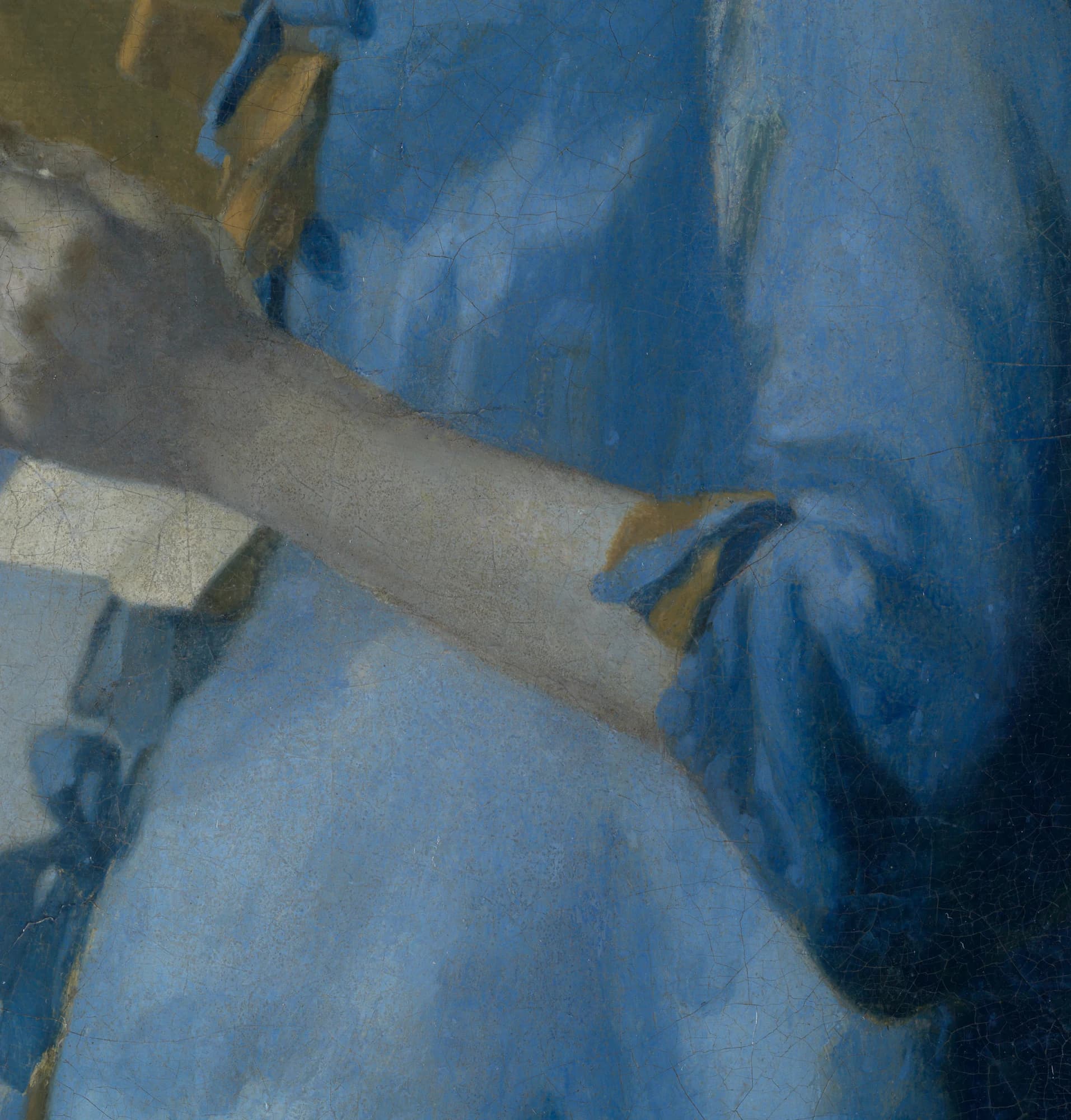
As the varnish came away, the blue returned in full. The jacket is painted in natural ultramarine, the ground-lapis pigment that was the most expensive colour on any seventeenth-century palette, and with it clean again the picture recovered its range, the velvet of the chairs now clearly a different blue from the jacket’s shadow.
The cleaning also opened a window onto how Vermeer built the colour. Under the brilliant blue, the conservators found that he had first laid down a layer of copper green, an undercoat that lends the ultramarine above it extra depth. It is a quiet bit of craft, hidden from anyone looking at the finished surface, and finding it was the high point of the project for Verslype.
The greatest surprise was when we discovered how Vermeer produced such an intense blue colour. We now know that he used a copper-green undercoat to give the colour extra depth.
An added string of pearls
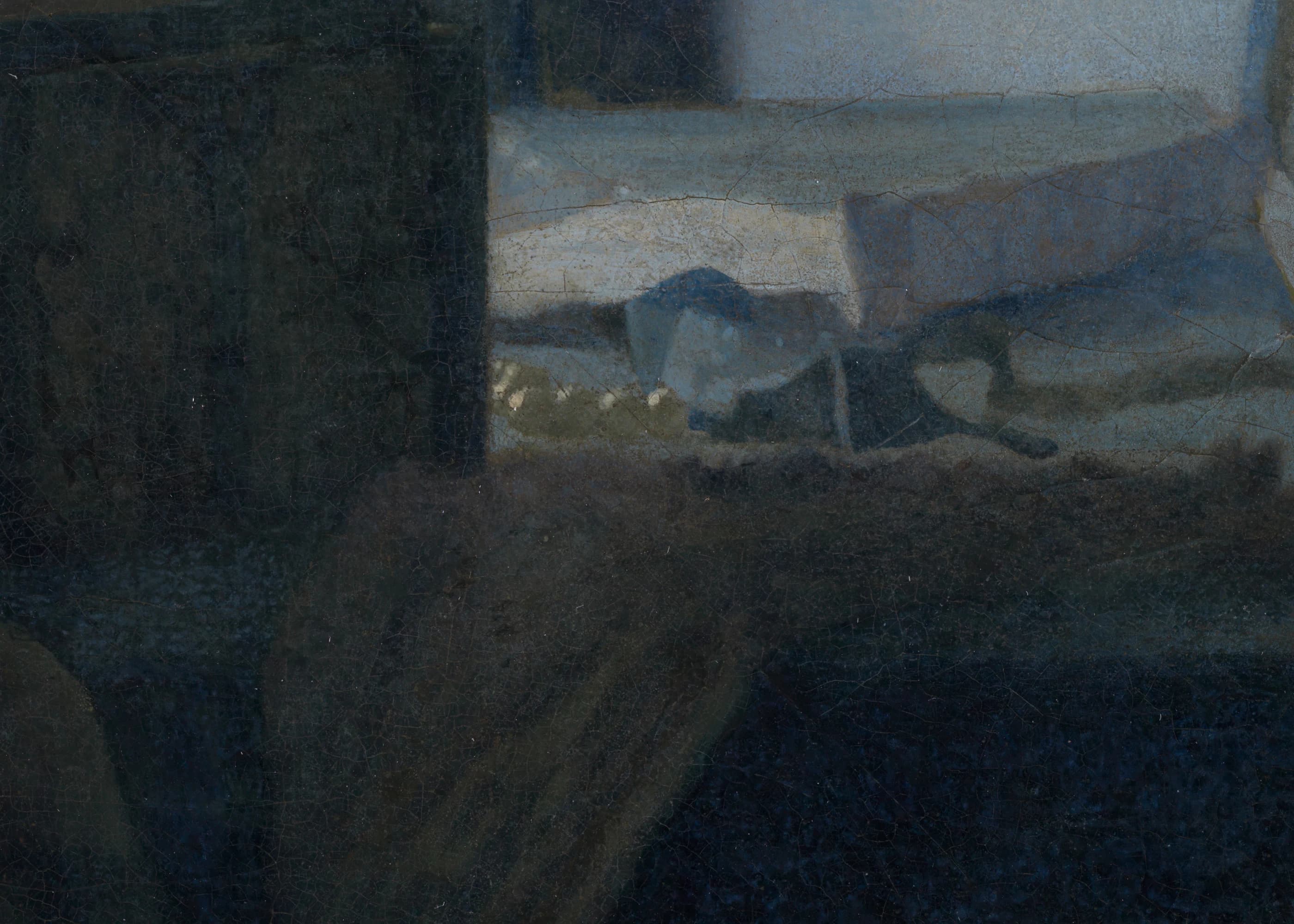
Cleaning a painting is also a chance to undo what other people have added to it, and this one had a small invention sitting on the table. Among the objects in front of the woman, a few dabs of light paint had at some point been worked up into a string of pearls, a tidy detail that looked like it belonged.
It did not. Vermeer had dotted the table with small touches of white, plain points of light. A later restorer read them as the start of a necklace and finished the thought for him, laying yellow over the white dots, and one more on the bare blue of the table, to round them into pearls. The giveaway was that the yellow ran straight across the fine cracks that age had opened in the surface, so it could not be Vermeer’s. Lifted off with solvent, the pearls came away and the white dots went back to being what he had left.
Brass nails and a purple wall
Two more things surfaced once the muddy layers were gone. Along the side of the foreground chair ran a neat row of small brass nail-heads, the upholstery tacks that hold the velvet to the frame. They had been buried under dark overpaint, and the cleaning let them catch the light again, a row of bright metal studs that give the chair its weight in the corner.
The wall held the other surprise. The patch of wall below the chair turned out to have been a vibrant purplish blue in Vermeer’s own paint, before someone later brushed it over in the greenish grey of the wall above. That grey has not held true either: tests on the upper wall found ultramarine slowly decayed toward grey, so it was once bluer than it looks now, and Vermeer’s wall ran closer to a single family of blues. It is a reminder of how far a painting can drift from its maker over three centuries, in colours nobody set out to change.
The original format
The cleaning even changed the painting’s shape. Over the years restorers had added not only to the surface but to the edges, extending the picture all the way round with overpaint, most of all at the top and bottom, until the room stood taller and more stretched than Vermeer had left it. When the discoloured overpaint along the edges came away, the original returned: a squarer canvas, and a more intimate one, the woman set a little more snugly in her room.
The old photographs settled a smaller question along the way. In the earliest known image of the painting, from 1894, the chair leg beside the woman’s skirt is broad; in pictures taken after the 1928 lining it had been quietly slimmed by a restorer. Cleaned back to Vermeer’s own paint, it was rebuilt to the shape he gave it, wide at the foot and narrowing as it rises. Even the frame had to follow, adjusted to fit the squarer picture Vermeer meant us to see.
On loan again
None of these findings rewrote who painted the picture or when. This was a cleaning, not a reattribution: the work that came off the surface was varnish, grime and the additions of later restorers, and what was left underneath was Vermeer. But a cleaning can change a painting all the same, and this one handed back a sharper, cooler, squarer, far bluer room than the one the twentieth century had grown used to.
The freshly cleaned picture spent its first years on the road. With the Rijksmuseum closed for its long renovation, the painting went out as the museum’s travelling ambassador: after the earlier loan to Japan, it was shown in Shanghai and São Paulo late in 2012, then at the Getty in Los Angeles early in 2013, the last stop before it returned to Amsterdam for the museum’s reopening that April. It travelled once more, to the National Gallery of Art in Washington, in 2015.
Notes
- 1.The restoration ran across 2010 and 2011, carried out by Rijksmuseum conservator Ige Verslype under the supervision of an advisory committee that brought in Arthur Wheelock (National Gallery of Art, Washington), Elke Oberthaler (Kunsthistorisches Museum, Vienna) and Norbert Middelkoop (Amsterdam Museum) alongside the Rijksmuseum’s own curators and conservators. The full account is Ige Verslype, “The restoration of Woman in Blue Reading a Letter by Johannes Vermeer,” The Rijksmuseum Bulletin 60, no. 1 (2012), pp. 3–18, at the Rijksmuseum Bulletin. The committee members are named there (note 1).
- 2.The conservator removed a thick, oxidised and yellowed varnish, along with discoloured old retouching and overpaint, using an organic solvent chosen to keep mechanical contact with the fragile surface to a minimum. The full account is in Ige Verslype, “The restoration of Woman in Blue Reading a Letter by Johannes Vermeer,” in the Rijksmuseum Bulletin.
- 3.The painting’s earlier treatments are set out in Verslype’s Rijksmuseum Bulletin article: a first recorded varnish repair in 1888; in 1892 W.A. Hopman reviving the dull varnish with solvent vapours and copaiba balsam (the Pettenkofer method); the 1928 wax-resin lining by P.N. Bakker and W.F.C. Greebe; and cleanings by H.H. Mertens in 1949 and, more thoroughly, in 1962. Greebe’s boast that it was he who had lined the Vermeer, and his predecessor’s stammered refusal to attempt it, are reported there from an Algemeen Handelsblad article of 1929. See the Rijksmuseum Bulletin.
- 4.Verslype found tiny circular losses scattered across the paint with small blisters beside them, evidence that the picture had once been overheated, most likely during a lining. The small losses already appear in an 1894 reproduction, so the damage predates the 1928 lining, which in turn flattened passages of Vermeer’s impasto. See the Rijksmuseum Bulletin.
- 5.Vermeer’s laying of a copper-green undercoat beneath the ultramarine to deepen it, which Verslype called the “greatest surprise” of the work, was announced in the Rijksmuseum press release “‘Woman in Blue Reading a Letter’ fully restored by the Rijksmuseum” (29 March 2012; the museum’s original page is offline, archived at the Internet Archive). Verslype’s own restoration article (the Rijksmuseum Bulletin) reported the conservation treatment and reserved the cross-section research on the paint build-up for separate publication.
- 6.In Verslype’s account Vermeer marked the table with small dots of white; a later restorer added yellow dots on top of them (and one on the bare blue of the tabletop), together with a yellow stroke above the letter, to work them up into a string of pearls. The yellow paint ran across age cracks in the surface, showing it was a later addition, and lifted off easily with solvent. The conservator’s account gives no date for the addition, though the Rijksmuseum’s 2012 press release stated that the pearls had been added in 1928. See also Verslype, Rijksmuseum Bulletin, p. 12, at the Rijksmuseum Bulletin.
- 7.Verslype records that, as the old restorations were lifted from the lower right corner, small brass nail-heads along the side of the foreground chair, painted by Vermeer and hidden for decades under dark overpaint, came back to light. See Verslype, Rijksmuseum Bulletin, pp. 12–13, at the Rijksmuseum Bulletin.
- 8.The Rijksmuseum found that the wall below the chair had originally been a vibrant purplish blue, painted over at a later date in the greenish grey of the wall above, and that the greenish grey is itself a faded blue whose ultramarine has degraded, so the two areas once sat closer in colour. See Verslype’s Rijksmuseum Bulletin and the Rijksmuseum object page, “Woman Reading a Letter,” SK-C-251.
- 9.Earlier restorers had extended the painting on all sides with overpaint, most of all at the top and bottom, leaving it more elongated than Vermeer’s squarer original. Removing the overpaint along the edges restored the intended format, and the chair leg beside the skirt, narrowed by a restorer after 1894, was reconstructed to its original width. The frame was then adjusted to the recovered sight size by the senior conservator Hubert Baija. See Verslype’s Rijksmuseum Bulletin article and the companion study, Gregor Weber, “A Question of Framing: On Vermeer’s Woman in Blue Reading a Letter,” The Rijksmuseum Bulletin 60, no. 1 (2012), pp. 20–27, at the Rijksmuseum Bulletin.
- 10.With the Rijksmuseum closed for renovation, the cleaned painting toured as the museum’s ambassador. After an earlier loan to Japan (Kyoto, Sendai and Tokyo, 2011 to 2012, recorded in Verslype’s Rijksmuseum Bulletin article, note *), it was shown in Shanghai and São Paulo late in 2012 and at the J. Paul Getty Museum in Los Angeles from 16 February to 31 March 2013, its last stop before returning to Amsterdam for the museum’s reopening that April. It travelled again to the National Gallery of Art in Washington from 19 September to 1 December 2015, hung beside the Gallery’s own Vermeers to mark the twentieth anniversary of its 1995 to 1996 Vermeer exhibition. See the J. Paul Getty Museum press release (28 January 2013) and the National Gallery of Art exhibition page, “Vermeer’s Woman in Blue Reading a Letter from the Rijksmuseum.”