The Procuress
ForgeryAbout this painting
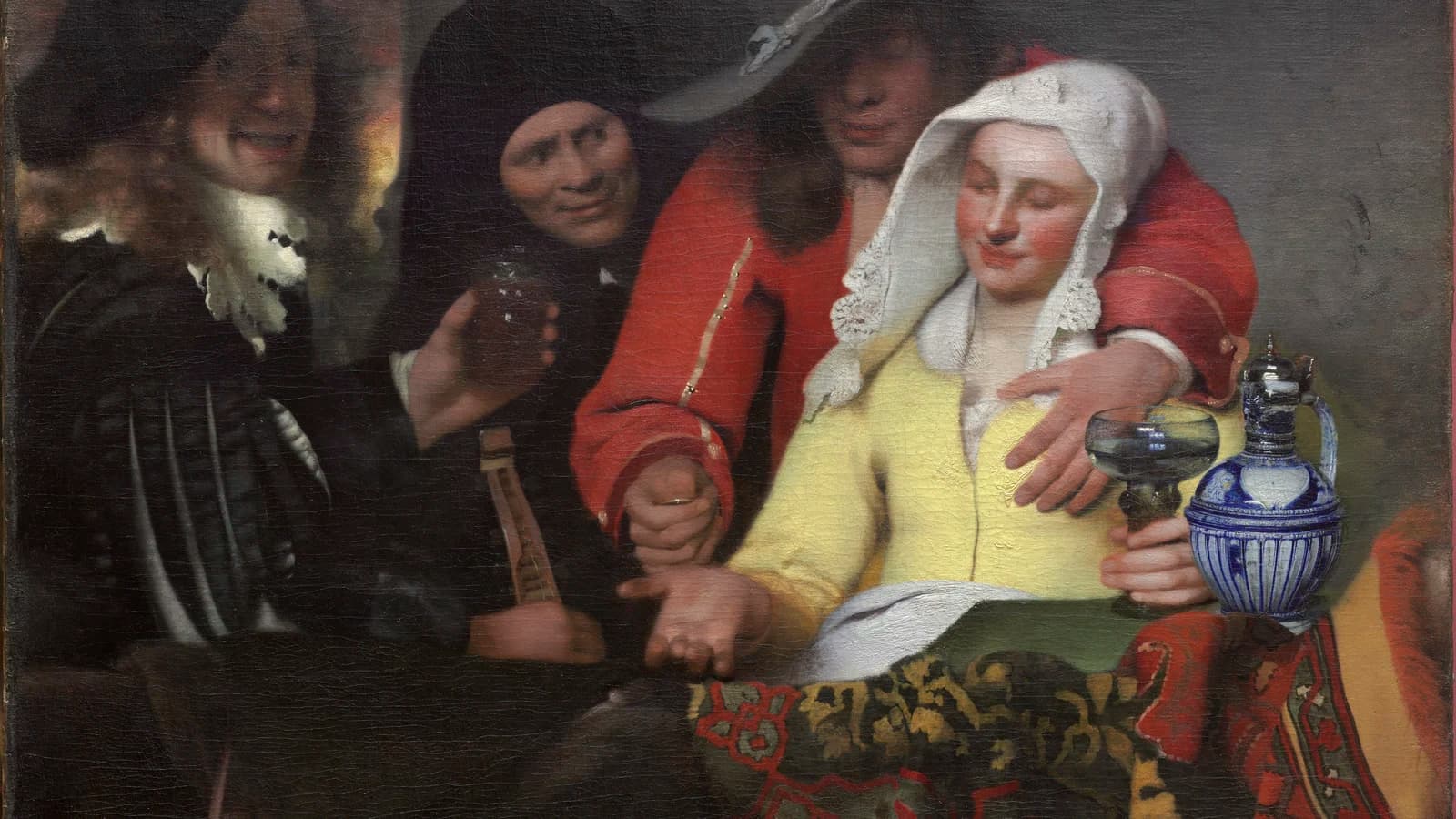
This is not a Vermeer but a 20th-century forgery in the manner of the Utrecht Caravaggist Dirck van Baburen, whose Procuress of about 1622 shows three half-length figures in a brothel: a lute-playing prostitute, a client offering a coin, and an old procuress pointing to her palm for payment. The composition matters to the Vermeer story because Maria Thins, Vermeer’s mother-in-law, owned a copy of it, and the picture turns up on the rear wall of two of his interiors, The Concert and Lady Seated at a Virginal, where its coarse subject sets off the restraint of his own manner.
A van Meegeren fake
The Courtauld’s version is attributed to Han van Meegeren (1889–1947), the Dutch painter who became one of the most successful forgers of the 20th century by working in the styles of Vermeer and his contemporaries. His most notorious fake, the Supper at Emmaus of 1936–1937, was hailed by the connoisseur Abraham Bredius as a genuine Vermeer and sold for a fortune; the deception only unravelled after the war, when a forgery he had sold to Hermann Göring led to his arrest and confession. He is best known on this site through Christ at Emmaus.
Exposed by its resin
The painting was given to the Courtauld in 1960 by Geoffrey F. Webb as a known van Meegeren forgery (accession P.1960.XX.269). Its status was thrown into doubt in 2009, when scientific analysis found no modern pigments and suggested the picture might be a genuine 17th-century work. The BBC series Fake or Fortune? reinvestigated it in 2011 and detected Bakelite, the phenol-formaldehyde resin van Meegeren used to harden his paint and counterfeit the hardness and craquelure of age, confirming the attribution to him. Documented as his work, it is arguably worth more as a celebrated forgery than it ever would have been as an anonymous old copy.
- Date
- 1935–1940
- Medium
- Oil on canvas
- Dimensions
- 99 × 107 cm