The Guitar Player
About this painting
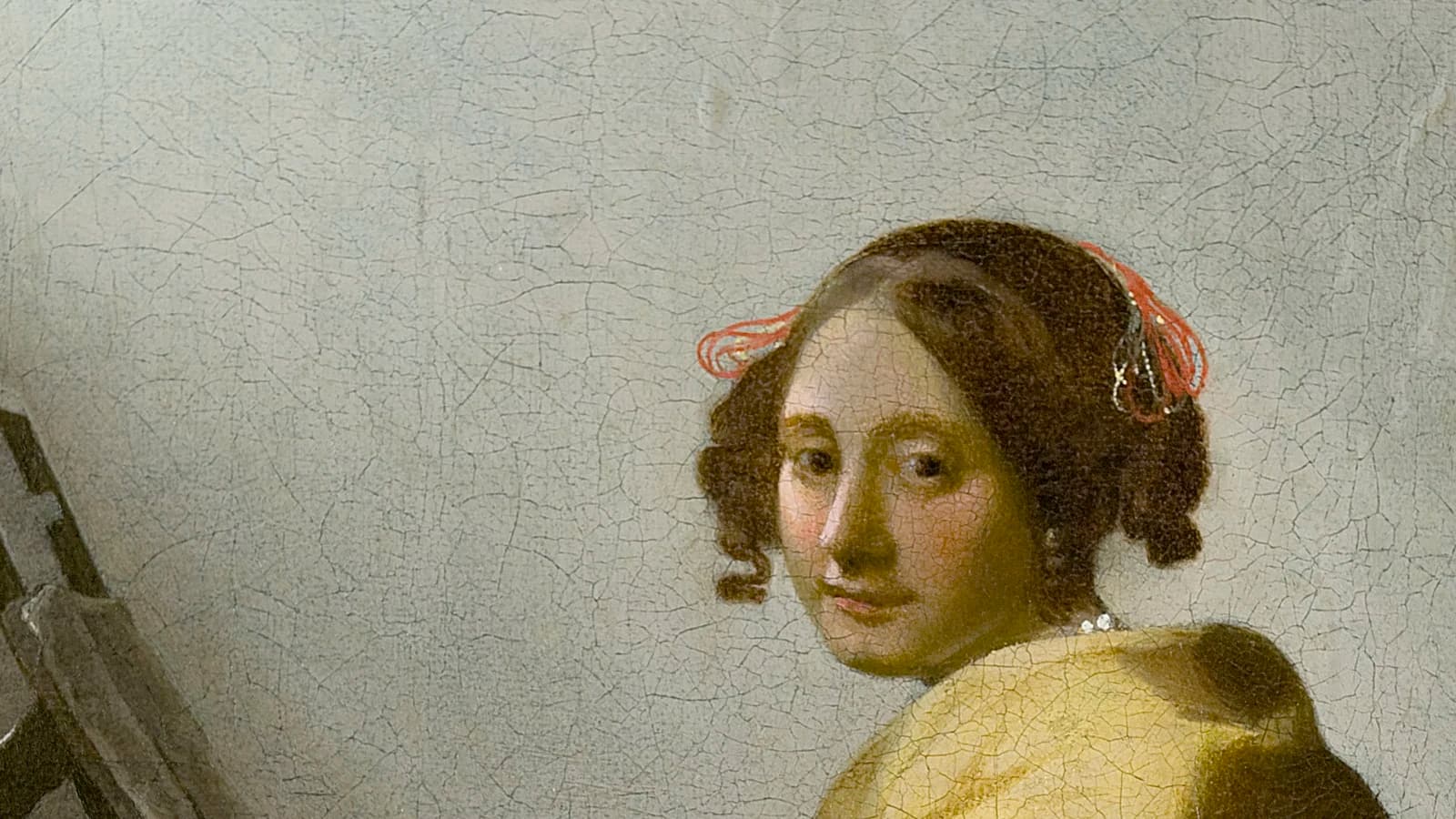
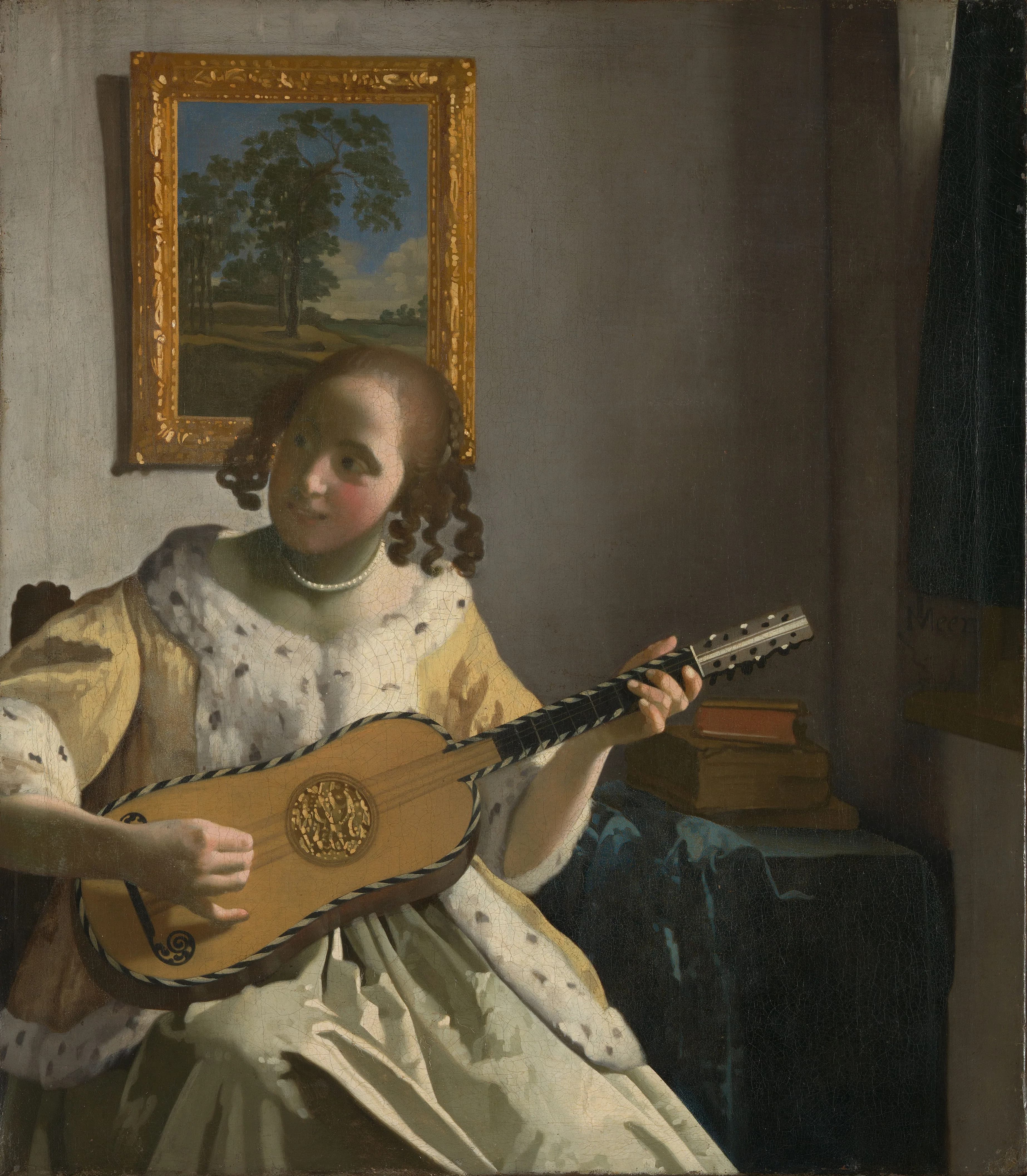
Painted around 1672, near the end of Vermeer’s short career, The Guitar Player shows a young woman in an ermine-trimmed yellow jacket caught mid-chord, her ringlets framing a broad, spontaneous smile. She looks not at us but at someone just beyond the right edge of the canvas, as if glancing up in the middle of a song.
A late, luminous style
By the early 1670s Vermeer had moved away from the soft, granular light of his middle years toward a brighter, more linear manner. Here the daylight falls in crisp, almost metallic touches: the gilded rosette of the guitar’s soundhole, the pearls at the woman’s throat, and the highlights along her fingers are set down as bright, abstract dabs rather than smoothly blended transitions. The mood is cheerful and immediate, a marked contrast to the contemplative stillness of works such as Young Woman with a Water Pitcher.
A fashionable instrument
The five-course baroque guitar that gives the picture its title was a novelty in the Dutch Republic of the 1670s, gradually displacing the lute as the instrument of polite society. Music in Vermeer’s interiors carries associations of love and harmony, and the woman’s outward gaze and smile imply an unseen companion, perhaps the listener she is playing for. The painting hung under exactly this theme in the National Gallery’s 2013 exhibition Vermeer and Music: The Art of Love and Leisure.
An off-center composition
What makes the picture unusual is its framing. Vermeer pushes the figure hard to the left, so that her shoulder is clipped by the edge and the gilt-framed landscape on the back wall is cropped to a sliver. The asymmetry is rare in his work and lends the scene an off-balance, almost photographic immediacy that anticipates the casual croppings of later centuries. A second version of the composition, in the John G. Johnson Collection in Philadelphia, is generally regarded as a copy rather than a second autograph painting.
From the Dissius sale to Kenwood
The Guitar Player most likely belonged to Vermeer’s Delft patron Pieter Claesz van Ruijven and passed through his heirs to the 1696 Dissius sale in Amsterdam, where it appeared as lot 4. It later moved into English collections, owned in turn by two Viscounts Palmerston and finally by Edward Cecil Guinness, 1st Earl of Iveagh; on his death it came to Kenwood House in London as part of the Iveagh Bequest of 1927.
The Guitar Player heist
On the night of 23 February 1974 thieves cut the telephone lines to Kenwood House, smashed a barred ground-floor window with a sledgehammer, and lifted The Guitar Player from the wall, scaling the perimeter wall before the alarm was answered; the empty frame was abandoned nearby. A run of anonymous demands followed: the distribution of food worth more than $1 million to the poor of Grenada, and the transfer of the imprisoned IRA members Marian and Dolours Price from England to a prison in Northern Ireland. To prove the threat was real, a strip cut from the edge of the canvas was posted to The Times in London with a note warning that the picture would be burned on St Patrick’s night. No ransom was paid. Acting on an anonymous tip, police recovered the painting on 7 May 1974 in the churchyard of St Bartholomew-the-Great in Smithfield, wrapped in newspaper and damp but otherwise undamaged. It hangs at Kenwood House again today.
- Date
- 1670–1673
- Medium
- Oil on canvas
- Dimensions
- 53 × 46.3 cm
- Home
 Kenwood House