A Maid Asleep
About this painting
Painted around 1656–1657, A Maid Asleep shows a young woman who has dozed off at a table, her head propped on one hand, beside a half-filled wineglass, an overturned roemer, and a Chinese porcelain bowl of fruit. She is richly dressed, in a dark-red silk jacket, pearl earrings, and a pointed black cap, attire well above the station of an ordinary servant. It is among the earliest of Vermeer’s domestic interiors, and the signature “I.VMeer” appears at the upper left.
A doorway into an empty room
Behind the woman an open door gives onto an adjoining room, a compositional device the Dutch called a doorkijkje, or see-through, favored by interior painters such as Pieter de Hooch. The far room is empty save for a table and a mirror or picture on the wall, so that the eye travels into a depth that the narrative never quite fills. The angled chair with its cushion in the foreground hints at company that has just departed.
What the X-rays revealed
Technical examination has shown that Vermeer reworked the scene substantially. In the doorway he had first painted a standing dog and, in the back room, a man in a broad-brimmed hat; both were painted out, as were grape leaves that once covered the fruit. Walter Liedtke noted that the dog would have alluded to the “impromptu relationships canine suitors strike up on the street,” an anecdotal touch Vermeer chose to suppress in favor of stillness and ambiguity.
Sleep, wine, and love
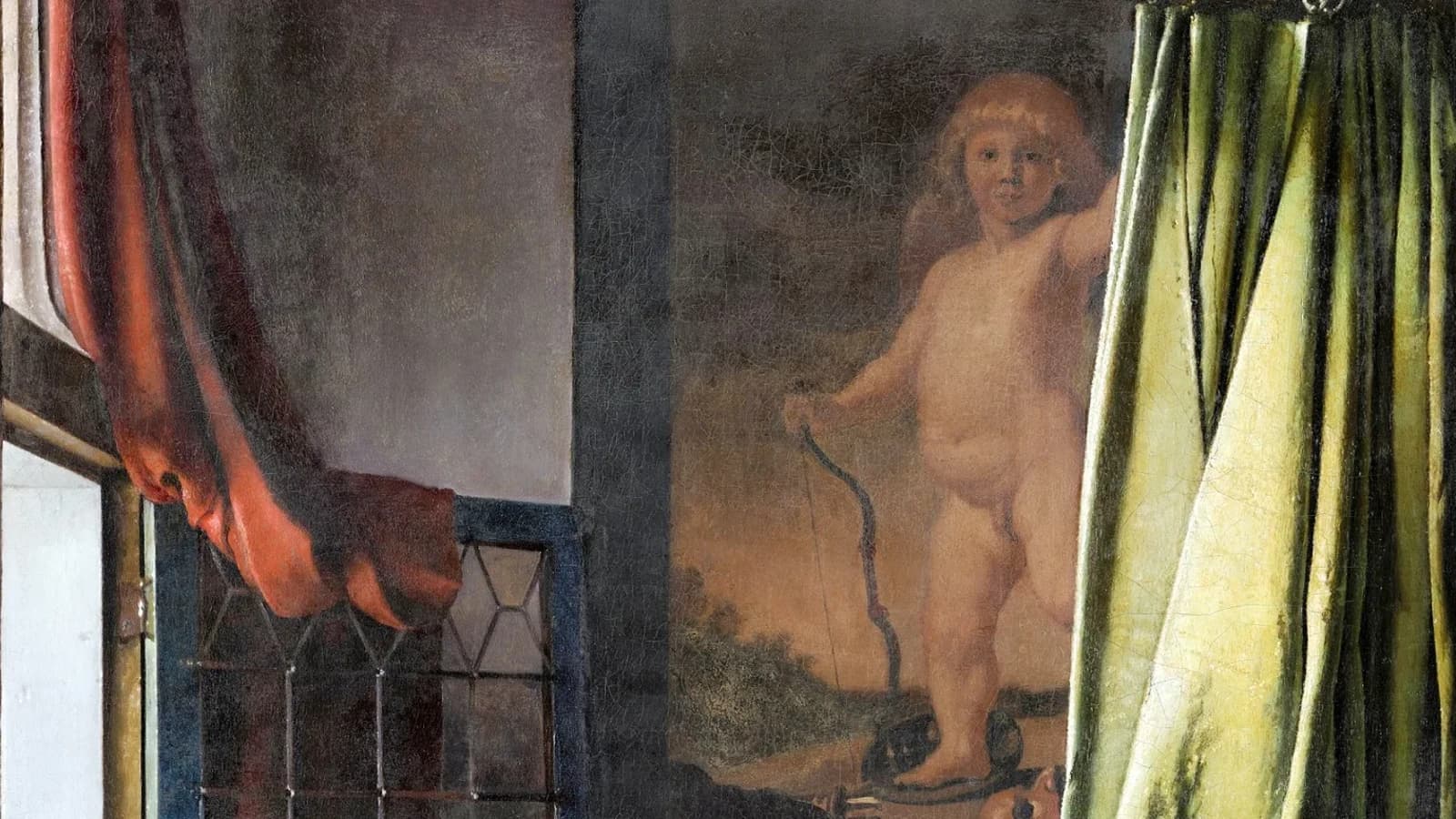
The overturned glass and wine jug invite a reading of drunkenness or idleness, while the bowl of fruit carried associations of temptation, and the knife and gauzy cloth held suggestive overtones for contemporary viewers. Above the woman’s head hangs a dimly lit, ebony-framed picture in which a leg of Cupid and a fallen mask are just visible; if the mask signifies deceit, she may be feigning sleep rather than overcome by it. Arthur K. Wheelock Jr. has read her pose less as slumber than as melancholy, the introspective state linked in the period to unhappy love.
An early venture into genre
The picture marks Vermeer’s first sustained move into the contemporary domestic interior, a genre then being shaped by Nicolaes Maes, Gabriel Metsu, and de Hooch, and a turn away from the large history and biblical subjects of his beginnings. It is thought to have been the first work acquired by Pieter Claesz van Ruijven, the Delft patron who would become Vermeer’s principal collector. The painting passed through the 1696 Dissius sale in Amsterdam and later the 1811 Smeth van Alphen sale in Paris, and reached the Metropolitan Museum of Art in 1913 with the bequest of Benjamin Altman.
- Date
- 1656–1657
- Medium
- Oil on canvas
- Dimensions
- 87.6 × 76.5 cm