The 2010 Examination of The Art of Painting
Vienna's largest Vermeer is too fragile to leave the building. The forensic study that explained why also read his construction pinholes, a date hidden beside the signature, and the underdrawing beneath the paint.
The Vermeer that stays in Vienna
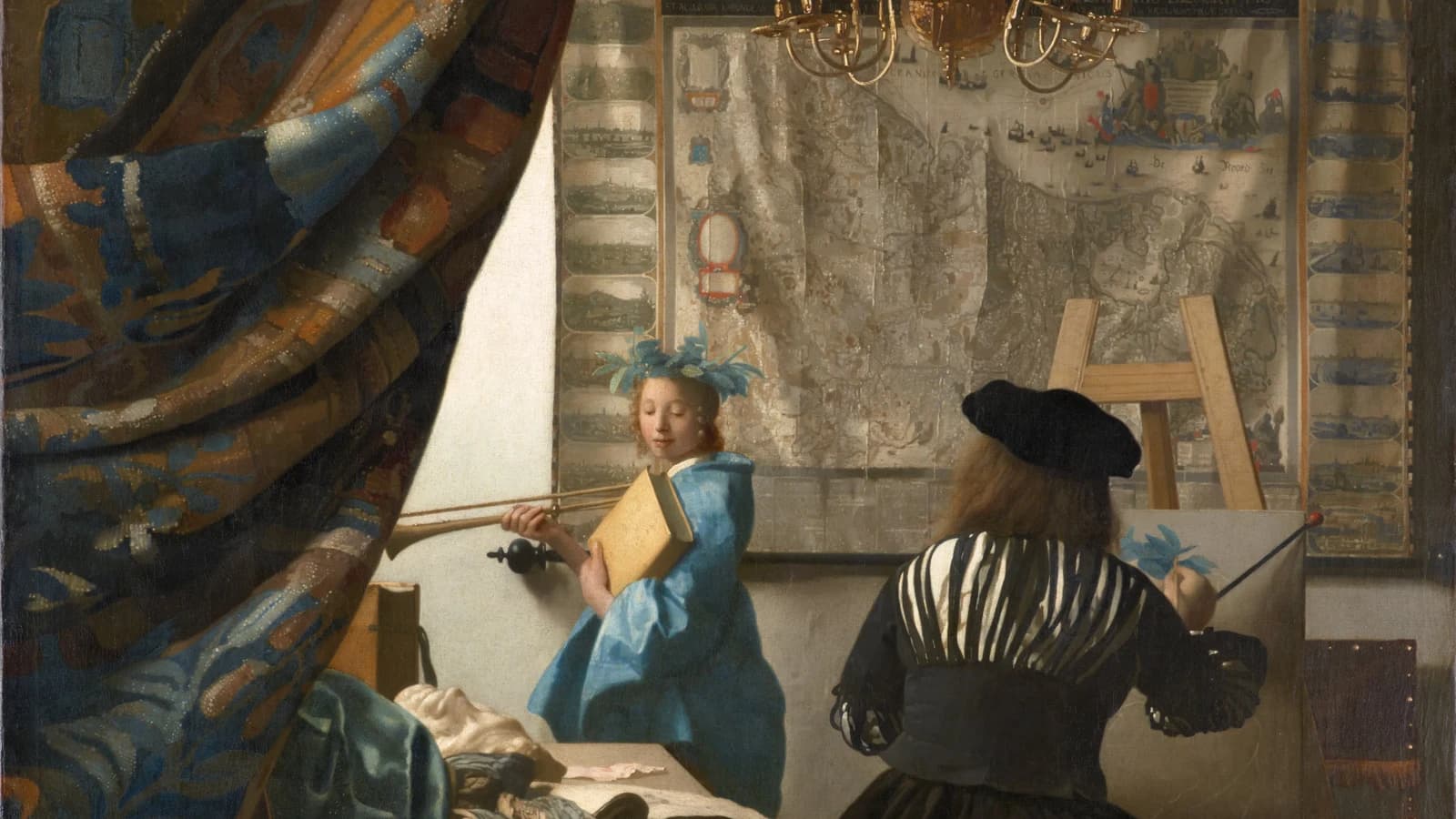
When the Rijksmuseum gathered most of Vermeer’s surviving paintings in one place in 2023, the largest of them was missing. Vienna’s The Art of Painting, the grandest picture he ever made, stayed home. The Kunsthistorisches Museum judged it too fragile to travel, and would not lend it even for a once-in-a-lifetime show.
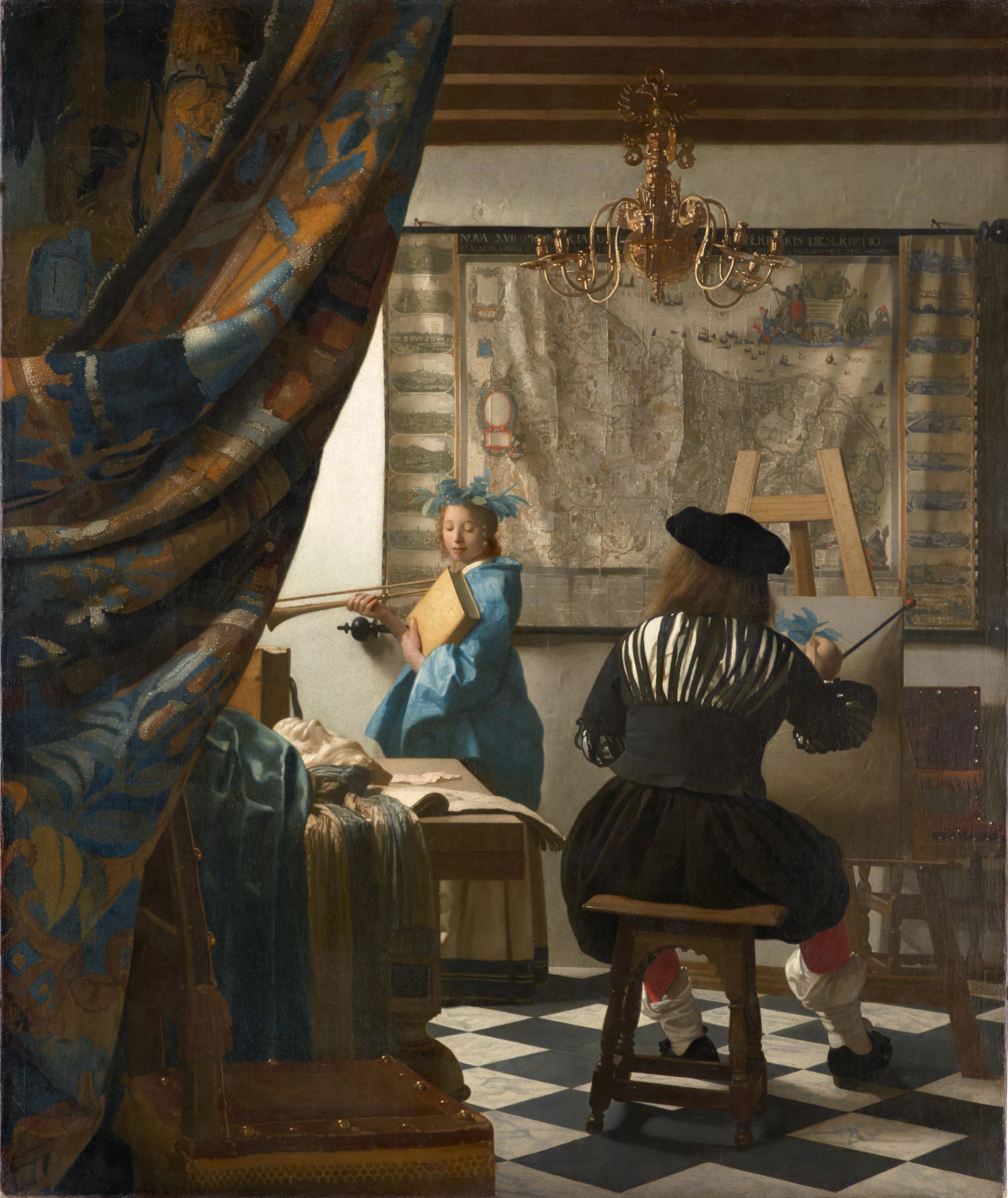
At 120 by 100 centimetres it is built on a scale far beyond the small domestic interiors Vermeer is best known for: a painter seen from behind at his easel, a young woman posing as Clio, the muse of history, and behind them a large map of the Low Countries under a gilt chandelier. The reason it cannot leave Vienna was set out by the museum’s own years-long study of the picture, presented in 2010 under a forensic title, “Vermeer. Die Malkunst. Spurensicherung an einem Meisterwerk,” which translates roughly as the securing of the traces on a masterpiece.
Securing the traces
The study was led by the museum’s conservator Elke Oberthaler, working with the scientist Jaap Boon, the curators Sabine Pénot and Sabine Haag, and Robert Wald, who examined Vermeer’s working method. It paired the close looking of conservation with the instruments of a laboratory: microscopy, cross-sections cut from tiny paint samples to read the layers in order, infrared imaging to see the drawing beneath the paint, and X-radiography to read the canvas and the build-up of the picture.
The aim was not a dramatic cleaning. Where the 2010 to 2011 cleaning of Woman in Blue Reading a Letter in Amsterdam lifted a yellowed varnish to recover the blues beneath, the Vienna campaign was largely a matter of understanding and steadying a delicate surface, and of recording what the picture could be made to tell. The findings filled the 2010 focus exhibition, hung with a slashed doublet, a trumpet and a chandelier of the kind Vermeer painted, and a working camera obscura for visitors to look through.
Conservation history
The picture’s fragility has a long record. Minute flaking, above all in the lighter passages, was first noticed in the early 1950s, after the painting had travelled in a touring exhibition of the Vienna collection. The first close study of its delicate condition was made in 1994 and 1995, when it was examined in connection with the large Vermeer exhibition that toured Washington and The Hague in 1995 and 1996. By the time of the Vienna campaign the painting was already considered too vulnerable to send on loan.
Why the paint is failing
The laboratory work explained the flaking. For the lighter passages, the analysis found, Vermeer used an oil-rich paint closer to a tempera, an oil bound up with a little egg or other proteinaceous material, rather than a straightforward oil. Over three centuries that particular build-up has grown mechanically weak, so the paint there tends to loosen and lift in tiny flakes.
The losses stay quiet under stable conditions and stir under stress, the kind a painting meets when the temperature and humidity around it shift, or when it is packed, moved and rehung. That is the plain reason a picture of this importance no longer travels: the surface most at risk is exactly the bright, pale paint that gives the room its light.
Lines beneath the paint
Infrared imaging looks through the upper paint to the dark drawing an artist lays down first, the underdrawing that maps out where things will go. Under The Art of Painting it found fine black lines setting the contours of the design: the arms of the chandelier, the framing of the small town views ranged along the edges of the wall map, and the easel. Vermeer planned the architecture of the room before he began to paint it.
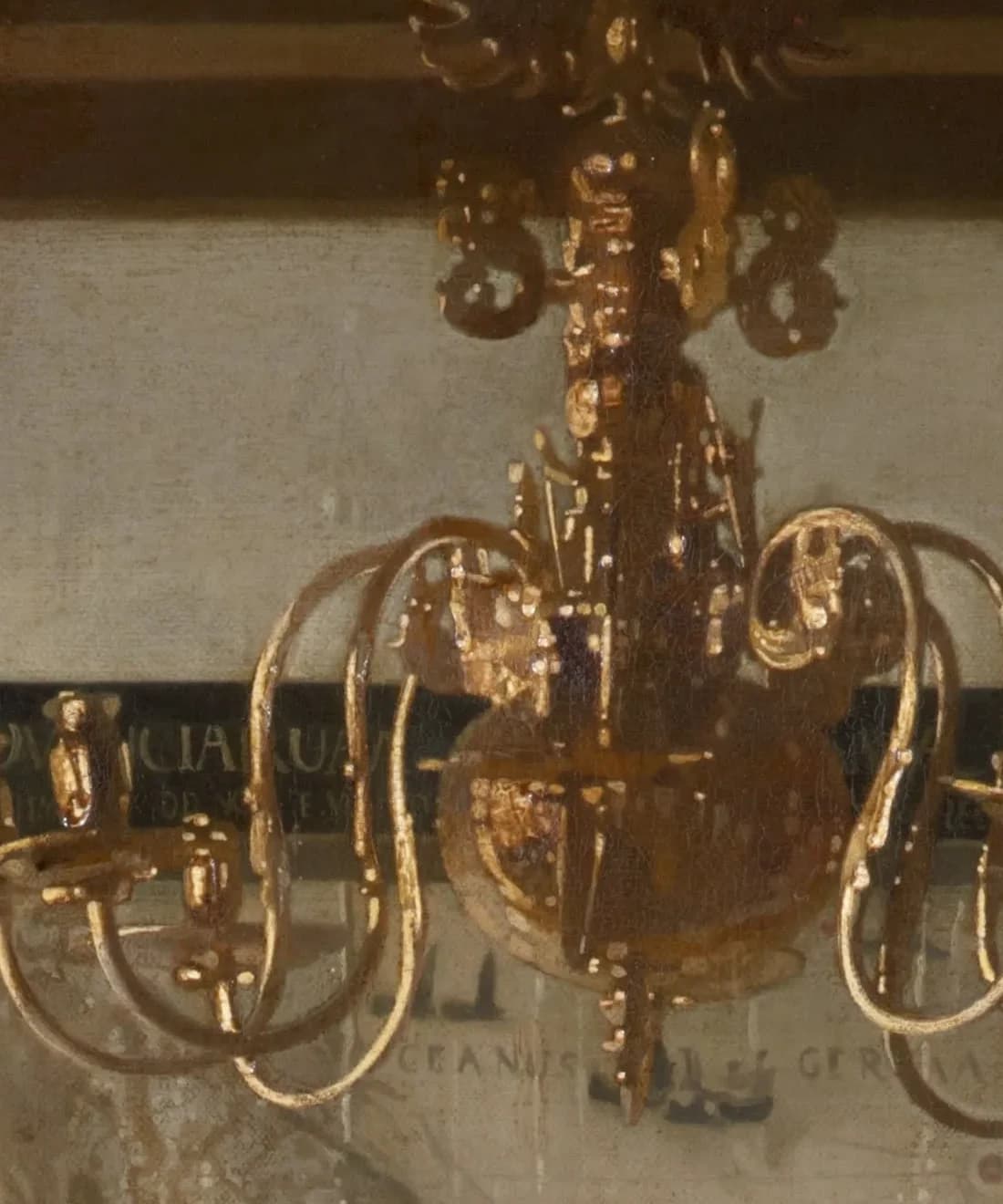
The chandelier is one of the clearest cases. It hangs high in front of the map, a heavy object whose scrolling arms were drawn in before they were modelled in gilt. The same is true of the small framed views that run down the sides of the map, each one ruled in before it was filled.
The drawing is not loose searching but careful setting-out. It belongs to a picture in which almost nothing is improvised, where the placing of every object answers to the geometry of the room.
The pinholes and the vanishing point
That geometry left a physical mark. The examination found a pinhole in the canvas at the principal vanishing point of the composition, just below the knob at the left end of the rod from which the map hangs. A painter laying out a perspective could pin a thread at the vanishing point and pull it taut to any corner of the scene, using it as a straight edge along which to draw the lines that recede into depth. The pinhole is where Vermeer’s thread was fixed.
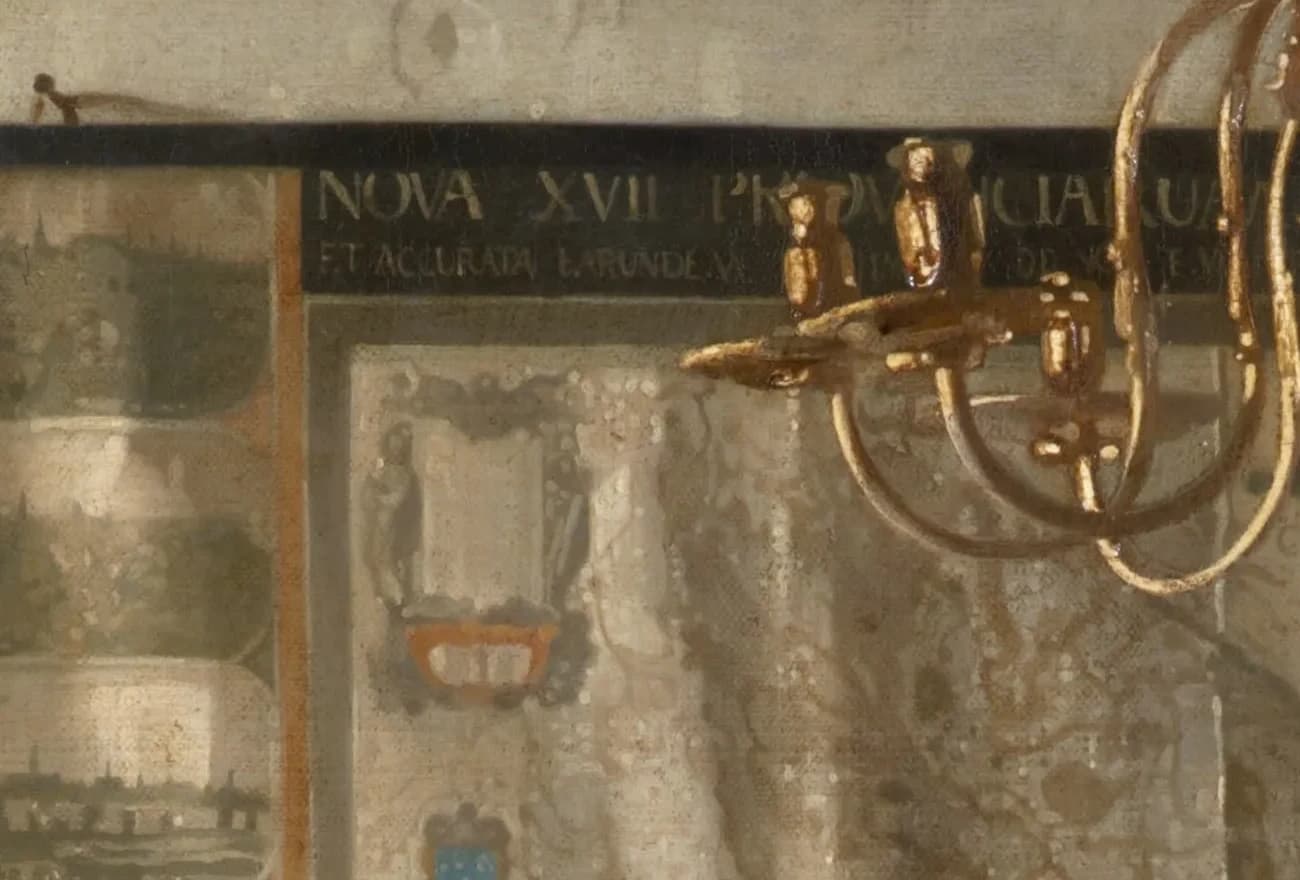
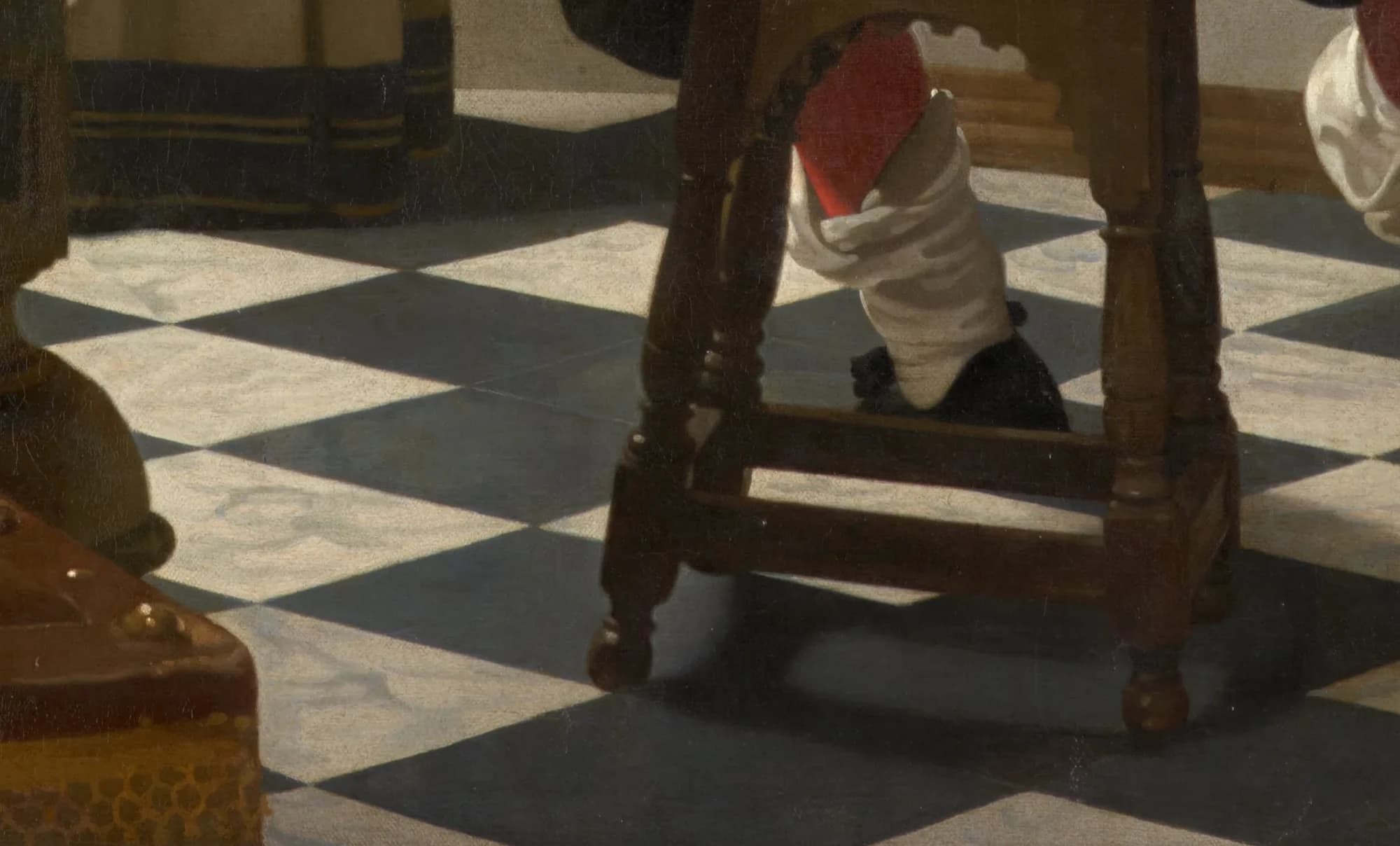
The study identified a second construction point as well, the one that governs the painter’s stool, set apart from the first. Together they show a composition worked out by hand and rule before the brush touched it.
None of this settles the older question of whether Vermeer also looked through a camera obscura, the lens-and-mirror box that can throw a scene onto a surface. A pin and a thread are evidence of geometry, not of a lens, and the camera obscura, if he used one, leaves no such mark in the paint. The 2010 exhibition put a working camera obscura beside the painting and left the question where it stands, open.
A date beside the signature
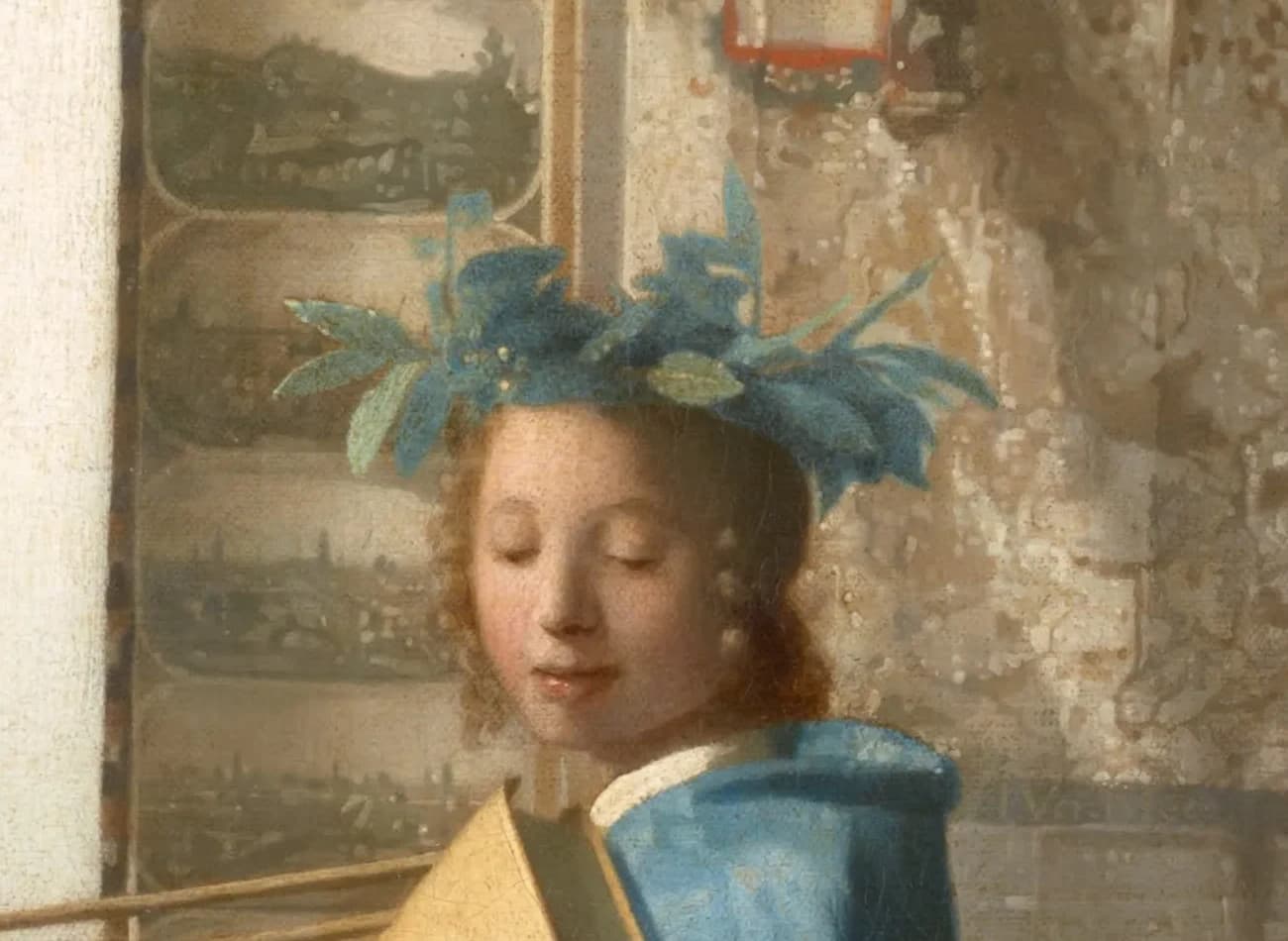
Vermeer signed The Art of Painting not in a corner but on the map itself, just to the right of Clio. The examination read a date applied immediately after the signature, worn but legible enough to narrow, and it can be interpreted as 1666 or 1668.
The form of the lettering is close to the inscriptions on The Astronomer and The Geographer, the two pictures Vermeer did date plainly, to 1668 and 1669. A date in the later 1660s fits where most scholars already place the picture, and ties this most ambitious of his works to the small, dated pair of men of science.
The painting that does not travel
The Vienna study did not change who painted the picture or when, within a year or two. What it changed is how well the painting is understood: the order in which Vermeer built it, the drawing under its surface, the pin that fixed its perspective, the date by his name, and the reason its bright paint keeps lifting away. Those last findings carry a practical weight. They are why the museum sent its research out into the world in 2010, in an exhibition and a catalogue, rather than the painting, and why, when the focus show closed, the picture went back to its wall in Vienna and has stayed there.
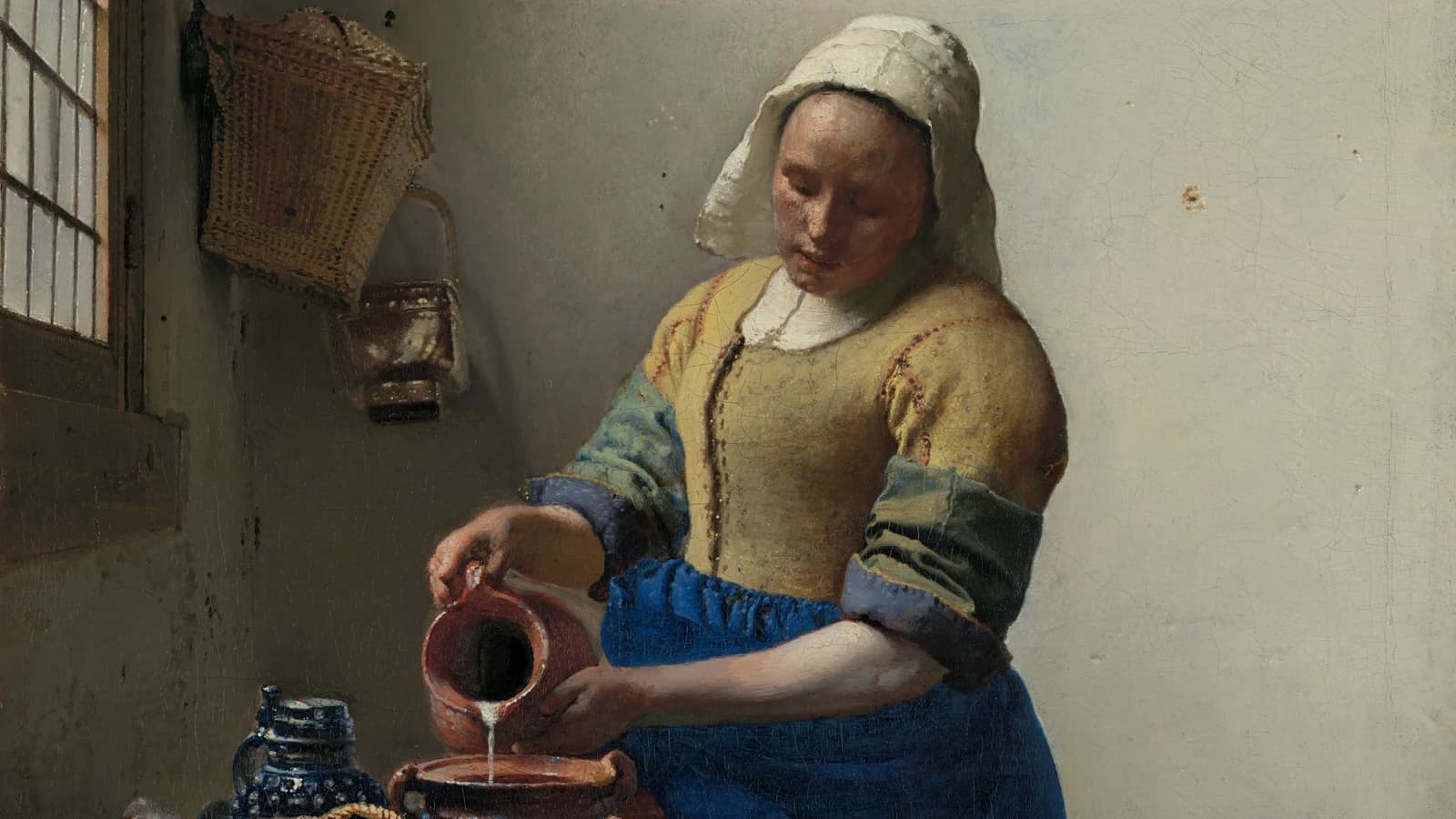
A few years later, the Rijksmuseum carried out a comparable technical study of one of its own Vermeers without cleaning it, reading the changes and the buried objects beneath the surface of The Milkmaid.
Notes
- 1.The multi-year study and conservation of The Art of Painting was carried out at the Kunsthistorisches Museum, Vienna, by the museum’s conservator Elke Oberthaler with the scientist Jaap J. Boon, the curators Sabine Pénot and Sabine Haag, and the painting-technique research of Robert Wald. It was presented in the focus exhibition “Vermeer. Die Malkunst. Spurensicherung an einem Meisterwerk” (25 January to 25 April 2010) and its catalogue, edited by Sabine Haag, Elke Oberthaler and Sabine Pénot (Vienna: Residenz Verlag, 2010). See the Kunsthistorisches Museum object page, “The Art of Painting”.
- 2.The condition history is set out in Elke Oberthaler, Jaap Boon, Sabine Stanek and Martina Griesser, “The Art of Painting by Johannes Vermeer: History of Treatments and Observations on the Present Condition,” in Vermeer. Die Malkunst (Vienna, 2010): adhesion problems and minute flaking, above all in the lighter passages, were noticed in the early 1950s after a touring exhibition, and the first close condition study was made in 1994 and 1995 in connection with the Washington and The Hague Vermeer exhibition of 1995 to 1996.
- 3.The mechanism behind the flaking is analysed in Jaap J. Boon and Elke Oberthaler, “Mechanical weakness and paint reactivity observed in the paint structure and surface of The Art of Painting by Vermeer,” in Vermeer. Die Malkunst (Vienna, 2010), pp. 328 to 335: Vermeer rendered the lighter passages in an oil-rich, tempera-like paint that included a little proteinaceous material, and this build-up has become mechanically weak and prone to small losses. See the publication record at ResearchGate.
- 4.Robert Wald’s study of Vermeer’s working method in the Vermeer. Die Malkunst catalogue (Vienna, 2010) reports the fine black underdrawing lines that lay out the contours of elements such as the arms of the chandelier, the framed town views along the map and the easel. The catalogue’s findings are summarised in the review by Ulrich Heinen, “Vermeer. Die Malkunst,” sehepunkte 10 (2010), no. 6.
- 5.Wald’s catalogue study (Vermeer. Die Malkunst, Vienna, 2010) locates a pinhole in the canvas at the principal vanishing point of the composition, just below the knob at the left end of the map’s roller, and identifies a second construction point for the painter’s stool. The vanishing point on the canvas “that served for the painter’s stool” is noted in the review by Ulrich Heinen, “Vermeer. Die Malkunst,” sehepunkte 10 (2010), no. 6. The pinholes show that Vermeer set out the perspective by geometric construction; they are not in themselves evidence of a camera obscura.
- 6.The examination read a date applied by Vermeer immediately after his signature on the map, which can be interpreted as 1666 or 1668, its lettering close to the inscriptions on The Astronomer and The Geographer. See Wald’s study in Vermeer. Die Malkunst (Vienna, 2010) and the review by Ulrich Heinen, “Vermeer. Die Malkunst,” sehepunkte 10 (2010), no. 6, which notes the date mark beside the signature.
- 7.The Art of Painting was not among the works gathered for the Rijksmuseum’s 2023 Vermeer exhibition; the Kunsthistorisches Museum judged it too fragile to travel, a judgement that follows directly from the condition research above. See Nancy Kenney, “Rijksmuseum upgrades three Vermeers ahead of blockbuster show,” The Art Newspaper (29 November 2022), at The Art Newspaper.