The Heist of The Concert
How Vermeer's The Concert was stolen from the Isabella Stewart Gardner Museum in 1990, and why its empty frame still hangs in Boston.
A Vermeer won with a handkerchief
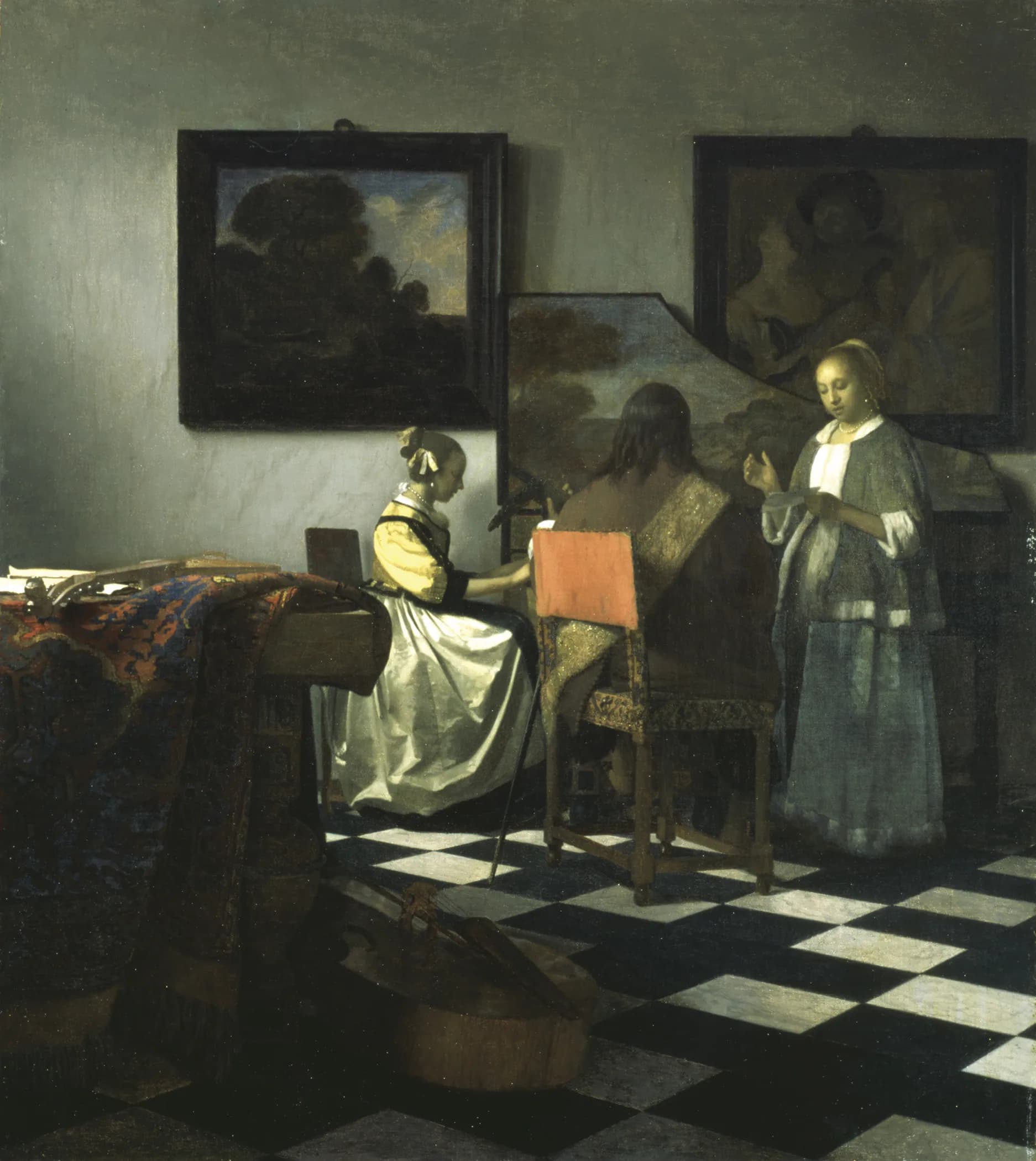
On 5 December 1892, the collection of Théophile Thoré-Bürger, the French critic who had done more than anyone to rescue Vermeer from two centuries of obscurity, was auctioned at the Hôtel Drouot in Paris. Among the lots was The Concert (c. 1663–1666), a quiet scene of three figures making music in a sunlit room: a young woman at a harpsichord, a man with a lute seen from behind, and a singer beating time with her raised hand.
In the saleroom sat Isabella Stewart Gardner, a New York-born collector married into Boston society. She had arranged a private signal with Fernand Robert, her agent in Paris: he was to keep bidding for as long as her handkerchief was raised. Agents for the Louvre and London’s National Gallery, by the account the museum itself tells, realised they were bidding against each other and politely withdrew, and Robert carried the picture off for 29,000 francs, about $5,000 at the time. It was one of Gardner’s first major old master purchases, and it made her name as a collector overnight.
A palace built for the public
Gardner was born in New York in 1840 and married Jack Gardner of Boston in 1860. The couple’s only child died before his second birthday, and travel and art gradually filled the space grief left behind. From the 1890s, advised by the young art historian Bernard Berenson, she assembled one of the finest private collections in America: Titian, Rembrandt, Botticelli, Sargent, and her Vermeer.
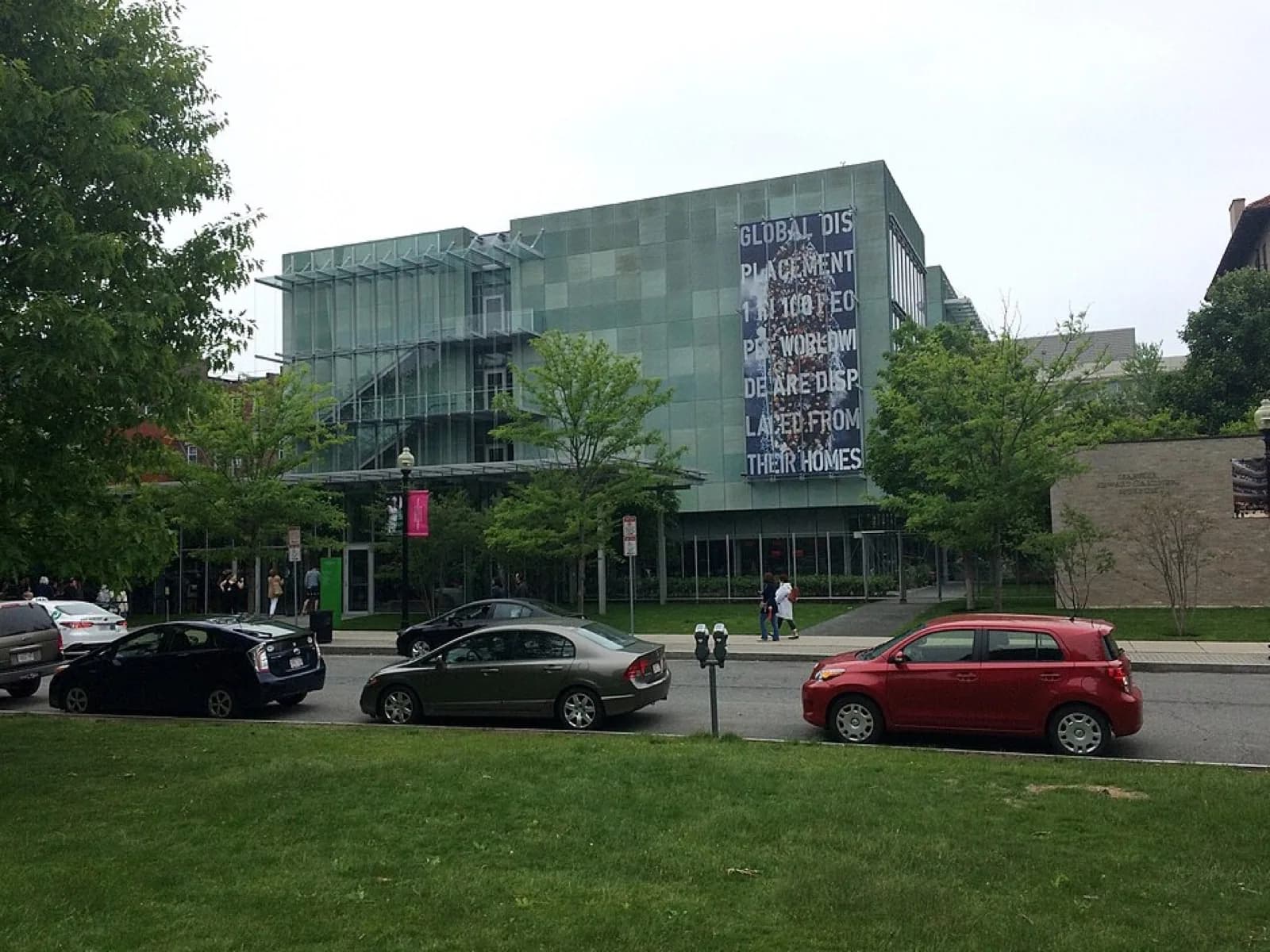
After Jack’s sudden death in 1898, she carried out their shared plan alone: Fenway Court, a Venetian-style palace on Boston’s newly filled Fens, its galleries wrapped around a glass-roofed courtyard. On the evening of 1 January 1903 she opened it with a concert by fifty musicians of the Boston Symphony Orchestra; when the music ended, the doors swung back on a candlelit courtyard banked with flowers.
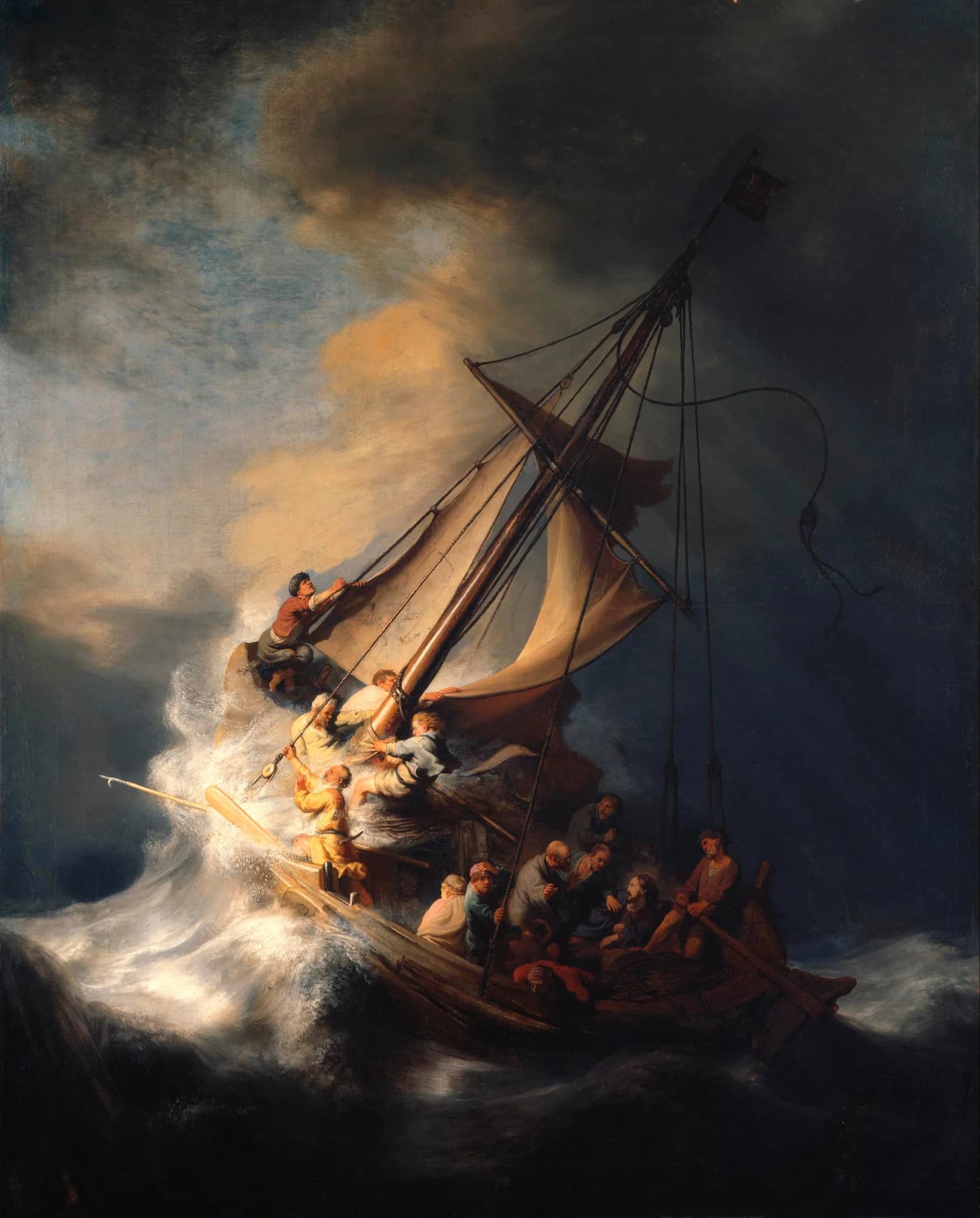
The Concert hung in the Dutch Room on the second floor, near Rembrandt’s Christ in the Storm on the Sea of Galilee. Gardner lived above her galleries until her death in 1924.
For the education and enjoyment of the public forever.
Her will fixed the museum in place: the collection was to remain arranged exactly as she had left it, with nothing added, removed, or rehung. If the terms were ever violated, everything was to be sold and the proceeds handed to Harvard. For nearly a century the condition preserved her vision. After 1990, it would preserve a wound.
Eighty-one minutes: the night of 18 March 1990
In the small hours of 18 March 1990, as Boston’s St Patrick’s Day celebrations wound down, two men in police uniforms pressed the buzzer at the museum’s side entrance and said they were responding to a disturbance. The young guard on duty broke protocol and let them in. Within minutes he and his fellow guard had been lured from the desk, handcuffed, and left bound in the basement, where police found them at 8:15 the next morning. The thieves had the building to themselves and took their time: motion detectors recorded them moving through the galleries for 81 minutes before they drove away at 2:45 am with thirteen works of art.
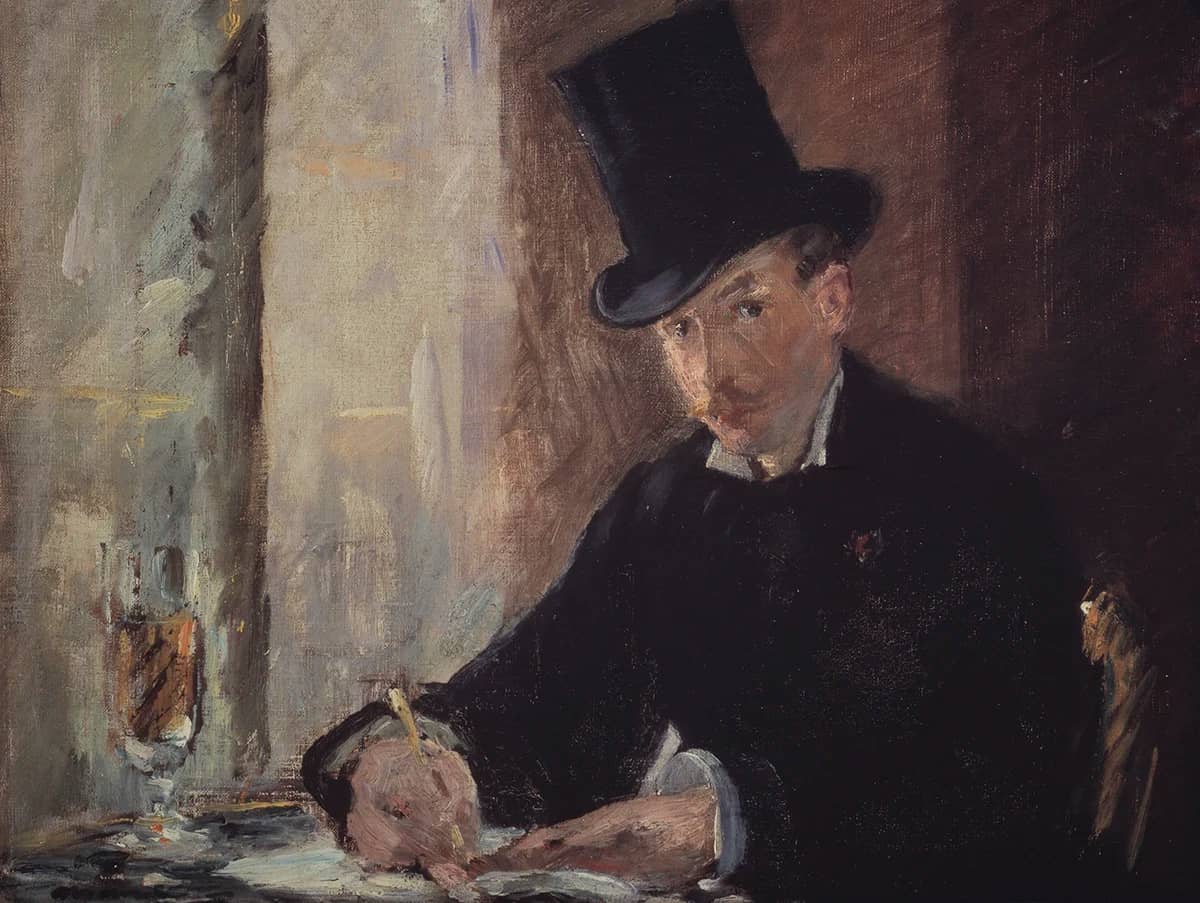
The worst losses came from the Dutch Room. The thieves cut Rembrandt’s Christ in the Storm on the Sea of Galilee, his only seascape, and A Lady and Gentleman in Black from their frames, and removed The Concert and Govert Flinck’s Landscape with an Obelisk from theirs. They also took a Chinese bronze beaker, a Rembrandt self-portrait etching, five Degas drawings, a bronze eagle finial from a Napoleonic flag, and Manet’s Chez Tortoni, while walking past Titian’s Europa, often called the most important painting in the collection. The haul has been valued at half a billion dollars, the costliest art theft on record, and The Concert, one of only thirty-six paintings by Vermeer, is widely described as the most valuable stolen artwork in the world.

The empty frames
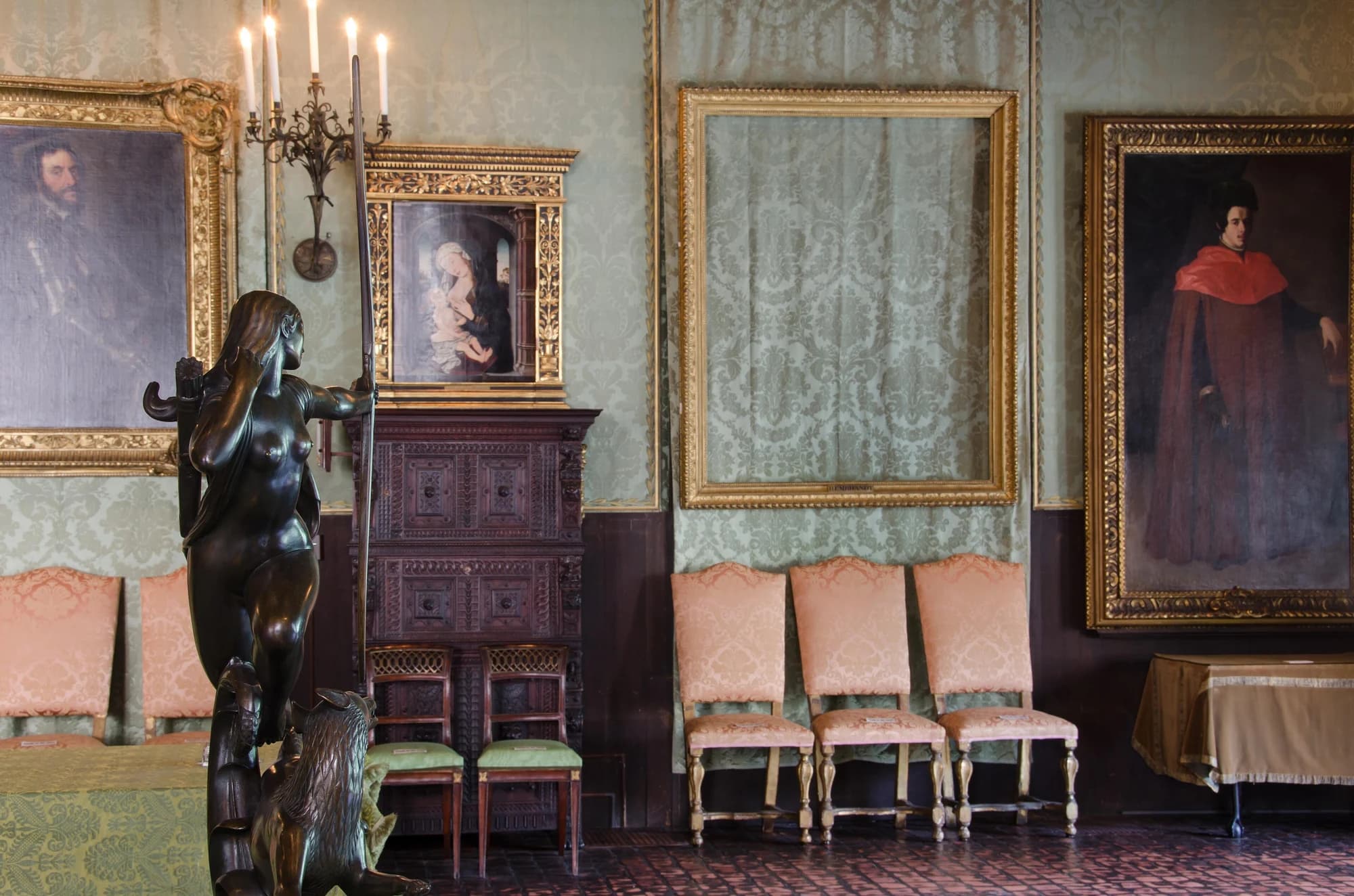
Gardner’s will, written to keep her arrangement intact, means nothing can take the place of what was stolen. The museum returned the looted frames to their walls empty, and there they still hang: a gilded rectangle of bare fabric in the Dutch Room where The Concert stood on its table by the window. Anne Hawley, who had been director for barely six months on the night of the theft, said the loss felt like a death in the family, and championed the empty frames as both a sign of mourning and a promise that the works are expected back.
The hunt and the $10 million reward
No one has ever been charged. The statute of limitations on the theft itself expired in 1995, and investigators have long emphasised that their goal is recovery, not prosecution. On the 23rd anniversary in March 2013, the FBI announced a breakthrough of sorts.
With a high degree of confidence we believe those responsible for the theft were members of a criminal organization with a base in the mid-Atlantic states and New England.
The bureau said the stolen art had travelled through Connecticut to the Philadelphia region, where some of it was offered for sale around 2002. There the trail goes cold, and the FBI has since said it believes both thieves are dead. The Gardner Museum offers a $10 million reward for information leading directly to the safe return of all thirteen works, and its security director still chases tips alongside the FBI and the US Attorney’s office. Until one of them pays off, the frames in the Dutch Room hang empty, waiting.
Notes
- 1.The handkerchief signal and the rival national museums bowing out come down through the museum’s own histories of the purchase; see Artnet News, “The Hunt: The World’s Most Valuable Stolen Painting”.
- 2.Sale and provenance details (5 December 1892, lot 31, 29,000 francs, bought through Fernand Robert) from the Gardner’s collection record for The Concert.
- 3.The Gardner Museum, “A Grand Opening, 1903”.
- 4.Gardner’s last will and testament is itself preserved in the museum’s collection; see also “Meet Isabella”.
- 5.Timeline, method of entry, and the works taken from each room follow the museum’s own account, “The Theft”.
- 6.The FBI puts the combined value at about $500 million; estimates for The Concert alone run to $250 million. See Artnet News.
- 7.WBUR, “30 Years Later, The Gardner Heist’s Emotional Toll Endures” (2020).
- 8.US Attorney’s Office, District of Massachusetts, press release, 18 March 2013.
- 9.The FBI said in 2015 that it believed both thieves had since died; see Boston.com’s 35th-anniversary explainer.
- 10.Reward terms from the museum: $10 million for information leading directly to the safe return of all thirteen works.