Masterpieces of Fifty Centuries
To mark its centennial, the Metropolitan Museum of Art mounted Masterpieces of Fifty Centuries as the culminating exhibition in a series of five major shows staged across eighteen months from October 1969 to February 1971. Organized by Theodore Rousseau, the Museum Vice-Director and Curator in Chief, in close collaboration with all seventeen curatorial departments, the exhibition brought together approximately four hundred works drawn primarily from the Museum own collection and supplemented by loans from thirteen American museums and private collections. The selection spanned five millennia of human creativity, from the ancient Near East through twentieth-century art, and was installed in strictly chronological sequence through the galleries.
Although the works were arranged chronologically, Rousseau intended the exhibition not as a lesson in art history but as a celebration of the singular beauty of each object and of the different spirits in which humanity has created art over the millennia. Sir Kenneth Clark, the eminent British art historian and presenter of the television series Civilisation, contributed the introduction to the accompanying catalogue published by E. P. Dutton. A ceremonial fanfare for brass ensemble by Aaron Copland was composed especially for the centennial occasion. The exhibition was conceived both as an homage to the patrons who had built and enriched the Museum during its first century and as a statement of institutional ambition for the future.
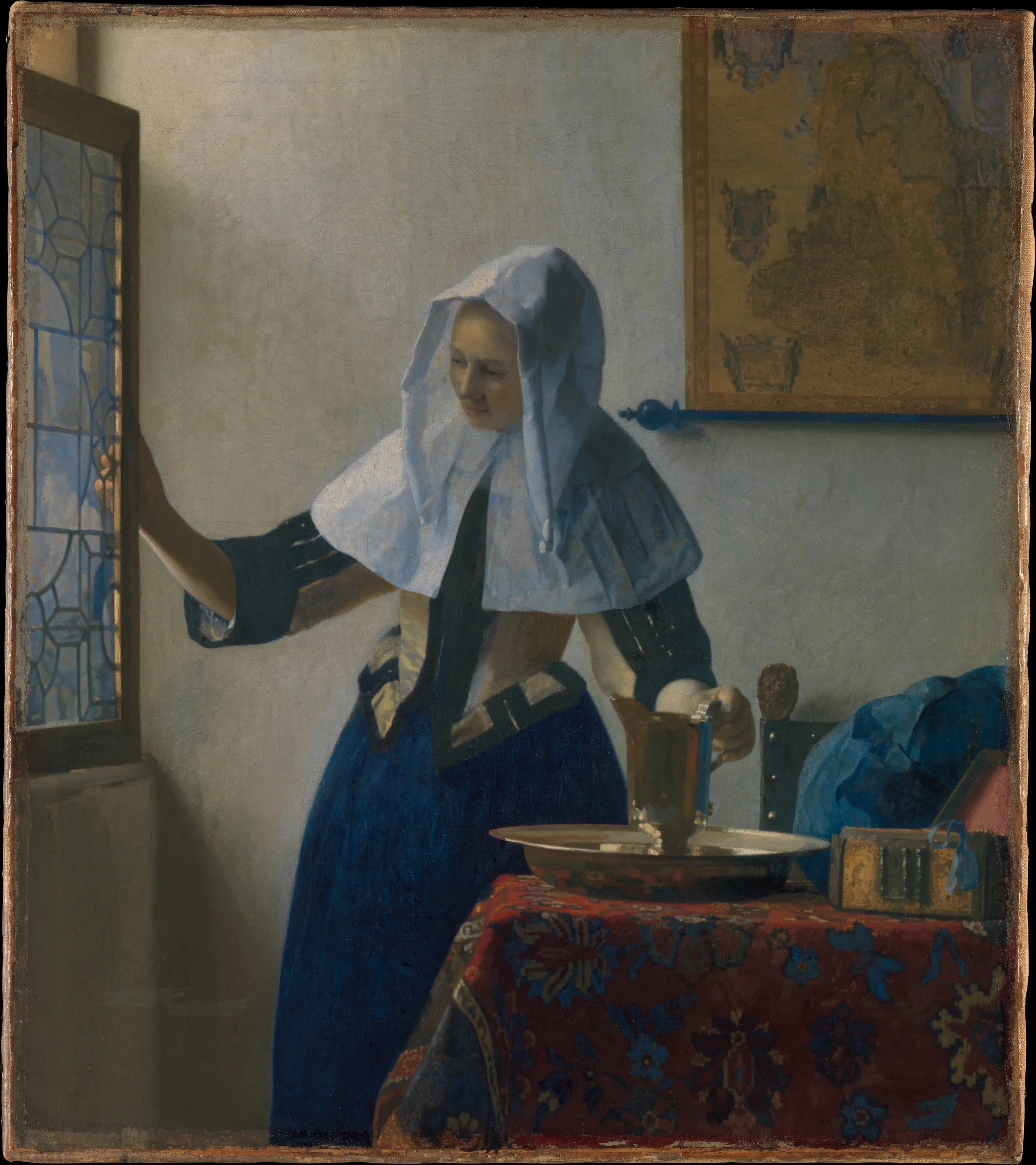
Vermeer’s Young Woman with a Water Pitcher appeared as catalogue number 283 in the chronological survey and was illustrated in colour in the catalogue. The painting had been a Met fixture since 1889, when Henry G. Marquand gifted it as part of his celebrated collection, making it one of the Museum’s earliest Vermeer acquisitions. At the Christie’s sale in 1877 where Marquand’s dealers first encountered the work, it had been attributed to Gabriel Metsu; reattribution to Vermeer followed swiftly. Presented among hundreds of the Museum’s greatest treasures, it stood as an emblem of the seventeenth-century Dutch holdings that Marquand’s generosity had helped secure for American audiences.
- Dates
- 15 Nov 1970 – 15 Feb 1971