Pride and Place: Dutch Cityscapes of the Golden Age
“Pride and Place: Dutch Cityscapes of the Golden Age” was a major loan exhibition jointly organised by the Mauritshuis and the National Gallery of Art in Washington, where a nearly identical version had been on view earlier in 2008. The Hague presentation, curated by Ariane van Suchtelen and Arthur K. Wheelock Jr. with an introductory essay by Boudewijn Bakker, brought together approximately 45 paintings alongside 22 maps, atlases, illustrated books, and prints to survey the rise of the Dutch cityscape as an independent genre.
The exhibition argued that the cityscape emerged in the seventeenth century as a direct expression of Dutch civic pride, driven by the booming economy of the Republic and an increasingly self-confident urban culture. Works ranged from wide-angle panoramas showing skylines of fortifications, windmills, and church steeples to intimate views of canals, market squares, and street life. Some 40 Dutch masters were represented, among them Gerrit Berckheyde and Jan van der Heyden (who depicted Amsterdam repeatedly), Pieter Saenredam (architectural interiors and facades), Jacob van Ruisdael, Jan van Goyen, Aelbert Cuyp, and Pieter de Hooch. Jan van der Heyden’s distinctive technique of pressing individual brick shapes into wet paint, revealed through microscopic restoration analysis, was a particular point of discussion in the catalogue.
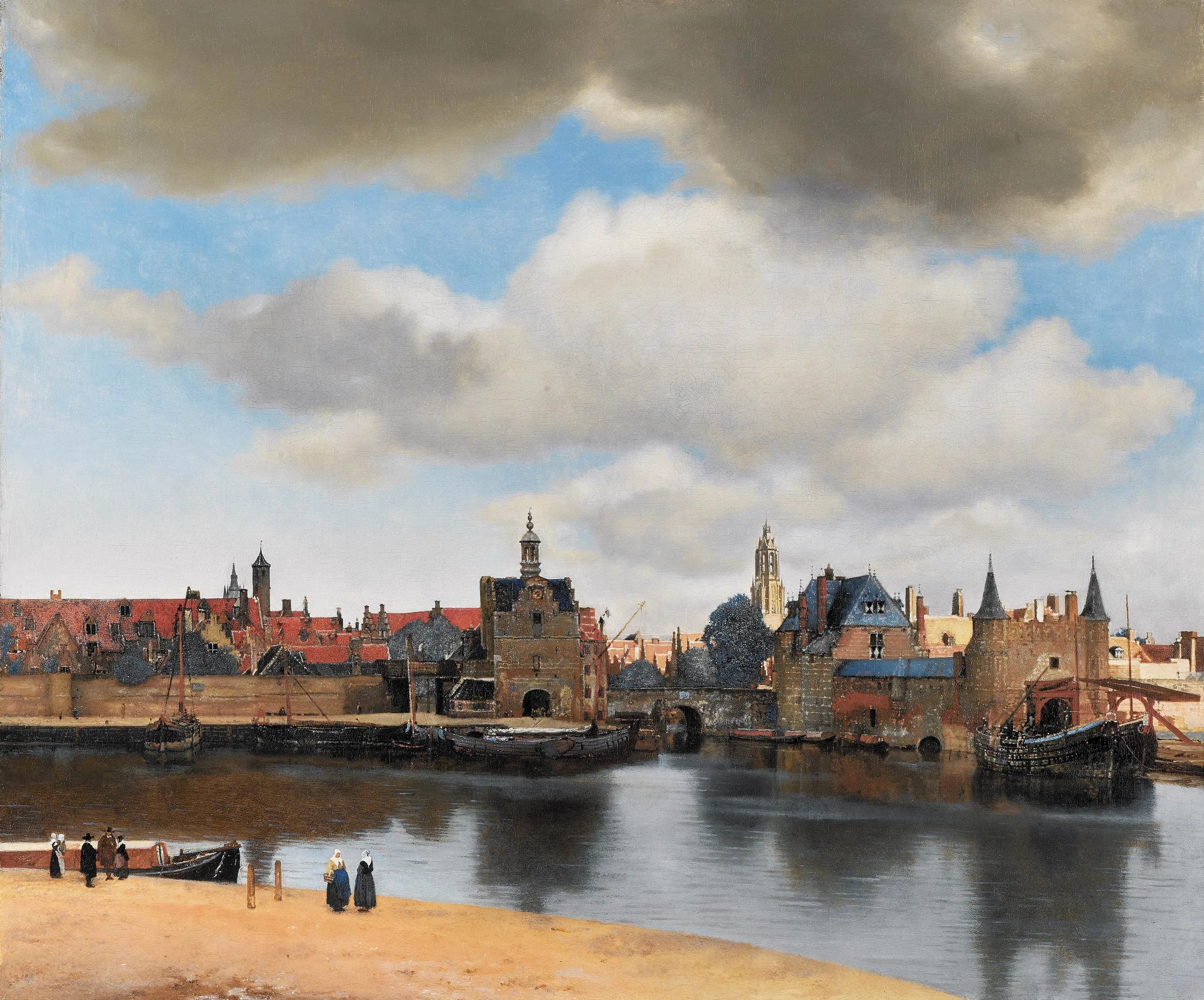
Vermeer’s “View of Delft,” the Mauritshuis’s most celebrated painting and the image used on the exhibition’s cover and promotional materials, served as the centrepiece. Because of conservation and fragility concerns the canvas did not travel to Washington, making the Mauritshuis presentation the only venue at which visitors could see it alongside the rest of the assembled cityscapes. Its presence anchored the show’s central claim: that Vermeer’s monumental panorama of Delft, with its luminous sky and scrupulous rendering of the city’s waterfront, represents the culmination of a tradition in which Dutch painters transformed local topography into an assertion of communal identity and pride.
- Dates
- 11 Oct 2008 – 11 Jan 2009
- Museum
 Mauritshuis