
Masters of the Everyday: Dutch Artists in the Age of Vermeer. An exhibition from the British Royal Collection
“Masters of the Everyday: Dutch Artists in the Age of Vermeer” brought twenty-seven paintings from the British Royal Collection to the Queen’s Gallery at the Palace of Holyroodhouse in Edinburgh from March to July 2016. Curated by Desmond Shawe-Taylor, Surveyor of the Queen’s Pictures, together with Mauritshuis scholar Quentin Buvelot, the exhibition surveyed the great tradition of seventeenth-century Dutch genre painting held in royal ownership, with works by Gerrit Dou, Gabriel Metsu, Jan Steen, Pieter de Hooch, and Vermeer. The Edinburgh showing followed an opening run at the Queen’s Gallery, Buckingham Palace (November 2015 to February 2016), and the tour concluded at the Mauritshuis in The Hague (September 2016 to January 2017), where it was presented under the title “At Home in Holland: Vermeer and his Contemporaries from the British Royal Collection.”
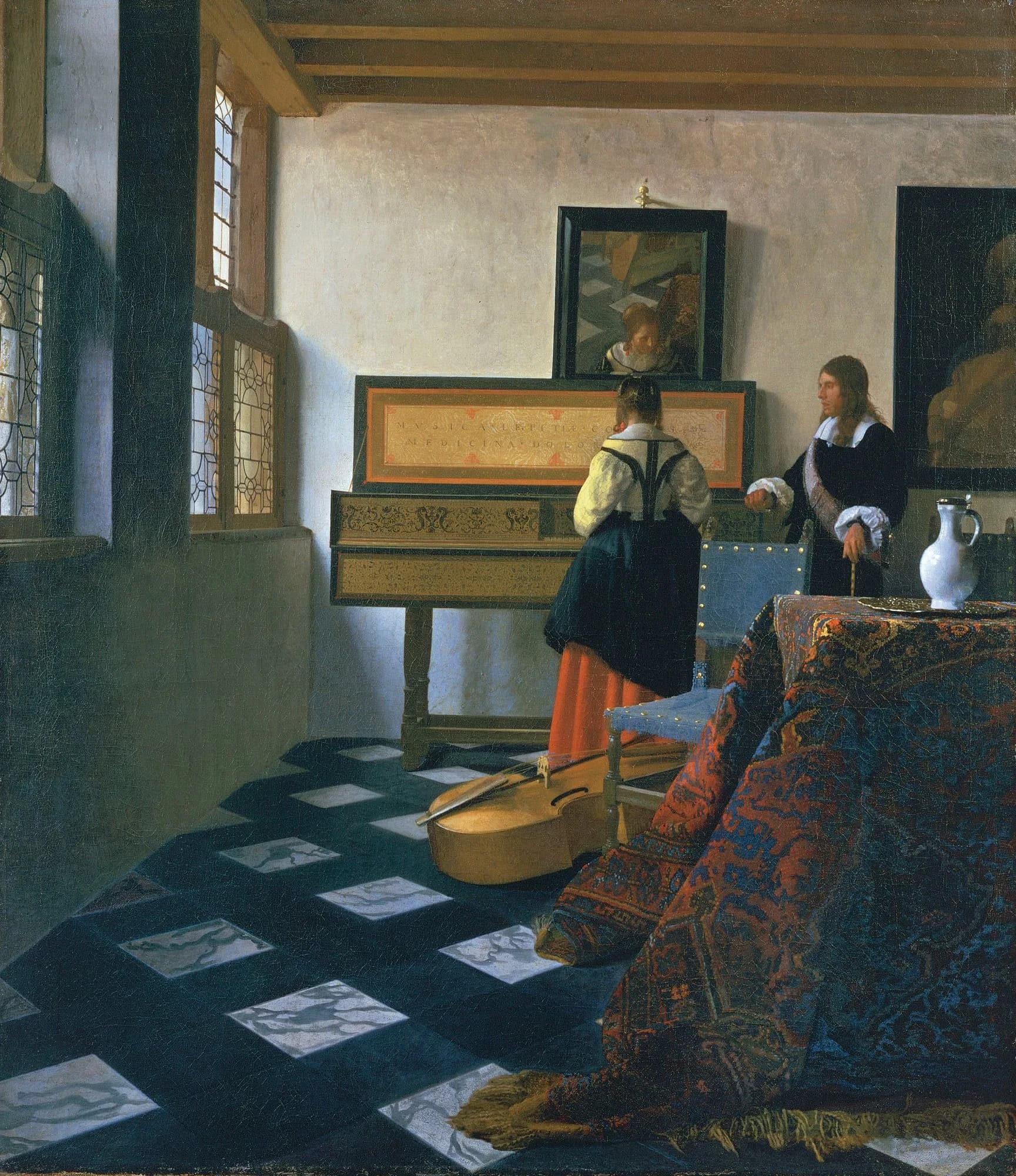
The centrepiece was Vermeer’s “A Lady at the Virginal with a Gentleman” (c. 1662–65), known informally as “The Music Lesson,” one of the most significant works in the entire Royal Collection. The painting entered royal ownership in 1762 when King George III purchased the cabinet of pictures assembled by Joseph Smith, the British Consul in Venice, and it has remained there ever since, alternating between display at Windsor Castle and Buckingham Palace. When acquired, the work was attributed to Frans van Mieris the Elder; the correct attribution to Vermeer was not established until 1866 by the French critic Théophile Thoré. The painting exemplifies the intimate domestic interior Vermeer made his own: a young woman plays a virginal while a gentleman stands nearby, her face visible only in the wall mirror above the instrument, and the lid of the virginal carries the Latin inscription “Musica Laetitiae Comes Medicina Doloris” (“Music is a companion in pleasure and a balm in sorrow”).
The broader exhibition explored how Dutch painters of the Golden Age transformed the unremarkable routines of daily life, from market bustle and tavern scenes to candlelit interiors and music-making, into richly crafted compositions whose surfaces are, as the curators noted, jewel-like, with equal attention paid to a discarded clay pipe as to a fine silk drape. Beneath these polished surfaces lay a layer of moral allegory readily understood by contemporary viewers, and the exhibition drew attention to both the visual pleasure and the coded meaning embedded in the genre. The Royal Collection holds one of the finest bodies of Dutch genre painting in the world, much of it assembled by George IV, whose purchases in the early nineteenth century, including eighty-six pictures from the Baring collection in 1814, transformed the royal Dutch holdings into a collection of international standing. “Masters of the Everyday” was the first exhibition to bring these pictures together in this way, and the Holyroodhouse presentation gave Scottish audiences a rare opportunity to explore the full depth of the collection.
- Dates
- 4 Mar 2016 – 24 Jul 2016
Paintings1
Sources
- Royal Collection Trust — Masters of the Everyday, The Queen’s Gallery, Palace of Holyroodhouse
- CODART — Masters of the Everyday: Dutch Artists in the Age of Vermeer (2016)
- Historians of Netherlandish Art Reviews — Masters of the Everyday: Dutch Artists in the Age of Vermeer
- Mauritshuis — At Home in Holland: Vermeer and his Contemporaries from the British Royal Collection (2016–17)
- Google Arts & Culture — Lady at the Virginal with a Gentleman, ’The Music Lesson’ (RCIN 405346)