Prism of Biblical Art
“Prisma der bijbelse kunst” (Prism of Biblical Art) was a large-scale survey of biblical imagery in Western art held at the Stedelijk Museum Het Prinsenhof in Delft from 17 May to 12 August 1952. The exhibition brought together 358 numbered works spanning several centuries, documented in a 168-page Dutch-language catalogue with 55 black-and-white plates. Its ambition was encyclopaedic: to trace how painters, printmakers, and draughtsmen from the medieval period through the seventeenth century visualised sacred scripture, assembling loans from major public and private collections across Europe and North America.
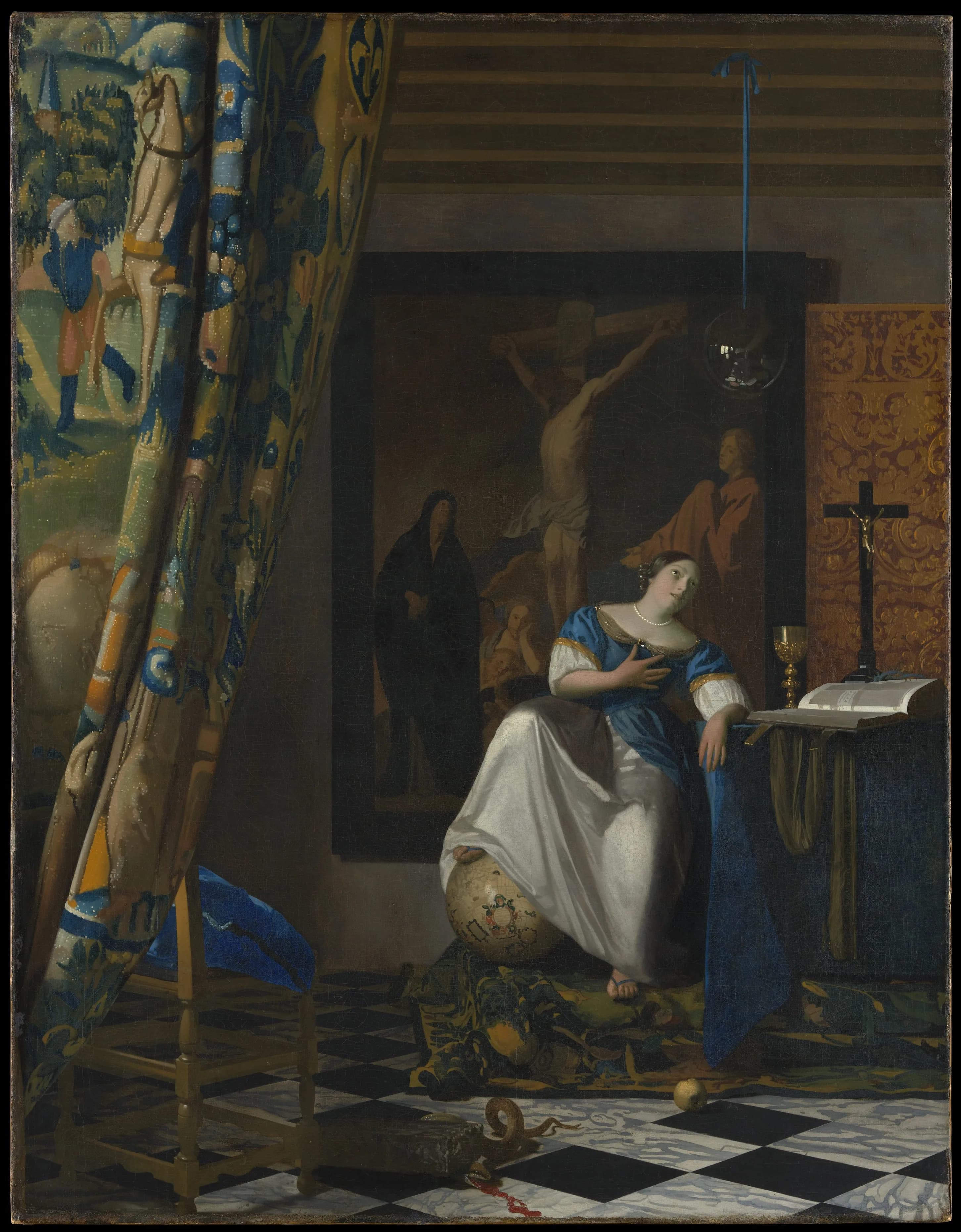
Vermeer’s “Allegory of Faith” (c. 1670–72), lent by the Metropolitan Museum of Art in New York, appeared as catalogue number 324 (pages 216–217, illustrated). Its inclusion was wholly apt: the painting is Vermeer’s most explicitly programmatic religious work, depicting a seated woman who personifies Catholic Faith according to Cesare Ripa’s “Iconologia.” She rests one foot on a terrestrial globe, signifying the universal reach of the Church, while a serpent lies crushed beneath a cornerstone in the foreground, representing the defeat of evil. A chalice, crucifix, and open Bible arranged on a table beside her complete the Eucharistic imagery. Vermeer drew on a tradition of Catholic allegory that remained vital in Delft’s surviving Catholic community, and the painting is thought to have been a private commission for a devout patron. Showing it in Delft, the very city where it was painted nearly three centuries earlier, gave the work a particular resonance.
The exhibition catalogue was edited by D. G. H. Bolten. The show drew on loans that included multiple works by Rembrandt alongside paintings by other Dutch and Flemish masters celebrated for their biblical compositions. As one of the few large post-war surveys dedicated specifically to the biblical dimension of Dutch Golden Age art, “Prisma der bijbelse kunst” offered a counterpoint to the prevailing critical emphasis on genre painting and still life, affirming the central place of religious subject matter in seventeenth-century Dutch visual culture.
- Dates
- 17 May 1952 – 12 Aug 1952
- Museum
 Museum Prinsenhof Delft