The Painter in His World: From Jan van Eyck to Van Gogh and Ensor
“De schilder in zijn wereld: Van Jan van Eyck tot Van Gogh en Ensor” was a wide-ranging historical survey tracing five centuries of Flemish and Dutch painting, from the Flemish primitives of the fifteenth century through the Impressionist and Expressionist currents of the late nineteenth. The exhibition opened at the Stedelijk Museum Het Prinsenhof in Delft on 19 December 1964 and ran until 24 January 1965, then transferred to the Koninklijk Museum voor Schone Kunsten in Antwerp, where it was on view from 6 February to 14 March 1965. The premise of the exhibition was the figure of the artist in relation to his social and cultural world, using the span from Van Eyck to Van Gogh and Ensor as a frame for examining how painters worked, how they represented themselves and their profession, and how the idea of the artist evolved across those centuries.
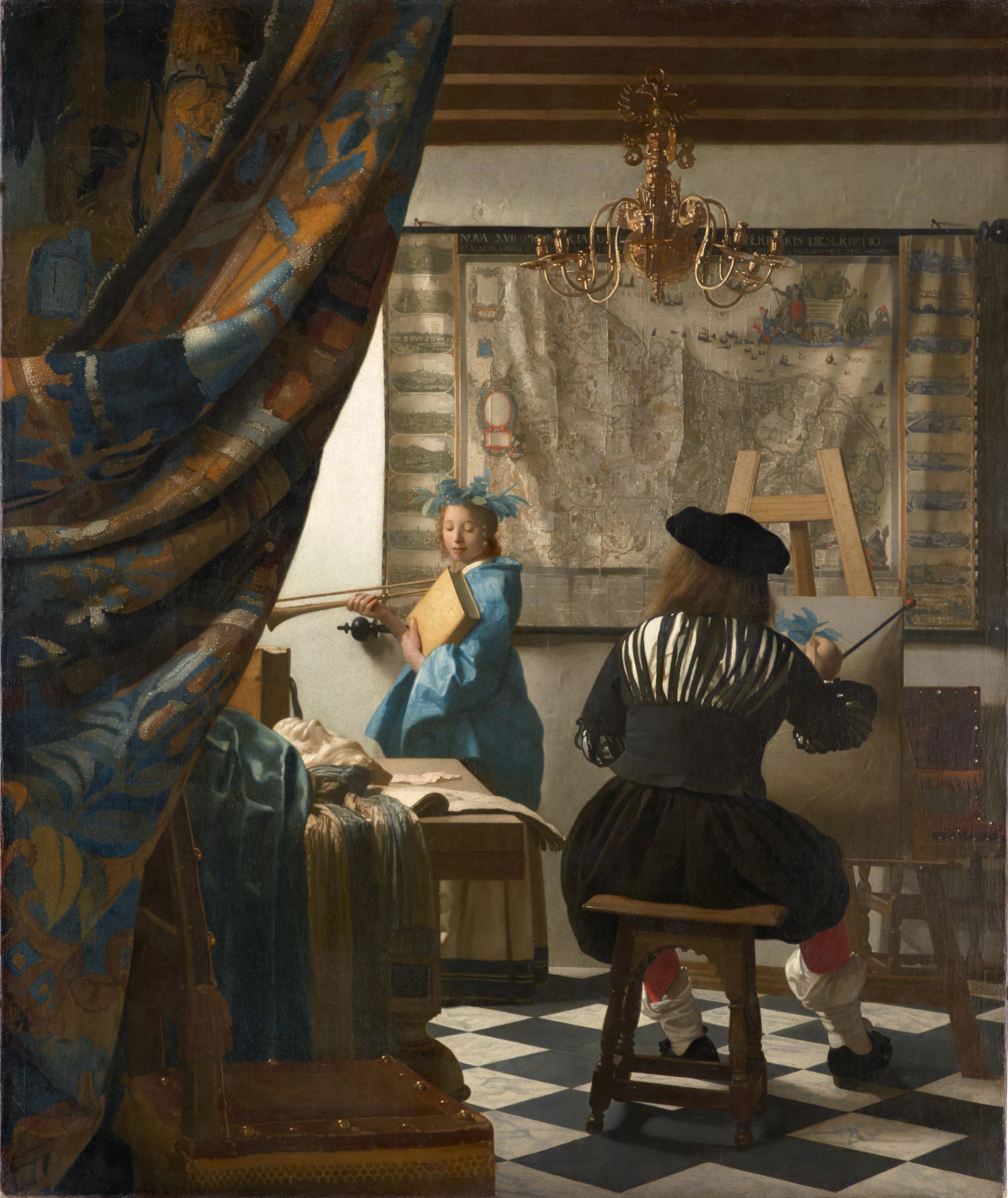
Vermeer’s The Art of Painting, lent by the Kunsthistorisches Museum in Vienna, was included in the Delft presentation as catalogue no. 113, though it did not travel to the Antwerp venue. Its presence was thematically apt: the painting depicts an artist at work in his studio, with a model dressed as Clio, the muse of history, posing before him. Vermeer himself never exhibited or sold the canvas during his lifetime, and it remained in his household inventory at his death in 1675. For an exhibition organised around the idea of “the painter in his world,” a work so explicitly concerned with the act and meaning of painting served as a natural centrepiece.
The Prinsenhof in Delft, housed in the former Sint-Agathaklooster where William of Orange was assassinated in 1584, was among the few Dutch museums with a direct institutional connection to Vermeer’s own city. Its hosting of this survey reinforced Delft’s position as a site of memory for Dutch Golden Age painting. The Antwerp venue, the Koninklijk Museum voor Schone Kunsten, was a natural second stop given the exhibition’s Flemish scope and the museum’s own depth in the early Netherlandish tradition from which the survey took its starting point in Jan van Eyck.
- Dates
- 1 Jan 1964 – 31 Dec 1965
- Museum
 Museum Prinsenhof Delft